













Ten crafts that shaped the memory of the world · Episode 8
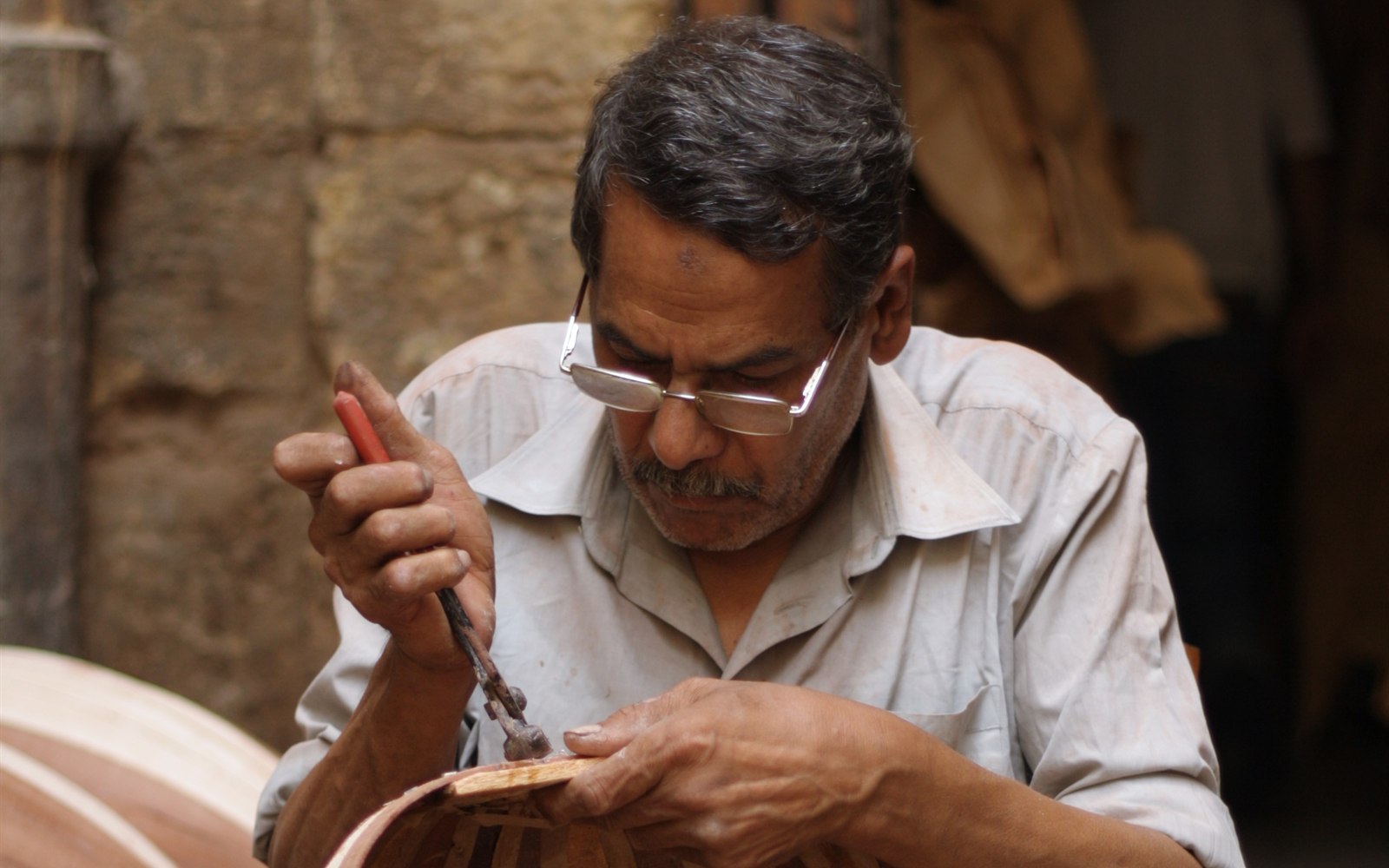
On Cairo’s Mohamed Ali Street, an oud maker holds a bowl that cannot yet make music. There are no strings, rosettes or polished ornaments—only narrow wooden ribs, one hand steadying the rim and a hot tool persuading the curve. Enas El Masry photographed the scene in 2014. The worker’s face is visible, but his name is not recorded, a sharp summary of the craft’s paradox: audiences remember celebrated players while the person who built their sound remains backstage. The story of the oud begins before the first note, in grain direction, thickness and patience, and in a maker’s ear trained to hear an instrument while it is still silent.
Sound begins in the bowl, not the string
An oud body is not carved from a solid block. Its pear-shaped bowl is assembled from bent wooden ribs joined over a temporary mould. The maker then adds the thin soundboard, internal braces, bridge, short fretless neck and bent-back pegbox. Every part affects the result: the bowl reflects energy, the face moves air, and the bracing must resist string tension without suffocating resonance. Visual beauty is not enough. A successful oud is a controlled negotiation between lightness, strength and a surface free enough to vibrate.
Twenty-five days may still be too short for judgement
UNESCO records that crafting an oud can take up to twenty-five days and describes wood being dried and hardened, then treated with water and steam for around fifteen days to build durability. This is not one universal workshop recipe; it demonstrates that time is a material. Poor seasoning may reappear months later as an opening seam or crack, and hurried assembly can lock invisible stress into the face. A serious maker sells more than labour days: the price also contains years spent learning when to apply pressure and when to wait.
The wood vocabulary: walnut, rosewood, poplar, ebony and apricot
The UNESCO file names walnut, rosewood, poplar, ebony and apricot in Iranian and Syrian practice. The Met’s Manol oud combines a spruce face, mulberry, other woods, mother-of-pearl and mastic. No species alone guarantees a fine voice. Density, seasoning, cut, rib thickness and bracing matter as much as an attractive timber name. Makers may alternate woods to balance weight and stiffness or create a visual rhythm across the back, but decoration cannot rescue a weak joint or a distorted face.
The ear is a workshop tool
The Syrian inventory submitted with the nomination says an oud maker needs a musical ear capable of distinguishing the correct sound. That line explains why making and playing belong together. A craftsperson taps the soundboard before assembly, listens to the bowl’s response and tests the instrument after stringing: are notes clear, bass and treble balanced, sustain alive, and action free of unwanted buzz? Measurement is essential, but it cannot replace the memory built by comparing hundreds of pieces of wood and completed instruments.
A long history without a single birth certificate
The oud belongs to an old family of lutes that appeared in many forms across West Asia and the Mediterranean. UNESCO’s earlier dossier describes a presence of more than fifteen centuries; The Met connects the wider family to a still longer past and notes that the European word lute derives from the Arabic al-ʿūd. Assigning the modern instrument to one inventor or city would flatten centuries of exchange among Iraq, the Levant, Egypt, Türkiye, Iran and North Africa. The accurate story is evolution: each centre recalibrated size, structure, tuning, ornament and voice.
Is there an Arab oud and a Turkish oud?
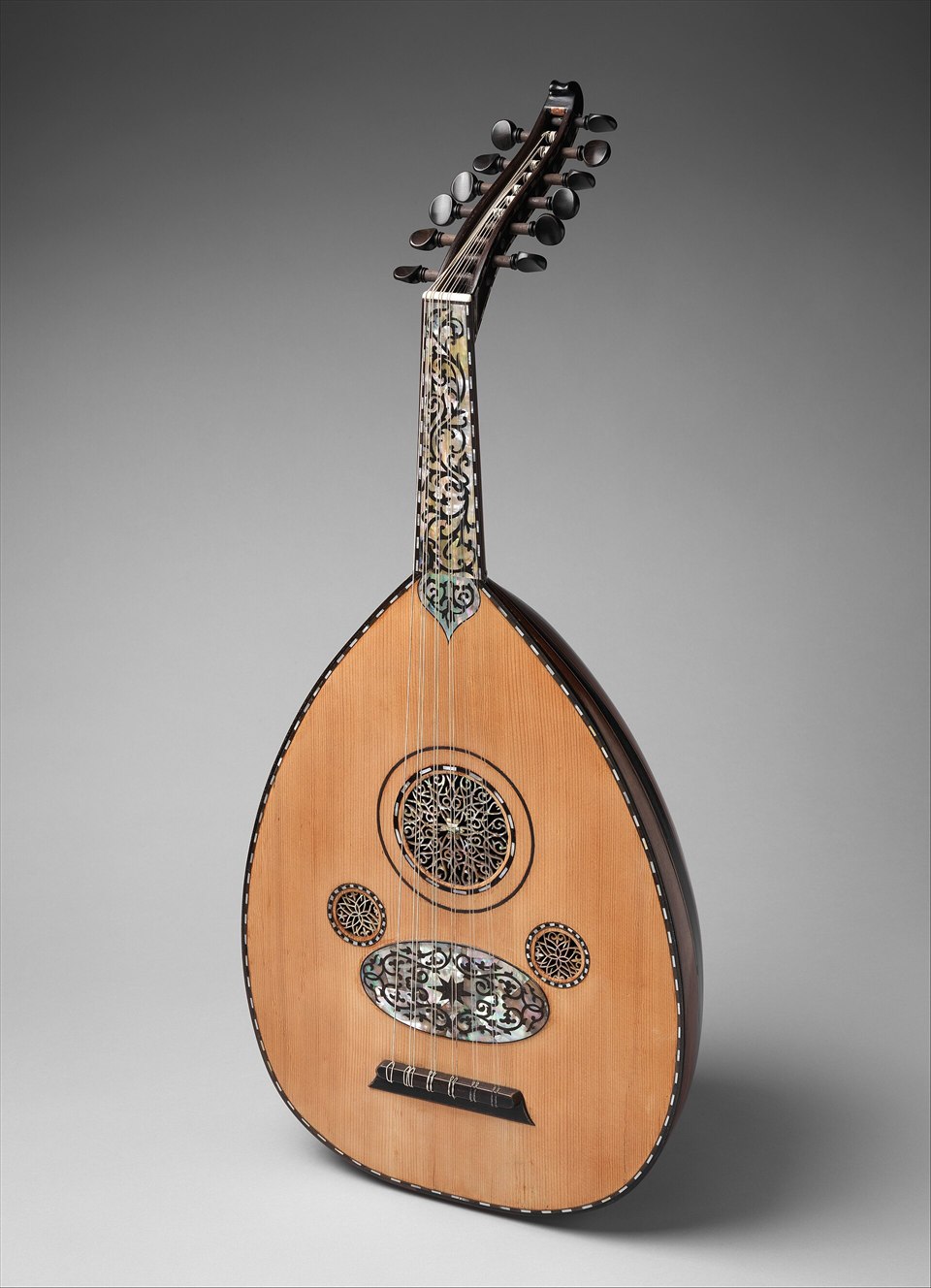
Yes, there are recognisable building and sound traditions, but the boundary is not absolute. Arab models are often larger and valued for a deep, warm register; Turkish instruments tend to be lighter and somewhat smaller, with a brighter response. Iraqi floating-bridge designs and modern hybrids add further choices, as do differences in scale length, tension, tuning and course count. A buyer should not choose a national label before listening. Start with repertoire, hand size, desired response and setup, then test the instrument that fits.
Manol: when the maker becomes the author of a sound
In Istanbul, Emmanuel Venios—known as Manol—had established a workshop on İstiklal Avenue in Beyoğlu by 1870. The Metropolitan Museum explains that he developed a lighter Turkish/Armenian style than the larger Arab model, using fewer back ribs and different bracing and neck attachment. Those structural decisions produced what the museum calls the “Manol sound” and earned him the sobriquet “Stradivarius of the Oud.” The Met’s ornate 1916 instrument passed through distinguished players, yet its stature rests on engineering as much as provenance.
From master to apprentice—and from home to university
UNESCO identifies apprenticeship as the primary route for both craft and performance, reinforced by families, music centres, colleges and universities. The learner first watches: choosing a rib, moistening wood, controlling the mould, preparing glue and setting distances. Small tasks come before responsibility for a complete soundboard. The nomination described makers as mostly men while noting increasing interest among young women. Safeguarding means turning that interest into paid access to benches, tools and mentorship rather than leaving the door theoretically open.
UNESCO 2022: inscription was not automatic
Iran and Syria first presented a joint file that UNESCO referred back in 2020 because it did not explain the shared knowledge, social functions and community participation sufficiently. The revised process included meetings, field visits and interviews with makers, players, researchers and institutions. In 2022, “Crafting and playing the Oud” entered the Representative List of the Intangible Cultural Heritage of Humanity. The sequence matters: inscription is not a finishing medal but a public commitment to let practitioners define and safeguard their living heritage.
Cairo’s Arab Oud House: heritage becomes a curriculum
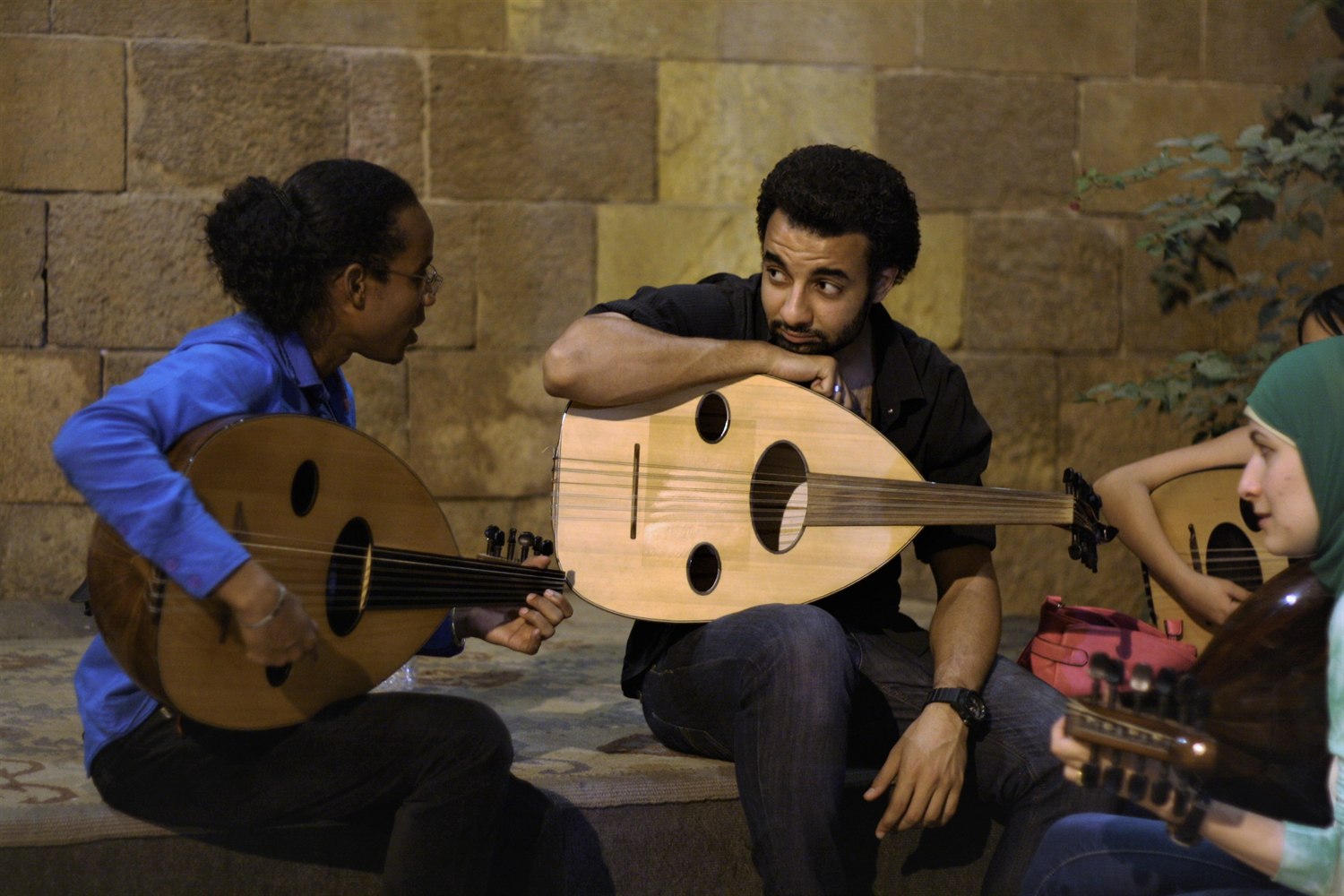
Egypt’s Ministry of Culture says Iraqi musician Naseer Shamma founded the Arab Oud House at Beit Al-Harrawi in 1998 as a comprehensive centre dedicated to the instrument, with a two-year programme developing solo performance and individual skill. The Cultural Development Fund’s 2026 schedules show oud and saz teaching continuing. A school does not replace the maker’s bench, but it creates listeners who can hear quality and links theory, solfège and ensemble practice. The restored historic house also makes a visit an encounter with architecture, teaching and sound.
The craft’s crisis: a cheap copy cannot sustain a tradition
Factory instruments can broaden access when honestly labelled. Damage begins when a rapid product is sold as handmade without a traceable maker, materials or service. Low prices squeeze small workshops; conflict and displacement can separate masters from cities and trainees; seasoned timber and storage add cost; and younger people leave when the apprenticeship years do not lead to a living. Practical safeguarding therefore means paid training, direct and traceable purchases, local repair networks, and exhibitions that name the builder as prominently as the performer.
Do travellers cross borders for the oud?
Yes, and the journey can be richer than souvenir shopping. In Cairo, a planned visit can link the Arab Oud House with makers on Mohamed Ali Street; in Istanbul, workshops reveal distinctions between Turkish and Arab construction; in Iran and Syria, the heritage has different local contexts that require current official travel advice and careful planning. A responsible workshop visit is pre-arranged, small and photographed only with permission. Pay for a lesson, consultation or repair; do not turn a working craftsperson into free entertainment.
How to buy a traceable handmade oud
Begin with the player, not the inlay. Define body size, scale length, tuning, repertoire and experience level. Ask for the maker, city, year, woods and seasoning, then inspect the neck joint, fingerboard line, seams, bridge and pegs. Play every region of the fingerboard, listening for buzz, dead spots, sustain and balance between courses. Request an invoice and written repair or warranty terms. A label inside the bowl helps, but it is not a substitute for a verifiable workshop reputation and an unhurried playing test.
Why there is no single correct price
Value changes with the maker’s experience, seasoned stock, mould and bracing work, materials, ornament, final setup and aftercare. A plain student oud can be excellent; abundant mother-of-pearl cannot make poor geometry luxurious. Ask what the price pays for: voice and stability, complex ornament, historic workshop reputation or all three. If the amount cannot plausibly cover weeks of skilled labour, ask exactly where time or material was reduced. Transparency is more useful than a bargain story.
Care and transport after the journey
Keep the oud in a hard case away from direct sun, a hot car, radiators and air-conditioning blasts. Sudden humidity change matters more than chasing one universal number; let the instrument acclimatise. Wipe strings and face with a dry cloth and never apply furniture polish or unknown oil. Before flying, obtain the carrier’s current cabin and instrument policy in writing, and retain the invoice, timber description and photographs. If a seam opens, do not add household glue: consult a luthier or string-instrument repairer.
The lesson: every note has an earlier hand
When a student at Beit el-Oud holds a finished instrument, another hand has already heated a rib, measured a brace, waited for glue and hidden its work inside a bowl the audience may never inspect. Protecting the oud does not mean freezing it in a museum. It means allowing makers to experiment, buyers to know who built their instrument, and apprentices to earn the time required to learn. Musical memory survives not through sound alone, but through the hand that gives sound a body.
Watch UNESCO’s official film on crafting and playing the oud
Craft at a glance
| Heritage status | UNESCO inscribed Crafting and playing the Oud in 2022 through a joint nomination by Iran and Syria |
|---|---|
| Making time | Up to 25 days in the UNESCO description; workshop, seasoning and ornament can change the schedule |
| Construction | Ribbed pear-shaped bowl, thin soundboard, internal braces, short fretless neck, bridge and bent pegbox |
| Strings | Typically five double courses with an optional sixth in the UNESCO file; regional and modern setups vary |
| Transmission | Apprenticeship and family teaching, complemented by music centres, colleges and universities |
| Best buying evidence | Traceable maker, complete playing test, written woods and construction, invoice and repair support |
Questions before visiting
Is every handmade oud better than a factory instrument?
No. Timber, geometry, setup and maker skill decide quality. A well-made factory student instrument can be useful if described honestly.
How do I choose between an Arab and Turkish oud?
Compare voice, scale length, tuning, body size and repertoire. Test several instruments with a teacher or experienced player.
Does mother-of-pearl prove quality?
No. Inlay is decorative craftsmanship, but it cannot correct a warped neck, compressed face or poor bracing.
How can I check the neck?
Look along the fingerboard, examine string height and play every position for buzz or dead notes. A player or repairer can assess it more reliably.
Is oud making recognised by UNESCO?
Yes. Crafting and playing the Oud was inscribed in 2022 under a joint Iran–Syria nomination. The inscription concerns living knowledge and practice, not a commercial certification for each instrument.
Where can I study in Cairo?
The Arab Oud House at Beit Al-Harrawi is part of Egypt’s Cultural Development Fund. Check the official schedule before visiting because times change.
Can I visit an oud workshop?
Often, with an appointment and permission for photography. Do not assume a demonstration is free, and buy direct when the work suits you.
Can I fly home with the instrument?
Agree on a hard case and insurance, check the carrier and current customs rules in writing, and retain the invoice and material description.
Sources and reference institutions
- UNESCO Intangible Cultural Heritage — Crafting and playing the Oud, decision 17.COM 7.b.16
- UNESCO Intangible Cultural Heritage — Crafting and playing the Oud, official video
- UNESCO — 2020 referral decision and the revised nomination process
- UNESCO nomination file — Syrian national inventory and craft description
- Egypt Ministry of Culture, Cultural Development Fund — Arab Oud House
- Egypt Ministry of Culture, Cultural Development Fund — Beit Al-Harrawi and Arab Oud House
- Egypt Ministry of Culture — oud and saz teaching programme, September 2026
- The Metropolitan Museum of Art — Ūd by Manol, Istanbul, 1916
- Wikimedia Commons — Oud maker on Mohamed Ali Street, Cairo
- Wikimedia Commons — Oud students at Beit el-Oud, Old Cairo
- Wikimedia Commons / The Met — Ūd by Manol, CC0
Image credit: Oud maker working on the ribbed bowl of an instrument on Mohamed Ali Street, Cairo, 2014. Enas El Masry / Wikimedia Commons, CC BY-SA 4.0; editorial crop.