











Verified 12 November 2026. This analysis uses official company, European Union, French public-service and New York labour sources. It is general information, not individual legal advice.
If a brand can send a model’s digital twin to ten cities without booking a flight or a studio, does the human model still have a future? Yes—but the job is changing. The strongest evidence so far points to a new market for consent, licensing and creative control, not to the disappearance of every person from the runway.
What H&M actually did with digital twins
In July 2025, H&M released its first campaign images featuring digital twins against fashion-capital backgrounds. The company described the project as co-created with a dedicated team and accompanied by behind-the-scenes material. Model Vanessa Moody called the process professional, collaborative and transparent; photographer Johnny Kangasniemi described AI as another tool in his creative toolbox.
That wording matters. A digital twin is not necessarily a fictional person generated from nothing. It can be a computational representation of a real model whose face, body and movement remain commercially valuable. The central business question therefore shifts from “Who attended the shoot?” to “Who controls the replica, for which uses, for how long, and for what payment?”
A digital twin is not the same as a fully synthetic model
| Type | What it is | Main question |
|---|---|---|
| Digital twin | An AI-generated or AI-enhanced representation closely tied to a real, identifiable person. | Did that person give precise consent, and does the contract cover this use? |
| Fully synthetic model | A fictional figure created without presenting itself as one named real model. | Is the content clearly identifiable, non-deceptive and lawfully trained and deployed? |
| Standard retouching | Conventional editing that does not create a new performance or deceptive replica. | Does the edit remain within the agreed campaign and image-use terms? |
The boundaries are not always obvious. A brand may start with a real photograph, alter clothing and background, create new poses, or generate an entire campaign from a scan. Those are different production choices and should not be hidden inside one vague sentence authorising “digital use”.
Europe now requires more transparency
Article 50 transparency duties under the EU AI Act have applied since 2 August 2026. The European Commission’s guidance says providers of generative systems must make AI-generated or manipulated outputs detectable through machine-readable marking. Deployers must clearly disclose deepfakes when the legal conditions are met.
Not every retouched fashion image is automatically a deepfake. The Commission’s test considers whether content resembles an existing person, object, place or event and would falsely appear authentic or truthful. A digital twin that closely imitates a real model can therefore raise a different transparency issue from an obviously fictional fashion illustration. The context and the audience’s expectation matter.
In France, image rights still begin with precise permission
French public-service guidance states that written agreement is required to reproduce or publicly distribute the image of an identifiable adult, especially for commercial use. The permission should specify the medium, objective and duration. Reusing the image for a purpose different from the original publication may require another agreement.
That principle remains useful when the output is generated rather than photographed. A contract for one campaign should not silently become indefinite permission to produce new poses, new products and new territories. Questions about personal data used in AI training can also engage data-protection rights; the CNIL says people may, in certain circumstances, exercise access, correction, deletion and objection rights over training datasets and models.
New York offers the clearest contract checklist
New York’s Fashion Workers Act is not French law, but its official rules provide a practical benchmark. Since 19 June 2025, management companies and clients covered by the law must obtain separate, explicit written approval before creating or using a model’s digital replica. That approval must state the scope, purpose, rate of pay and length of use. A power of attorney cannot simply absorb the right to create the replica.
The New York Department of Labor also gives a direct example: if an earlier agreement covered AI use for one campaign but not a future campaign, the client must obtain fresh written approval. This is the detail that turns the debate from a slogan about “AI replacing models” into a negotiable commercial relationship.
What should a model ask before approving a digital replica?
- What photographs, scans, recordings or measurements will be collected?
- Will the material train a reusable model, or generate assets for one named campaign only?
- Which countries, platforms, stores and advertising formats are covered?
- How long can the replica be used, and can the period be extended automatically?
- Can new poses, voices, expressions, products or sensitive contexts be generated?
- Is approval required for every final image, video or substantial alteration?
- What is the fee, and does additional reuse create another payment?
- What happens to the files and trained system when permission ends?
- How will viewers be told that the content is AI-generated or manipulated?
These questions should sit beside the ordinary checks on salary, expenses and image usage explained in our guide to fashion-model pay in Paris. A glamorous render is still a commercial asset governed by a contract.
Will the runway itself become artificial?
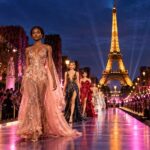
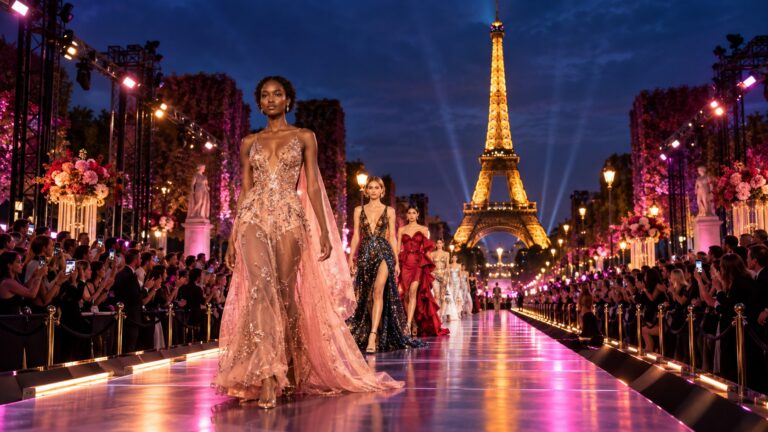
There is no reliable evidence that every live model is about to disappear. Runway shows sell more than clothing images: they create a shared moment for buyers, press, clients and creators, and they generate travel, hospitality, transport and cultural attention around cities such as Paris. Digital tools can multiply content after that moment, but they do not automatically reproduce the commercial relationships built in the room.
Our inference from the current evidence is that advertising production will change faster than live Fashion Week. Brands can test backgrounds, localise campaigns and extend the life of a look without repeating every shoot. Human models may perform fewer routine reshoots while negotiating more valuable rights over digital reuse. Photographers, casting directors and agencies will not vanish; their work will increasingly include data provenance, approvals and version control.
What the future model career may require
The traditional portfolio will remain important, but a second portfolio of rights may emerge: which scans exist, who holds them, where they were used and when permission expires. Agencies will need to explain technology in plain language. Brands will need auditable consent. Models will need to understand that “digital” is not one medium but a chain of possible outputs.
That can create new income if the replica is licensed fairly. It can also erode work if one fee quietly covers unlimited reuse. The future therefore depends less on whether AI exists—and more on whether contracts, disclosure and bargaining power keep pace with it.
Quick answers
Will AI replace fashion models?
AI is likely to replace some repeat production tasks, but current evidence does not show the end of human casting or live runway work. Digital replicas create new licensing work as well as new risks.
What is an AI digital twin in fashion?
It is an AI-generated or AI-enhanced representation tied to a real model’s identifiable appearance and used to create new commercial images or video.
Can a brand reuse a model’s digital twin forever?
That depends on the applicable law and contract. A model should require written terms covering purpose, territory, media, payment and duration rather than accepting unlimited reuse.
Must AI fashion images be labelled in Europe?
EU rules require technical marking of generative outputs, and clear disclosure for deepfakes that meet the legal test. Not every ordinary edit is a deepfake.
What protects a model’s image in France?
French guidance requires precise written permission for commercial reproduction or distribution of an identifiable person’s image, including the medium, purpose and duration.
Official sources
- H&M Group: first published digital-twin campaign images
- European Commission: Article 50 AI transparency guidance
- Service-Public.fr: image rights and written permission in France
- New York Department of Labor: Fashion Workers Act FAQ
- CNIL: exercising personal-data rights in AI systems
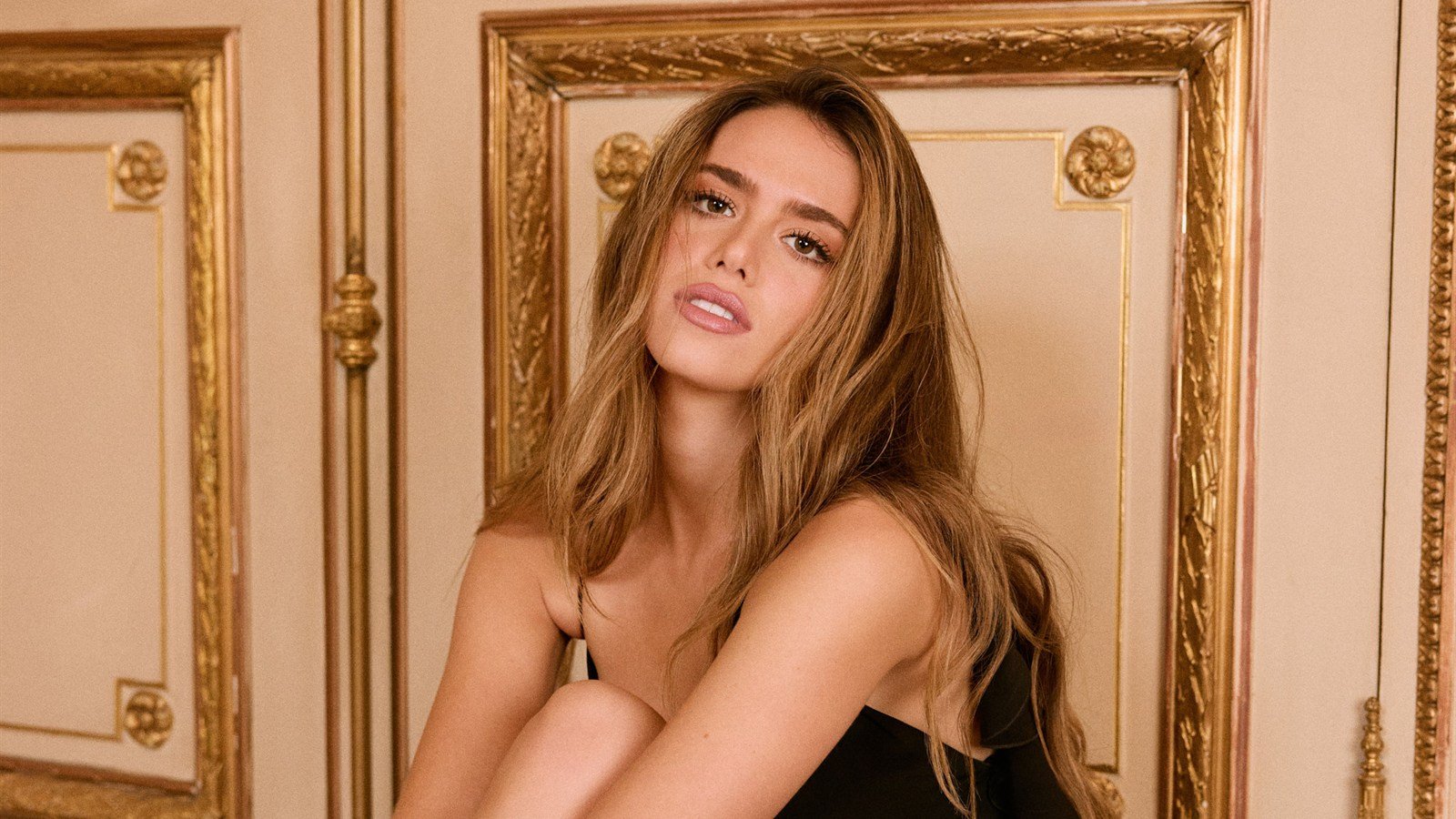
Cover: real editorial portrait of Sarai photographed in Paris by Greg Swales; image supplied by Madcak via Wikimedia Commons, CC BY-SA 4.0. The photograph is not connected to H&M or an AI campaign.
Cite this article
When citing the text or analysis, include the magazine, title, original URL and publication date. Preserve the stated attribution of statistics and photographs.
OUISTARS Travel — Will AI Replace Fashion Models? Digital Twins, Rights and the Future of the Runway
Published: