












The first commercial opportunity is not ticket sales. It is readiness: knowing which capabilities a complex destination needs at each phase and waiting for verified procurement before committing capital.
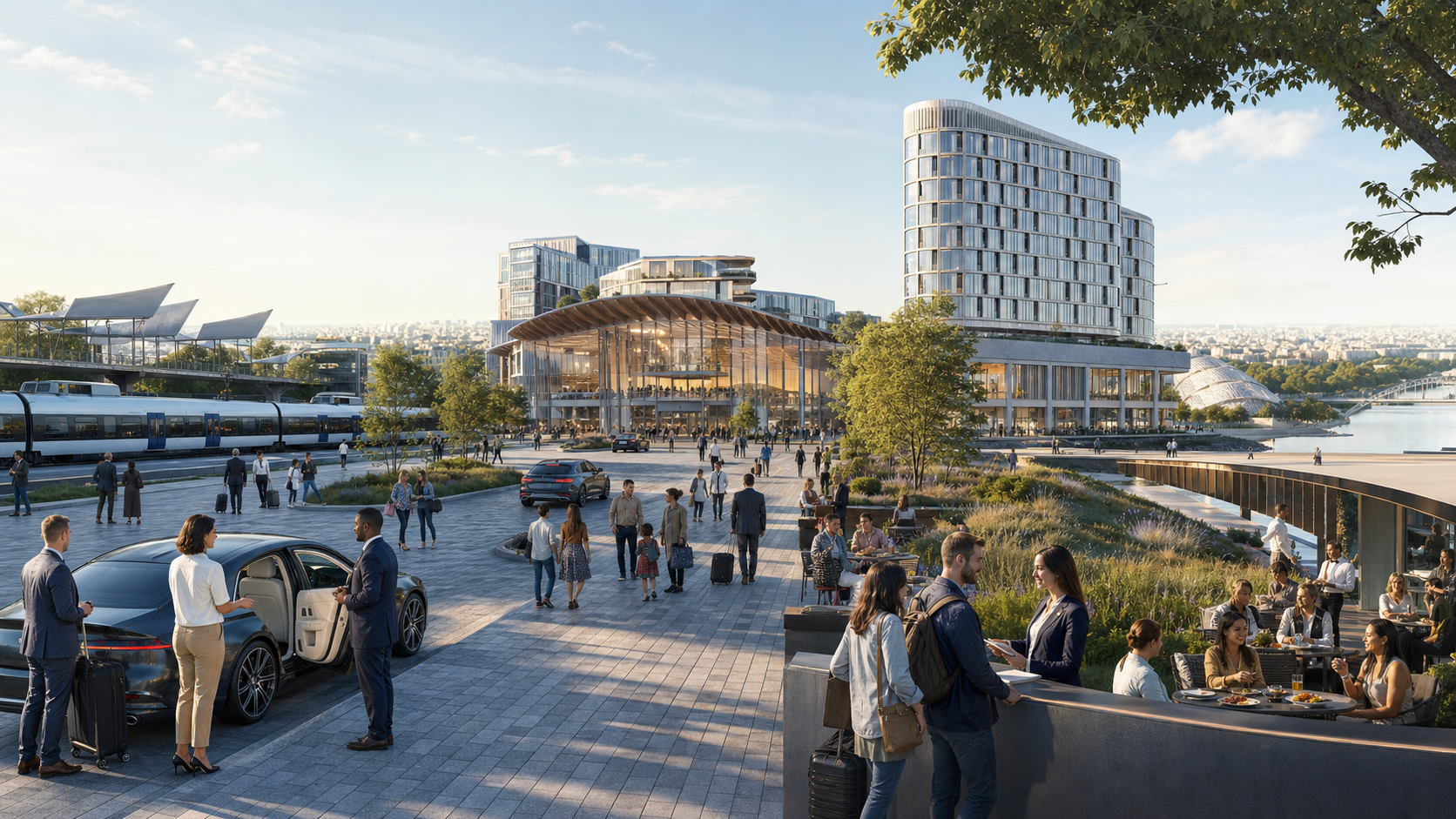
Hero visual: editorial illustration generated for OUISTARS Travel. It is conceptual and is not documentary photography or evidence of a completed project.
OUISTARS forecast policy
Confirmed: Qiddiya signed an MoU to explore a mixed-use Cergy-Pontoise destination; early concepts include up to three major recreational facilities, hotels, leisure, culture and sport; full-cycle value is estimated around €6 billion.
Outlook: every opportunity below is conditional on planning, finance, phasing and delivery. No tender, opening date or visitor volume is implied.
Think in phases
Definition and approvals
Potential needs include masterplanning, transport studies, environmental assessment, land and legal advice, financial modelling, community engagement, security planning, tourism research and hotel feasibility.
Construction and systems
Engineering, project management, utilities, rail interfaces, attractions technology, data, landscaping, signage, logistics and quality assurance become central.
Pre-opening
Operators recruit and train, hotels connect distribution, agencies contract products, mobility providers test flows and destination teams build multilingual content.
Operations and expansion
Revenue management, events, maintenance, data and repeat visitation determine whether a destination becomes a durable tourism economy.
Tourism products: sell a region
A strong destination could unlock two- and three-night packages, but the surrounding region needs bookable content. Agencies could connect Paris, Cergy-Pontoise, Auvers-sur-Oise, the Vexin and Versailles according to guest profile. Family itineraries, event weekends, youth travel, cultural extensions and incentives become possible only after calendars, transfer times and admission rules are confirmed.
Hospitality: different segments, different economics
Cergy-Pontoise has 17 hotels and 1,332 rooms, with no classified five-star hotel in INSEE’s 2026 inventory. A fully developed cluster could support demand, but not every segment simultaneously.
- Themed hotels depend on rights and integrated strategy.
- Family apartments depend on stay length and group configuration.
- Select service can serve contractors and employees before leisure matures.
- Luxury requires suites, private transport, food service and international distribution.
Investors should stress-test seasonality, rates, staffing, land cost and reduced-project scenarios.
Travel agencies and tour operators
The opportunity is not merely adding a ticket. It is choosing the right hotel zone, transfer window, dining plan, accessibility support and contingency. Saudi and GCC specialists need Arabic content, multi-generational rooming logic, prayer and dining information, private mobility and late-hour service.
DMCs: the integration layer
Destination management companies can connect airports, central Paris, hotels, attractions, restaurants, events and excursions. Qualified DMCs need real-time operations, multilingual support, duty management, accessible transport, supplier standards and transparent agency handovers. The project could reward operators with local depth and GCC cultural competence.
Mobility: more than a shuttle
Demand could span rail integration, shuttles, private drivers, coaches, taxis, accessible vehicles, parking technology, luggage and airport transfers. Guests peak at closing, employees after late shifts, groups at coach bays and VIPs on flexible schedules. Providers should model scenarios rather than buy fleets against an unconfirmed entrance.
Concierge and premium services
Premium guests may combine the destination with fashion, private museums, restaurants, medical or business meetings and onward travel. Potential services include meet-and-assist, chauffeurs, villa or suite support, personal shopping, Arabic-speaking assistance, private dining and celebrations. Providers must separate confirmed inventory from requests and document terms.
Food, retail and suppliers
Visitor opportunities include restaurants, cafés, catering, licensed merchandise, convenience and beauty. B2B demand can be larger: laundry, cleaning, uniforms, food distribution, waste, maintenance, security, landscaping and technology.
Local access is not automatic. SMEs should prepare insurance, quality systems, financial capacity, traceability, data security and multilingual proposals. Consortiums can help meet scale.
Skills and employment services
The 22,000 direct-job projection creates a potential market for recruitment and training in attraction operations, maintenance, hospitality, food safety, security, first aid, languages, guest recovery and revenue systems. Programmes should connect to named job families; generic courses before operator requirements risk certificates without placements.
Real estate and future investment
Potential demand spans hotels, logistics, offices, staff housing and services. Investors should distinguish land with real access and planning change from land marketed through proximity alone. Future participants could include hotel brands, operators, infrastructure funds, developers, mobility platforms and rights holders; none should be inferred before documentation.
Opportunity matrix
| Sector | Useful action now | Evidence before major spend |
|---|---|---|
| Agencies/DMCs | Map markets and partners | Opening phase, contracts, transfers |
| Hotels | Feasibility screening | Demand study, planning, operator terms |
| Mobility | Scenario modelling | Site access, rail plan, volumes |
| Suppliers | Credentials and consortiums | Procurement portal and compliance |
| Training | Job-family mapping | Standards and recruitment calendar |
Red flags
- selling packages before inventory exists;
- treating €6 billion as immediate annual spending;
- buying land from media maps;
- using 22,000 without saying it is a projection;
- claiming a licensed France theme before publication;
- assuming current rail and hotels need no upgrade.
OUISTARS forecast
If the destination progresses, durable value is most likely in systems serving visitors and residents: mobility, trained hospitality talent, destination management, modern hotels and local procurement. Those assets remain useful if the attraction mix changes.
Connected coverage
Work with OUISTARS
OUISTARS works with agencies, Saudi and GCC clients, institutions and groups needing accountable delivery. Explore France DMC services, concierge and premium coordination, or contact OUISTARS for B2B partnerships.
Sources and limits
This outlook uses the official announcement, INSEE, France Diplomatie, Visit Paris Region and Qiddiya. Forward statements are OUISTARS scenarios, not commitments.
Frequently asked questions
Can businesses bid now?
No public procurement programme reviewed by OUISTARS has been announced. Businesses can prepare credentials but should not assume tenders are open.
Which sectors could benefit first?
Planning, engineering, legal, environmental, research and skills services usually precede visitor operations. Actual procurement depends on the published programme.
How should travel agencies respond?
Track verified milestones, build flexible Paris products, strengthen local partners and avoid selling an unconfirmed attraction.