

















TRAVEL INTELLIGENCE | ADMINISTRATIVE INVESTIGATION
People often ask which French prefecture is “easier” for a residence permit. The evidence does not support that claim. Legal eligibility is national law; administrative access and processing performance can differ, but the available official data are too incomplete and inconsistent for a responsible league table.
Verdict: an investigation, not a ranking
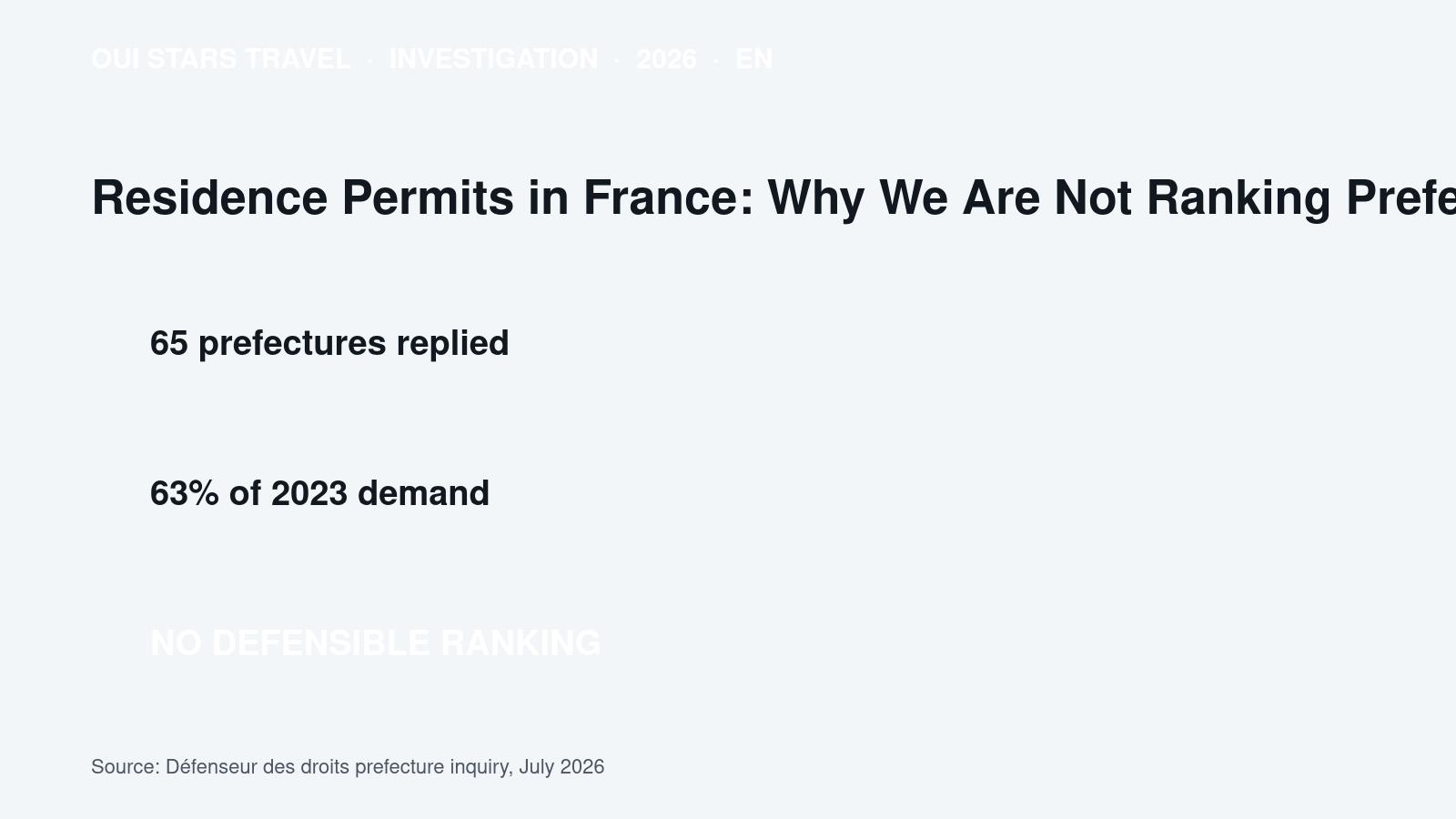
The Défenseur des droits sent a uniform 32-indicator questionnaire to every prefecture, covering requests received and processed from 2019 to 2023. By June 2025, 65 prefectures had answered. They represented 63% of national residence-permit demand in 2023, but roughly one third of prefectures did not provide data. Responses varied from complete questionnaires to central extracts with missing fields.
The report itself says the gaps prevented all intended comparisons. Some categories could not be reconciled because totals and sub-totals used different scopes; the admission-exceptionnelle data were excluded from parts of the analysis because unlike procedures were combined. Four Île-de-France prefectures did not answer, including departments with very high demand. Publishing a “best prefecture” list from this evidence would reward missingness, not performance.
What the official evidence does establish
- The national average time to deliver a residence permit rose from 78 days in 2019 to 110 days in 2023, a 41% increase.
- The Interior Ministry reported an average of 117 days for renewals in 2025.
- Pending applications at 31 December increased from about 243,000 in 2019 to almost 403,000 in 2023.
- Between 2019 and 2023, renewal demand rose 43% while full-time-equivalent staffing rose 10%.
- Foreigners’ rights represented 41% of Défenseur des droits referrals in 2025, compared with 10% in 2019. The institution reports more than a sixfold increase in related complaints over that period.
These are national or survey-wide findings. They document saturation and rights risks; they do not prove that a particular department is more permissive, or that a legally ineligible case becomes eligible there.
Appointments, ANEF and provisional documents
More than 80% of applications handled by prefectures are now filed through ANEF. The Interior Ministry says ANEF can issue renewable three-month attestations prolonging examination for complete renewal files and an attestation of favourable decision once approval is recorded. It also says an in-person or paper fallback must be offered when a technical blockage cannot be resolved within a reasonable time.
The Défenseur des droits nevertheless documents persistent access failures, late or absent provisional documents, unanswered files and late delivery of the final card. These failures can interrupt work, housing and social rights. A technical upload is therefore not the same thing as effective access to the public service.
What a fair prefecture comparison would require
- Monthly prefecture-level publication of median and 90th-percentile processing times, separated by procedure and complete-file date.
- Appointment availability measured by successful booking attempts, not anecdote or screenshots.
- Rates of provisional-document issuance before expiry, rights interruptions, ANEF escalations and paper fallback.
- Stocks and inflows published together, with staffing and case complexity.
- Independent definitions, an audit trail, coverage flags and suppression rules.
What can be done now?
Applicants should use the official procedure for their legal basis, keep dated proof of every submission and technical incident, and seek qualified legal help when rights are at risk. This article is not legal advice. The State should make provisional documents automatic through the entire examination, guarantee an accessible non-digital route, set public service standards, publish comparable departmental dashboards and give frontline services durable staffing.
oui stars Travel invites the Interior Ministry, all prefectures, the Défenseur des droits, administrative courts and recognised legal-aid organisations to provide comparable 2024-2026 data or corrections. If a complete, audited dataset becomes available, we will test a performance report. Until then, we will not market administrative friction as an immigration shortcut.
Sources
- Défenseur des droits, prefecture inquiry and recommendations, July 2026
- Défenseur des droits, ANEF report, December 2024
- Interior Ministry response on ANEF safeguards, June 2025
- French Senate, 2026 state territorial administration budget report
Osama Samaha
Editor-in-Chief, oui stars Travel