













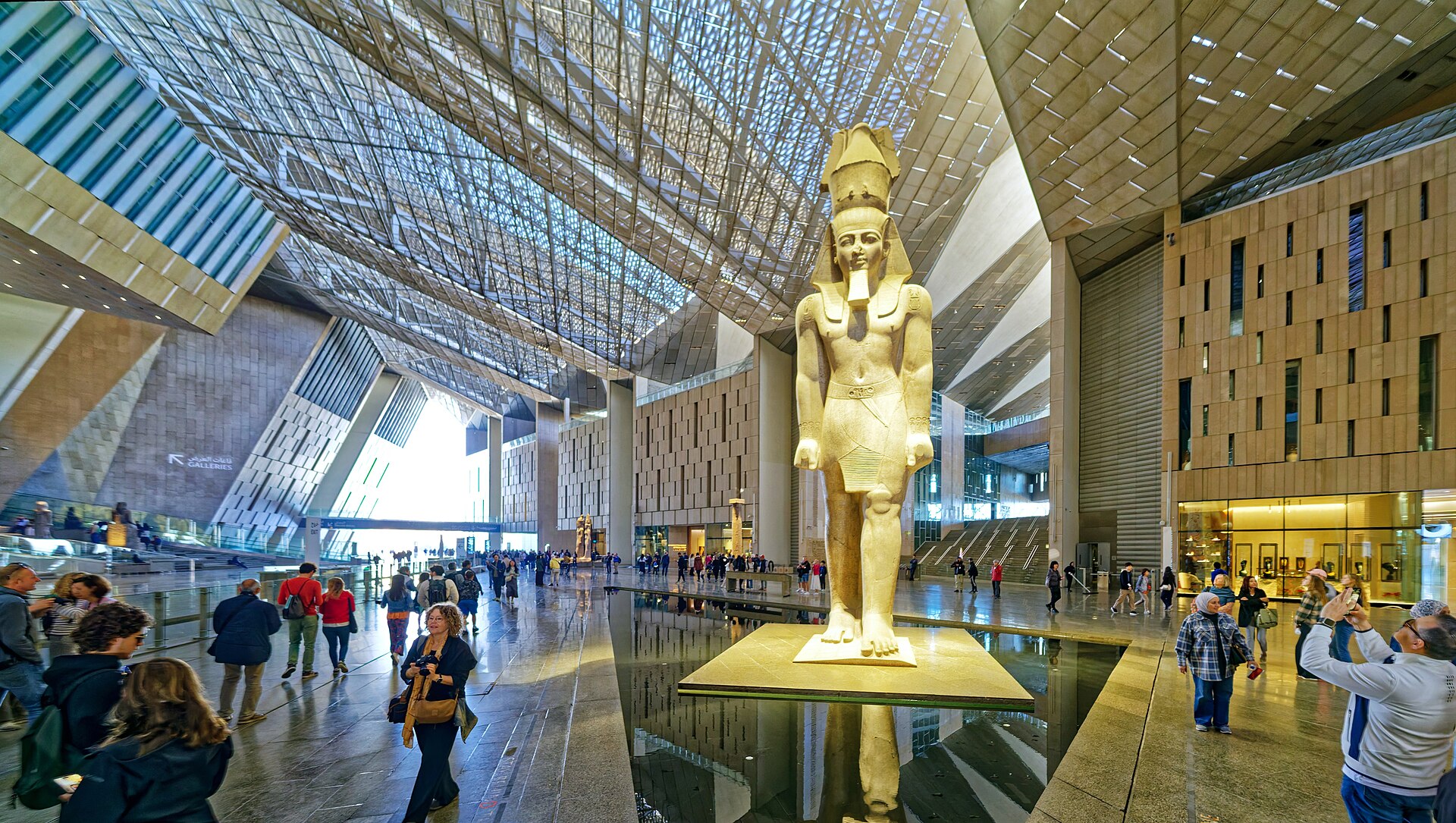
From Tutankhamun’s treasures to the mysteries of life and death: why we should not visit this museum with our eyes alone.
What has Egypt given the world? The answer may be too large to compress into pyramids, temples, kings or even the treasures of Tutankhamun. Egypt left humanity a memory. It also left questions that have never quite closed.
Some museums invite us to see what is inside them. Other places ask for a degree of inner readiness — a willingness to slow down and think. I believe the Grand Egyptian Museum belongs to the second kind.
Do not enter it counting only the objects you expect to see, the photographs you hope to take or the hours required to “finish” the visit. Enter with questions. Pause. Look again. Explore.
You are not standing only before ancient remains. You are standing before messages that crossed millennia to reach you.
Author’s note. This signed editorial combines verified historical and museum information with Osama Samaha’s personal spiritual reflection. The reflection is not an archaeological conclusion or a scientific claim. It does not describe every artefact as a literal divine message, and it does not identify any particular mummy with a named religious figure.
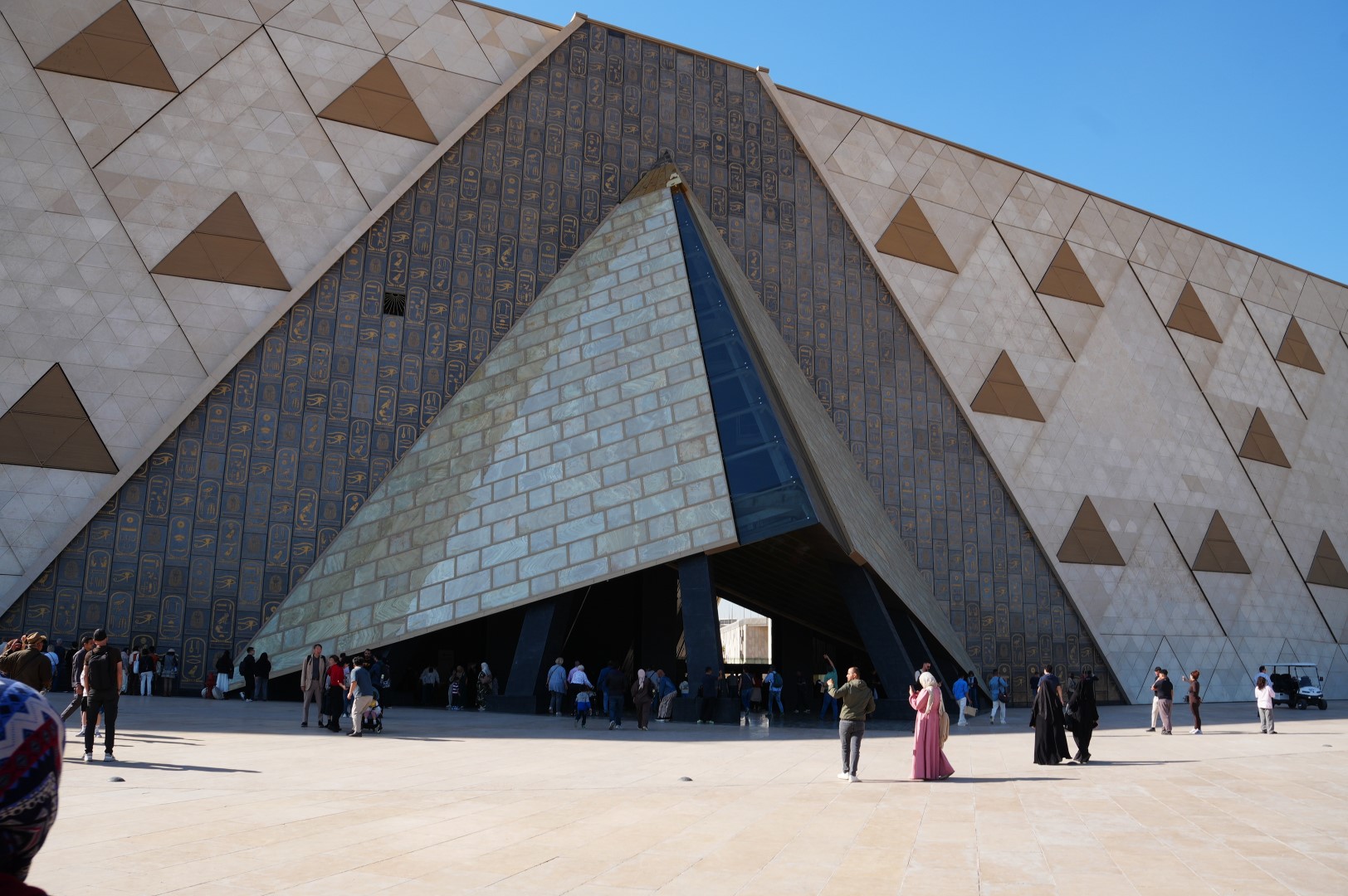
“So that you may be a sign to those after you”
A passage from Surah Yunus has stayed with me:
﴿فَالْيَوْمَ نُنَجِّيكَ بِبَدَنِكَ لِتَكُونَ لِمَنْ خَلْفَكَ آيَةً﴾
Quran, Surah Yunus, 10:92
In meaning: “Today We shall preserve your body so that you may be a sign to those after you.” The phrase that holds my attention is the last one: something remains so that later generations can see it, question it and contemplate it.
That is the beginning of a personal meditation, not a label applied to a museum collection. Archaeology has its methods; dating has its evidence; curators and conservators have scientific responsibilities. Yet the verse opens a valid human question: what does it mean for a body, a stone or an object made by human hands to arrive before generations its maker could never have imagined?
Inside the museum, survival becomes a subject in itself. Different objects reached us by different routes: sealed in tombs, covered by sand, broken, excavated, documented, restored and moved. Somewhere between their material survival and the meaning we give them now, the real visit begins.
Why did all this remain?
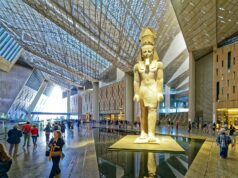
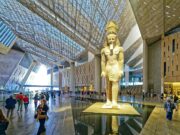
The museum’s modern institutional story is already a long one. A site near the Giza pyramids was allocated in 1992; the foundation stone was laid in 2002; Heneghan Peng won the international architectural competition in 2003. The Conservation Center opened in 2010. The colossal statue of Ramesses II entered the Grand Hall in 2018, the Grand Staircase partially opened in 2023, and trial operations in the Main Galleries followed in 2024. The official inauguration took place on 1 November 2025.
The deeper story, of course, is thousands of years older. The collection spans ancient Egyptian civilisation from prehistory through the Greek and Roman periods. In the Main Galleries, chronology is only one organising principle. Kingship, society and beliefs form three ways of reading how ancient Egypt understood power, community, order and the cosmos.
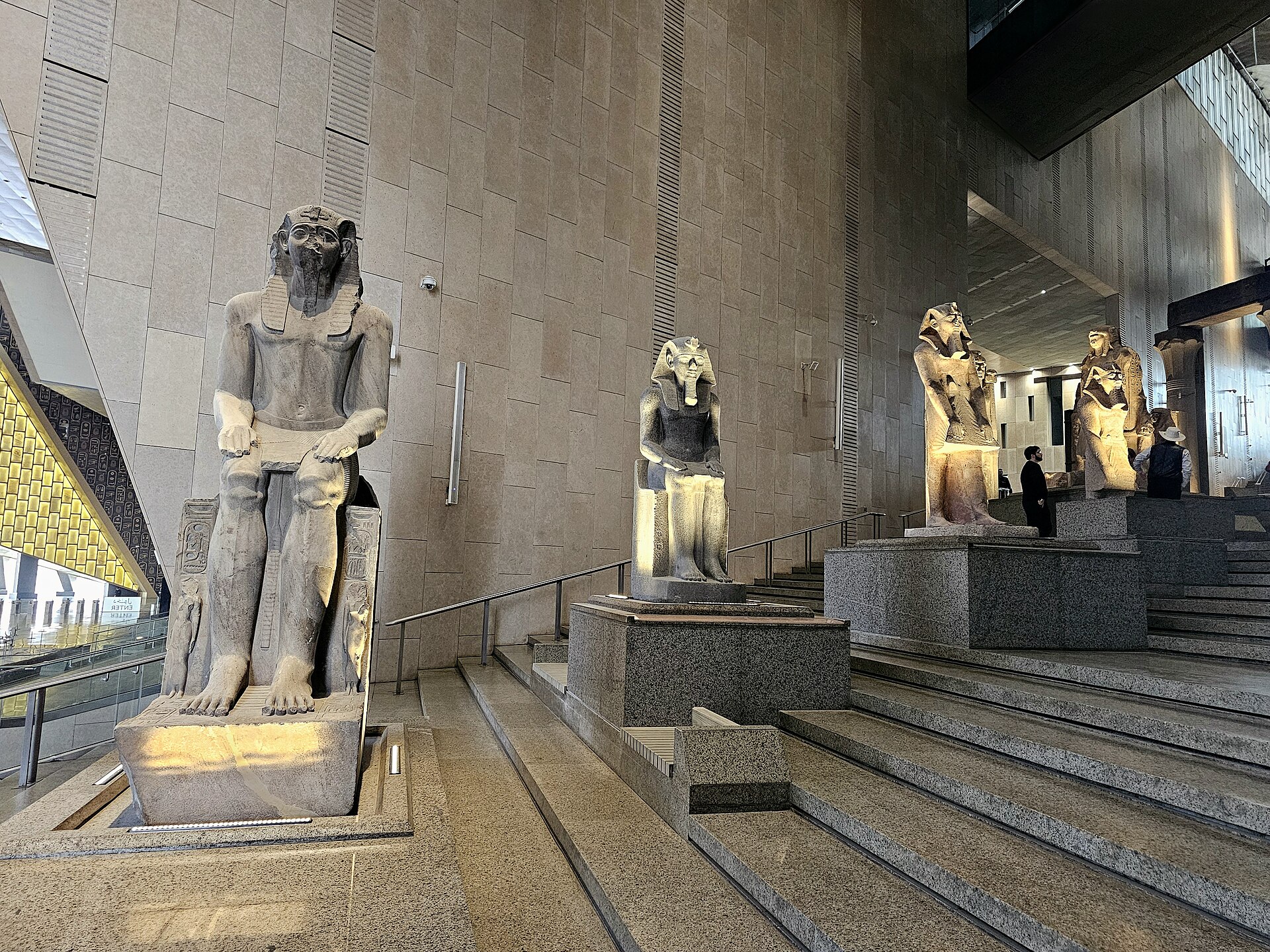
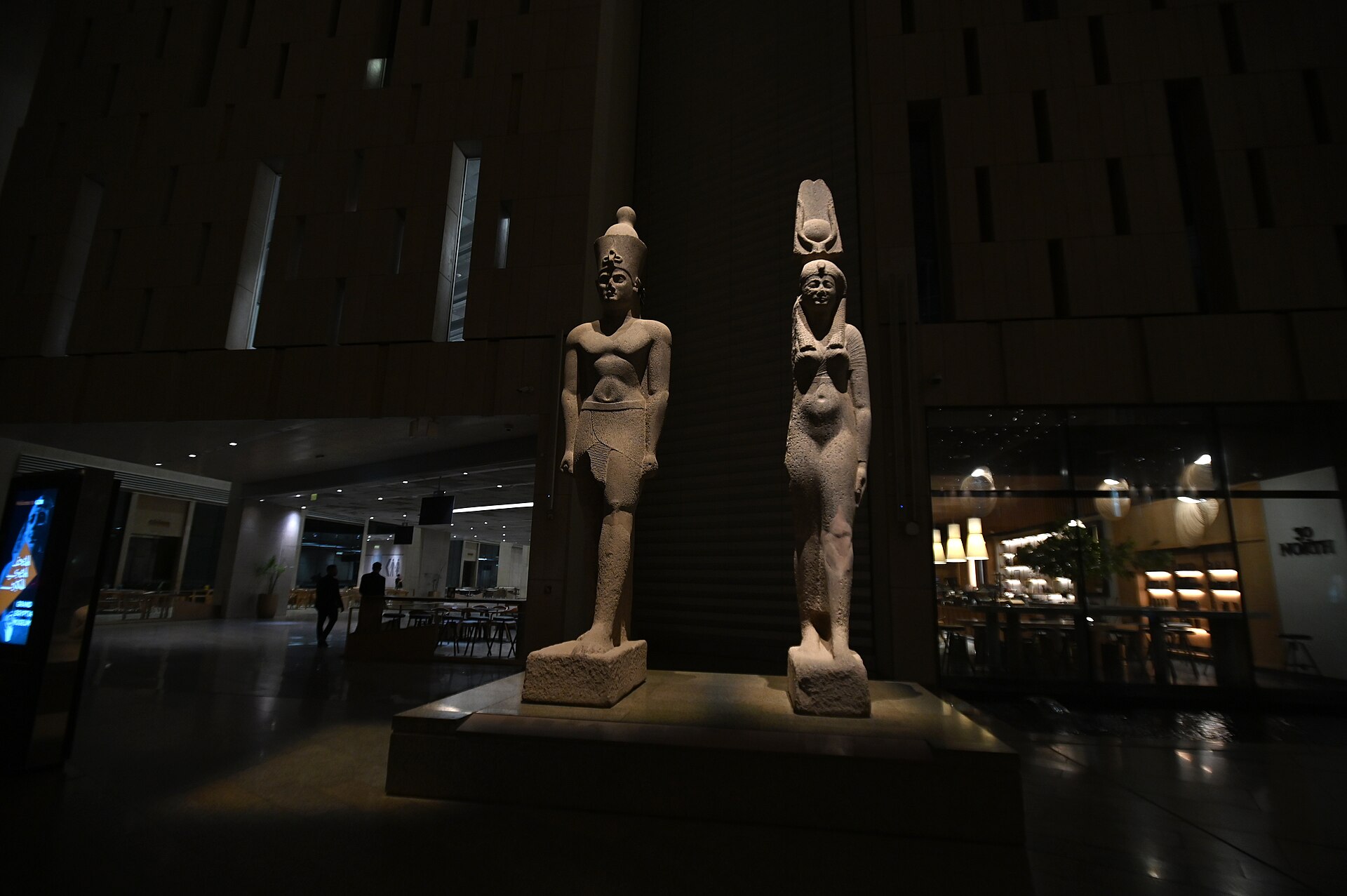
Royal statues, stelae, columns, sarcophagi and architectural fragments meet on the Grand Staircase. Their survival was not one simple miracle. It was a long chain involving durable materials, burial practices, chance, excavation, conservation and patient documentation.
Each answer produces another question. How were these masses moved? How were workshops organised? What does a small detail in a crown, cartouche or sculpted gesture reveal? How did ancient Egyptians imagine death? Why was one thought set in stone, another in colour and another in gold?
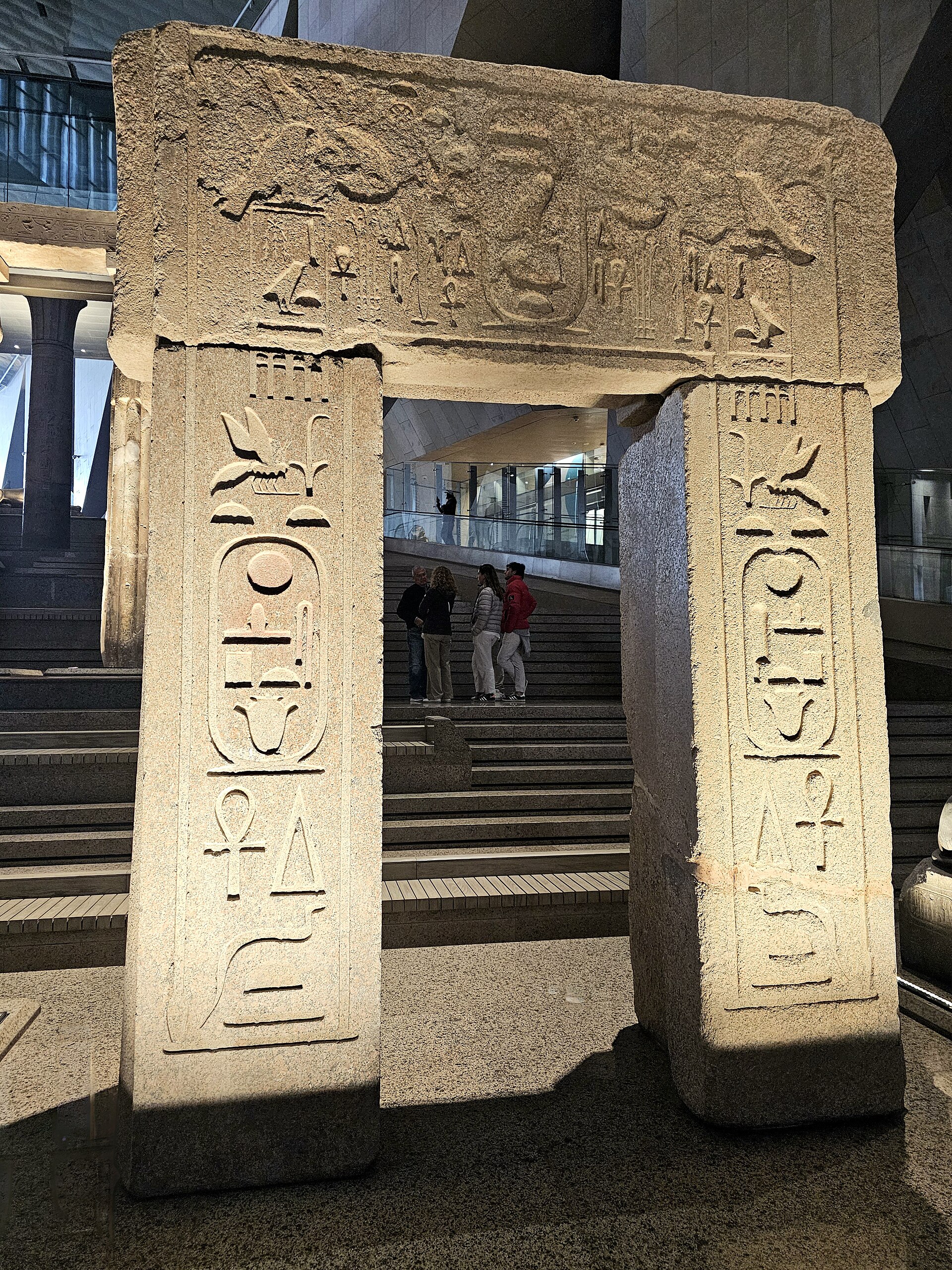
Before Tutankhamun, look beyond the gold
The Tutankhamun collection seizes the eye. Gold glows, the name is familiar, and the mask has become one of archaeology’s most recognisable faces. But the experience narrows if we reduce it to brilliance.
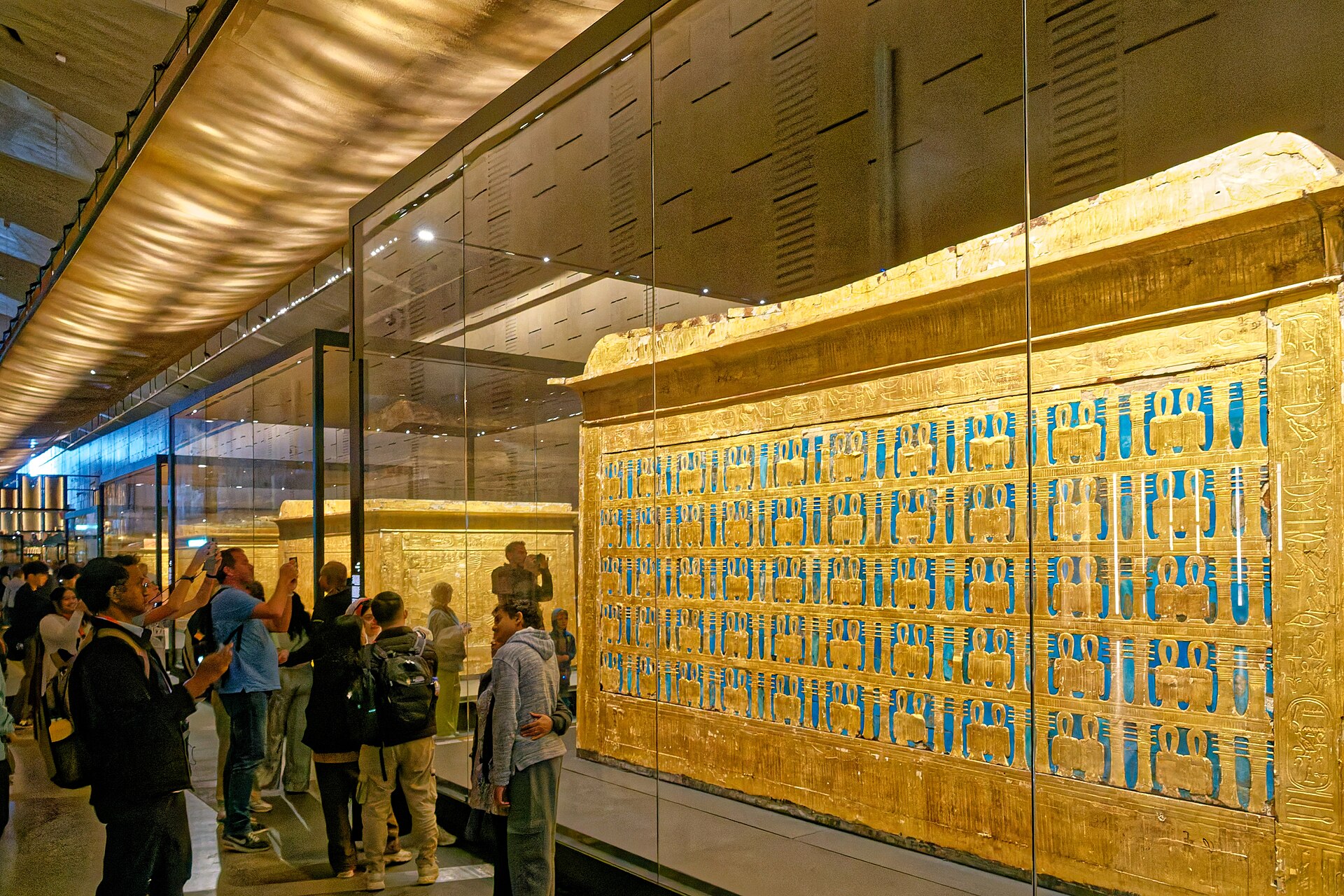
The tomb was discovered in 1922 by Howard Carter and his team, supported by Lord Carnarvon. Today the Tutankhamun Galleries bring thousands of objects together in a narrative that moves through the discovery, the king’s identity and family, funeral preparations, everyday life and the idea of rebirth in the afterlife. This is not a vault of gold. It is a human biography told through the things that surrounded a life and a death.
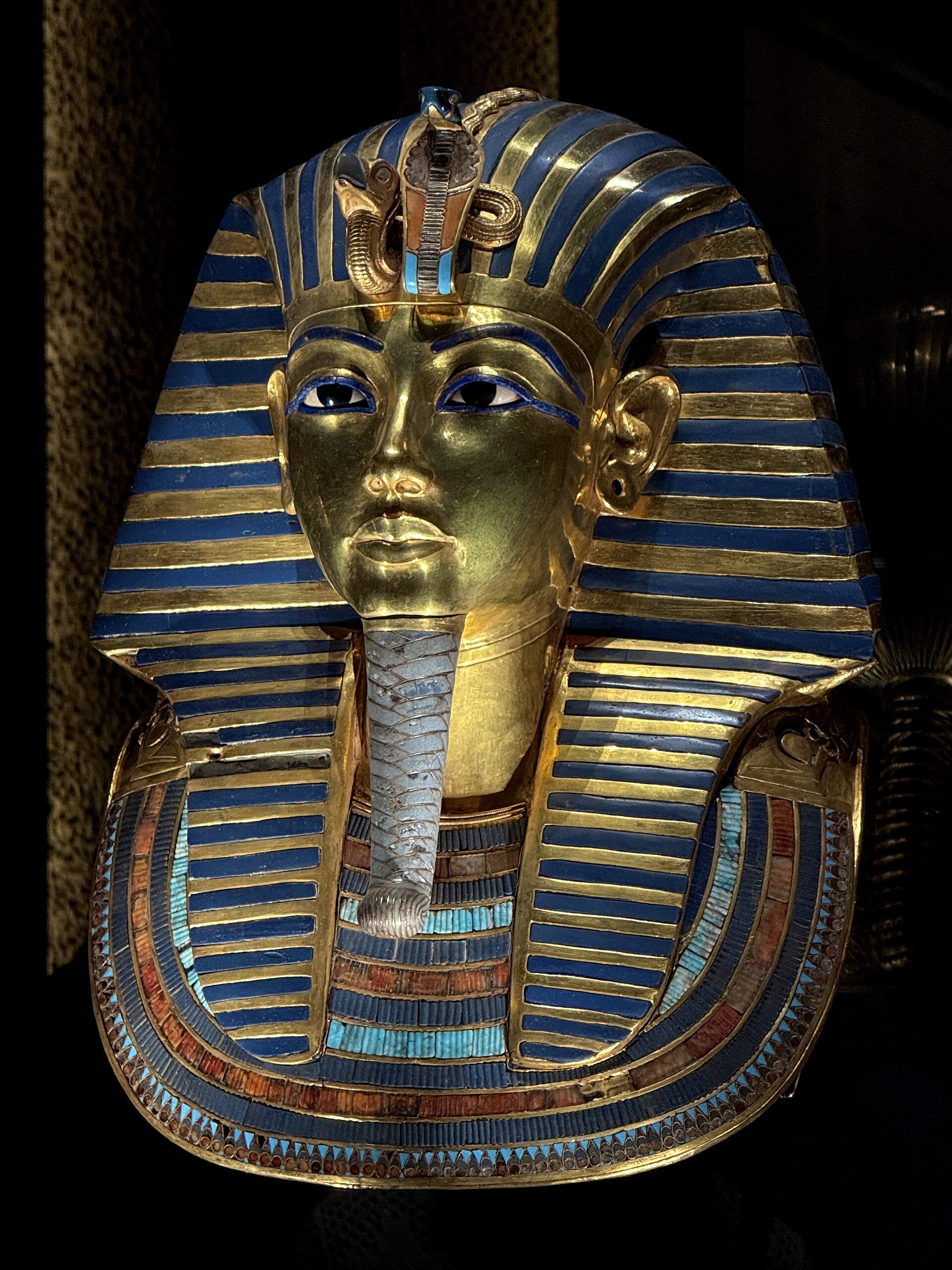
Stand before the mask and think about the hand that worked the metal, the eye that selected lapis lazuli, glass, carnelian, obsidian, faience and quartz. Consider the belief system that linked the king’s image to protection and eternity. The inscriptions are not decoration added to valuable material. They belong to a complete way of understanding the world.
We do not need to deny the wonder of gold. It is genuinely beautiful. Yet the craftsmanship is more astonishing still, as is the human impulse to turn fear of disappearance into images, rituals and things made to endure.
Read — then go to the museum
I recommend beginning before you arrive. Read one reliable chapter on ancient Egyptian history. Learn the difference between the Old, Middle and New Kingdoms. Understand the purpose of a temple, the logic of a tomb, the royal name and the basic principle of hieroglyphic writing. This will not make you an Egyptologist. It will give your eyes keys.
Visitors interested in religion may also reflect, according to their faith and method, on the presence of Egypt, its peoples, rulers and prophets in the Quran, Bible or Torah. The boundary must remain clear: spiritual meditation is not archaeological proof. We should not force a text onto an object or assign a historical identity without solid evidence.
The museum will not give every visitor the same answer — and that is one of its strengths. A child may ask how a statue was raised. An engineer may read the light. An artist may stop at a carved line. A believer may contemplate survival. A researcher may recognise a question that remains unresolved.
Do not visit quickly
The official website describes a complex of about 500,000 square metres. Do not turn that scale into a race. A meaningful visit is not measured by the number of galleries “completed”, but by the moments in which you actually saw something.
Stop before the faces. Notice the stones. Read the entire label. Look behind a sculpture where the route allows it. Compare the size of a tool with the hand that once held it. Step back to understand the object’s relationship with the space, then come closer to find a scratch or trace of pigment that survived.
If time is limited, choose one thread: kingship, daily life, beliefs, Tutankhamun or the Grand Staircase. It is better to leave with five real questions than hundreds of photographs you may never open again.
They were human, as we are
The solemnity of colossal statues can make us forget this. Ancient Egyptians loved, feared, dreamed, worked, fell ill and mourned. They built institutions, experienced conflict, left personal messages and thought about death and what might follow it.
Technology changed; many fundamental questions did not. How do we protect those we love? What remains of a name? Will later generations remember us? How do we give meaning to a short span of time? What makes a life worth telling?
Before a chair, sandal, box, toy or vessel, “civilisation” stops being an enormous abstraction. It becomes the trace of a daily habit. In the small distance between an ancient hand and a contemporary eye, history becomes a human relationship.
What will we leave?
The museum now becomes a mirror. Ancient Egyptians left objects that still generate research, disagreement and wonder thousands of years later. What will our civilisation leave? Billions of images trapped inside platforms that may disappear? Towers without memory? Open knowledge? Pollution? Art? Better questions?
We have no right to look down on the past. Our present will also become ancient. Materials, texts, decisions and probably mistakes will remain. The museum does not ask only, “What did they make?” More quietly, and perhaps more urgently, it asks: “What are we making — and for whom?”
Watch before you go
This short official film from Experience Egypt offers a visual introduction to the Grand Egyptian Museum’s opening. Treat it as a prelude, not a substitute for being there.
Official video: Experience Egypt, published 2 November 2025.
Plan the visit
Location: El Remayah Square, Cairo–Alexandria Desert Road, Giza, near the Giza plateau.
Currently published hours: Sunday, Monday, Tuesday, Thursday and Friday, the complex opens 8.30am–7pm and galleries 9am–6pm. On Wednesday and Saturday, the complex remains open until 10pm and galleries until 9pm. Last entry is one hour before gallery closing.
Tickets: use only the museum’s official ticketing portal. Check again before travelling; hours, ticket conditions and the availability of individual experiences can change.
Egypt’s gift to humanity
The Grand Egyptian Museum’s value is not only its scale, architecture or the number of works it protects and presents. Its deeper achievement is to rearrange our relationship with a distant time and place memory before us in a form we can see, read and question.
Egypt offers humanity memory. Questions. Civilisation. Messages across time.
Visit the Grand Egyptian Museum not only as a tourist, but as a thoughtful explorer. Take your children. Take your friends. Bring curiosity and questions with you.
You may find an answer to something that has followed you for years. You may notice something no one around you has seen. You may realise that some of Egypt’s greatest gifts to humanity are not only the objects before our eyes…
But the messages and questions that still reach us after thousands of years.
Osama Samaha
Editor-in-Chief
oui stars Travel
Principal fact-checking sources: official museum story; Tutankhamun Galleries; colossal statue of Ramesses II; museum complex map; Surah Yunus 10:92. Practical information checked 14 September 2026.