










THE STORY BEHIND THE HOTEL | PARIS SEASON
By Osama Samaha, Editor-in-Chief — oui stars Travel
Before it became a hotel, the Crillon was a façade designed for a king, an aristocrat’s private house and a front-row witness to a square where France repeatedly changed its mind about power. In 1919, while Paris tried to build peace from the ruins of war, statesmen gathered inside its rooms to debate the covenant of the League of Nations. The Hôtel de Crillon is not simply beside history. History has repeatedly checked in.
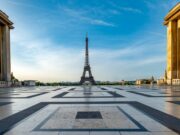
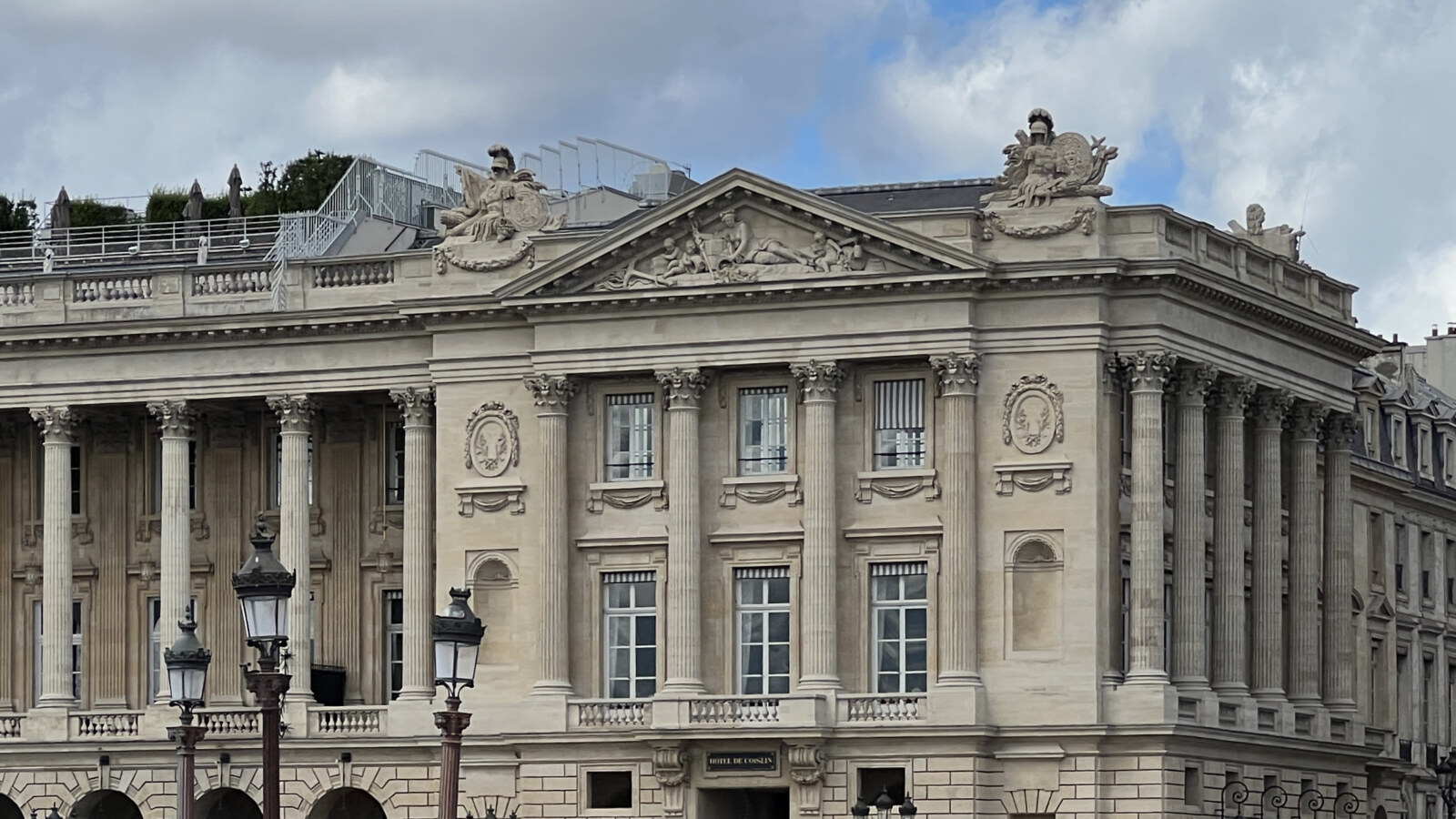
Stand on Place de la Concorde at dawn, when the traffic briefly loosens its grip. To the north, two great stone compositions frame the opening of Rue Royale. The eastern pavilion belongs to the Hôtel de la Marine; the western one carries the name Crillon. Their symmetry is so commanding that it is easy to mistake the western building for a purpose-built palace hotel. It was neither a palace in the royal-residence sense nor a hotel when its story began.
That distinction matters. The Crillon’s appeal comes from layers rather than from one founding gesture: a royal urban project, a private hôtel particulier, a grand hotel of the early twentieth century, a diplomatic headquarters, an occupied building and, after a four-year restoration, a contemporary Parisian Palace. Each era left something behind, and not all of it is comfortable.
A square built to glorify Louis XV
In 1755, Louis XV commissioned his Premier architecte, Ange-Jacques Gabriel, to design the new Place Louis XV around an equestrian statue of the king. Gabriel conceived the monumental façades on the square’s north side: disciplined Neoclassical architecture with giant Corinthian columns, sculpted pediments and a long colonnaded screen. Work began in the later 1750s.
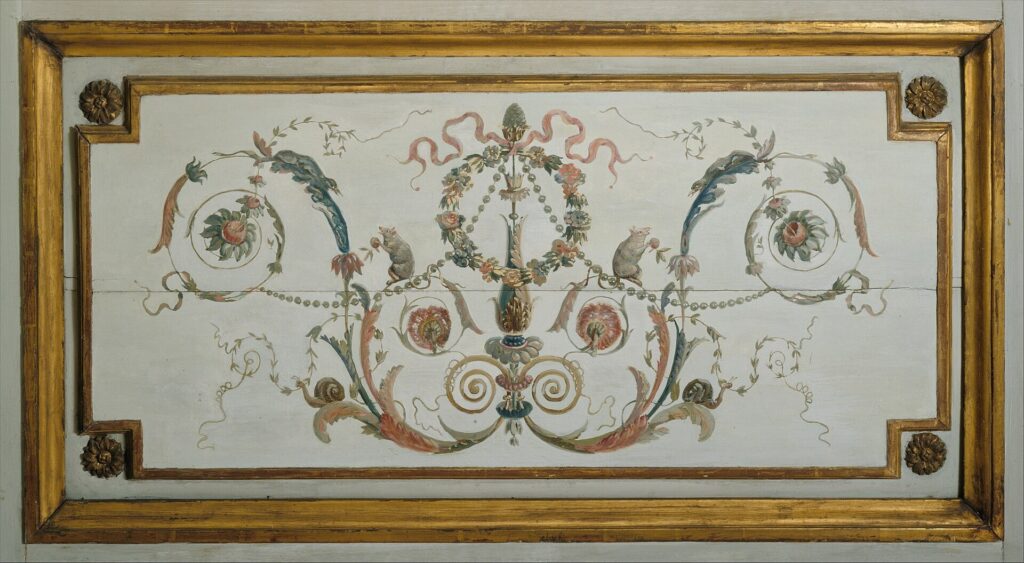
Behind Gabriel’s western façade, the story became more private. Louis-Marie-Augustin, duc d’Aumont, a senior courtier and celebrated collector, took the unfinished townhouse in 1776. Louis-François Trouard worked on the building, while Pierre-Adrien Pâris designed interiors of woodwork, mirrors, friezes and delicate arabesques. A surviving boudoir, removed in the early twentieth century, is now installed at New York’s Metropolitan Museum of Art. It is physical evidence that the building’s refinement existed long before room service.
François-Félix-Dorothée des Balbes de Berton, comte de Crillon, acquired the residence in April 1788. His family name stayed with the property even as the square outside changed names and regimes. During the Revolution, the Place Louis XV became Place de la Révolution; the guillotine stood there, and Louis XVI and Marie-Antoinette were among those executed. The Crillon residence faced a theatre of political violence that no later mythology can make picturesque.
Architecture: a public monument with a private interior
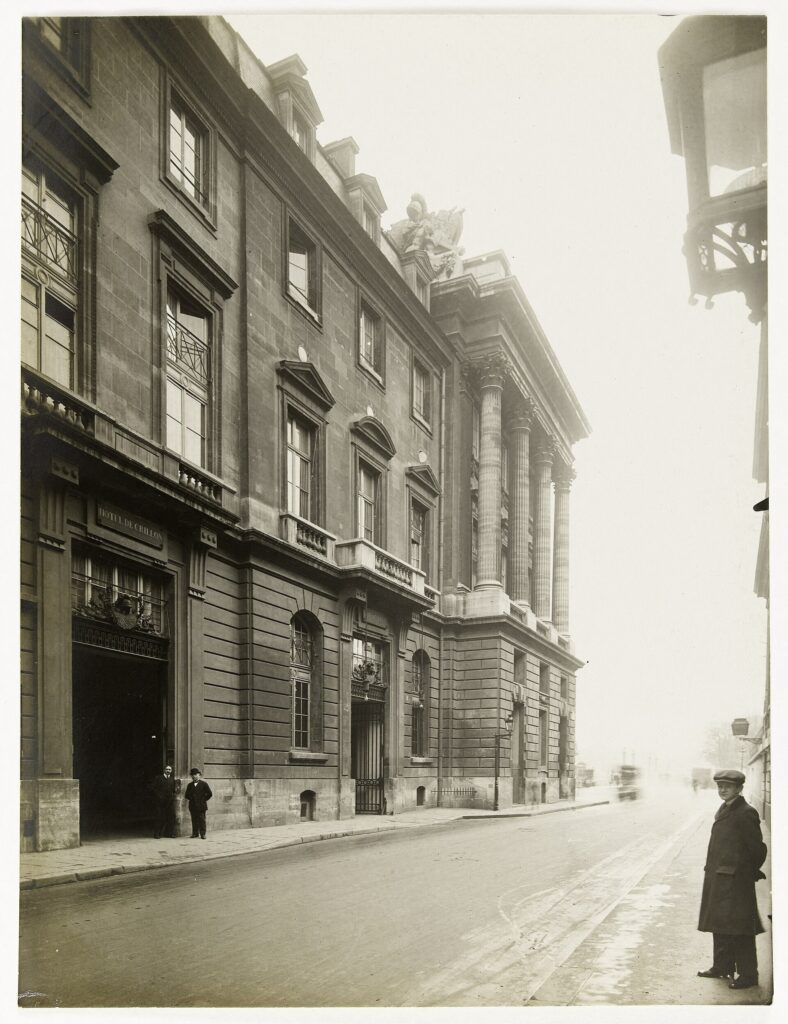
The exterior belongs to a vast urban composition, not to the hotel alone. Gabriel used proportion, repetition and the classical orders to close the north side of the square without making it feel like a fortress. The colonnade creates shadow and rhythm; the corner pavilion gives the composition a ceremonial focus. From the Tuileries, the building reads as part of the capital’s state architecture. From within, its salons once followed the more intimate logic of aristocratic life.
That double identity survives. The French Ministry of Culture lists the façades, roofs and important interior decorations among the protected elements. The Grand Salon des Aigles and the adjacent Louis XVI decoration are historically classified. The official heritage notice also makes a useful correction: the latter room is often called the Marie-Antoinette salon, but that name is improper. The association may be seductive; the documentary record is more exacting.
How a residence became the Hôtel de Crillon
In 1904, the Société du Louvre bought the property from the heirs of the duchesse de Polignac with a clear commercial ambition: turn the aristocratic residence into a prestigious hotel. Walter-André Destailleur directed the conversion, joining the historic house to neighbouring buildings on Rue Boissy-d’Anglas and introducing the services, circulation and scale expected of a modern grand hotel.
Not everything was preserved. Furnishings and decorative elements were sold, including Pâris’s extraordinary boudoir. The Metropolitan Museum records that the room was purchased directly from the Hôtel de Crillon in 1905 and later given to the museum by Susan Dwight Bliss in 1944. The loss in Paris became a rare period room in New York, but it also reveals an uncomfortable truth about early hotel transformations: heritage was often valued selectively.
The first hotel guests arrived on 12 March 1909. The timing placed the Crillon inside the golden age of the European grand hotel, when railways, diplomacy, international fortunes and new standards of service were reshaping travel. Unlike a new Belle Époque building, however, the Crillon entered that world wearing an eighteenth-century state façade.
IF THESE WALLS COULD TALK: the rooms where the League of Nations was debated
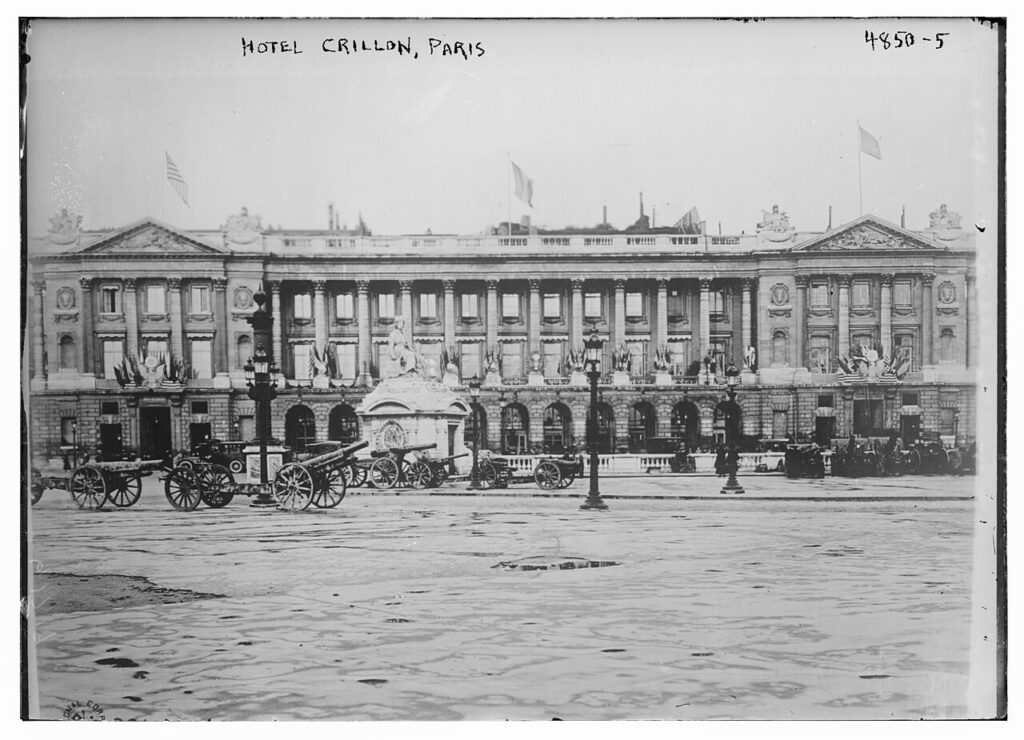
In the winter of 1918–1919, the Hôtel de Crillon became the centre of the American Commission to Negotiate Peace. U.S. State Department records list the American delegation at the hotel and identify it as a meeting place for the Commission on the League of Nations. President Woodrow Wilson chaired sessions there alongside figures including Lord Robert Cecil, Jan Smuts, Léon Bourgeois, Vittorio Orlando and Makino Nobuaki.
The story is not a vague hotel legend. An official American bulletin recorded the ninth meeting on 13 February 1919: delegates reviewed the drafting committee’s work in the morning, returned in the afternoon and adopted the full 26-article draft after prolonged discussion. Further sessions followed. The covenant did not spring from one dramatic signature in a single suite, but crucial drafting, revision and debate took place inside the Crillon.
There is a powerful irony in the setting. A residence built behind a façade intended to glorify an absolute monarch hosted negotiations for a new international system founded on collective security. The League ultimately failed to prevent another world war, and the United States never joined it. Yet the work done here became part of the institutional lineage that led to the United Nations. Few hotel corridors have carried an argument with such global consequences.
War, requisition and the difficulty of glamorous history
The Crillon’s historical prestige cannot be separated from the periods when hospitality gave way to power. During the First World War it received military and political delegations. After the armistice it was taken over for peace-conference work. During the Second World War, after initially serving Allied forces, it was requisitioned by the German military command during the occupation of Paris.
To say that a hotel “witnessed history” can turn suffering into decoration. The more responsible reading is that buildings are used by whoever controls a city. The façade remained; the meaning of the flags, uniforms and orders behind it changed. Photographs from the Liberation place the Crillon within the charged landscape of Place de la Concorde in August 1944. The building’s continuity is real, but continuity is not innocence.
Artists, designers and political figures: documented presences
Hotel guest lists are fertile ground for exaggeration, so the reliable names are the ones the record can support. Hôtel de Crillon’s own historical documentation identifies collector Peggy Guggenheim, composer Leonard Bernstein, sculptor César, designer Sonia Rykiel and Jean Cocteau as regulars or familiar figures. Pierre Cardin and Mary Quant presented collections in its salons. Andy Warhol, also described by the hotel as a regular guest, attended the debutante ball in 1992.
Bernstein’s connection became architectural memory: a signature suite bears his name and opens onto a large terrace above the square. The 1919 documents establish the presence of Woodrow Wilson and numerous international statesmen for formal work, even when the records do not prove that every participant slept under the hotel’s roof. Precision is more interesting than a swollen celebrity roll call.
Changing taste: Rykiel, César and the restorations before 2013
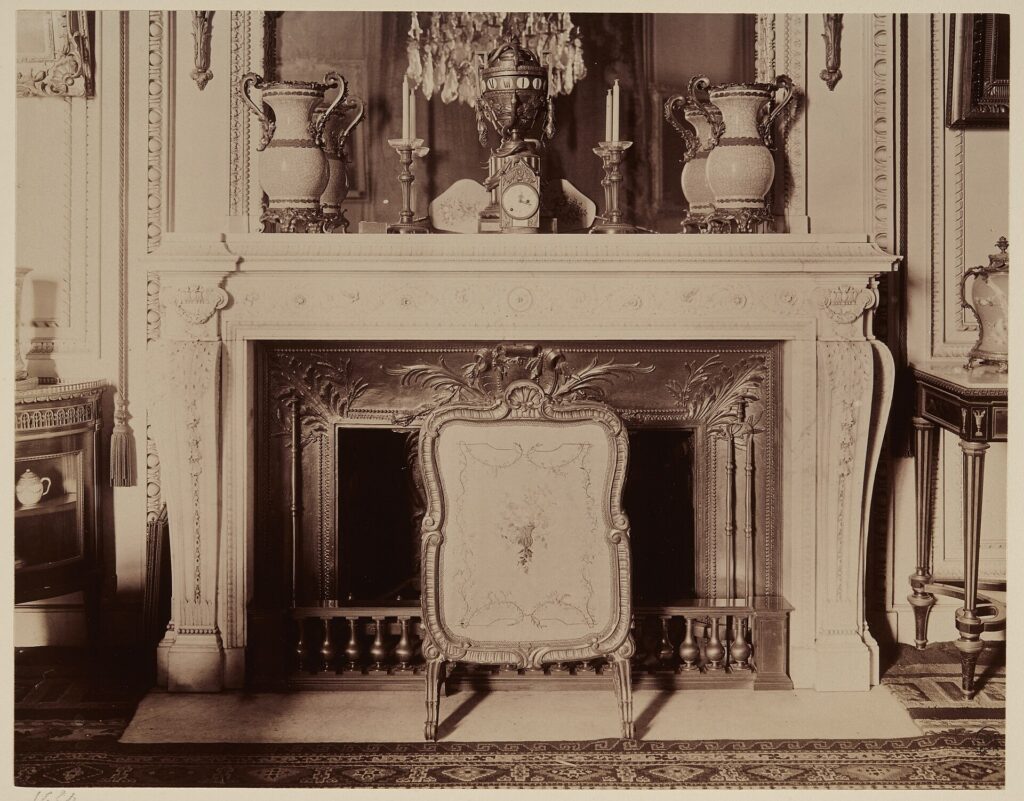
The Crillon was not frozen after 1909. The Taittinger family acquired it in 1954. In 1982, Jean Taittinger asked Sonia Rykiel to renew the interiors. Her yellows, reds and Art Deco inflection brought a strong contemporary personality; César created a monumental bar covered with faceted mirrors. The result belonged unapologetically to its moment.
It also came at a cost. The hotel’s own account acknowledges that eighteenth-century elements outside the legally protected ensemble disappeared through successive renovations. That candour is essential. Restoration is never simply a return to an original state: a building with two and a half centuries of life has several originals competing for attention.
After the Taittinger era, ownership passed to Starwood Capital Group and then, five years later, to a member of the Saudi royal family. Rosewood Hotels & Resorts was chosen to manage the property as the next transformation began.
The four-year restoration: conservation without imitation
The hotel closed on 31 March 2013 and reopened on 5 July 2017 after the largest restoration in its history. Richard Martinet led the architectural work, including the protected façade, historic reception rooms and structural interventions. Aline Asmar d’Amman served as artistic director, establishing the conversation between eighteenth-century craft and contemporary Paris.
The design was deliberately plural. Tristan Auer shaped the arrival spaces and brasserie; Chahan Minassian worked across dining areas, the bar, spa and several signature suites; Cyril Vergniol designed the guestrooms and suites outside the signature collection. Louis Benech created the courtyards. Karl Lagerfeld, an obsessive student of the eighteenth century, designed Les Grands Appartements with Aline Asmar d’Amman.
The scale was closer to reconstruction than redecoration: the hotel reports 147 craftspeople and 250 master builders, 53 types of marble, nine floors and extensive excavation beneath the historic site. Rooms were reduced in number to create more suites. Listed spaces were restored; new functions were threaded through and below the old fabric.
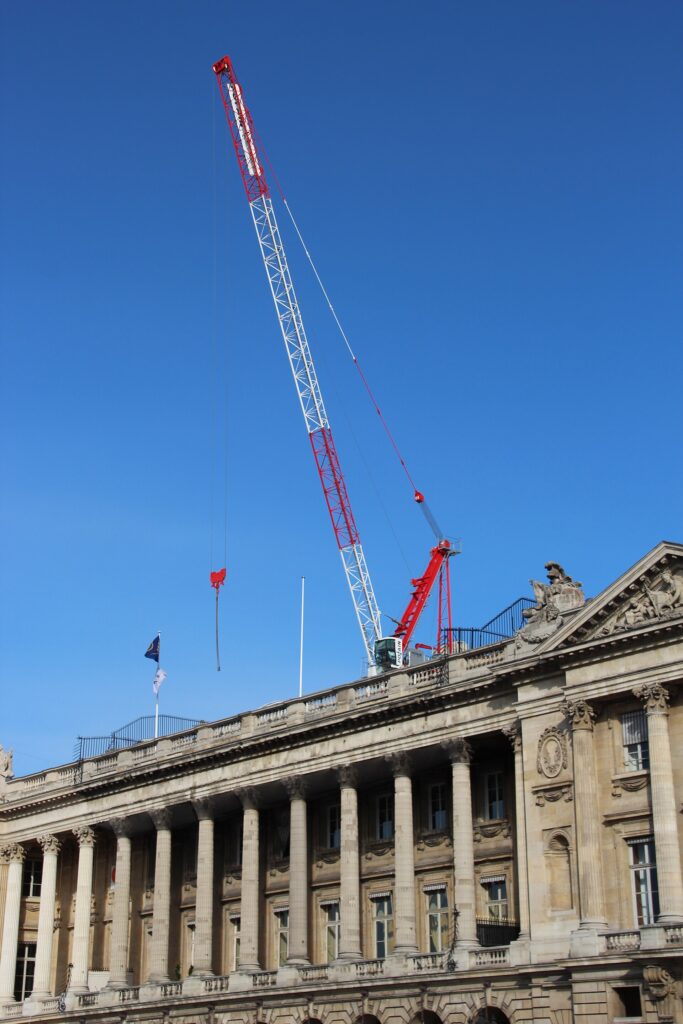
One detail captures the mixture of extravagance and engineering. A bathtub for Lagerfeld’s Grands Appartements was carved from a single slab of Carrara marble weighing more than two tonnes. It entered through a window by crane and was lowered onto blocks of ice; as the ice melted, the tub settled into position without damaging the floor.
The Hôtel de Crillon today
The contemporary hotel has 124 rooms and suites: 78 rooms, 36 suites and 10 signature suites. Its official Palace distinction was renewed in 2025, and Atout France continues to list it among France’s distinguished Palace hotels. The designation is not a casual synonym for luxury; it is a national distinction reserved for selected five-star properties.
The most distinctive accommodations translate the building’s history rather than merely reproducing period style. Les Grands Appartements carry Lagerfeld’s exacting, graphic interpretation of French classicism. Suite Duc de Crillon retains the memory of the former private chapel. Suite Marie-Antoinette uses the name and atmosphere cautiously better than many retellings do: its present design is a homage, not proof that the queen lived here. Suite Bernstein turns a documented relationship into a terrace-facing residence. The Ateliers d’Artistes occupy former administrative spaces beneath the roof.
Dining has become another reason to enter the building without staying overnight. L’Écrin offers a gastronomic experience built around pairings; Nonos by Paul Pairet takes a more generous, contemporary approach; Butterfly Pâtisserie, Jardin d’Hiver and Bar Les Ambassadeurs give the hotel different rhythms across the day. Sense, A Rosewood Spa includes a pool, sauna, steam facilities, experience showers and a resting area with a Himalayan salt wall.
Why travellers still choose it
The strongest reason is not a checklist of luxury services. It is the unusual compression of Paris into one address. A traveller can sleep behind Gabriel’s monumental façade, cross a square marked by monarchy and revolution, walk through the Tuileries to the Louvre, reach Rue Saint-Honoré and Place Vendôme in minutes, then return to interiors that do not pretend the twenty-first century never arrived.
Scale also matters. With 124 rooms and suites, the Crillon is large enough to contain several restaurants, historic salons and a serious spa, yet smaller than many international city hotels. Its appeal is most convincing for travellers who value architecture, centrality and cultural memory alongside service. Those seeking anonymity away from major sights may prefer a quieter district; Place de la Concorde is magnificent, but it is also busy, exposed and intensely public.
Practical location
| Address | 10 Place de la Concorde, 75008 Paris, France |
|---|---|
| Arrondissement | 8th arrondissement, on the north-west corner of Place de la Concorde |
| Nearest Métro | Concorde, served by lines 1, 8 and 12 |
| On foot | Tuileries Garden, Musée de l’Orangerie, Rue Saint-Honoré, Place Vendôme, Champs-Élysées and the Louvre are within a central walking circuit |
| Map | Open the location in Google Maps |
| Official information | Hôtel de Crillon official website |
For wider planning, continue with our guide to the most popular areas for five-star hotels in Paris and our independent guide to planning luxury travel in France.
Watch: Hôtel de Crillon’s 2017 return
This official Rosewood film introduced the restored hotel ahead of its reopening. It remains hosted by YouTube and is embedded here without downloading or rehosting.
Featured image: Hôtel de Crillon on Place de la Concorde. Chabe01/Wikimedia Commons, CC BY-SA 4.0; cropped by oui stars Travel.
Editorial independence
This story was selected and produced independently by oui stars Travel. It does not imply a partnership, sponsorship, complimentary stay, endorsement or commercial relationship with Hôtel de Crillon, Rosewood Hotels & Resorts or any organisation mentioned. Hotel facilities and operations can change; verify current details directly before travelling.
Sources and fact-checking
- French Ministry of Culture, POP/Mérimée: Hôtel Crillon heritage notice
- The Metropolitan Museum of Art: Boudoir from the Hôtel de Crillon
- U.S. Department of State, Office of the Historian: Paris Peace Conference records
- Hôtel de Crillon historical and restoration dossier
- Hôtel de Crillon: documented stories behind the signature suites
- Atout France: current list of Palace-distinguished hotels
Fact-check completed 15 September 2026. Search-intent review covered English, French and Arabic queries around Hôtel de Crillon history, architecture, famous guests, suites, restaurants and Place de la Concorde location.





[…] the Paris season: Hôtel de Crillon: The Palace That Watched Paris Make History. Related architecture: How I. M. Pei’s Louvre Pyramid Changed […]