
Ten crafts that shaped the world’s memory · Episode four
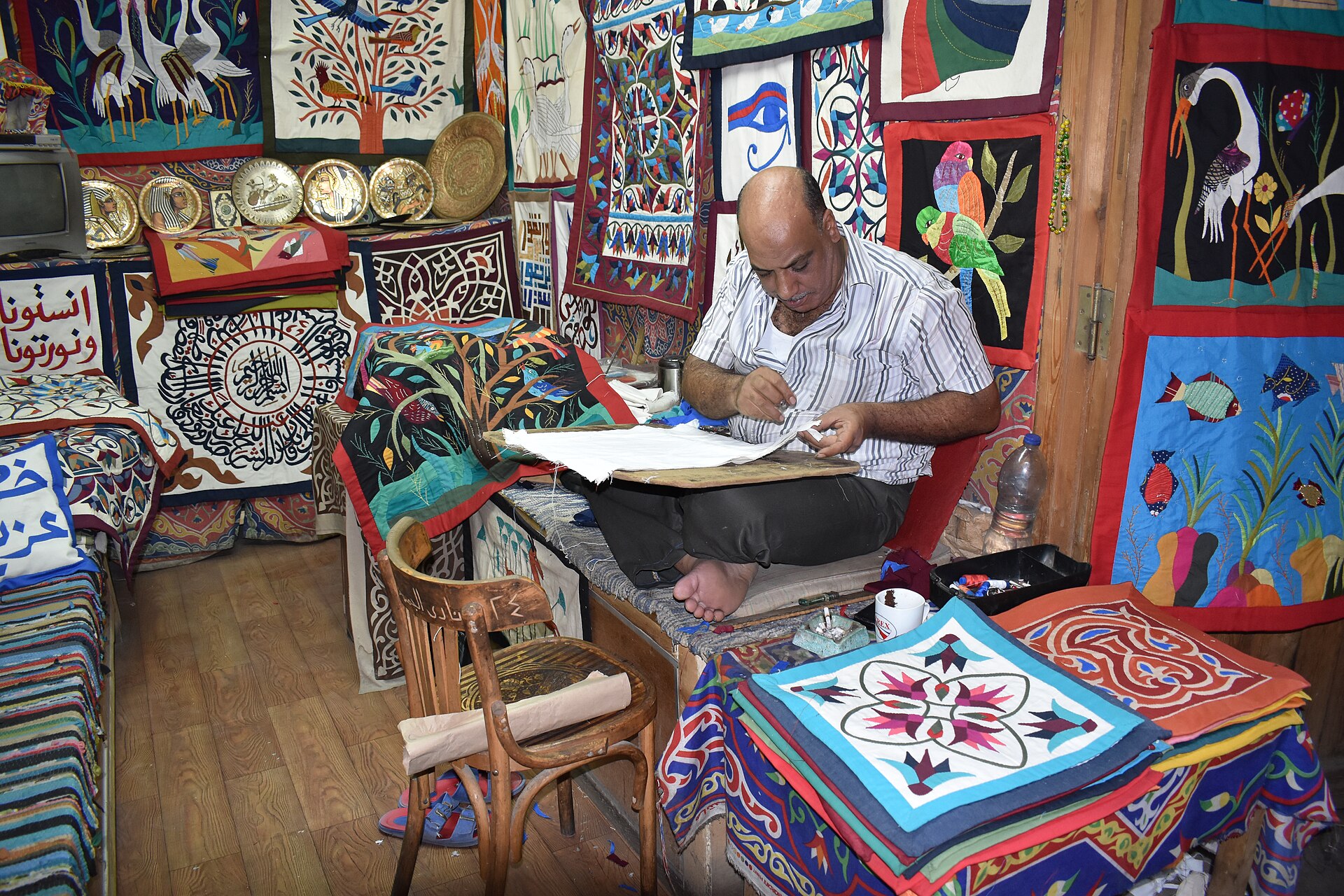
In his workshop in Historic Cairo, Hani Abdel-Fattah sits beside the cloth that has occupied him for thirty-five years. He told Al-Ahram that khayamiya is “a story told with a needle, thread, and colour,” and that passing his experience to the next generation is a duty. Around him, nothing looks as though it came from one production line: a bird emerges from cotton fragments, a geometric star demands dozens of precise turns, and Arabic lettering becomes clean only when every raw edge disappears beneath a small stitch. Behind Bab Zuweila, Cairo’s memory is not locked in a case. It is folded between two fingers and secured with a needle.
When the master becomes a bridge
Hani Abdel-Fattah is not an isolated figure. Al-Ahram also met Mohsen Shaaban, who spent fifty-five years in the profession and taught its secrets to his son, and Sameh Suleiman, who learned from his grandparents and tried to teach his daughters. Artisans describe a long apprenticeship requiring talent, patience and repeated practice before a professional piece can be made. A master is therefore valued not only for speed, but for explaining a pattern the student cannot yet see whole, correcting a stitch without erasing the learner’s voice, and proving that slow knowledge can still support a future.
What khayamiya actually is
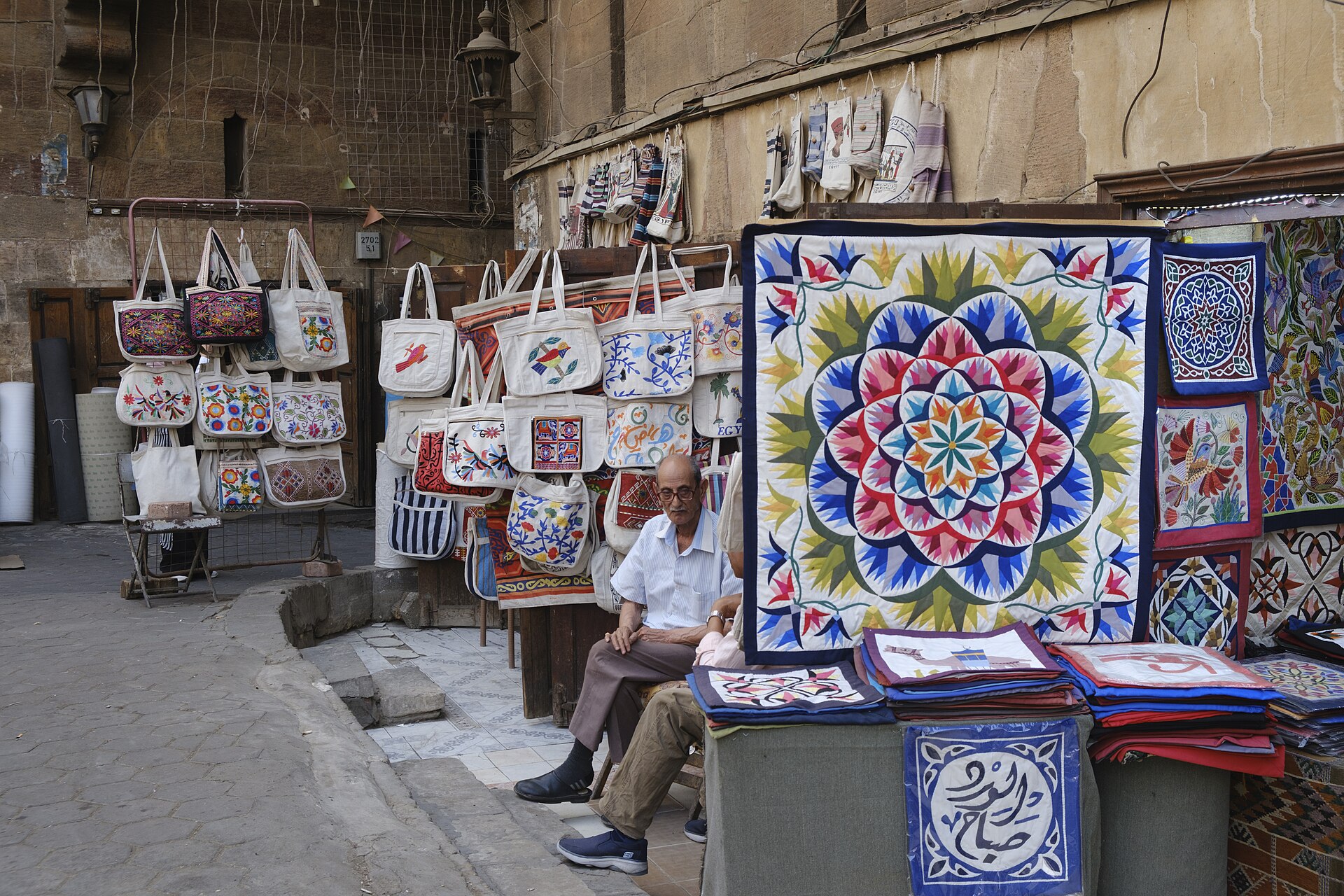
Khayamiya is appliqué: coloured cloth is cut, placed over a heavier backing, its raw edge turned under and secured by close hand-stitching. Cairo Governorate describes it simply as decorating fabric with fabric and records its use in ceremonial pavilions, tents, panels and cushions. Cotton is common, while velvet, silk, satin, sailcloth and other materials may be chosen for different functions. The essential distinction is material: colour is a piece of cloth, not an image printed onto the surface. Viewed closely, authentic work reveals layers, folded edges and the rhythm of the hand.
From the shade of a tent to a traveller’s wall
For generations khayamiya lined suradeq—temporary architectural pavilions used for weddings, mourning gatherings, festivals and public occasions. Egyptian sources trace related textile practices across many periods, while museum objects provide firmer evidence from Ottoman and Khedival Egypt into the twentieth century. As tourism expanded, makers changed their output: large red, indigo and white panels were joined by smaller portable works, and Pharaonic and folkloric scenes appeared beside arabesque and calligraphy. Adaptation was not a betrayal. It was the tentmaker’s answer to a changing market and a way to keep the needle moving.
The street that carries the craft’s name
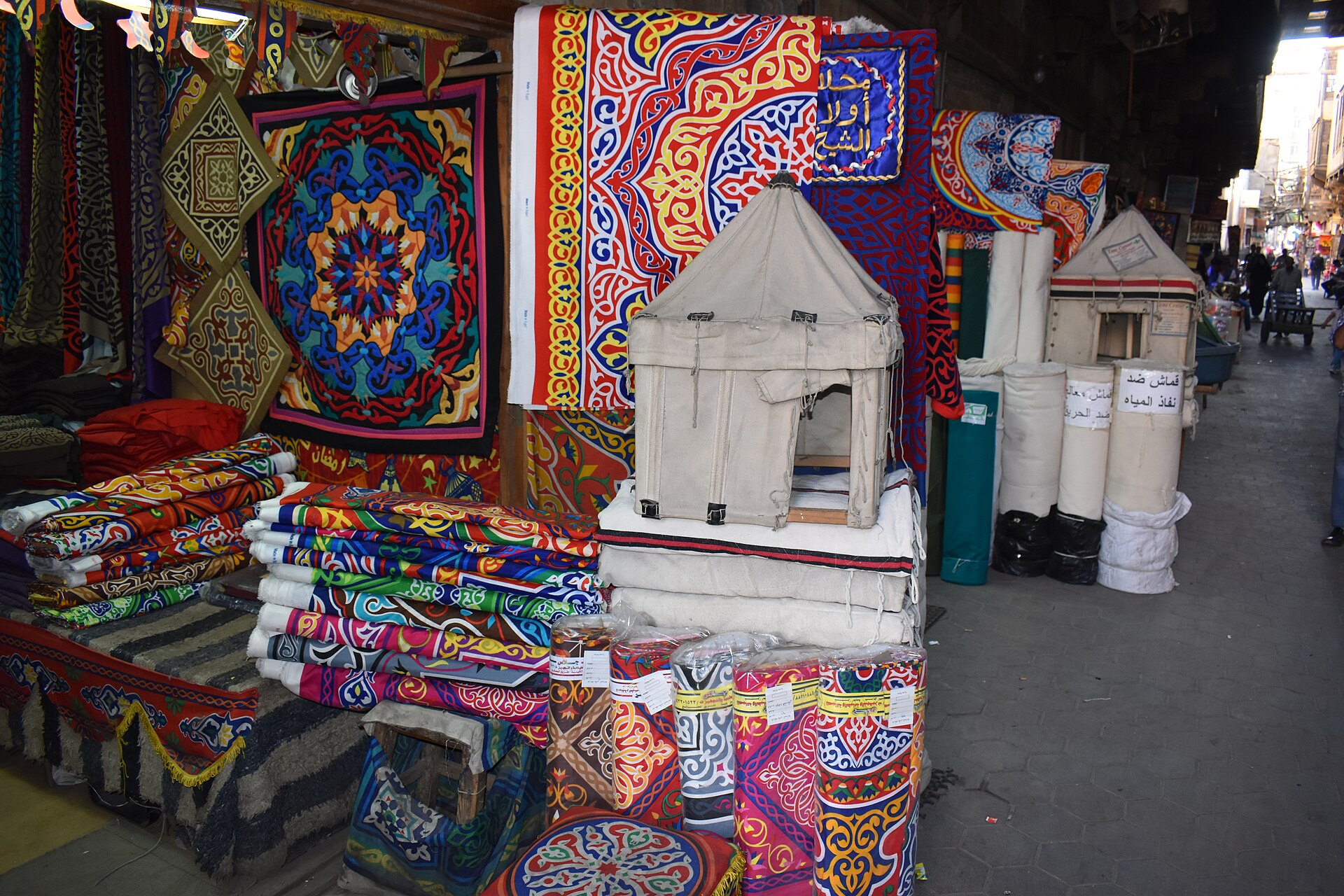
The Street of the Tentmakers lies south of Bab Zuweila on the historic Cairo axis that continues from Al-Muizz Street. UNESCO notes how the old city’s streets were identified by the trades and markets they served, including Al-Khayamiya. The covered market associated with the Qasaba of Radwan Bey is more than a row of shops: its filtered light, narrow bays and textiles hung from floor to ceiling are part of the experience. To visit is to encounter the craft in its urban habitat rather than remove a souvenir from the city that gave it a function and a name.
How a panel is made
Work begins with an idea and a drawing that determines the relationship between shapes. The design is transferred to the backing; colours are chosen and each fragment is cut with large scissors as it is needed. The coloured piece is placed, its edge turned under and fixed with a sequence of small stitches until the raw line vanishes. Curves and slender calligraphic forms demand special control, while large panels require planning to prevent symmetry from drifting. The process is visible, but the decisive knowledge lives in the fingers: thread tension, depth of fold and stitch direction.
One language, several visual voices
Visitors encounter recurring families of design: Islamic geometry and arabesque, Arabic calligraphy, Pharaonic scenes, and images of popular life, plants and birds. These are not sealed categories. A maker may combine them or develop a contemporary commission. The Metropolitan Museum of Art and British Museum hold documented Cairo examples, evidence that khayamiya is more than an unrecorded modern souvenir. The value of a contemporary piece lies in the artisan’s decisions—drawing, colour, rhythm and execution—rather than mechanical repetition.
The crisis: printed cloth is faster than the needle
The strongest competitor is not another artisan but mass-printed fabric that imitates the ornament and covers a large area quickly. Changing uses for ceremonial tents, unstable tourism and material costs make handmade income uncertain. Young people may hesitate before a profession that takes months to learn and many hours to complete a single panel. The danger is deceptive: Cairo may remain full of the familiar pattern while losing the knowledge of how to cut, fold and stitch it. Safeguarding khayamiya therefore means protecting fair, skilled labour—not merely preserving a visual motif.
What safeguarding has achieved
Khayamiya should not be described as a separately inscribed element on UNESCO’s Representative List. What is verified is that a UNESCO-supported inventory of living crafts in Historic Cairo documented khayamiya among thirty crafts. The project trained forty-six craftspeople and fifteen young volunteers in audio-visual inventory methods, then enrolled the young participants in apprenticeships with experienced makers. This matters because safeguarding begins by knowing who holds the skill and how it is practised. Exhibitions and Egyptian training programmes add visibility, but survival still depends on sustained teaching, real demand and clear distinction between hand appliqué and printing.
Why travellers cross borders for a craft
Craft travel offers an encounter that a conventional shop window cannot: the visitor sees time inside an object, hears how motifs are read and understands why two panels differ in price. A visit can connect Bab Zuweila, Al-Muizz and Al-Darb Al-Ahmar in one cultural route, supporting guides, cafés, workshops, transport and accommodation. Good visitors do not turn the maker into a free performance. Ask before photographing, do not interrupt exacting work, allow time for conversation and, when a piece speaks to you, pay for the skill rather than bargaining away its labour.
How to buy authentic khayamiya
Look at the reverse, the folded edges and the stitches. Handmade khayamiya shows separate layers of cloth; a printed imitation is a single surface. Ask for the maker’s name, time required, materials and care instructions, and whether the work is unique or part of a repeated design. Judge price by scale, density, number of colours, difficulty of curves and hours of stitching—not by fabric area alone. Request an invoice and workshop details. For shipping, require moisture-resistant packing and folding instructions that protect raised appliqué. Authentic work is not the cheapest because its price contains the time that keeps the craft alive.
The lesson held by one small stitch
Khayamiya began by building entire spaces from cloth, then sometimes became a wall panel or cushion small enough for a traveller’s luggage. The object shrank; the memory did not. Every turned edge hides a decision, and every colour links today’s shop with ceremonies, homes and streets across generations. When a master teaches a young person to conceal a raw edge, he is teaching more than a hand movement. He is offering a livelihood and a reason for the Street of the Tentmakers to keep its name. The future requires more than nostalgia: an attentive traveller, institutions that document and a market willing to pay fairly for the hand.
Craft at a glance
| Home | The Street of the Tentmakers in Historic Cairo, south of Bab Zuweila |
|---|---|
| Technique | Hand-cut coloured fabric appliquéd onto a heavier backing with turned-under edges |
| Products | Ceremonial pavilions, wall panels, cushions, furnishings, bags and contemporary commissions |
| Safeguarding | Documented in a UNESCO-supported inventory of Historic Cairo crafts; not a separately inscribed Representative List element |
| Best visit | Combine Bab Zuweila, Al-Muizz and Al-Darb Al-Ahmar; ask before photography and buy from a named maker |
Questions before visiting
Is khayamiya embroidery?
It is principally appliqué: shapes cut from coloured cloth are sewn over a backing with the edges turned under. Other decorative techniques may accompany it.
Where is the Street of the Tentmakers?
In Historic Cairo, south of Bab Zuweila and close to Al-Muizz Street and Al-Darb Al-Ahmar. Confirm shop hours and access conditions.
Is khayamiya UNESCO-listed?
It was documented through a UNESCO-supported inventory of living crafts in Historic Cairo, but that is not the same as separate inscription on the Representative List.
How can I distinguish handmade work from print?
Inspect the layers, stitches, folded edges and reverse. Printing produces one flat surface without individually applied pieces.
Why do prices vary?
Size, design density, colour count, cutting difficulty, stitching hours, cloth quality and the maker’s experience all matter.
Can it be shipped abroad?
Yes. Request an invoice, moisture-resistant packing, folding and care instructions, and verify destination customs rules.
Sources and reference institutions
- Cairo Governorate — Khayamiya, an Egyptian art inherited through generations
- UNESCO Intangible Cultural Heritage — Inventory of traditional crafts in Historic Cairo
- UNESCO — Safeguarding traditional crafts in the heart of Historic Cairo
- UNESCO World Heritage Centre — Historic Cairo
- Al-Ahram Weekly — The Egyptian art of khayamiya
- Egypt State Information Service — Culture and arts: Khayamiya
- The Metropolitan Museum of Art — Tent panels (Khayamiya), Cairo, circa 1930
- The British Museum — Modern Egypt khayamiya textile
- Gregg Museum of Art + Design — Egyptian Tent
Image credit: Tentmaker at work on El-Khayamiya Street, Cairo, 2017. Hatem Moushir / Wikimedia Commons, CC BY-SA 4.0.