














Ten crafts that shaped the world’s memory · Episode five
In a cramped Kashan workshop, carpet designer Javad Amorzesh sat alone before drawings that once kept four or five assistants busy. When the Associated Press visited in 2024, he said his commissions had fallen from roughly ten carpets a year to two. His ability to draw a garden, flower and knot had not disappeared; the road between his hand and the buyer had. That distance contains the Persian carpet’s contemporary story: a heritage the world recognises instantly, while the people who carry it struggle to keep it a living body of knowledge and a viable livelihood.
One carpet, two distinct knowledge systems
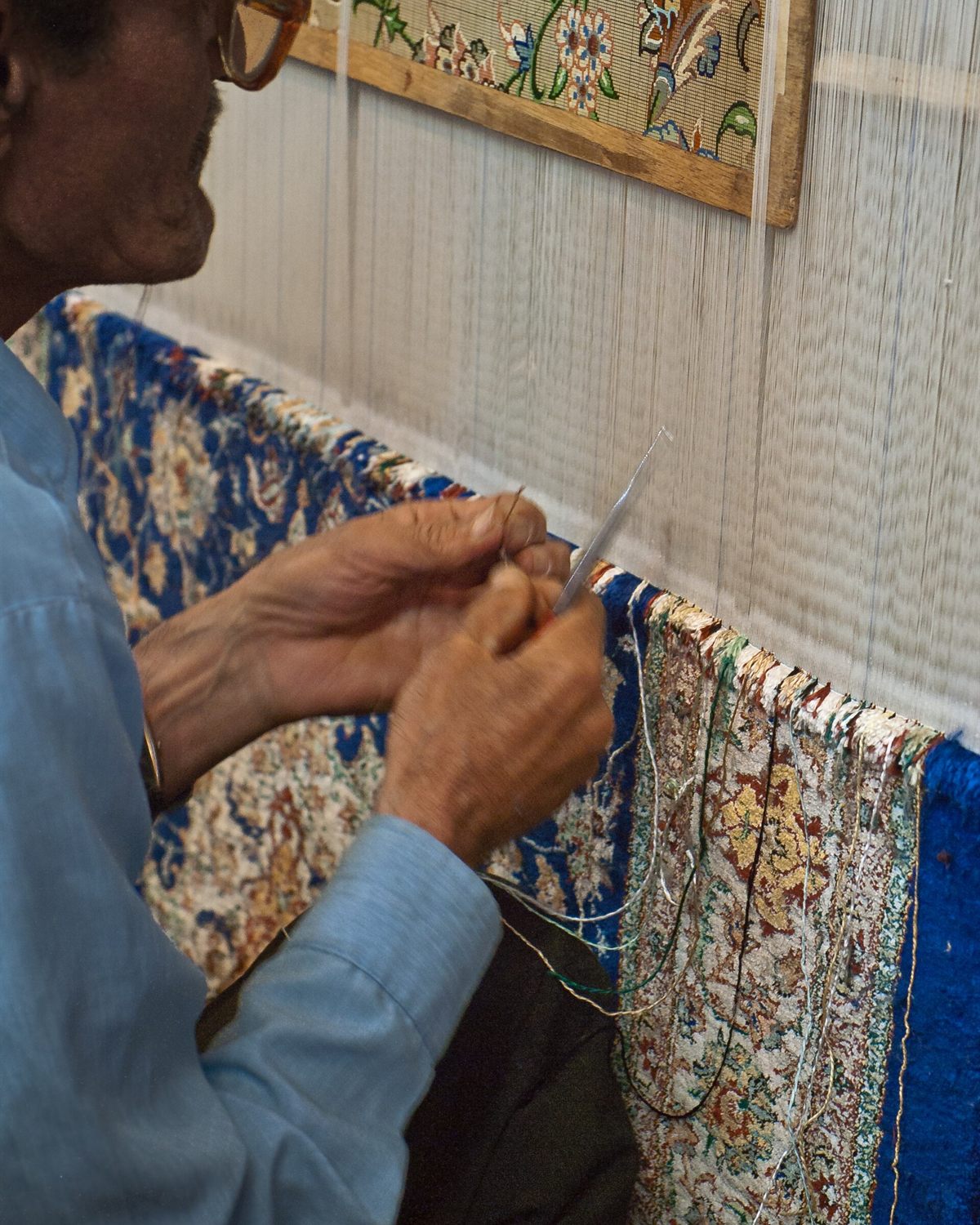
There is no single recipe called the Persian carpet. In Fars, south-western Iran, Qashqai, Khamseh and other women weave on horizontal ground looms and summon compositions from memory without a cartoon, so no two works are identical. In Kashan, work commonly begins with a detailed design, executed with the asymmetrical Persian knot on cotton or silk foundations. UNESCO inscribed the skills of Fars and Kashan as two separate elements in 2010 because their difference is not just decorative. Each is a complete system: who shears wool, builds the loom, designs, dyes, knots and teaches the next generation.
The women who hold the design before it appears
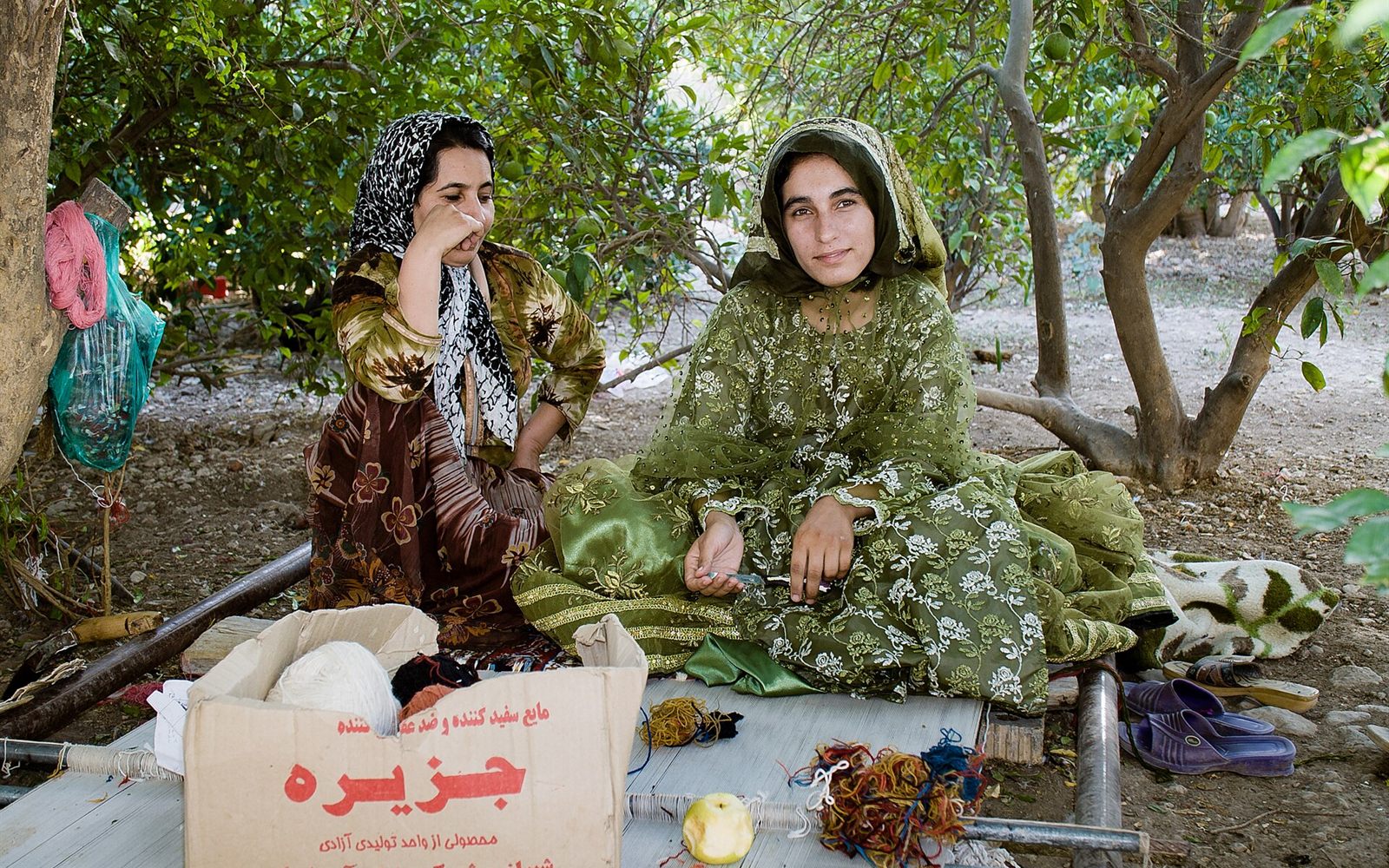
UNESCO describes Fars women spinning wool, choosing colour and composition, then weaving scenes from nomadic life without a prepared drawing. Knowledge passes orally and by demonstration: mothers train daughters in material, tool and knot, while men teach sons shearing and loom construction. In Kashan, women also carry much of the weaving and girls apprentice under mothers and grandmothers; men often enter through design, dyeing, shearing and tool-making. A carpet is therefore less the isolated signature of one artist than the working archive of a household and community.
From fleece to the surface underfoot
The journey begins with fibre: resilient wool for pile, silk for exceptionally fine work, and cotton or silk for warp and weft according to the workshop. Wool is cleaned, spun and dyed; warp threads are tensioned on the loom. The weaver ties each tuft around the warp, passes a row of weft and beats it down with a comb, trimming the pile as the pattern rises. Edges and fringes are finished, then the carpet is washed and levelled. Months of labour cannot be reduced to the last knot. Quality is the balance of fibre, colour, structure, design and fairly paid skill.
The Persian knot is not a quality certificate
The Persian, or asymmetrical, knot loops around one warp and remains open around the other, allowing curves and fine detail. The symmetrical knot is strongly associated with Anatolian and Caucasian traditions but is also used in parts of Iran. Neither knot type nor knot count alone makes one carpet superior. A densely knotted work made with weak fibre and mechanical design may matter less than a lower-density tribal carpet with excellent wool, balanced colour and clear identity. Inspect the whole construction and ask about origin, maker, materials and repairs instead of trusting a single number.
When pomegranate creates colour with depth
UNESCO records Fars colours derived from madder, indigo, walnut skin, cherry stem, pomegranate skin and other sources; in Kashan it lists madder, walnut, pomegranate and vine leaves. Not every historic or contemporary Persian carpet is naturally dyed, and the phrase “vegetable colour” proves neither age nor authenticity. Good hand-dyeing can create depth and subtle shifts between batches. A restrained change of shade within one colour may record separate dye lots rather than a defect to be erased. The evidence lies in the carpet, not in a romantic sales phrase.
From Safavid workshop to a global museum language
Encyclopaedia Iranica warns that carpet history is crowded with unsupported stories, yet museum evidence clearly shows the importance of royal workshops and trade under the Safavids. Iranian centres produced medallions, garden plans, hunts, animals and flowers for distant palaces, religious spaces and markets. The Persian garden—with water, shade and ordered space—became a long source of textile design. A carpet can thus read like horizontal architecture: a pool or medallion at the centre, four directional fields, and borders functioning as walls around an interior world.
The Ardabil Carpet: years of labour, minutes of light
The V&A’s Ardabil Carpet carries the date 1539–1540 and the name Maqsud Kashani, probably the official who supervised production. It is the world’s oldest dated carpet. A team of up to ten weavers may have worked for several years, producing around 5,300 knots in every ten square centimetres. To conserve its colour, the museum lights it for only ten minutes on the hour and half-hour. That precaution offers a practical lesson: direct light, moisture and aggressive cleaning can damage what skilled hands made to survive generations.
The present crisis is a broken route to market
In May 2024 the Associated Press reported that Iranian rug exports had fallen from more than $2 billion roughly two decades earlier to under $50 million in the Iranian year ending in March 2024, citing government customs data. Sanctions, payment barriers, inflation and the decline of some tourism markets squeezed workshops. A visitor may love a carpet and still be unable to use a major international bank card. When wages collapse, young people leave the loom; the pattern remains visible while the person able to build it disappears. These figures are dated evidence, not a permanent market forecast.
What institutions can protect—and what they cannot
UNESCO inscription gave Fars and Kashan an international safeguarding framework, but a listing does not automatically pay a weaver. Kashan’s heritage administration operates a traditional arts centre in a restored historic textile workshop, with weaving and pottery studios. Museums preserve, research and teach, yet a living craft also needs vocational routes, documented maker names, fair prices and contemporary design that respects knowledge rather than appropriating a surface. The strongest safeguard is a future in which a young person can choose the profession without choosing poverty.
Do travellers cross borders for carpets?
Yes, when shopping becomes learning: seeing a working loom, meeting a weaver or designer, understanding the difference between Fars and Kashan, and visiting a bazaar or museum. Craft travel distributes spending across guides, transport, lodging and workshops, but it requires preparation. Check official travel advice, insurance, payment channels and customs rules before travel to Iran; conditions change, and major international cards do not function normally. When travel is not practical, the V&A and Metropolitan Museum collections provide serious routes into the objects and techniques.
How to buy a handmade Persian carpet without mythology
Begin with precise questions: where was it woven, by whom, when and from what? Inspect the reverse for knot structure and pattern continuity, and the sides and fringes to see whether they belong to the construction or were later attached. Look for moth damage, stains, moisture and pile restoration; require written disclosure of repair. For a high-value carpet, do not rely only on the seller’s certificate. Obtain an independent assessment, invoice, condition photographs and provenance where available, and verify export, sanctions and import rules in your country before payment or shipment.
The lesson: do not separate memory from its makers
A medallion can be copied by machine in minutes; the human chain behind it cannot. It includes the shepherd who knows fibre, the dyer who balances colour, the mother correcting her daughter’s hand, the designer turning a garden into lines and the weaver repeating thousands of motions without losing rhythm. Safeguarding Persian carpets means naming makers, paying time fairly and documenting what we buy, not freezing a style in the past. Then the carpet becomes more than a luxurious surface: it becomes a route connecting the present to everyone who taught the knot.
Craft at a glance
| Two UNESCO homes | Fars and Kashan; UNESCO inscribed the traditional skills of each in 2010 |
|---|---|
| Construction | Wool or silk pile knotted onto cotton or silk warp, secured by beaten rows of weft |
| Key contrast | Fars memory-led design and ground loom; Kashan detailed cartoons and delicate Persian knotting |
| Care | Keep from direct sun and moisture; use a specialist cleaner for handmade textiles |
| Safe purchase | Document origin, maker, materials, condition, repairs, invoice and customs rules before payment |
Questions before visiting
Are all Iranian rugs Persian carpets?
The terms overlap in trade, but a professional description should identify a specific origin such as Kashan, Fars or Tabriz, plus materials and technique.
How can I tell if it is handmade?
Inspect the reverse, individual knots, pattern continuity, sides and integral fringes. Natural variation helps, but valuable pieces need independent expertise.
Does a higher knot count mean better quality?
It enables finer detail but is not a complete verdict. Fibre, dye, structure, design, condition and origin matter together.
Do natural dyes prove a carpet is old?
No. Natural dyes are used today, while synthetic dyes have a long history. Dating requires construction, material, condition and documented provenance.
How should I care for it?
Rotate it, avoid direct sun and damp, use a suitable underlay, blot spills without rubbing and consult a handmade-textile specialist.
Can I buy in Iran and ship abroad?
Possibly, but export, sanctions, payment and import rules vary by nationality and country and can change. Verify officially and require an invoice and origin documents.
Sources and reference institutions
- UNESCO Intangible Cultural Heritage — Traditional skills of carpet weaving in Fars
- UNESCO Intangible Cultural Heritage — Traditional skills of carpet weaving in Kashan
- UNESCO World Heritage Centre — The Persian Garden
- Victoria and Albert Museum — The Ardabil Carpet
- The Metropolitan Museum of Art — Carpets from the Islamic World, 1600–1800
- The Metropolitan Museum of Art — The Art of the Safavids before 1600
- Encyclopaedia Iranica — Carpets I: Introductory survey
- Encyclopaedia Iranica — Carpets II: Raw materials and dyes
- Encyclopaedia Iranica — Carpets IV: Knotted-pile carpets, designs
- Associated Press — Sanctions and a hobbled economy pull the rug out from under Iran’s traditional carpet weavers
- Kashan Cultural Heritage, Tourism and Handicrafts Administration — Traditional arts and crafts centre
Image credit: Qashqai sisters beside a horizontal carpet loom near Firuzabad, Iran, 2008. Julia Maudlin / Wikimedia Commons, CC BY 2.0.