




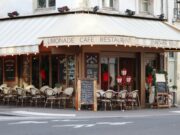
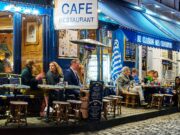
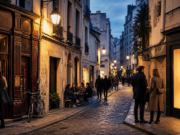







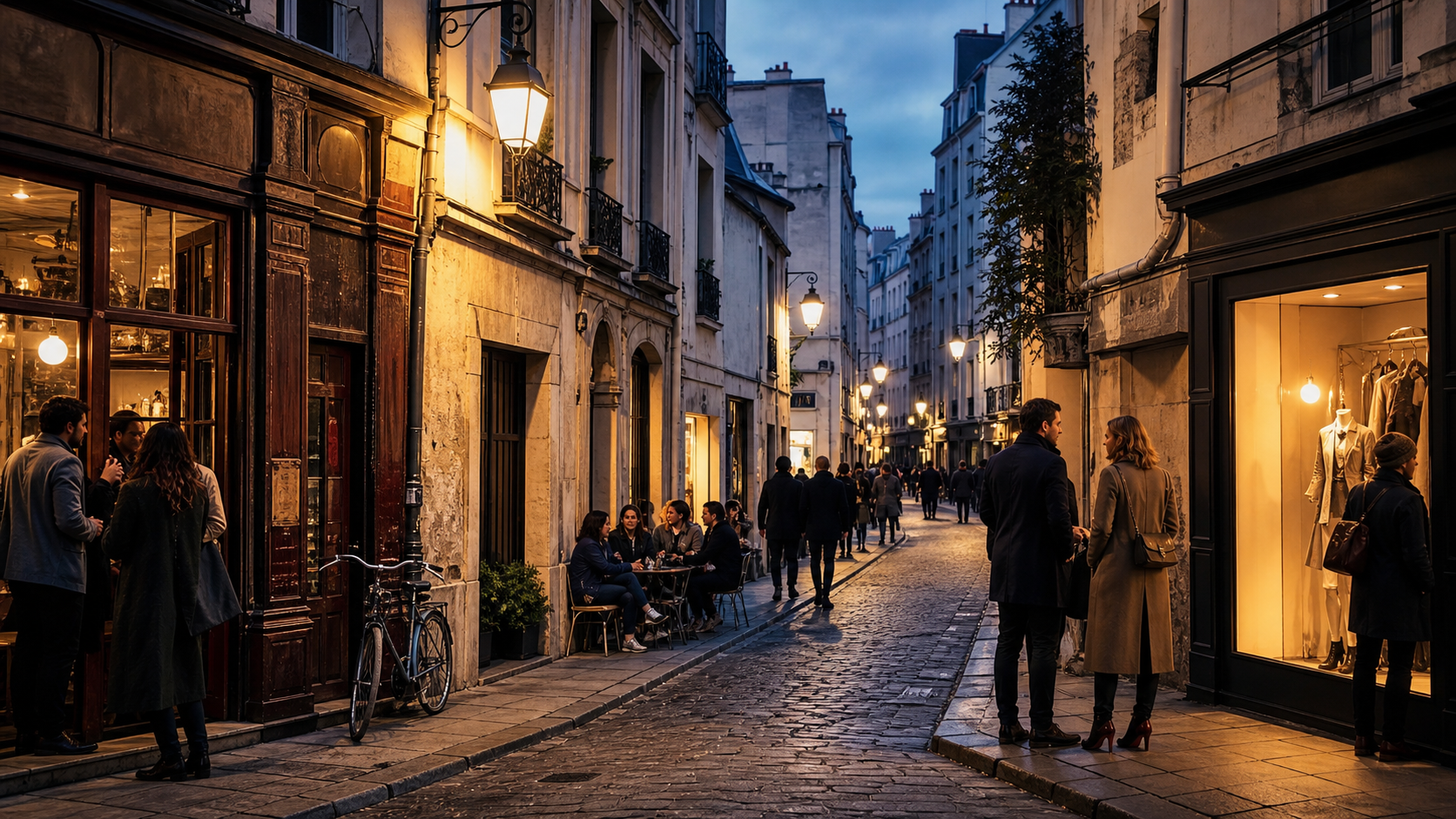
Begin at Saint-Paul just before the shops open, when the shutters are still down and the old stones have the street to themselves. Rue Pavée rises ahead in a tight corridor of cream façades. A delivery bicycle whispers over the asphalt. Somewhere beyond Rue des Rosiers, bread is warming; farther north, a café is arranging its first chairs. In Le Marais, Paris never arrives as a single period. The medieval city, the aristocratic seventeenth century, the Jewish Pletzl, the workshop quarter and the fashion capital all walk beside you.
This is the district’s seduction. It appears modest at street level: narrow lanes, worn doors, courtyards glimpsed for a second. Yet behind them stand palaces, archives, memories, ateliers and some of the most closely watched retail space in Paris. Young Parisians queue beside international collectors. A family buying challah passes a luxury client studying a window. Residents carry groceries through a street that visitors have crossed an ocean to photograph.
A neighbourhood made from water, fields and power
The name Marais recalls marshy ground and the market gardens that occupied this eastern edge of medieval Paris. Religious orders drained and cultivated the land. The city expanded, walls shifted, and by the seventeenth century the quarter had become one of the capital’s most fashionable addresses. Nobles built hôtels particuliers: private urban mansions arranged between a ceremonial courtyard and a garden.
Place des Vosges, begun under Henri IV as Place Royale, gives that transformation its grandest rhythm. Red brick, pale stone and slate roofs form an almost theatrical enclosure. Under the arcades, footsteps soften; in the central square, residents read beneath clipped trees. At number 6, the Maison de Victor Hugo recalls the writer’s years here. Through the discreet entrance of the seventeenth-century Hôtel de Sully at 62 rue Saint-Antoine, a sequence of courtyard and garden leads toward the square.
The aristocracy later moved west, leaving many mansions to workshops, commerce and denser housing. That fall from fashion helped preserve a different Paris. By the twentieth century, however, parts of the quarter had become severely dilapidated and threatened with clearance. The 1962 Malraux law enabled protected historic sectors; the City’s present heritage plan covers 126 hectares across the 3rd and 4th arrondissements. Restoration did not freeze Le Marais. It gave old architecture a new economic life.
Read the architecture through half-open doors
Walk Rue des Francs-Bourgeois slowly. At number 60, the Hôtel de Soubise opens into the National Archives complex, its princely rococo rooms preserving state documents since Napoleon assigned the residence to the archives in 1808. Nearby gardens and courtyards offer a sudden silence behind the retail street. On Rue de Sévigné, the Musée Carnavalet occupies two historic mansions; Hôtel Carnavalet itself was built between 1548 and 1560 and remains a rare Parisian Renaissance survivor.
Continue north to the Hôtel Salé, home of the Musée Picasso, then weave through Rue de Thorigny, Rue du Parc-Royal and Rue Payenne. The pleasure is not a checklist but a visual grammar: carriage doors tall enough for coaches, stone masks above windows, worn bollards, courtyards narrowing toward gardens. Le Marais trains the eye to suspect that every plain wall may conceal a second city.
Rue des Rosiers and the living memory of the Pletzl
Turn into Rue des Rosiers and the atmosphere tightens. The Pletzl, “little place” in Yiddish, formed around this street and Saint-Paul. A Jewish community existed in the Marais from the thirteenth century before expulsion in the following century. After Jewish emancipation in 1791, families from Alsace arrived; from the 1880s, thousands came from Eastern Europe, escaping poverty and persecution. They established synagogues, workshops, bakeries, restaurants and associations in these narrow streets.
The Shoah devastated the neighbourhood: the Musée d’art et d’histoire du Judaïsme’s historical walk records that more than half its Jewish inhabitants were murdered in the camps. Post-war arrivals from North Africa gave the area new life in the 1960s and 1970s. Today the Pletzl is neither a museum set nor simply a restaurant strip. It is a living community layered with loss, renewal and commerce.
At 10 rue Pavée, Hector Guimard’s synagogue interrupts the street with an undulating Art Nouveau façade. Visits are by request, and worship deserves respect. A few streets away, the Mémorial de la Shoah at 17 rue Geoffroy-l’Asnier makes remembrance unavoidable. Look, too, for plaques on schools and façades. They change the walk: history is no longer an architectural style but the names of neighbours who did not return.
The taste of a street that travelled
Rue des Rosiers smells of sesame, fried chickpeas, pickles and pastry. L’As du Fallafel at number 34 remains the famous queue, serving kosher falafel and shawarma; nearby counters offer competing versions and different family histories. The significance lies beyond any “best falafel” debate. Food here is migration made public, a language through which the neighbourhood renews itself daily.
At number 10, step into the Jardin des Rosiers–Joseph-Migneret. The noise falls away behind the gate. The garden honours the headmaster of the nearby Hospitalières-Saint-Gervais school, recognised as Righteous Among the Nations for saving Jewish children during the Occupation. A memorial recalls children deported from the arrondissement. One of the surviving towers of Philippe Auguste’s medieval wall stands among vegetation, while a brick chimney remembers the nineteenth-century Société des Cendres and the Marais jewellery trades.
From workshops to the fashion map
Le Marais became desirable because its old rooms could absorb new ideas. Small floorplates suited ateliers, galleries and independent shops; rough beams and courtyard light supplied character that a conventional mall could not manufacture. Rue Vieille-du-Temple, Rue Charlot, Rue du Temple, Rue des Archives and Rue des Francs-Bourgeois now form a shifting fashion circuit, from independent jewellery and vintage to global houses.
In the Haut Marais, The Broken Arm at 12 rue Perrée combines a designer concept store with a café. Merci, at 111 boulevard Beaumarchais, occupies a nineteenth-century building with fashion, furniture and domestic objects staged like an editorial argument. Neither address is “old Paris” in a nostalgic sense. Both use the district’s architecture to sell a contemporary idea of taste.
The same clientele appears during show season in our guide to where the fashion crowd eats, sleeps and meets in Paris. In Le Marais, however, hierarchy is deliberately blurred: a €6 coffee, an archival coat, a museum ticket and a major artwork can occupy one afternoon.
Markets, cafés and the art of being seen
Rue de Bretagne is the neighbourhood’s broad exhale. At number 39, the Marché des Enfants Rouges, created in 1615, is Paris’s oldest covered food market. Produce stalls share the hall with Moroccan couscous, Japanese counter food, Italian plates and Lebanese cooking. Office workers, gallery assistants, families and visitors squeeze onto the same benches.
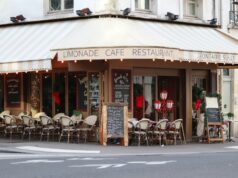
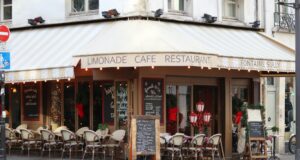
Across the street, Café Charlot at 38 rue de Bretagne opens from early morning until late, its terrace functioning as an informal casting call for the Haut Marais. Farther down Rue Vieille-du-Temple, Breizh Café at number 109 has served Breton galettes and cider since 2010. These are not secret addresses, and that is precisely their role: Le Marais is a theatre where watching the room is part of the meal.
Galleries in the spaces aristocrats left behind
Art dealers were drawn to volume, courtyards and centrality. Around Rue de Turenne, Rue Debelleyme, Rue Chapon and Rue Vieille-du-Temple, contemporary galleries occupy former workshops and mansion rooms. The Musée Picasso and the Musée d’art et d’histoire du Judaïsme, housed in the Hôtel de Saint-Aignan on Rue du Temple, anchor the district culturally, but discovery often happens through an unmarked doorway.
Saturday afternoon can feel like an international art fair dispersed through streets. Collectors move between openings; students look without buying; affluent visitors treat galleries as an extension of luxury shopping. The district survives this mix because culture is not isolated in one institution. It leaks into cafés, bookshops, windows and conversation.
When daylight leaves the stone
After dark, the Marais changes tempo. Rue Sainte-Croix-de-la-Bretonnerie and Rue des Archives retain their importance to LGBTQ+ Paris, a social history central to the modern district. Wine bars fill around Rue de Saintonge; tiny restaurants glow on Rue du Trésor; terraces on Rue Vieille-du-Temple become louder while residential lanes remain startlingly still.
The evening clientele is as mixed as the day: creative teams after work, young Parisians on dates, established collectors, fashion executives, residents and first-time visitors. For a broader nocturnal portrait, see why luxury travellers are rediscovering Paris after dark.
Why this “simple” old quarter became elite again
Le Marais possesses what luxury development tries hardest to create: scarcity, narrative and friction. Its protected fabric limits easy enlargement. Its small streets force walking and discovery. Jewish heritage, aristocratic architecture, LGBTQ+ history, craft, art and fashion generate meanings that no single brand owns. The district feels desirable because it remains partly resistant to efficiency.
That success brings tension. Global chains can outbid independent businesses; intense tourism can turn daily life into scenery; restoration can price out the very communities that made the neighbourhood culturally rich. To love Le Marais seriously is to see both its beauty and these pressures.
The walk that remains after the itinerary
Return toward Place des Vosges at dusk. A gallery is closing. Someone carries flowers across Rue de Turenne. On Rue des Rosiers, a family disappears through a doorway as visitors study the next menu. The brick arcades darken, and the lamps come on one by one.
Le Marais endures not because it preserved one perfect past, but because successive worlds left marks without entirely erasing the ones beneath. It is old Paris, Jewish Paris, fashionable Paris, queer Paris, domestic Paris and international Paris at once. That unresolved density is why the elite still comes, why creatives still look, and why a walk through apparently ordinary streets can feel like entering the private memory of the city.




[…] Le Marais: The Old Paris Where History, Fashion and the Elite Still Meet The Night Notre-Dame Nearly Fell: Inside the Fire and the 860-Year Fight to Save It The Eiffel Tower Had an Expiry Date. The Signal That Saved Paris’s Icon France Wants the World’s Richest Tourists. But Is It Ready for Them? The Great Migration: Inside Africa’s 1,000-Kilometre Journey Where Millions Move to Survive […]
[…] Le Marais: The Old Paris Where History, Fashion and the Elite Still Meet The Night Notre-Dame Nearly Fell: Inside the Fire and the 860-Year Fight to Save It The Eiffel Tower Had an Expiry Date. The Signal That Saved Paris’s Icon France Wants the World’s Richest Tourists. But Is It Ready for Them? The Great Migration: Inside Africa’s 1,000-Kilometre Journey Where Millions Move to Survive […]