











Ten crafts that shaped the world’s memory · Episode three
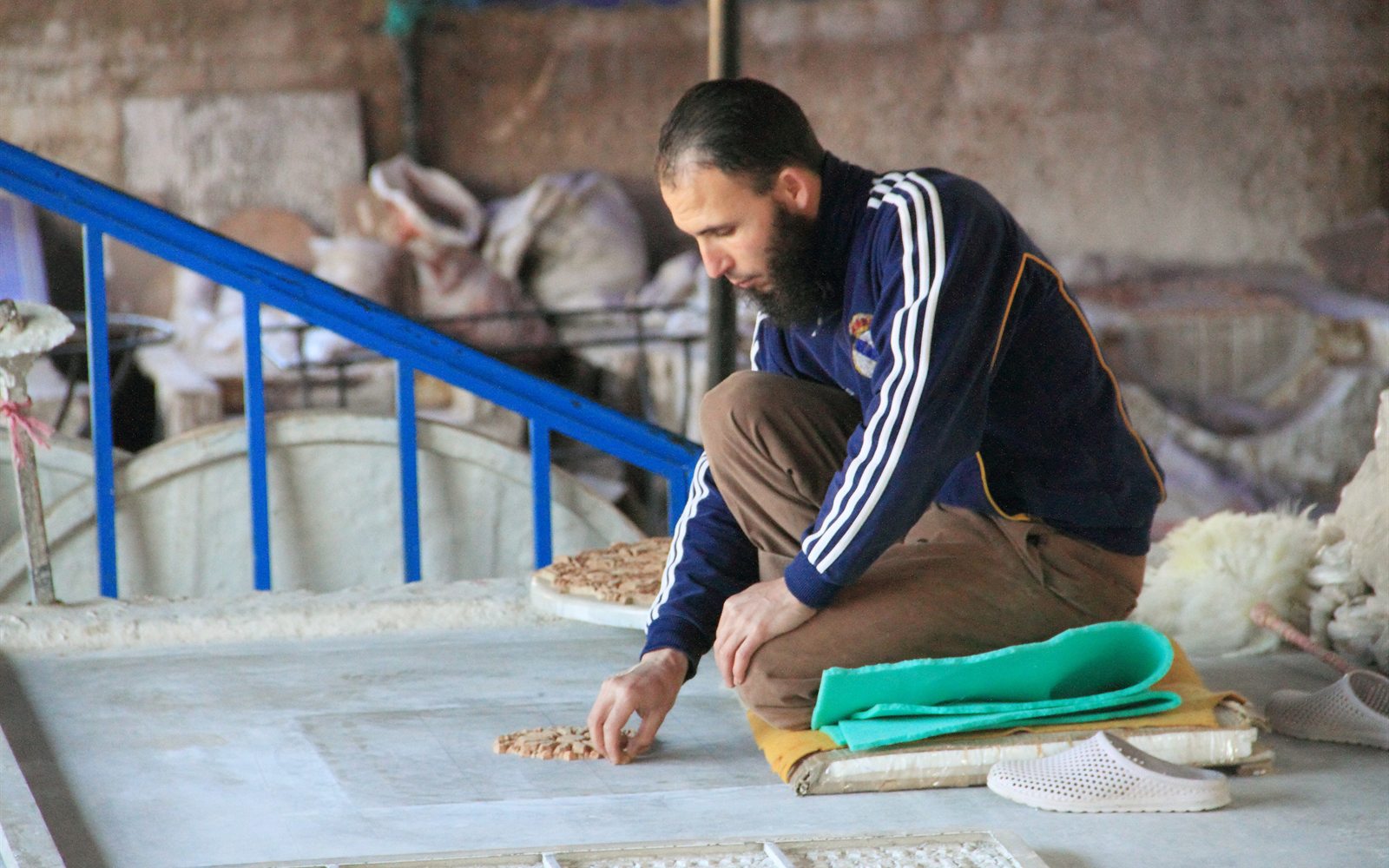
When Morocco’s National Tourist Office introduced master craftsman Haj Said Ben Adiba, it presented more than a tile maker. Born into an old family of Fez artisans, he carries a demanding body of knowledge and passes its secrets to a new generation. In the workshop, the story begins not with colour but with modest clay and a hand that knows where the hammer must strike—and where it must stop. Every star and polygon passes through a chain of people: preparing, shaping, firing, glazing, cutting and finally assembling thousands of pieces face-down until the image is ready to be revealed. Moroccan zellige is not a decorated surface. It is professional memory built one fragment at a time.
The master who does not keep the secret to himself
Haj Said Ben Adiba’s story offers a human way into the craft. Belonging to a family of Fez artisans is only a beginning; a master proves his value by turning inherited knowledge into knowledge that can travel to the next hand. The title maâlem is not a marketing label. It recognises long experience in reading patterns, controlling proportion, choosing colour and leading a team capable of completing a wall, fountain or courtyard. An apprentice learns more than a motif: precision, economy of movement, respect for material and responsibility for a small error that can multiply hundreds of times across a geometric field.
From a green tile to an architectural identity
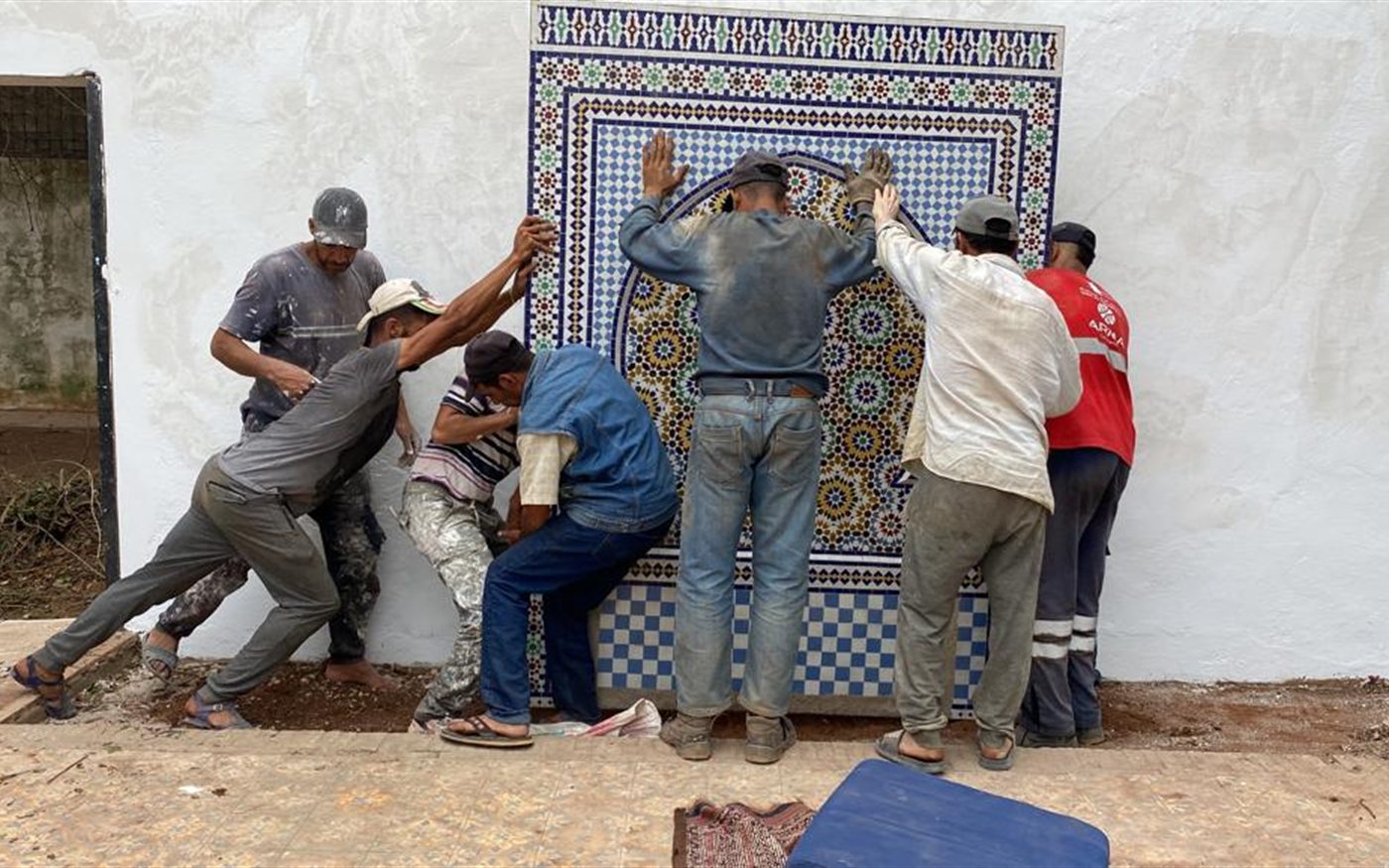
The Hassan II Mosque Foundation and the Academy of Traditional Arts trace the use of zellige in Moroccan architecture to the twelfth century, with double firing and polychrome glazing developing in the Marinid period in the fourteenth century. Morocco’s Ministry of Culture also points to early Fez examples from the thirteenth century, including work associated with the Seffarine Madrasa and the Great Mosque of Fès Jdid. Across madrasas, palaces, mosques, riads and hammams, zellige became an architectural language linking water, light and geometry—and identifying a place without a sign.
How Moroccan zellige is made, step by step
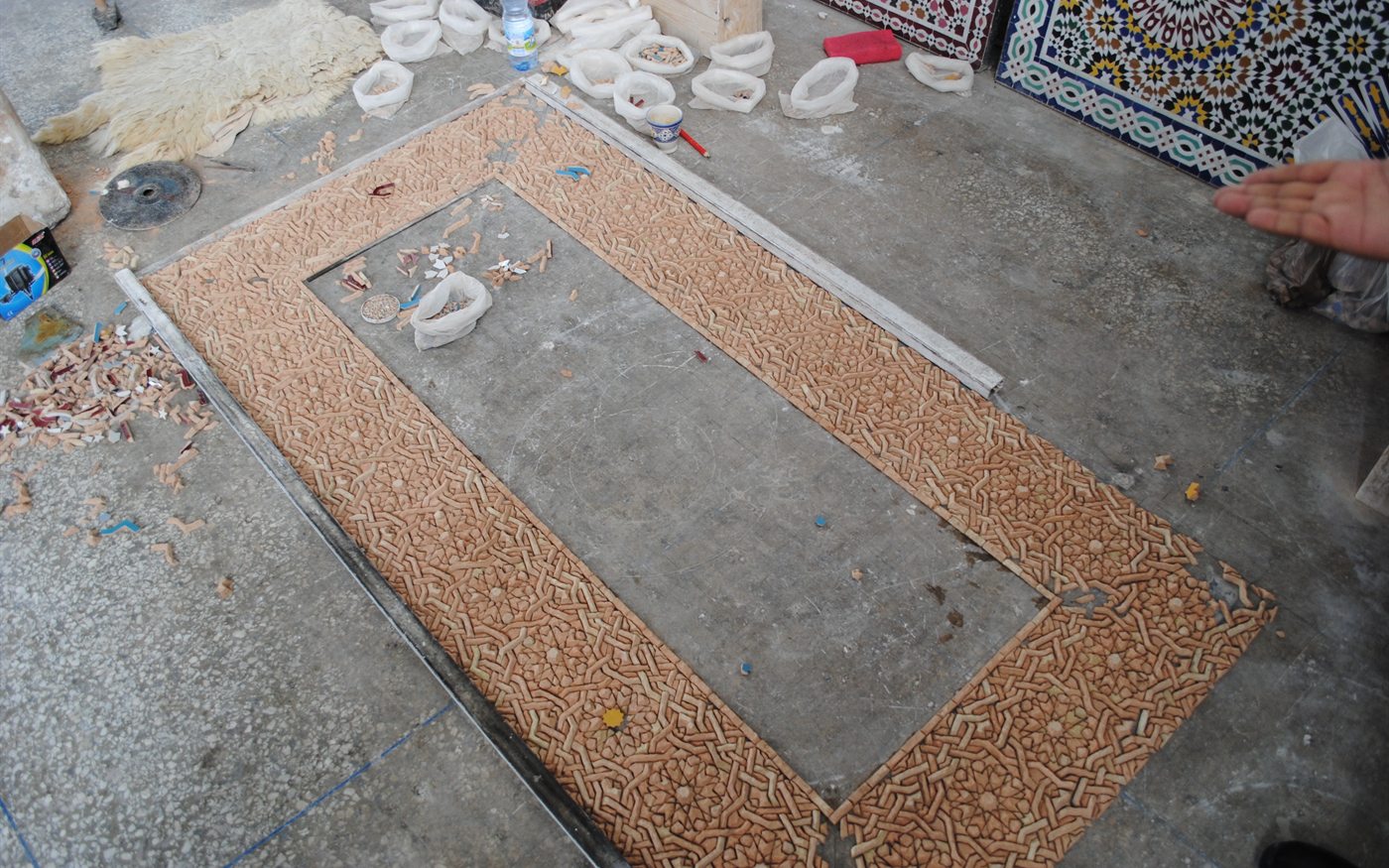
Production starts with clay that is cleaned, kneaded, levelled and formed into tiles. The Hassan II Mosque Foundation describes a first firing at about 1,000°C, followed by glazing and another firing at a lower temperature of roughly 800°C. Templates are traced on the back and the tile is cut with a sharpened hammer into small units known as forma. The pieces are arranged face-down according to the drawing, then secured with traditional mortar before the panel is lifted and installed. What the visitor sees at the end is only the final moment of a long process that leaves no room for improvised geometry.
Fez and Tetouan: two schools within one art
Fez is the best-known capital of zellige, with its clay, workshops and Marinid monuments, while Tetouan carries a Moroccan-Andalusian tradition with its own colours, compositions and procedures. The Ministry of Culture stresses that Tetouan zellige is not simply a copy of Fez. Each city has a vocabulary of forms and colour relationships. “Moroccan zellige” is therefore a canopy over a living, varied heritage—not a single commercial template. The differences lie not only in colour, but in proportion, star construction, the use of empty space and the architectural setting for which a panel is designed.
Geometry is not random decoration
Zellige compositions are constructed from exact networks of squares, stars, polygons and bands that repeat, rotate and reflect. A maâlem reads the design as a builder reads a plan. If one unit is incorrectly measured, the error appears at the border or where stars meet. Drawing and calculation therefore precede cutting, and the Academy of Traditional Arts includes architectural survey and plan-reading in its curriculum. A visitor watching a hammer strike sees manual skill, but also mathematical and architectural knowledge turning irregular pieces into a balanced system.
From workshop apprenticeship to the academy
The craft’s survival no longer depends only on family inheritance. Casablanca’s Academy of Traditional Arts offers a zellige track covering ceramic materials, firing, surface treatment, architectural drawing and interior architecture, alongside practical training under an experienced maâlem naqqach. The academy does not replace the workshop; it gives the workshop an academic partner and opens the door to young people without a craft family. The strongest model combines both: a hand trained by a master and an eye educated in materials, safety, documentation and the demands of a contemporary architectural project.
Is Moroccan zellige on UNESCO’s list?
As of this report, Moroccan zellige should not be described as already inscribed on UNESCO’s Representative List of Intangible Cultural Heritage. In November 2025, Morocco’s Ministry of Culture officially launched the project to prepare “the art of zellige in Fez and Tetouan” for nomination. Nomination and inscription are different stages. Safeguarding work includes inventory, documentation, legal protection and transmission. The Kounouz programme also identifies Tetouan zellige among endangered crafts that merit support for masters, youth training and permanent digital recording of gestures and specialist knowledge.
The traveller inside the workshop
A workshop visit in Fez or Tetouan can justify a journey rather than fill a spare hour between monuments. Book through a reputable workshop or professional guide and ask in advance about photography, duration and hands-on participation. Do not touch hot tiles or face-down assemblies, and do not interrupt measurement or cutting. Buy from a source that names the maker, city and materials, and request an invoice and professional packing. The souvenir then becomes income for the holder of the skill instead of payment for an anonymous industrial copy.
How to recognise handmade zellige before buying
Handmade work is not a perfectly repeated printed surface with no trace of material. Examine the thickness, hand-cut edges and natural colour variation caused by glaze and firing. Ask whether the product is a traditionally assembled panel or an industrial tile reproducing a motif. Irregularity alone does not prove authenticity, so request the workshop’s name, place of manufacture, process photographs and installation specifications. Price varies with pattern density, number of shapes and colours, cutting difficulty, area, clay and glaze quality, labour, packing, transport and installation; there is no single fair price for every “square metre of zellige.”
A living economy between restoration and design
Zellige supports a value chain beginning with clay and kiln and extending to designers, restorers, guides, drivers and hotels that connect guests with workshops. International demand opens markets but can also pressure makers toward speed, uniformity and lower wages. Moroccan institutions therefore work on quality, innovation and protection of designs and knowledge from imitation. The craft’s future is not to remain frozen in a museum. It must be able to restore a monument, build a contemporary fountain and train a new hand without losing its Moroccan name or handmade logic.
The lesson: the image appears only when the panel is turned
For much of the process, the zellige maker sees the backs of the pieces, not their coloured faces. The pattern is assembled upside down through drawing, memory and trust; only when the panel is lifted does the star appear whole. That reversal holds the craft’s central lesson. What looks like instant beauty to a visitor is the result of patience, cooperation and knowledge hidden beneath the surface. To safeguard zellige is to safeguard not only a motif, but the master, apprentice, clay, kiln, workshop and city that give it meaning. A traveller who goes to see that becomes a witness to the making of memory, not merely its buyer.
Craft at a glance
| Home | Morocco, especially Fez, Tetouan and centres of traditional craft |
|---|---|
| Material | Fired and glazed clay hand-cut into small forma units |
| Stages | Clay preparation, forming, firing, glazing, cutting, face-down assembly and installation |
| Safeguarding status | A project to nominate Fez and Tetouan zellige to UNESCO was officially launched in 2025; final inscription has not yet been established |
| Best visitor experience | A documented workshop with a master or guide, original monuments and purchases with invoice and origin details |
Questions before visiting
How is zellige different from printed mosaic tile?
Traditional zellige uses glazed clay tiles cut into small units and assembled by hand. Industrial imitations may print the whole motif onto one tile.
Where can I see Moroccan zellige?
Fez, Tetouan, Marrakesh, Meknes, Rabat and Casablanca offer major monuments, riads and workshops. Check access rules and opening times.
Is Moroccan zellige UNESCO-listed?
Morocco officially launched the Fez and Tetouan nomination project in 2025. A nomination project is not the same as final inscription.
Why do prices vary so widely?
Pattern complexity, number of pieces and colours, labour time, project area, transport and installation all change the cost.
Can zellige be used on floors or near water?
It has long been used on walls, floors and fountains, but suitability depends on the product, substrate, waterproofing, installation and maintenance. Obtain technical specifications.
How do I ship it abroad?
Request professional packing, a piece list, weight and dimensions, invoice, clear delivery terms and insurance; verify customs and secure an experienced installer at destination.
Sources and reference institutions
- Moroccan National Tourist Office — On the Tiles
- Moroccan National Tourist Office — Meeting with Haj Said Ben Adiba, master zellige craftsman
- Academy of Traditional Arts, Casablanca — Zellige programme and workshop
- Hassan II Mosque Foundation — The stages of making zellige
- Moroccan Ministry of Culture — Fès and Tétouan zellige UNESCO nomination project
- Moroccan Ministry of Tourism and Handicrafts — Kounouz programme
- Moroccan Ministry of Tourism and Handicrafts — Quality, innovation and heritage protection
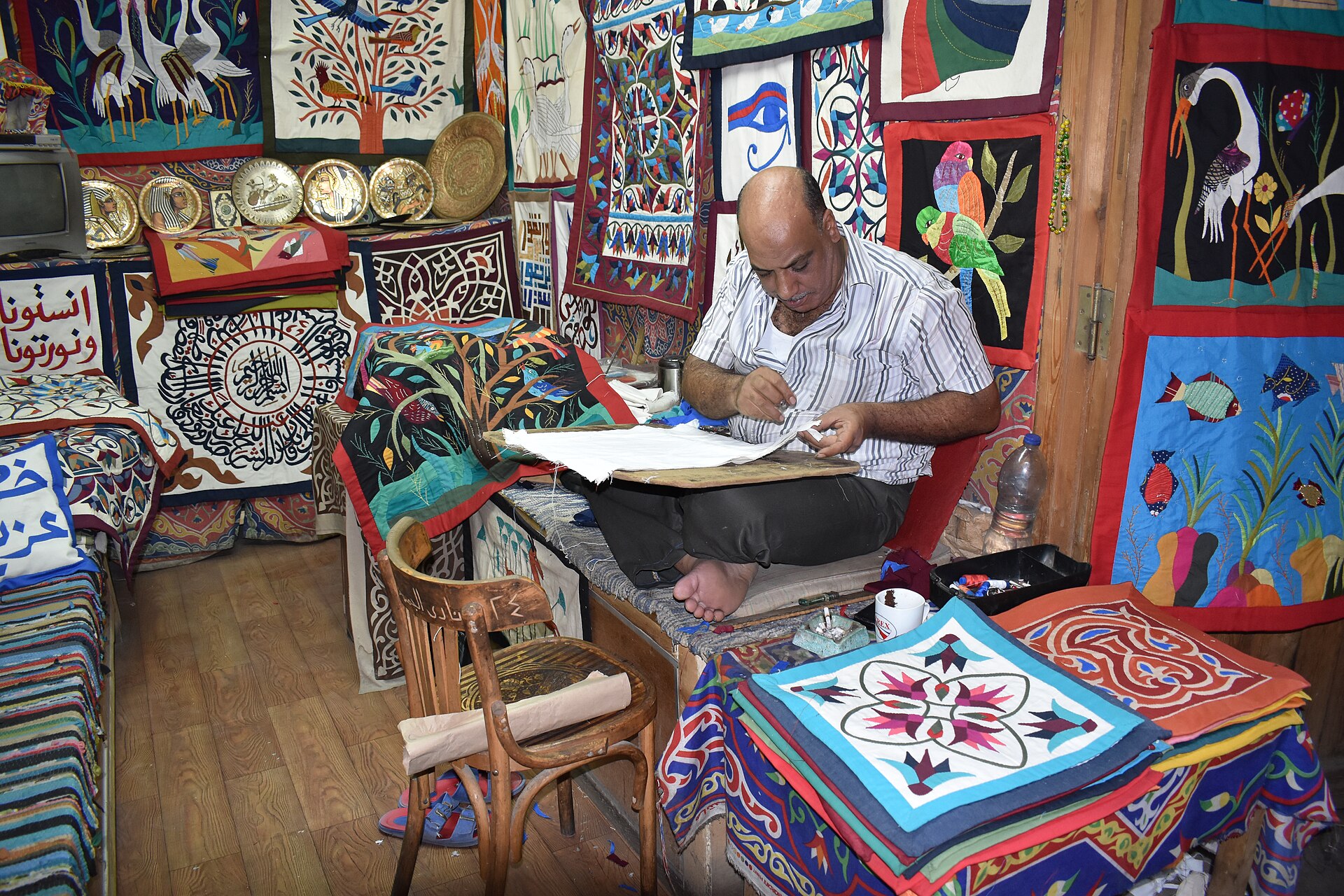
Image credit: Zellige artisan at work in Fès, Morocco, 2016. Schorle / Wikimedia Commons, CC BY-SA 4.0.