






OUISTARS TRAVEL · PARIS HISTORY IN WATER
Paris does not always need a museum to tell its history. Sometimes a fountain is enough: a queen recreating the gardens of Florence, an imperial regime concealing an awkward wall, or a modern city turning water into kinetic art. This route connects five fountains in central Paris and reads them as open-air documents, not merely photo backdrops.
Allow half a day from the Luxembourg Gardens to Place de la Concorde. The full route is roughly five kilometres on foot, with the option of taking the metro for the final section. In winter, water may be switched off because of frost or maintenance, but the architecture, sculpture and public spaces remain worth the journey.
| Stop | What it reveals about Paris | Suggested time |
|---|---|---|
| Medici Fountain | Italian court taste and the arrival of water on the Left Bank | 25 min |
| Saint-Michel Fountain | Haussmann’s Paris and imperial authority | 20 min |
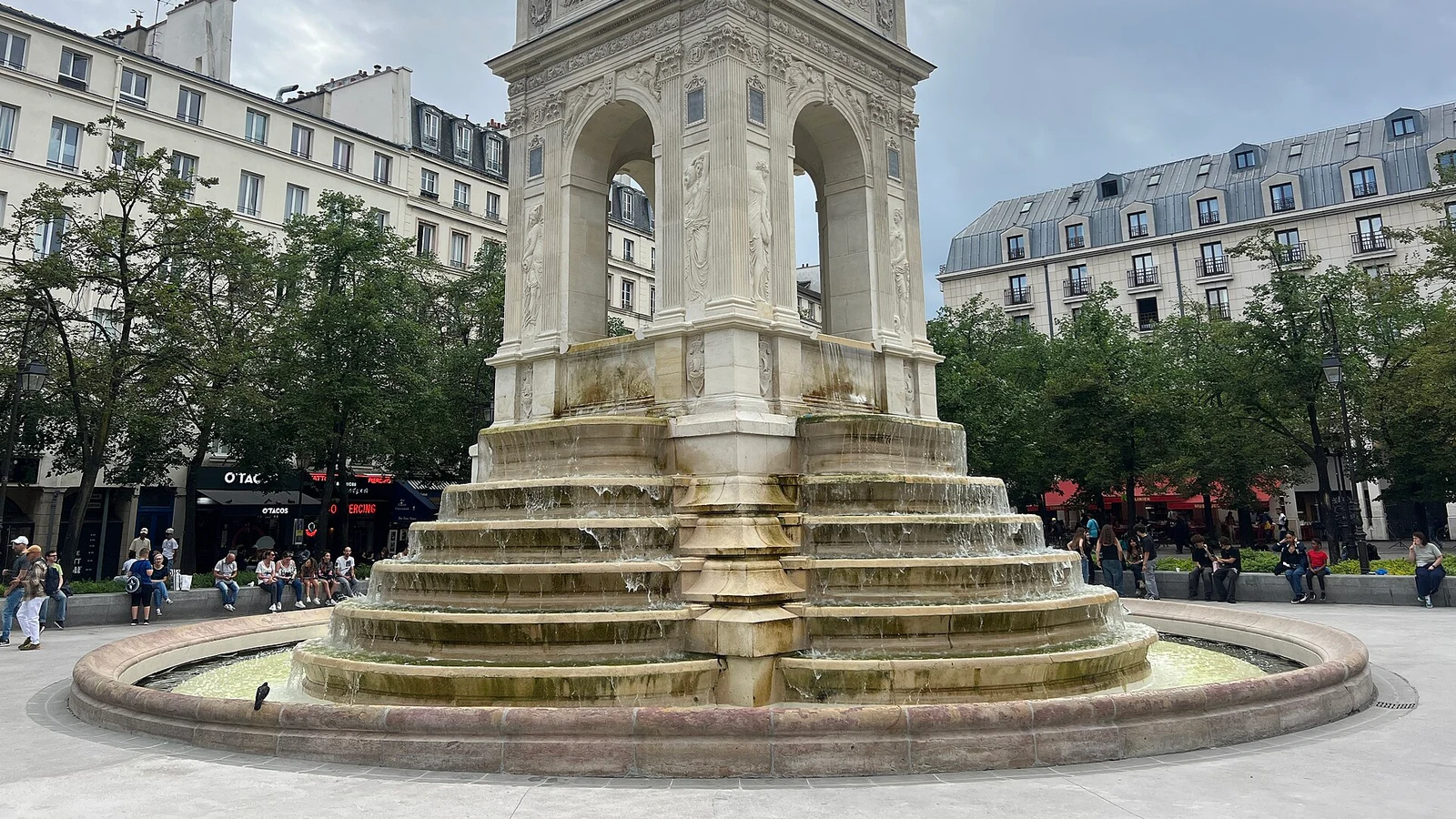
| Fontaine des Innocents | Renaissance design, public water and heritage protection | 25 min |
| Stravinsky Fountain | Public art, movement and music | 20 min |
| Concorde fountains | Navigation, industry and the image of the state | 30 min |
1. The Medici Fountain: when a queen brought Italy to Paris
Begin in the Luxembourg Gardens. Around 1630, Marie de’ Medici commissioned a grotto inspired by the nymphaea and fountains of the Italian gardens she had known in childhood. The French Senate attributes the likely design to the Florentine engineer Thomas Francine.
The fountain is not a monument that survived unchanged. Haussmann’s works moved it by about thirty metres in 1862; a long basin and new sculpture followed. Those layers make it an ideal opening stop: water appears as royal privilege, migrant memory and then an element in the redesign of Paris.
From 16 to 30 November, the garden normally opens from 8 a.m. to 4.45 p.m., according to its official daylight-based schedule. Start in the morning so the early winter closing time does not compress the rest of the route.
2. Saint-Michel: a fountain that hides a wall and projects authority
Walk down Boulevard Saint-Michel. The fountain may look like a straightforward theatre of the archangel defeating evil, but its purpose was also urban. The City of Paris explains that Haussmann’s new boulevard created a powerful perspective ending at a huge blank side wall. Gabriel Davioud’s design concealed that problem and gave the axis a monumental conclusion.
Inaugurated in 1860, the fountain was initially mocked for its decoration, colour and proportions. It nevertheless became a Left Bank landmark. A major 2025–2026 restoration renewed stone, bronze, lighting and hydraulic machinery. Here, water helps stage political power: an architectural problem is transformed into a symbol of order and victory.
3. Fontaine des Innocents: from neighbourhood service to heritage cause
Continue toward Les Halles and Place Joachim-du-Bellay. Fontaine des Innocents was erected in 1549 on the site of an older fountain that supplied local residents. Associated with architect Pierre Lescot and sculptor Jean Goujon, it was moved and reshaped repeatedly as the cemetery, market and Les Halles district changed around it.
Its importance lies not only in age but in the way Paris learned to save and reuse a monument. Musée Carnavalet documentation presents the late-18th-century campaign against dismantling it as an early milestone in French heritage protection. A full 2023–2024 restoration repaired the structure and sculpture and returned water and lighting, according to the City of Paris.
Move close to the reliefs rather than settling for a wide photograph. Nymphs, shells and dolphins reveal a language in which water was both a public service and an artistic subject.
4. Stravinsky: when water became a visual instrument
Walk from Les Halles to the square between the Centre Pompidou and the church of Saint-Merri. Inaugurated in 1983, the Stravinsky Fountain is the work of Niki de Saint Phalle and Jean Tinguely. Sixteen colourful moving elements refer to the musical world of Igor Stravinsky.
The Centre Pompidou notes that the square also opened the surrounding urban space, while historic parts of IRCAM lie below it. This is a new chapter: no queen or emperor, but a public commission for contemporary art in a place shared by residents, children and visitors.
Water and mechanical movement can vary with season and maintenance, so do not make the visit dependent on every element operating. The value lies in the relationship among colour, motion, music and the neighbourhood.
5. Concorde: water as a map of French power
Finish at Place de la Concorde, either walking through the Louvre and Tuileries or saving time with the metro. The twin fountains of the Rivers and the Seas opened in 1840. The northern fountain celebrates inland navigation; the southern one maritime navigation. The City of Paris links them to the naval power represented by the Ministry of the Navy on the edge of the square and records their restoration in 2023.
Bronze, gilding and water are not detached decoration. Rivers, ports, agriculture and industry are presented as a state narrative at the centre of the capital. The route ends with its clearest expression of water and power: the fountain speaks about resources, movement and trade as much as beauty.
How to walk the route well
- Begin between 9.30 and 10 a.m., especially in winter.
- Allow three to four hours with a short coffee stop.
- Wear shoes with good grip; paving around the squares can be slippery in rain.
- Do not assume every fountain operates year-round. Paris places many fountains into winter mode when temperatures fall, protecting pipes and reducing ice hazards.
- Respect barriers and never climb on basins or sculpture.
Why this route matters to visitors and the city
The route is free, yet it creates real visitor value. It distributes time across the garden, Latin Quarter, Les Halles, Beaubourg and Concorde, giving local cafés, shops and cultural spaces a share of movement not tied to a single ticket. It also shows that infrastructure can become memory, art and identity rather than remain a hidden utility beneath the street.
Frequently asked questions
Is the route free?
Yes. The fountains and squares are free, although the Luxembourg Gardens follow seasonal opening hours.
Do all the fountains run in winter?
Not always. Water may be stopped because of frost or maintenance, but each stop remains valuable for architecture, sculpture and history.
Is the route suitable for families?
Yes. Use the metro for the final section if needed and supervise children closely near basins and busy streets.
Which stop is best for photographs?
Saint-Michel offers drama, Fontaine des Innocents gives Renaissance detail, and Concorde provides scale and gilded spectacle.
Fontaine des Innocents in Paris after restoration. Photo: Charly Bernard (Chabe01) / Wikimedia Commons / CC BY-SA 4.0. Cropped for publication. Source · CC BY-SA 4.0
Cite this article
When citing the text or analysis, include the magazine, title, original URL and publication date. Preserve the stated attribution of statistics and photographs.
OUISTARS Travel — Paris Fountains Tell the City’s History: A Route Through Water, Power and Art
Published: