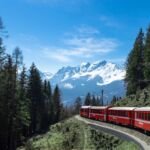









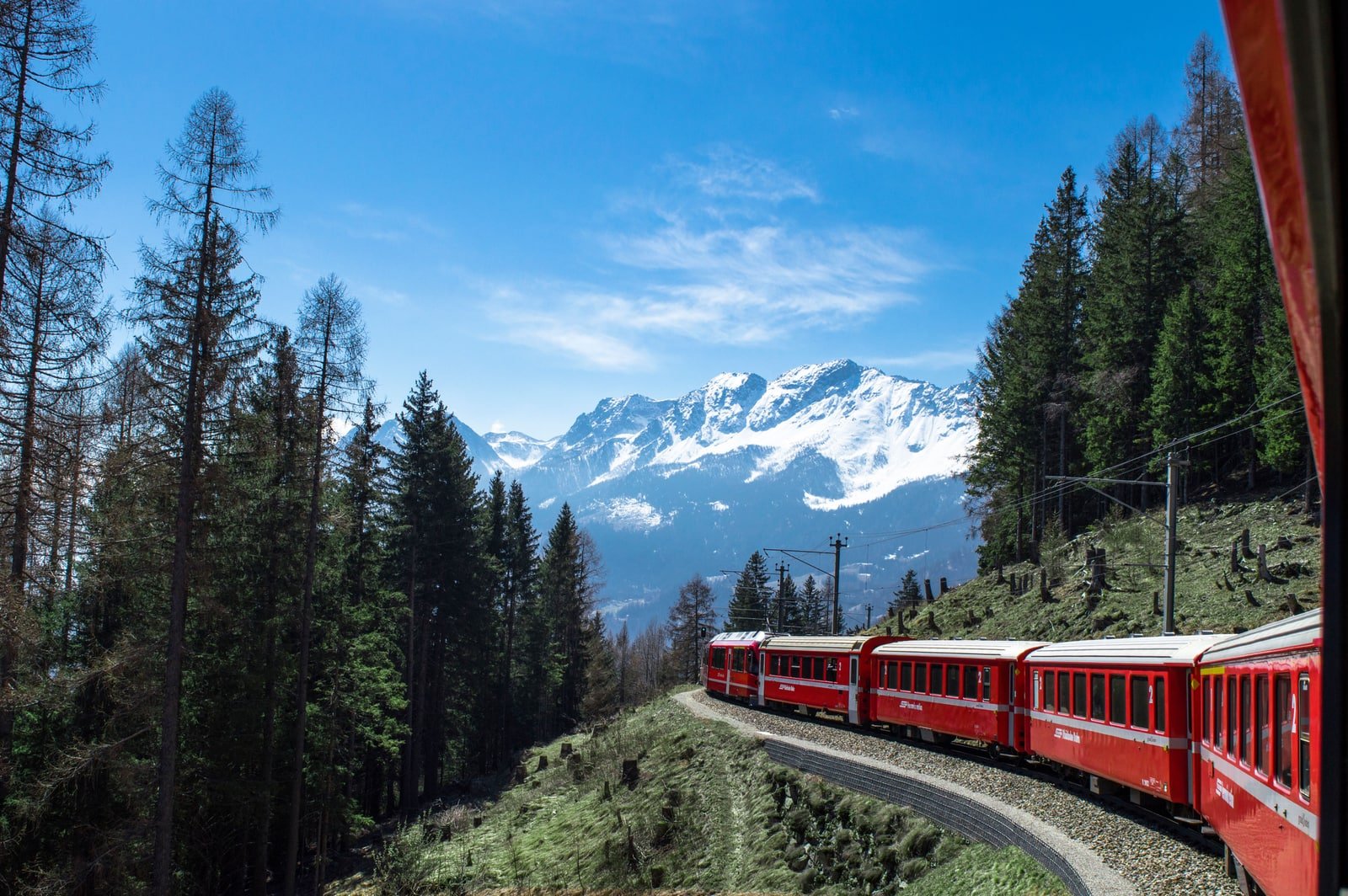


A red train in a Swiss mountain landscape, April 2023. Photograph: Oleksandr Lutsenko / Pexels.
The Swiss Travel Pass earns its price when the journeys and benefits you will actually use outweigh its cost, after allowing for charges it does not include. The length of your stay alone cannot decide that. Price the same itinerary, in the same travel class, before comparing the alternatives.
Two visitors can spend eight days in Switzerland and reach different conclusions. One changes cities most mornings; the other stays beside a lake and takes just two excursions. The useful question is how much your planned travel will cost, rather than how many forms of transport appear on the pass.
The prices that start the comparison
| Option | Reference price | Basis of comparison |
|---|---|---|
| Swiss Travel Pass: six days | CHF 399 | Consecutive days |
| Swiss Travel Pass: eight days | CHF 439 | Consecutive days |
| Swiss Half Fare Card | CHF 150 | One-month discount card; tickets cost extra |
| Saver Day Pass without half-fare entitlement | From CHF 52 | Selected day, subject to availability |
The table uses adult prices from age 25, in second class where applicable, checked against SBB on 25 November 2026. The current Swiss Travel Pass price table is stated as valid until 31 December 2026; it is not a price guarantee for a later trip. Check SBB’s official price table.
A week in Switzerland does not mean a seven-day pass exists
SBB lists consecutive passes for 3, 4, 6, 8 and 15 days. For a seven-day trip, compare the eight-day option with alternatives, including a six-day pass plus separate cover for the remaining day if that suits the itinerary. An unused day should not be counted as money saved.
Three hypothetical baskets show the difference
| Tickets without a card | Half Fare: 150 + half the tickets | Eight-day Travel Pass |
|---|---|---|
| CHF 280 | CHF 290 | CHF 439 |
| CHF 560 | CHF 430 | CHF 439 |
| CHF 800 | CHF 550 | CHF 439 |
These are editorial calculations, not fares offered for actual routes. We assume eight days, all journeys fully covered by the Travel Pass, every individual ticket reduced by exactly half with the Half Fare Card, and no extra fees or other discounts. A real itinerary does not automatically meet these assumptions.
With a CHF 280 basket, buying tickets alone is cheaper than either card strategy. At CHF 560, the Half Fare option costs CHF 430, nine francs less than the Travel Pass. At CHF 800, the Travel Pass wins within this model. More travel does not automatically justify the most comprehensive pass: the discounted-ticket alternative belongs in the comparison too.
Where is the break-even point?
In this simplified model only, the Half Fare Card recovers its cost above CHF 300 of full-price tickets: half that amount covers the CHF 150 card fee. It equals the eight-day Travel Pass at CHF 578: 150 + 578 ÷ 2 = 439. These are mathematical boundaries for the assumptions above, not universal buying rules.
For a real comparison, use the fares available on your travel dates and add the saving on each ticket with the card. When those savings exceed the fee for the Swiss Half Fare Card, its purchase cost has been recovered through those journeys. The tourist card offers reductions of up to 50%; do not assume every product is discounted by exactly half.
Mountain trips and panoramic trains can change the result
SBB distinguishes included travel from seat-reservation fees or supplements on some panoramic trains. Mountain-excursion coverage also varies. A summit on your itinerary is not proof that the entire ascent is included. Mark each activity as included, discounted or separately payable, then add the remaining charge to your comparison.
Do not compare a CHF 29 headline with an all-in pass
The Saver Day Pass starts at CHF 52 without half-fare entitlement or CHF 29 with it, subject to availability. Add the cost of acquiring the discount card if you do not already hold one. Check advance-purchase rules, validity and refunds: a starting price does not establish availability for your day.
For a refined trip, flexibility has a value too
The freedom to board included services and rearrange days can matter to travellers who want an unhurried holiday. Calculate the price difference first, then decide whether that convenience is worth the premium to you. Describe the benefit as comfort or flexibility when it does not produce a cash saving.
Before paying, make a one-page comparison
List each journey and paid activity, the fare available without a card, the price under each alternative and outstanding reservation fees. Add the card fee once and exclude benefits you will not use. For a family, calculate with the travellers’ ages and the rules of each product rather than multiplying the adult price by the number of people.
To turn the calculation into an itinerary, see the magazine’s seven-day Switzerland train itinerary without skiing. Plan the journey first, then choose the ticket—and adjust the plan if the figures reveal a better fit.
Cite this article
When citing the text or analysis, include the magazine, title, original URL and publication date. Preserve the stated attribution of statistics and photographs.
OUISTARS Travel — Swiss Travel Pass or Half Fare Card? Do the Maths Before You Buy
Published: