









FASHION × TOURISM × INVESTMENT
When Dior placed its runway before the Pyramids, Egypt was not simply a spectacular backdrop. It presented a rare asset to the world: a civilisation that gives fashion a story, and a destination capable of converting imagery into stays, transport, production, craftsmanship and jobs. The question is no longer whether Egypt belongs in global fashion, but how to build an industry without reducing heritage to scenery.
The answer in one minute
- Dior staged its Men’s Fall 2023 show at Giza in December 2022 for roughly 800 guests.
- Stefano Ricci marked its 50th anniversary at Hatshepsut Temple before 400 international guests, with 45 models.
- Jacquemus presented its 2025 La Croisière campaign as a visual journey from Cairo to Aswan.
- Naeem Khan linked a Cairo runway to Pyramid imagery, while RIMOWA travelled from Giza to Siwa’s salt lakes.
- The opportunity is not one show. It is an ecosystem of production, hotels, mobility, crafts, hospitality and global marketing.
- Egypt’s official strategy targets 30 million international visitors by 2031. Fashion tourism can support diversification, but it is not an automatic guarantee of returns.
More than a location
Destinations now compete through stories as much as monuments or hotel inventory. Egypt holds layers rarely found together: Giza and Saqqara, the temples of Luxor, historic Cairo, the Nile and Aswan, desert oases, and two very different coastlines.
These are not interchangeable backdrops. The Pyramids offer temporal power; Islamic Cairo offers architectural density; Aswan brings light and stillness; Siwa and Fayoum provide space and abstraction. Value begins when those choices become a clear, professionally managed product for fashion houses and producers.
Heritage as creative and economic value
Geometric ornament, khayamiya, embroidery, weaving, metalwork and the colours of the Nile and desert are not decorative footnotes. They can support equitable collaborations between designers and makers—if origin is documented, cultural ownership respected, labour fairly paid and quality developed over time.
Modern luxury is built on rarity and narrative as much as material cost. A precisely made Egyptian object can carry global value when it enters a design, supply and marketing chain that protects the maker’s name rather than erasing it.

Five global names that chose Egypt
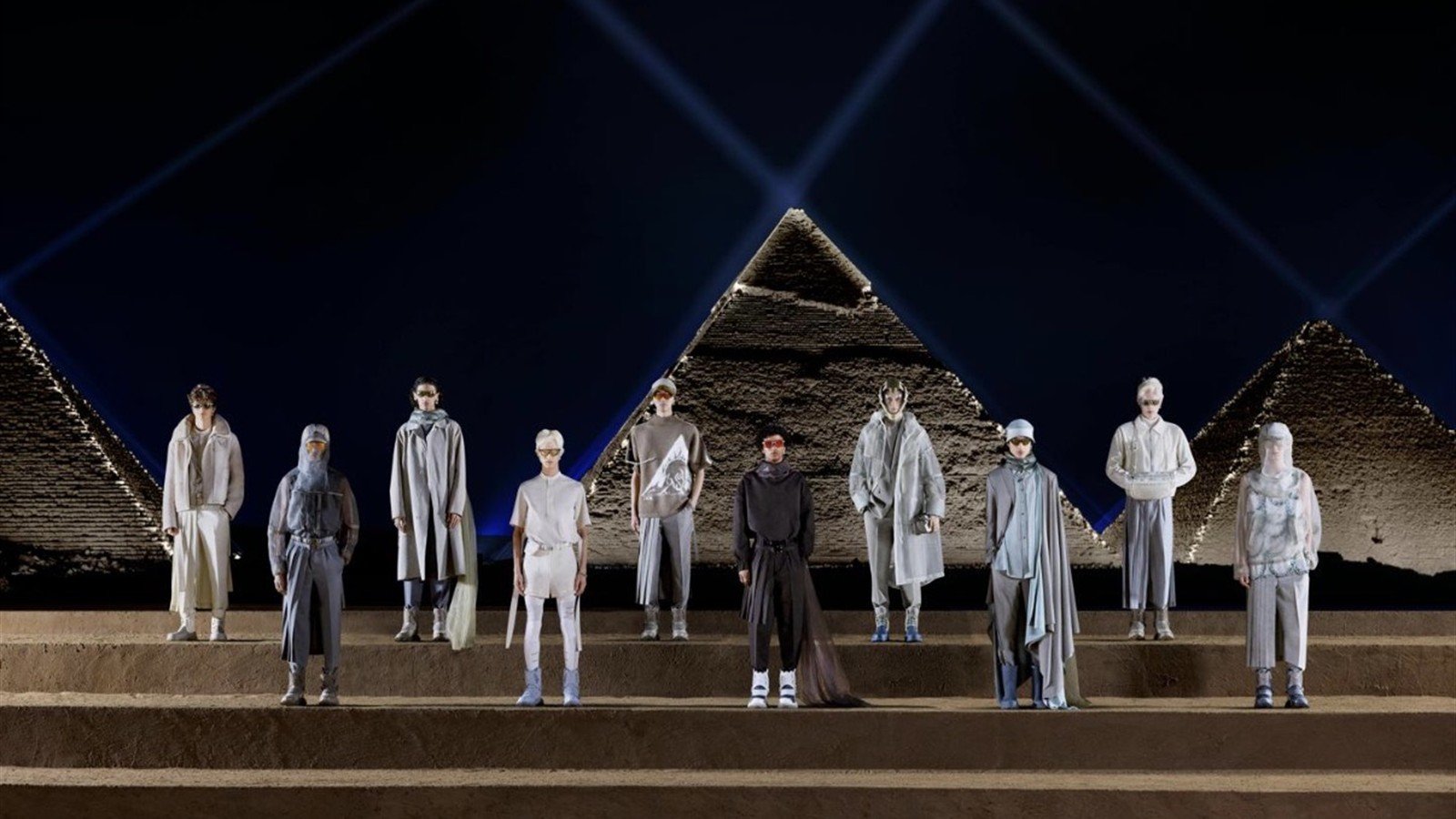
Dior at the Pyramids: in December 2022, the house presented Dior Men Fall 2023 at Giza. Dior framed the site as a dialogue between desert and sky, while reports recorded an audience of around 800. The event’s power lay in placing Giza inside fashion’s global visual memory.
Stefano Ricci in Luxor: the house’s official record says its 50th-anniversary event at Hatshepsut Temple welcomed 400 international guests, 45 models and 90 looks, with Andrea Bocelli performing. The occasion extended into accommodation, transfers, logistics and hospitality around a historic destination.
Jacquemus from Cairo to Aswan: the April 2025 La Croisière campaign presented Egypt as a 24-hour journey rather than a single archaeological frame, photographed and directed by Egyptian creative Mohamed Sherif with Mohamed Hassan and Angelina Kendall. It connected places, landscapes and local talent in one narrative.
Naeem Khan in Cairo: the Indian-American designer presented Spring–Summer 2023 for the launch of Cairo Design District in December 2022, while campaign imagery used the Giza Pyramids. A global name was connected to an emerging Egyptian design platform, not only to an archaeological site.
RIMOWA from Giza to Siwa: in 2023, the luxury travel house devoted an Egyptian chapter of New Horizons to imagery by Egyptian photographer Ahmed Chrediy, travelling from the Pyramids to Siwa’s salt lakes. The emotional result is precise: luggage becomes a companion to a journey readers can imagine taking.
From event hosting to destination industry
The transition requires a production-ready location map, a coordinated permit window, clear heritage protections, and a qualified network of producers, hotels, private transport and technical crews. A global house chooses more than beauty; it chooses the certainty that a complex project can be delivered on time.
An “Egypt Fashion Locations” portfolio could define season, light, capacity, restrictions, access and nearby hospitality for each site. Egypt would then move from waiting to be discovered to presenting an organised investment proposition.
Fashion as a visitor economy
Every campaign or show opens a chain of spending: photography, lighting, staging, security and permits; hotels, aviation and premium mobility; restaurants, events and guest management; models, designers, beauty teams and suppliers. The effect becomes durable only when expertise, purchasing and creative ownership remain partly in the local market.
OECD reports 15.8 million international arrivals and USD 15.3 billion in tourism receipts for Egypt in 2024. The national 2025–2031 strategy aims for 30 million visitors by 2031 while diversifying products and investment. Fashion tourism can contribute, but success should be measured in room nights, local contracts, jobs, international coverage and the share of Egyptian suppliers—not views alone.
A roadmap for a sustainable global stage
Egypt also has a local platform to build on. Since its first edition, Egypt Fashion Week has brought Egyptian labels, craftspeople and international industry leaders into museums and cultural venues. The next value lies in connecting this platform with houses that have already tested Egypt, turning temporary fascination into a repeat business calendar.
- Create a fashion and creative-production office linking tourism, culture, antiquities, investment and private operators.
- Publish a trilingual location guide with capacity, restrictions, permits and services.
- Adopt a heritage-use charter covering safety, attribution and cultural respect.
- Connect every event to accommodation, mobility, dining and cultural itineraries that extend the stay.
- Build contracts between global houses, Egyptian designers and makers with transparent rights and fees.
- Measure visitor and economic value instead of stopping at media reach.
Egypt does not need to prove that it is beautiful; global fashion has already done that. It needs to manage beauty as a cultural and economic asset—with professionalism, respect and a long horizon. Then the world will come not only to see beauty in Egypt, but to create it with Egypt.
Frequently asked questions
What is fashion tourism in Egypt?
Travel and events that connect shows, campaigns, shopping, design and crafts with accommodation, mobility, culture and hospitality.
Did Dior stage a show at the Giza Pyramids?
Yes. Dior Men presented its Fall 2023 collection at Giza in December 2022, according to the house’s official show page and event reports.
How can global fashion events benefit tourism?
They can generate production, hotel, transport, hospitality and supplier spending, as well as destination exposure. The real effect depends on local purchasing, length of stay and repeat projects.
How should heritage be protected?
Through clear permits, operational limits, cultural attribution, fair maker contracts and archaeological and environmental review.
Sources and verification
- Dior — official Dior Men Fall 2023 show at Giza
- Dior Finance — 2022 annual report
- Vogue — report from Dior’s Giza show
- Stefano Ricci — 50th anniversary in Luxor
- Jacquemus — La Croisière in Egypt
- LMD — Naeem Khan in Cairo and at the Pyramids
- CairoScene — RIMOWA New Horizons in Egypt
- Egypt Fashion Week — official platform
- OECD Tourism Trends and Policies 2026 — Egypt
 Add OUISTARS Travel as a preferred source on Google
Dior Men Fall 2023 at the Giza Pyramids, December 2022. Image: © Dior; source: the official show page.
Cite this article
When citing the text or analysis, include the magazine, title, original URL and publication date. Preserve the stated attribution of statistics and photographs.
OUISTARS Travel — Egypt: The Next Global Stage for Luxury Fashion
Published: