



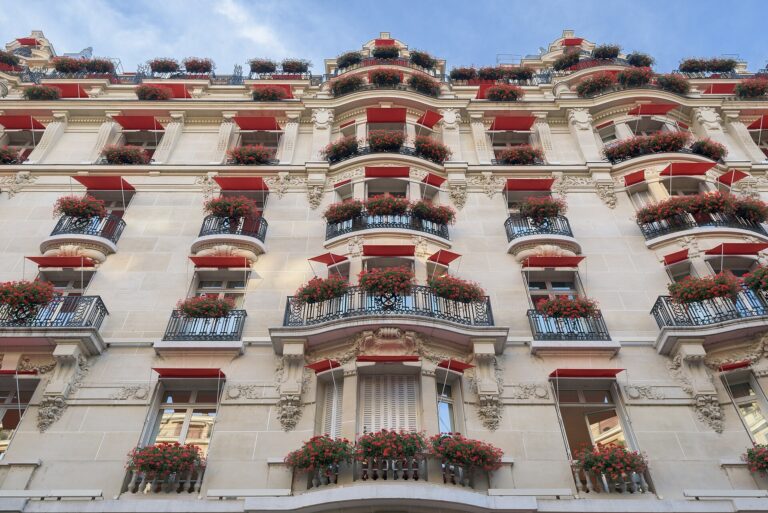
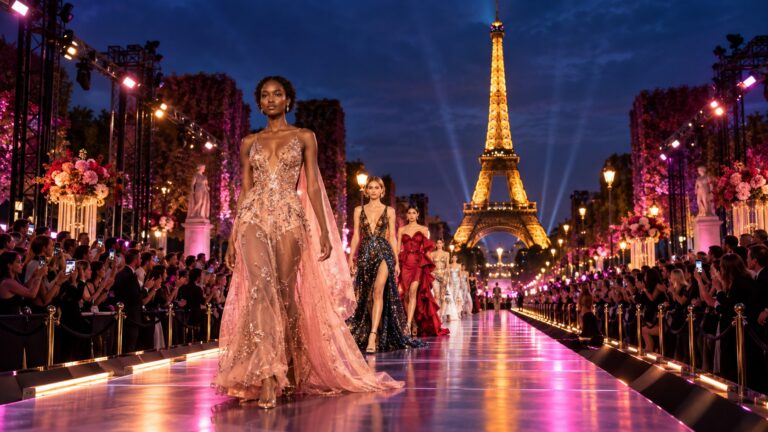
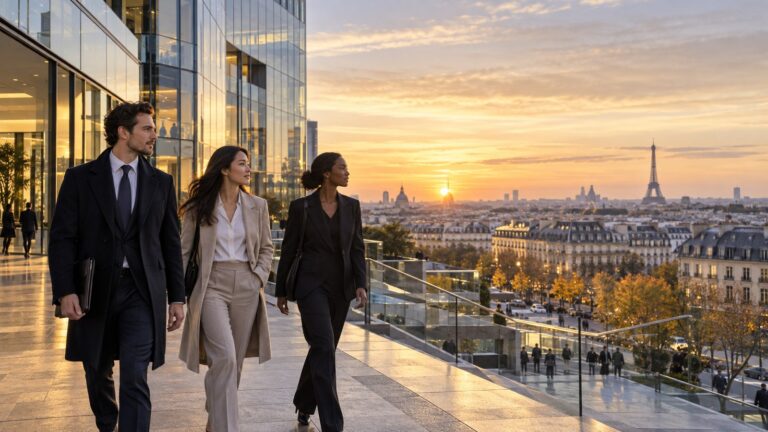
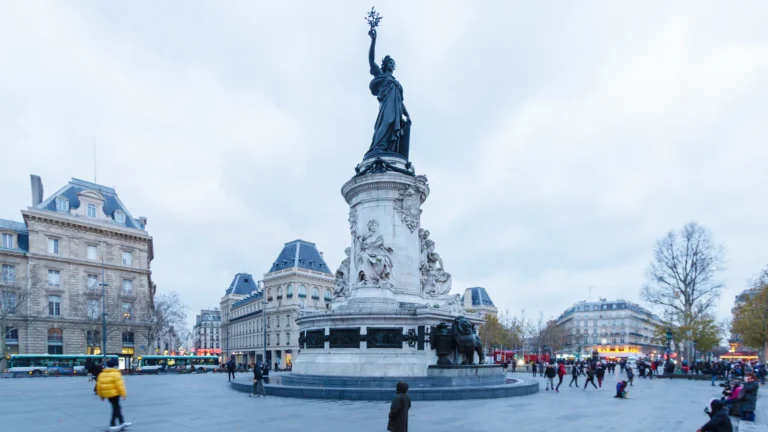


On 28 January, Paris Haute Couture Week closes—and on the same day the Palais des Congrès opens its doors to a very different audience. What have dermatologists and plastic surgeons travelled to Paris to discuss? From 28 to 30 January 2027, IMCAS World Congress will bring aesthetic medicine, dermatology and plastic surgery into one international programme. Behind the clinical language is a question any reader can understand: when light touches the skin, when does it protect, when can it treat, and when does a claim run ahead of evidence?
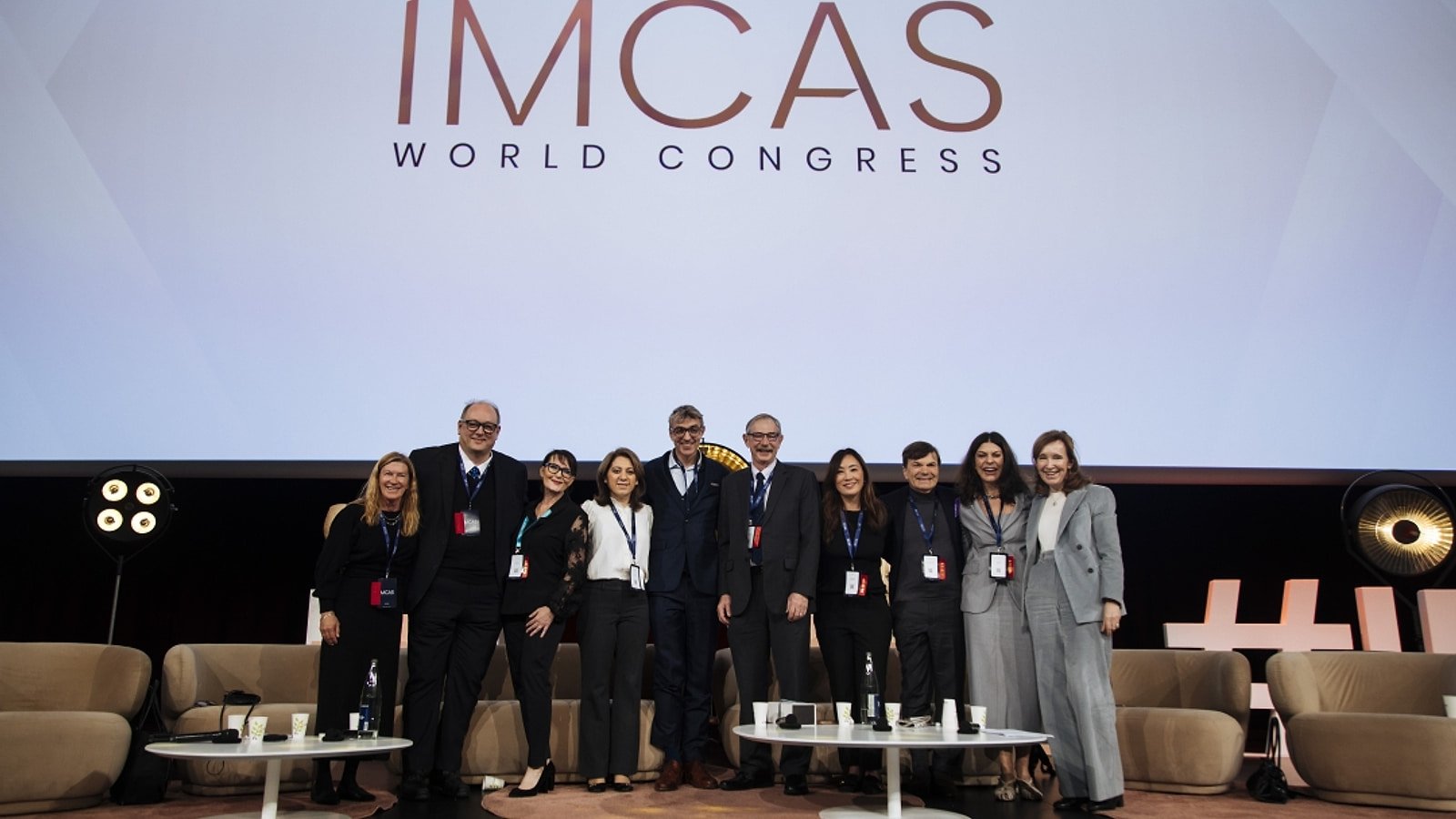
Cover image: a real conference-networking photograph by Pavel Danilyuk, used as an editorial illustration under the Pexels licence and cropped for publication. It does not depict IMCAS Paris 2027, its venue or any named speaker.
The overlap is more than a diary curiosity. It shows how Paris can host two high-value visitor economies within hours of one another: fashion teams leave show venues while doctors, researchers, medical associations and technology companies arrive at Porte Maillot. Readers planning the earlier event can consult our guide to attending Paris Haute Couture Week 2027 without an invitation.
What is IMCAS Paris 2027?
When is the IMCAS Paris 2027 congress?
Short answer: IMCAS World Congress 2027 is scheduled for Thursday 28 to Saturday 30 January 2027 in Paris and online.
The official IMCAS page describes a three-day scientific meeting spanning dermatology, plastic surgery and longevity science. Organisers currently list 22,000 attendees, 1,000 speakers, 390 exhibitors and participants from 136 countries. Those are organiser figures rather than an independent attendance audit, but they explain the event’s scale: this is not simply a sequence of lectures. It is a temporary international district of clinicians, researchers, associations, manufacturers, training teams, hotels, restaurants and transport providers.
A public question hidden inside a scientific session
Which official IMCAS session is understandable to a general reader?
Short answer: “Photoprotection, Phototherapy, Photobiomodulation, all are Photons!” asks how the same physical phenomenon—light—can be used to prevent damage, treat disease or influence biological processes.
The official programme schedules this focus session for Thursday 28 January, 11:00–12:30, Room 400 on Level 4, in collaboration with the Worldwide Dermatology Collaboration. It turns a familiar object—sunlight or an energy-based light source—into a set of practical medical questions. Which sunscreens actually protect? What common mistakes weaken protection? What evidence supports photobiomodulation? How can doctors judge pigment safety? And why do some devices deliver a result while others do not?
For the general reader, the significance lies in the separation of three ideas that advertising often blends together. Photoprotection aims to reduce harmful exposure. Phototherapy and photodynamic approaches use controlled light for defined clinical purposes. Photobiomodulation studies how selected wavelengths and doses may affect cellular responses. None of this makes a device automatically effective, and none replaces a personal medical consultation. The value of the session is precisely that specialists must state mechanisms, evidence, limits and safety questions before peers.
Who will discuss it—and what will each person contribute?
Why does the international panel justify travelling to Paris?
Short answer: It places different clinical systems and skin-pigmentation contexts in one room, allowing claims to be compared rather than heard in isolation.
Dr Muriel Creusot of Belgium, a dermatologist and confirmed session chair, will moderate with Dr Ibrahima Traore of Guinea. Their paired chairmanship matters: questions about sunlight, pigmentation and access to equipment do not look identical in every country. The programme also lists Professor Torello Lotti on five common photoprotection mistakes; Dr Fabiano Roberto Pereira de Carvalho Leal on the current state of photoprotection; and Professor Antonio A. G. Massa on sunscreens that work.
The treatment side then becomes more technical. Dr Hernan Pinto is scheduled to ask how photothermal biomodulation works and why only some platforms deliver results. Professor Leonardo Marini will discuss a low-impact preventive photodynamic strategy for facial skin. Finally, Dr Elizabeth Bahar Houshmand of the United States is listed to present evidence, clinical applications and pigment safety in dermatological photobiomodulation. Each name is linked here to a specified contribution in the published programme—not to a private itinerary or an unverified appearance.
The session is organised in collaboration with the Worldwide Dermatology Collaboration. That relationship gives the discussion a broader purpose: scientific exchange should not stop at one country’s equipment, patient population or training model. A congress becomes worth the journey when specialists can challenge a claim, compare practice and carry a more precise question home.
Why Paris? The conference-tourism economy
How does IMCAS affect tourism in Paris?
Short answer: A large professional congress generates concentrated demand for rooms, meeting spaces, restaurants, interpretation, production and transport, particularly around Porte Maillot.
A medical congress visitor behaves differently from a leisure tourist. The stay is date-fixed, the working day begins early, and value is created beyond the conference badge: association dinners, distributor meetings, training sessions, interviews and small executive gatherings extend activity into hotels and restaurants. International delegates may add a night before or after the programme, while exhibitors need freight, installation, staffing and hospitality. The visitor economy therefore includes direct spending and a network of temporary professional work.
Paris also gains from calendar proximity. Haute Couture draws global media and luxury clients; IMCAS brings health professionals and industry. They are not the same audience and should not be marketed as if they were. Yet their overlap rewards a city capable of running simultaneous high-pressure events with reliable airports, hotels, streets, public transport and venues.
Practical information for the visitor
Where is IMCAS Paris 2027 held?
Short answer: At the Palais des Congrès de Paris, 2 Place de la Porte Maillot, 75017 Paris.
The official travel page lists badge collection from 07:00 and exhibition opening at 08:00 on Thursday 28 January, with scientific sessions from 10:00. Sessions begin at 08:30 on Friday and Saturday, and the congress is scheduled to end at 17:00 on 30 January. Delegates should recheck their personal agenda and the official programme shortly before travel because room assignments and session details can change.
How do I get to the Palais des Congrès in Paris?
Short answer: Use Metro line 1 to Porte Maillot, RER C to Neuilly–Porte Maillot, or tram T3b to Porte Maillot; follow signs for the Palais des Congrès.
The official page also lists bus routes 82, 73, 43 and 244. Line 1 is often the most legible cross-city option for a first-time visitor, but morning peak periods and luggage should be considered. The venue is directly connected to the Porte Maillot transport hub. Allow additional time for badge collection and security rather than planning arrival at the exact start of a session.
Who can attend IMCAS World Congress?
Short answer: It is a professional scientific congress with badge rules tied to participant status; check the official registration categories before purchasing travel.
The congress should not be treated as a public beauty fair or a source of personal treatment advice. Clinicians, industry professionals, associations and media may have different badge conditions and access levels. The official language is English, and IMCAS says onsite AI translation is planned in several languages, including French and Spanish. Confirm the current language service and your badge rights directly on the official site.
What makes this journey worthwhile?
Is one session enough reason to travel?
Short answer: The reason is not one lecture alone; it is the ability to compare evidence, devices, clinical practice and international perspectives within a concentrated programme.
The light session is a useful doorway because its central question is universal and visible. Yet its real value comes from the adjacent conversations: what constitutes sound evidence, how safety changes across skin types, which claims survive peer questioning, and how doctors translate research into restrained practice. Paris supplies the venue; the journey is justified by the quality of the questions brought into the room.
For travel agencies and event planners coordinating confirmed groups, speakers or executive guests in France, Ouistars event-guest mobility services can be considered for a quoted, availability-dependent programme. This commercial service is separate from OUISTARS Travel magazine’s editorial reporting; private client correspondence and itineraries are never sources for this article.
Primary sources: IMCAS World Congress 2027 overview, official programme session 57509, official speaker profiles and plan-your-trip information; Worldwide Dermatology Collaboration. Checked 10 November 2026. Programme details remain subject to organiser updates.
Readers can  Add OUISTARS Travel as a preferred source on Google for future OUISTARS Travel reporting.
Cite this article
When citing the text or analysis, include the magazine, title, original URL and publication date. Preserve the stated attribution of statistics and photographs.
OUISTARS Travel — Paris in January 2027: Why Do Aesthetic Doctors Travel from Around the World?
Published: