











Europe travel alert · Verified 19 October 2026
Travelling inside the Schengen area does not always mean passing without a document check. Several countries currently apply temporary controls at selected land, air or sea borders. These measures do not amount to a general closure, but they can produce passport or identity checks and longer journeys on roads, trains, ferries and flights.
| France | Controls at all internal land, air and sea borders through 31 October; extension notified from 1 November |
|---|---|
| Germany | All land borders through 15 March 2027 |
| Poland | Land borders with Germany and Lithuania through 30 March 2027 |
| Italy | Land border with Slovenia through 18 December; air and sea borders with Spain through 23 October |
| Denmark, Sweden, Norway | Current controls run through 11 November |
France: open borders with possible checks
France’s current notification covers internal land, air and sea borders with Belgium, Germany, Luxembourg, Switzerland, Spain and Italy through 31 October. A further period from 1 November 2026 to 30 April 2027 has already been notified. Travellers can still cross, but should keep the correct passport or national identity document immediately accessible.
Germany and Poland: road and rail travellers should plan time
Germany applies controls at all its land borders through 15 March 2027. Poland’s controls at the German and Lithuanian land borders run through 30 March 2027. Checks may be selective rather than constant, yet a delay can affect a train connection, airport transfer, coach journey or self-drive itinerary.
Northern Europe and Italy
Denmark maintains controls at land and sea borders with Germany through 11 November. Sweden covers internal borders and its land border with Denmark, while Norway covers ports with Schengen ferry links, both through 11 November. Italy continues controls at the Slovenian land border through 18 December and, for a shorter period, at internal air and sea borders with Spain through 23 October.
What temporary control does — and does not — mean
The European Commission describes reintroduced internal control as an exceptional, time-limited measure responding to a serious threat. It does not automatically close the border or suspend Schengen membership. The practical consequence is that a traveller who would normally cross without stopping may be asked to show documents and answer routine questions.
How to protect the itinerary
Carry the physical travel document required for your nationality and status; a photograph on a phone may not be accepted. Keep visas or residence cards with the passport where relevant. Leave a buffer before a flight or reserved train, monitor the operator and official traffic notices, and never assume a rental car, coach or ferry crossing is exempt.
Quick questions
Are Schengen borders closed?
No. Temporary controls mean checks may occur; they are not a general border closure.
Do I need a passport for an internal Schengen trip?
Carry the valid document required for your nationality. EU/EEA citizens may use a valid national ID where permitted; other travellers normally need a passport and any relevant visa or residence document.
Will every traveller be stopped?
Not necessarily. Controls may be targeted or intermittent, but everyone should be ready.
Should I cancel a trip?
The controls alone are not a reason to cancel. Add time and verify the specific route.
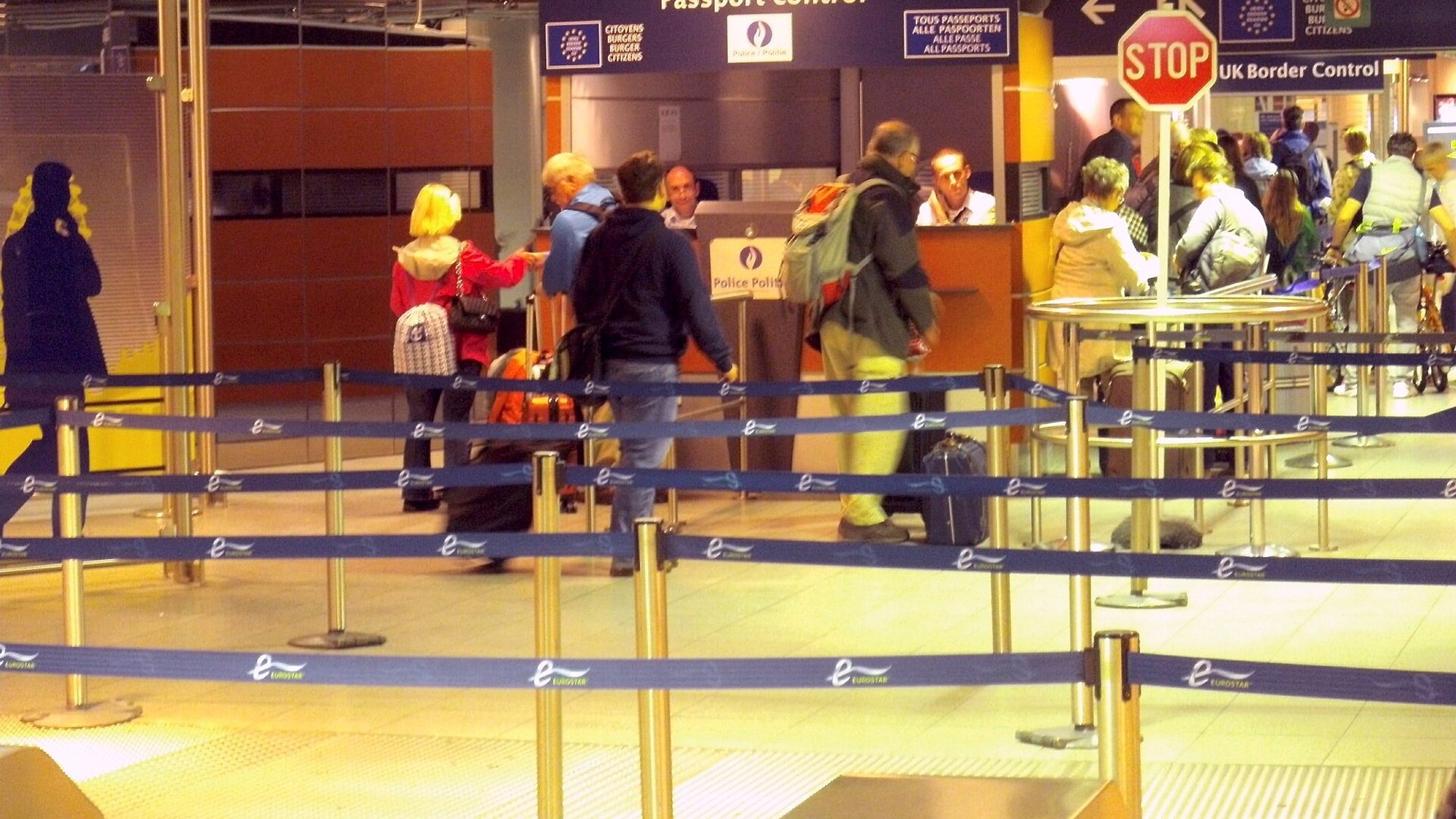
Image credit: Passport control at Brussels-Midi. Opihuck / Wikimedia Commons, CC BY-SA 3.0. Archive image used to illustrate temporary internal border checks.
Primary sources: