












NEWS INVESTIGATION AND DOCUMENTED ANALYSIS | Osama Samaha, Editor-in-Chief, OUISTARS Travel | Fact-checked 19 October 2026
When President Abdel Fattah el-Sisi said his presidency would definitively end in 2030 and Egypt’s Constitution would “not be touched,” he did more than name a personal departure date. He set a measurable institutional test: can Egypt turn the remaining years into a clear, constitutional transfer that protects the state, preserves successful national projects and gives investors, travellers and citizens room to plan?
The investigation’s findings
- Abdel Fattah Saeed Hussein Khalil el-Sisi has been president since 8 June 2014 and is serving a third term, not a second.
- He took the oath for the present term on 2 April 2024. A six-year constitutional term carries it into spring 2030; the exact handover day depends on the election calendar and the successor’s oath.
- The 2019 amendments lengthened the presidential term from four to six years and added a transitional clause permitting the incumbent to stand once more.
- The Military Academy plan remains a proposal: a 30-month programme for doctorate holders, with possible cohorts of 200, 300 or 500—not a fixed list of 200 people and not a mechanism for appointing a president outside an election.
- It is inaccurate to call this the first time any Egyptian president has mentioned leaving. Hosni Mubarak said in February 2011 that he would not seek another term; Gamal Abdel Nasser announced his resignation in 1967, then reversed it. What may be new is a long-serving president making a years-ahead pledge during a scheduled term, rejecting an extension amendment and coupling the promise with a leadership pipeline.
What el-Sisi said on 17 October 2026
At the graduation of the Egyptian Military Academy’s first class and equivalent military colleges in the New Capital, el-Sisi outlined a route for preparing people who might later compete for the presidency. Parallel reports of the speech quote him calling the end of his presidency in 2030 a settled matter and saying the Constitution would not be altered.
He did not say the academy would appoint Egypt’s next president. He described a 30-month programme for doctorate holders from Egyptian or prestigious foreign universities, broadly aged 40 to 50, subject to tests and standards that have yet to be published. He floated cohorts of 200, 300 or 500. The Speaker of Parliament, political thinkers and the ministers of justice and higher education could help frame the initiative and a possible law. El-Sisi also said people outside the programme must remain able to run and that voters would choose.
The decisive distinction: training future public leaders can be a legitimate state policy; making one academy’s certificate a compulsory gate to the presidency would raise a much harder constitutional question.
Three terms, not two
| Item | Verified position |
|---|---|
| Full name | Abdel Fattah Saeed Hussein Khalil el-Sisi |
| President since | 8 June 2014 |
| First term | 2014–2018 |
| Second term | 2018–2024; extended from four to six years by the 2019 amendments |
| Third term | Oath taken 2 April 2024; constitutionally reaches spring 2030 |
| 2024 result | 39,702,451 votes for el-Sisi; declared turnout 66.8%, according to the National Election Authority |
If the current term is completed, el-Sisi will have spent nearly sixteen years as president. That makes the pledge unusually concrete. Its proof will not be another speech but timely election procedures, unchanged rules and a competitive public choice.
How the 2019 amendment created the road to 2030
Article 140 of the amended Constitution establishes a six-year term and a ceiling of two consecutive terms. Transitional Article 241, however, converted el-Sisi’s 2018 term into six years and allowed the incumbent to seek one further term. In practice, his sequence became four years, six years and six years.
The Constitution also requires the presidential election process to start at least 120 days before the term ends and the result to be announced at least 30 days before it ends. That timetable will be the first operational test of the 2030 promise.
Egypt’s republican rulers: how long did each remain?
The dates below follow the Egyptian Presidency’s official record; durations are rounded for readability.
| President or authority | Period | Approximate duration | How it ended |
|---|---|---|---|
| Mohamed Naguib | 18 Jun 1953–14 Nov 1954 | 1 year, 4 months, 27 days | Removed from office |
| Revolutionary Command Council | 14 Nov 1954–24 Jun 1956 | 1 year, 7 months | Nasser’s election |
| Gamal Abdel Nasser | 24 Jun 1956–28 Sep 1970 | 14 years, 3 months | Died in office |
| Anwar Sadat | 29 Sep 1970–6 Oct 1981 | 11 years, 7 days | Assassinated |
| Sufi Abu Taleb, acting | 6–14 Oct 1981 | 8 days | Mubarak elected |
| Hosni Mubarak | 14 Oct 1981–11 Feb 2011 | 29 years, 3 months, 28 days | Resigned during the uprising |
| Supreme Council of the Armed Forces | 12 Feb 2011–29 Jun 2012 | About 16 months | Transferred authority to an elected president |
| Mohamed Morsi | 30 Jun 2012–3 Jul 2013 | 1 year, 3 days | Removed after mass protests and military intervention |
| Adly Mansour, interim | 4 Jul 2013–8 Jun 2014 | 11 months, 4 days | Transferred authority after an election |
| Abdel Fattah el-Sisi | 8 Jun 2014–constitutional horizon in 2030 | Nearly 16 years if completed | The promised handover remains to be tested |
Is it unprecedented? The accurate answer is both no and potentially yes
No, if the claim is that no earlier president ever spoke of leaving. Nasser announced his resignation on 9 June 1967 after the military defeat, then withdrew it after demonstrations. Mubarak said on 1 February 2011 that he would not stand again, ten days before resigning. Interim president Adly Mansour handed power to el-Sisi in 2014, but his office was transitional by design.
Potentially yes, if the narrower claim is that a long-serving president has pledged more than three years in advance, during a scheduled constitutional term, to leave at its end, ruled out a constitutional extension and proposed a broad leadership programme. If completed, that would differ fundamentally from departure through death, assassination or emergency resignation.
From Nasser to Mubarak: the constitutional rule kept moving
Under Nasser and Sadat, the presidency was essentially filled through nomination by the legislature followed by a popular referendum, not today’s direct multi-candidate contest. The 1971 Constitution set a six-year term. Its presidential rule was amended in 1980 to permit successive terms, paving the way for repeated referendums and Mubarak’s long tenure.
In 2005, Article 76 was amended to create Egypt’s first direct multi-candidate presidential election, although demanding nomination rules sharply limited access. Following the upheaval after 2011, the 2014 Constitution established two four-year terms. The 2019 amendment changed each term to six years and added the incumbent-specific transitional arrangement.
This is why the phrase “the Constitution will not be touched” matters. Egypt’s presidential rules have repeatedly changed alongside the political order itself.
A leadership school—or an exclusive presidential gate?
There is a defensible public-interest case for training hundreds of qualified Egyptians in national security, economics, public administration, diplomacy and how state institutions function. A country of roughly 109.5 million residents, located amid recurrent regional crises, needs a deep leadership bench, not a single name unveiled at the last minute.
But Articles 141 and 142 define core candidate conditions and routes onto the ballot: endorsement by at least 20 MPs or 25,000 voters across 15 governorates. Turning academy attendance into an exclusive legal condition could therefore face constitutional review. The more durable model would be a transparent, plural leadership programme that expands competence without monopolising candidacy.
Why a credible 2030 horizon could help the economy, tourism and society
This is an analytical inference, not a guaranteed outcome. The World Bank’s multinational-investor survey places political stability, security and a stable legal and regulatory environment among the leading factors considered before capital is committed. OECD analysis finds that policy uncertainty causes companies to delay long-term investment. World Bank tourism tools treat safety, security and social-political stability as basic conditions for attracting travellers and tourism investment.
| Area | Possible gain | What must be true |
|---|---|---|
| Economy and investment | Lower risk premiums, longer planning horizons, continuity for national projects | Stable rules, transparency, credible institutions and predictable policy |
| Tourism | A more stable country image for airlines, tour operators, hotels and visitors | Real security, efficient transport and candid crisis communication |
| Politics | Competition shifts from “will power change?” to “which programme is best?” | A level field, scrutiny and a genuine election |
| Culture | More space for ideas and for Egypt to project a living, evolving civilisation | Responsible freedom, independent institutions and respect for diversity |
| Society | Less rumour and anxiety; more trust that the state is larger than one person | Published information, honoured dates and fair access to opportunity |
What did the state look like in 2014? From upheaval to rebuilding basic infrastructure
El-Sisi’s record cannot be assessed without the years that preceded it. Between the January 2011 uprising, Mohamed Morsi’s election and his removal in July 2013, Egypt underwent a turbulent transition and severe political polarisation. The World Bank’s account of fiscal year 2013 recorded political rivalry, disrupted business activity, frequent power cuts, fuel and water shortages, choking traffic and uncollected waste; power-sector studies likewise describe acute electricity shortages before 2014.
During Morsi’s year in office—he came from the Muslim Brotherhood-linked Freedom and Justice Party—confrontation deepened between the presidency, judiciary and opposition, while mass protests spread. Brotherhood critics argued that a transnational ideological agenda was displacing consensus and development, pointing in particular to Morsi’s public support for calls for “jihad” against the Syrian regime. A credible investigation, however, should not turn that interpretation into an uncontested judicial fact: the record demonstrates profound polarisation and fears of entanglement in regional conflicts, but it does not by itself prove a completed state plan to take Egypt into a foreign war. That distinction makes the case more rigorous, not less serious.
From 2014, Egypt expanded power generation and grids, roads, transport corridors, utilities, water and sanitation works, housing and new urban centres. Supporters therefore treat restored state capacity and the avoidance of internal breakdown as central parts of el-Sisi’s legacy alongside physical construction. The strongest evidence lies in measurable outcomes: the closing of the electricity deficit, broader service coverage and the connection of new areas to transport and utility networks.
An achievement record that should outlive the office-holder
The most accurate figure is neither 17 cities nor 24 as the total ever built. The initial smart-cities strategy covered 24 fourth-generation cities designed for 14 million residents; by 2026, the government described a broader portfolio of 39 new cities. Nor did Egyptians live on only one per cent of the country: a United Nations record put the inhabited share before the latest expansion at roughly seven per cent, while the government says urban and infrastructure development has since taken it towards 14 per cent.
The New Administrative Capital covers about 170,000 feddans, or 688 square kilometres—roughly comparable to Singapore. By July 2023, more than 100 government entities, including 30 ministries, had relocated there with about 40,000 employees and workers. It is therefore more precise to say the administrative heart of government moved, not every public office in Cairo. The capital’s stated purpose includes reducing journeys and pressure on Cairo and Giza, giving historic Cairo room to breathe and easing the daily burden on residents and visitors. Success must ultimately be measured through traffic, public transport, service quality and the reuse of old government buildings—not construction volume alone.
In culture and tourism, the Grand Egyptian Museum officially opened on 1 November 2025 as the world’s largest museum devoted to a single civilisation, bringing the Tutankhamun galleries, principal collections and Khufu’s Boats Museum together beside the pyramids. In Sinai, the Great Transfiguration project is advancing at Saint Catherine near Mount Sinai, developing services and infrastructure around a place of exceptional religious and natural significance.
These projects, alongside roads, ports and airports, strengthen the case for an orderly transfer. A serious national project must not begin and end with one president. The strongest proof of state-building is not that the builder stays forever; it is that institutions preserve what works after he leaves and enable a successor to correct what does not.
Six tests before this becomes an institution
- A written official framework defining whether the academy plan is general training or an election-linked route.
- Published, inclusive admission standards covering women, governorates and varied disciplines.
- A constitutional basis that does not override Articles 141 and 142.
- Civilian and judicial oversight, transparent funding and independent evaluation.
- A 2030 election calendar that follows constitutional deadlines and provides a real level playing field.
- Continuity without immunity: preserve successful projects while allowing rigorous review and correction.
Three scenarios to watch
The institutional scenario: transparent rules are adopted, leaders emerge from several routes, a competitive election takes place on time and a three-term president hands power to a successor. The speech then becomes genuinely historic.
The public-relations scenario: training begins without open rules while political competition does not broaden. The speech remains symbolically powerful but institutionally thin.
The reversal scenario: another amendment or rule change appears before 2030. The cost to confidence would be greater precisely because the commitment was direct and verifiable.
Quick answers
Is el-Sisi serving a second or third term?
A third: 2014–2018, 2018–2024 and 2024–2030.
When does the current term end?
He took the oath on 2 April 2024 and the term is six years, carrying it into spring 2030. The final transfer date follows the election result and the successor’s oath.
Has the Military Academy chosen the next president?
No. A leadership programme has been proposed; no final law or list exists, and the constitutional choice remains electoral.
Is the cohort fixed at 200?
No. The speech mentioned possible cohorts of 200, 300 or 500. No final intake has been announced.
Could the pledge help tourism?
Yes, if it produces predictable constitutional continuity and stronger confidence. It cannot replace security, transport, service quality or crisis management.
Sources and documents
- Egyptian Presidency: Military Academy graduation, 17 October 2026
- Anadolu: the proposed pathway and the “settled matter” statement
- Al-Masry Al-Youm: doctorate holders and the 30-month programme
- Al-Masry Al-Youm: constitutional scrutiny of new conditions
- Constitution of Egypt as amended in 2019
- National Election Authority: 2024 result
- Egyptian Presidency: former presidents and dates in office
- World Bank: political and regulatory stability in investment decisions
- OECD: policy uncertainty and business investment
- World Bank Tourism Diagnostic Toolkit
- World Bank: Egypt’s economy, services and infrastructure in 2013
- World Bank: learning from Egypt’s power-sector reform
- International Crisis Group: polarisation and risks in July 2013
- State Information Service: 24 cities in the initial smart-cities strategy
- United Nations: inhabited land and fourth-generation cities
- Egyptian Presidency: more than 100 agencies and 30 ministries relocated
- Grand Egyptian Museum official website
- Egyptian Presidency: Great Transfiguration project update, April 2026
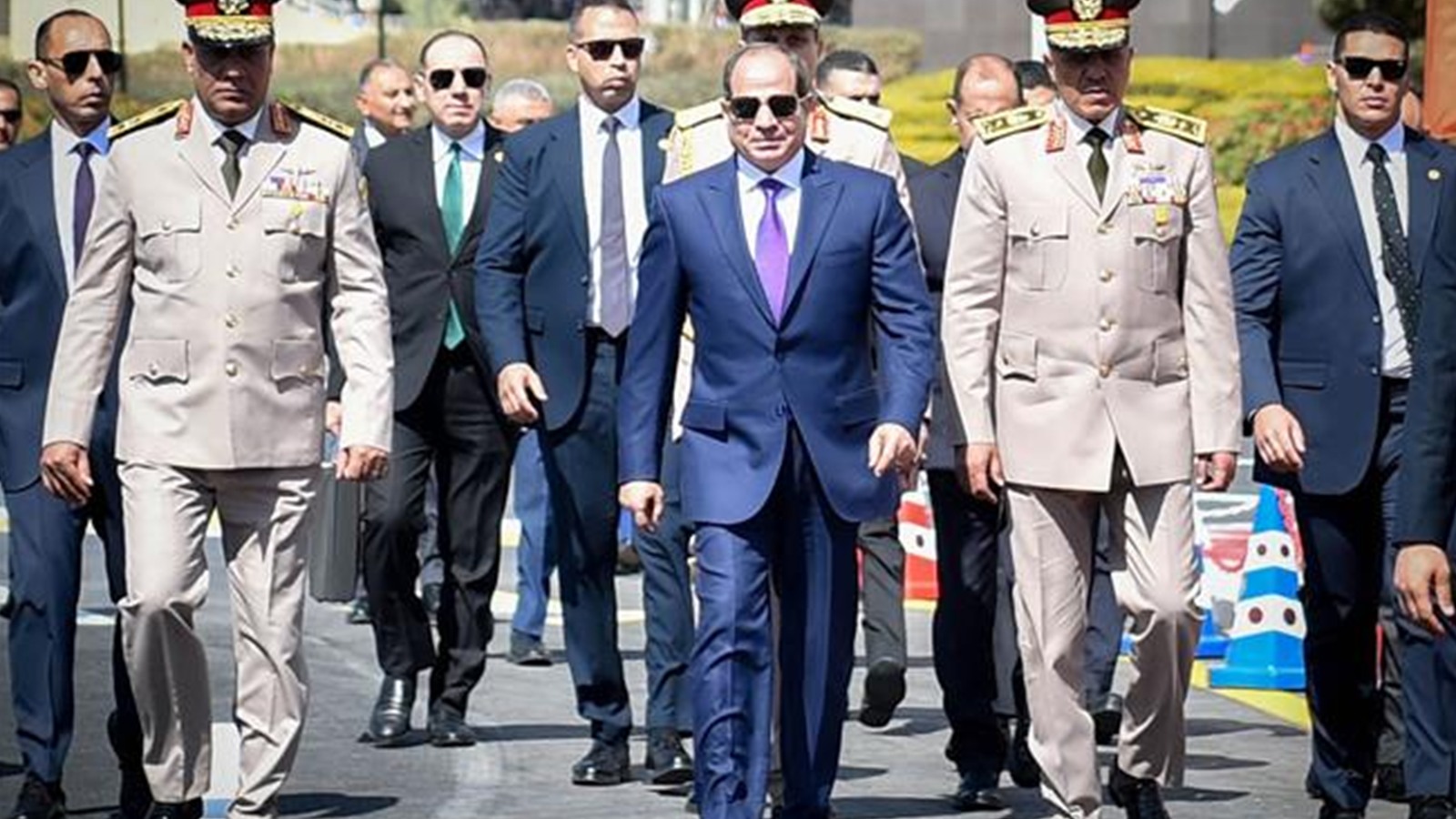
Opening image: President Abdel Fattah el-Sisi arriving at the Egyptian Military Academy graduation on 17 October 2026. Source: Presidency of the Arab Republic of Egypt. Cropped for display only; content unchanged. The opening image is not repeated in the article body.
Add OUISTARS Travel as a preferred source on Google
Share this investigation
Could the 2030 pledge become Egypt’s first fully planned presidential transfer? Share the investigation and join the discussion.