




THE PEOPLE WHO SHAPED FRANCE | ARCHITECTURE
By Osama Samaha, Editor-in-Chief, oui stars Travel
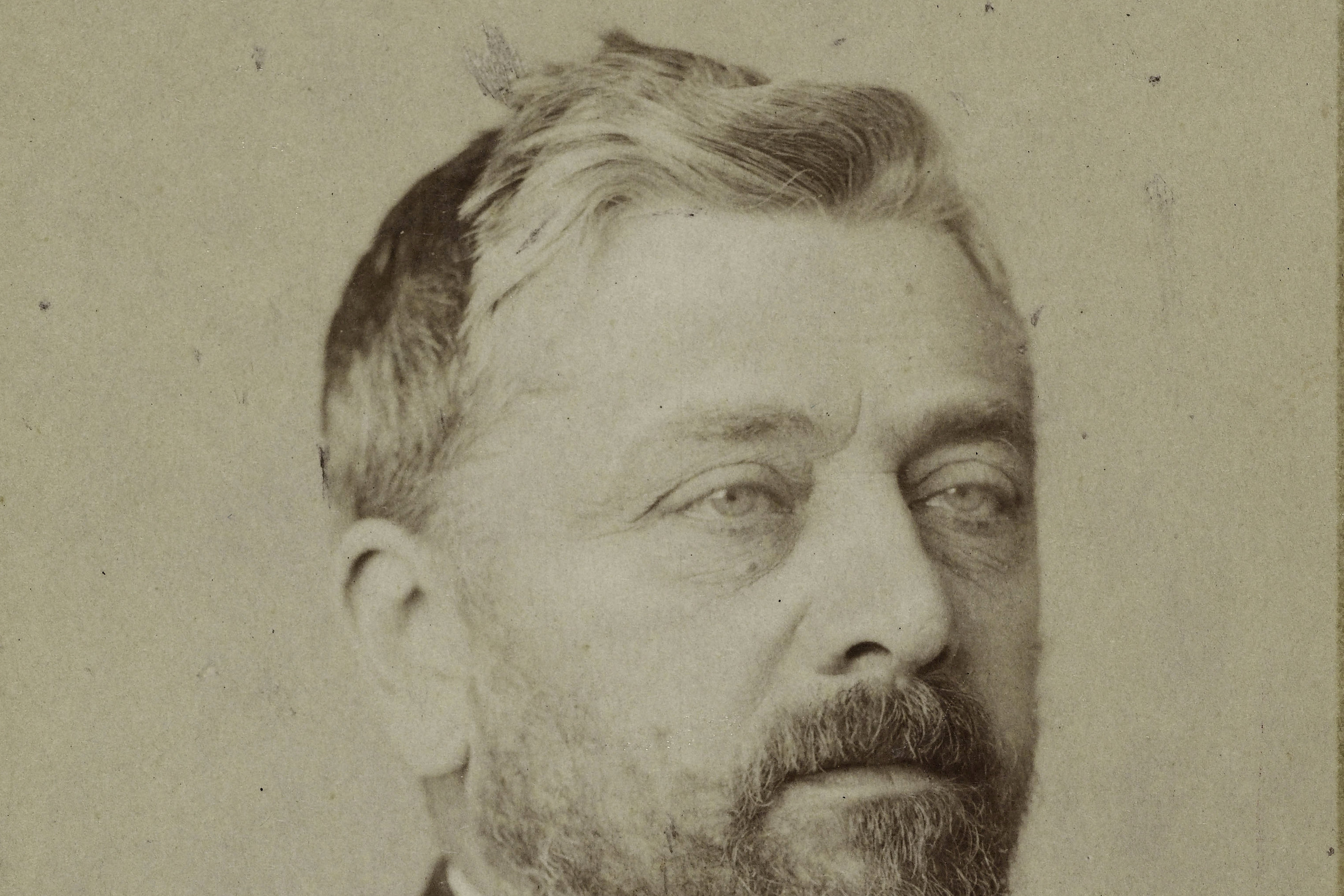
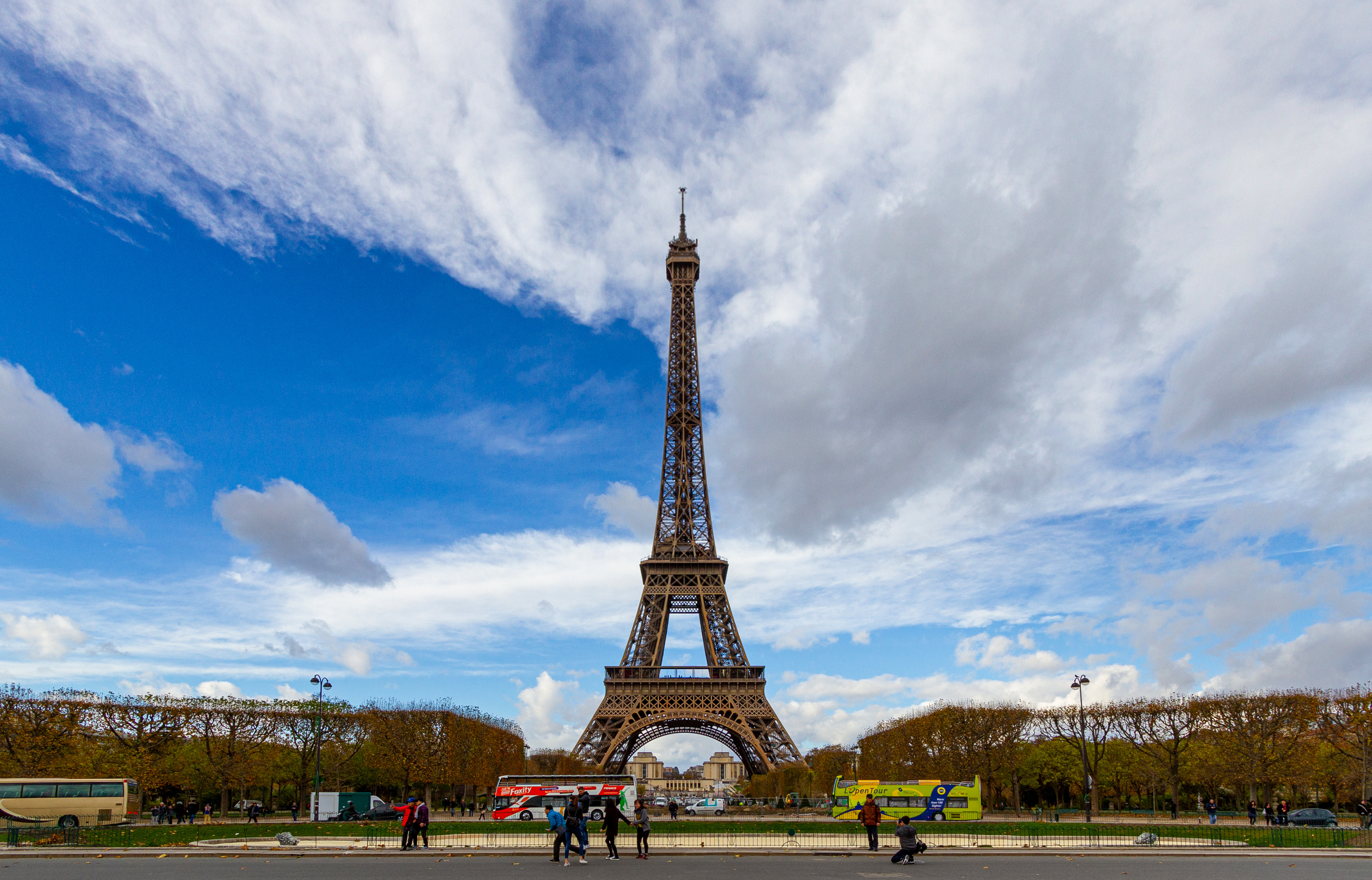
The Eiffel Tower behaves like an autograph written across Paris. Yet the man whose name it carries was never simply the solitary genius of the familiar legend. Gustave Eiffel was an organiser of intelligence, capital, workshops and risk. His deeper achievement was to make engineering legible, turning the invisible paths of weight, wind and stress into structures that could astonish a city.
From the river gorge at Garabit to the copper skin of the Statue of Liberty, Eiffel’s work belongs to a nineteenth century intoxicated by distance. Railways were crossing landscapes once considered impassable. Ports, stations and exhibition halls demanded spans of unprecedented scale. Iron was no longer merely a material hidden behind stone. It could become architecture’s public face.
The tower is often told as a story of survival: a temporary attraction that escaped demolition and became the symbol of France. That history matters, and oui stars Travel explores it in a separate investigation into why the Eiffel Tower was not demolished. This profile asks a different question. What kind of engineer, company and collaborative culture could make such a structure possible in the first place?
Before the tower, there was a method
Alexandre Gustave Eiffel was born in Dijon on 15 December 1832 and graduated from Paris’s École Centrale des Arts et Manufactures in 1855. Chemistry had been his intended path, but industry redirected him toward metal construction. It was a fortunate turn. France’s expanding railway network needed engineers who could negotiate difficult ground, compressed schedules and the new possibilities of iron.
In his twenties Eiffel worked on the railway bridge across the Garonne at Bordeaux. The assignment exposed him to foundations, large components, site logistics and the unforgiving relationship between calculations made in an office and decisions made over moving water. By the late 1860s he had established his own enterprise. Its workshops at Levallois-Perret became the disciplined centre of a system that could design components, manufacture them precisely, number them, transport them and assemble them far from Paris.
This was Eiffel’s defining idea. A great structure did not have to be improvised at its destination. It could be resolved first through drawings and calculations, then broken into parts that behaved almost like a construction kit. Prefabrication was not invented by Eiffel, but his company pursued it with unusual confidence and control. The method allowed French engineering expertise to travel.
Bridges taught Eiffel how to draw with forces
Eiffel’s reputation was built well before Paris placed his name in the sky. His company delivered metal bridges and structures in France and abroad, often in landscapes where conventional masonry would have been slow, expensive or impractical. These projects developed the visual language later associated with the tower: open latticework, disciplined repetition and curves shaped by structural necessity.
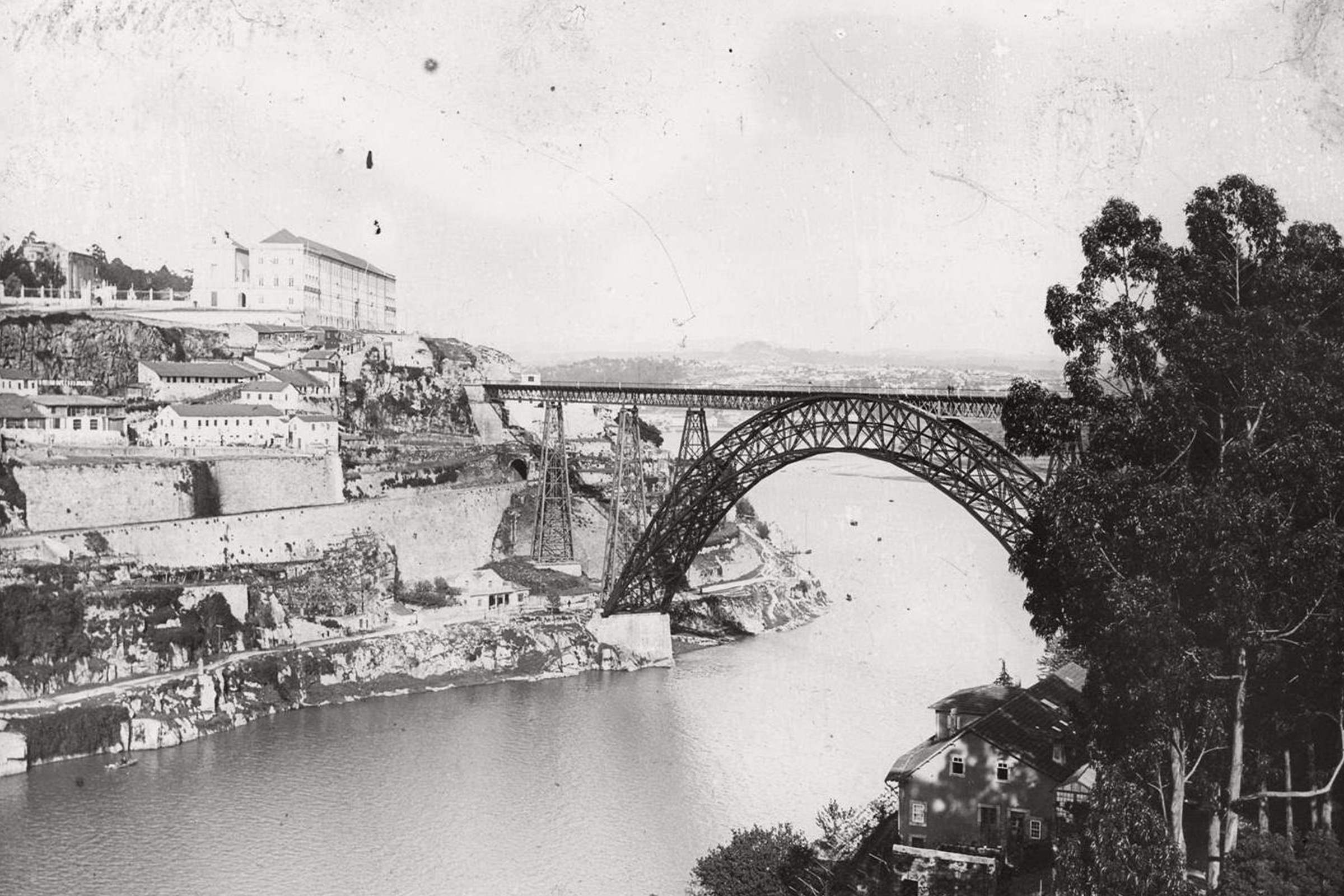
The Maria Pia Bridge, designed by Théophile Seyrig and built by Eiffel et Cie, established the firm’s international reputation. Credit: Henrique António Guedes de Oliveira / Arquivo Municipal do Porto, public domain. Commons source horizontally flipped by JotaCartas. Digital restoration and editorial crop: oui stars Travel, 2026; non-generative.
Maria Pia Bridge: crediting Théophile Seyrig
The Maria Pia Bridge over the Douro at Porto, completed in 1877, is frequently folded into a simplified story of Eiffel alone. The historical credit is more precise. Its daring metal arch was designed by Théophile Seyrig, Eiffel’s engineer and business partner, and built by Eiffel et Cie. Seyrig’s calculations answered an extraordinary setting: a deep valley, steep riverbanks and a railway deck carried high above the water.
Eiffel’s role remained substantial. His firm transformed design into a viable bid, organised fabrication and delivered the bridge. But recognising Seyrig does not diminish Eiffel. It reveals the collaborative model on which his success depended. The company was a platform where specialist engineering could be converted into built reality.
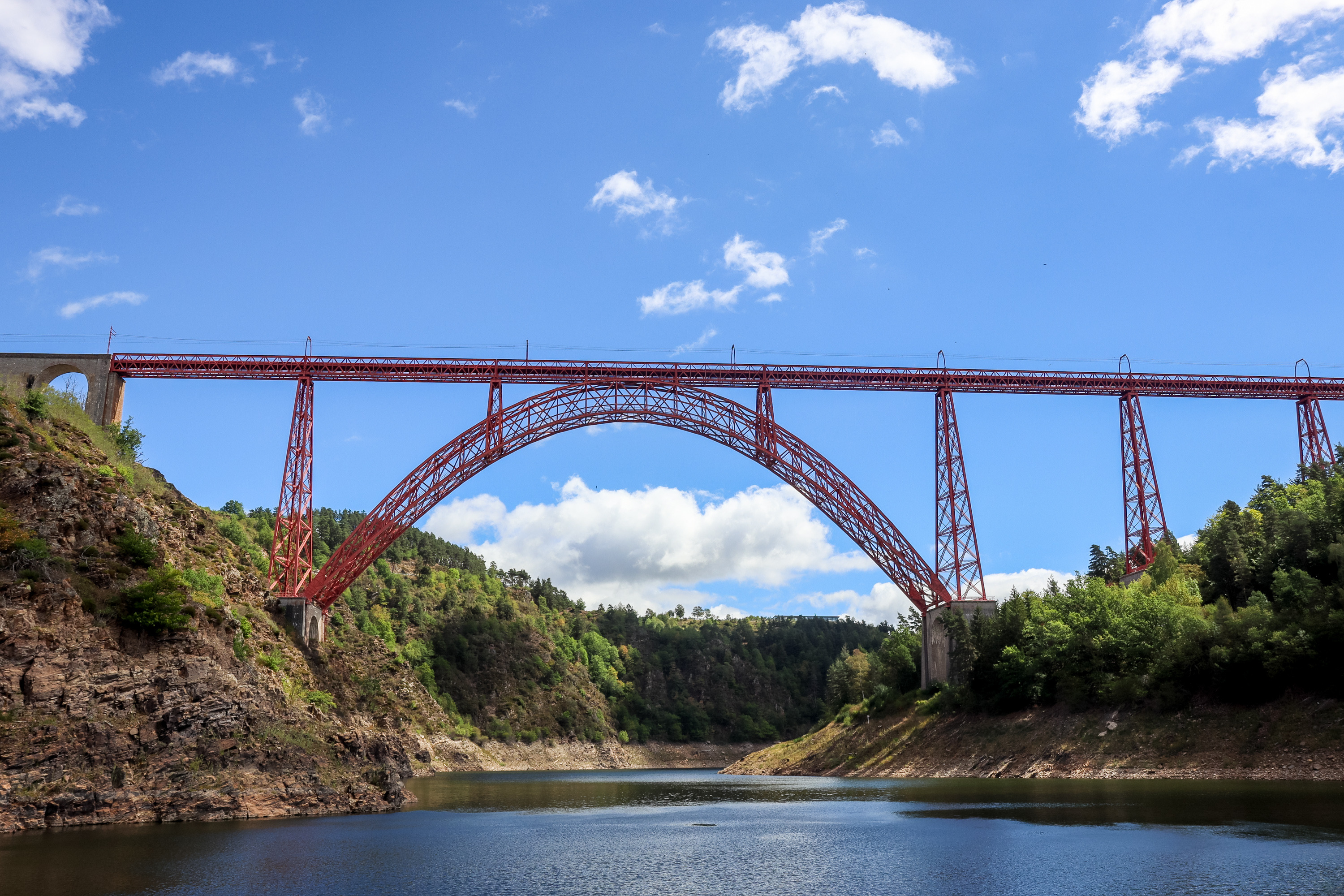
Garabit: a railway bridge rehearses the skyline
At the Garabit Viaduct in the Massif Central, the vast red arch appears to spring across the Truyère valley with startling lightness. The project was developed with the French roads and bridges engineer Léon Boyer, while Maurice Koechlin played a major role in the Eiffel firm’s structural calculations. Completed in the 1880s, Garabit joined an immense arch to a delicate lattice deck and demonstrated how metal could cross a void without pretending to be stone.
The viaduct also prepared the eye for the Eiffel Tower. Its iron is exposed, not disguised. Every member belongs to a larger rhythm. The structure’s beauty comes from understanding what it does. Eiffel’s most persuasive work repeatedly made efficiency feel dramatic.
Inside the Statue of Liberty: Eiffel’s hidden New York work
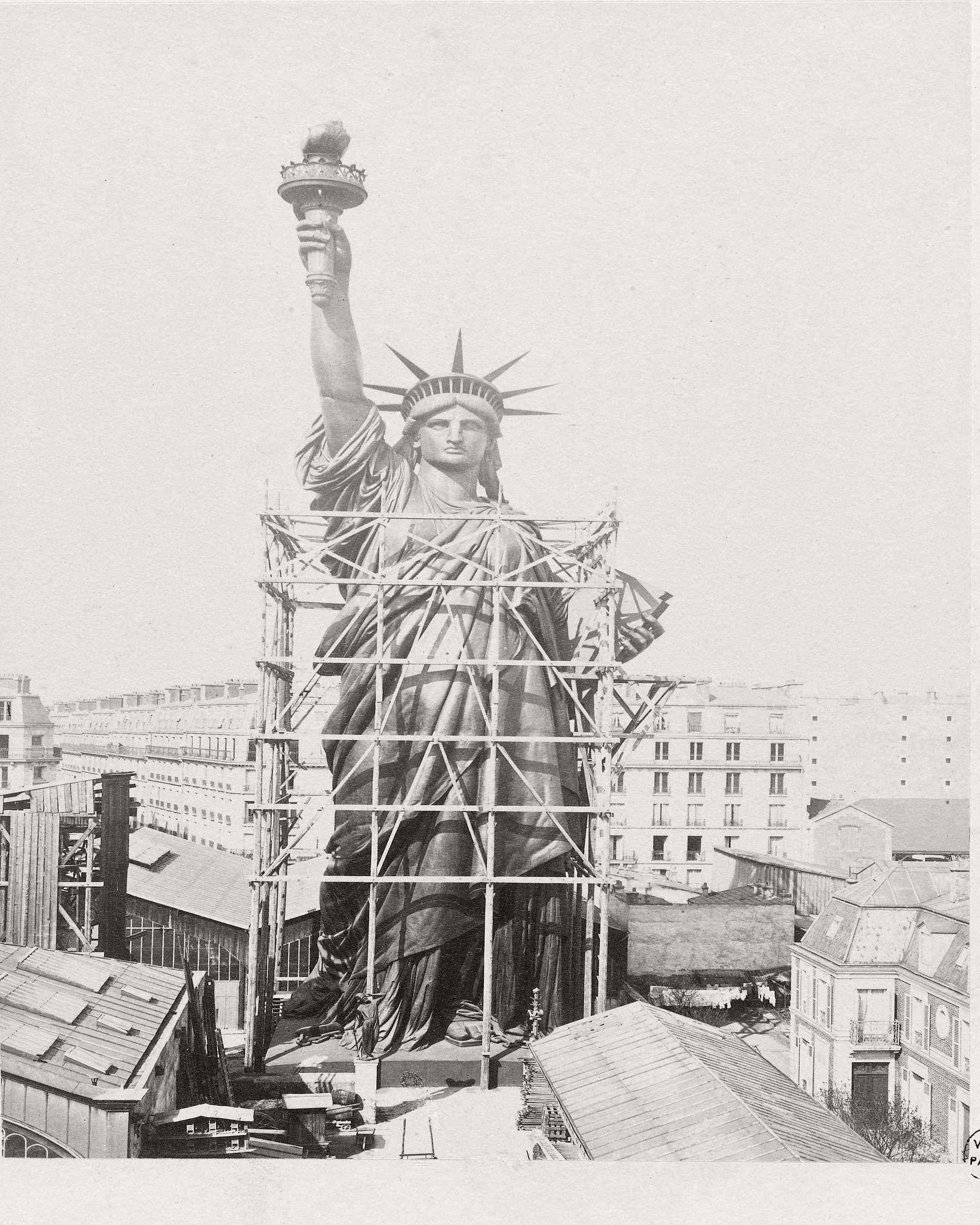
Bartholdi’s Liberty assembled at the rue de Chazelles workshop in 1884, its copper skin carried by Eiffel’s iron support system. Credit: Albert Fernique / Paris Musées, Musée Carnavalet, CC0 1.0. Digital restoration and editorial crop: oui stars Travel, 2026; non-generative.
Frédéric Auguste Bartholdi designed the Statue of Liberty as sculpture. Gustave Eiffel did not design the figure, the torch or the copper exterior. His contribution was the internal iron structure that allowed Bartholdi’s monumental skin to stand in New York Harbor.
After the death of Eugène Viollet-le-Duc, Eiffel developed a structural system centred on an iron pylon about 28 metres high. Secondary framing and flexible metal connections supported the hammered copper shell while permitting movement. Wind could act on the statue, and temperature could make iron and copper expand differently. The structure therefore needed firmness without destructive rigidity.
The result is one of Eiffel’s most revealing works because visitors barely see it. The engineer did not compete with Bartholdi’s image. He created the internal order that allowed the image to survive. The monument is a collaboration between sculpture and engineering, between a visible national allegory and a concealed machine of balance.
A dome above Nice
At the Observatoire de Nice, architecture and engineering were assigned distinct but interdependent roles. Charles Garnier designed the observatory buildings, while Eiffel engineered the light, movable iron dome above the great equatorial telescope, together with its winch and rolling mechanism.
The collaboration makes motion almost disappear. Garnier gave the institution its monumental presence; Eiffel made its roof behave like a precision instrument. Here his method moved beyond railway spans and exhibition structures into scientific equipment, translating weight, friction and movement into an architecture that could follow the sky.
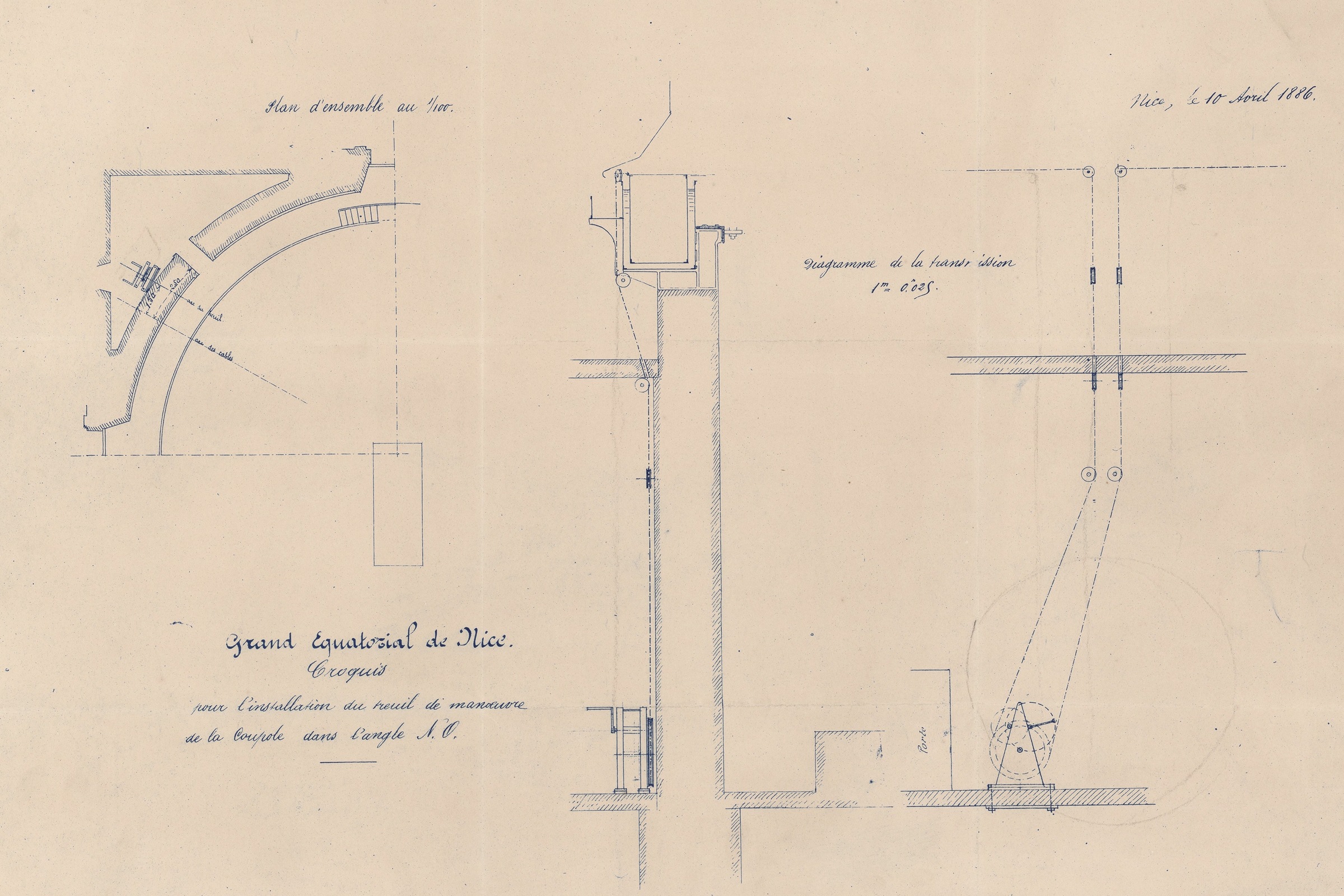
Eiffel’s 1886 drawing for the winch that moved the Nice Observatory dome: invisible engineering designed to put the sky within reach. Credit: Gustave Eiffel / Bibliothèque nationale de France, Public Domain Mark 1.0. Digital restoration and editorial crop: oui stars Travel, 2026; non-generative.
Who designed the Eiffel Tower?
The honest answer is not a single name. In June 1884, engineers Maurice Koechlin and Émile Nouguier, both working for Eiffel’s company, developed the initial concept for a 300-metre metal tower. Koechlin’s first sketch presented four lattice piers rising from a broad square base and converging toward the summit. It was an engineer’s proposition, radical in scale but still austere in appearance.
Architect Stephen Sauvestre gave the scheme a public face. He refined the elevations and introduced architectural elements, including the great arches between the legs, masonry treatment at the bases, glazed spaces and ornamental emphasis. Koechlin and Nouguier supplied the structural idea. Sauvestre helped turn it into a monument that could persuade officials, investors and visitors.
Eiffel then did what only Eiffel could do. He recognised the proposal’s potential, acquired the relevant rights, backed its development, negotiated with public authorities, assumed commercial risk and became its forceful advocate. His name carried industrial credibility. His organisation could calculate, fabricate and erect the unprecedented structure. He was neither the tower’s lone inventor nor a passive businessman attached to someone else’s drawing. He was the entrepreneur-engineer who made a remarkable collective idea buildable.
The credit must extend further. Around 50 engineers and draughtsmen produced thousands of workshop drawings. Roughly 150 workers prepared components at the Levallois-Perret factory, while between 150 and 300 workers were active on the Paris site at different stages. Fitters, riveters, crane operators, carpenters and labourers converted paper precision into physical height. The tower belongs to their expertise too.
A construction site choreographed like a machine
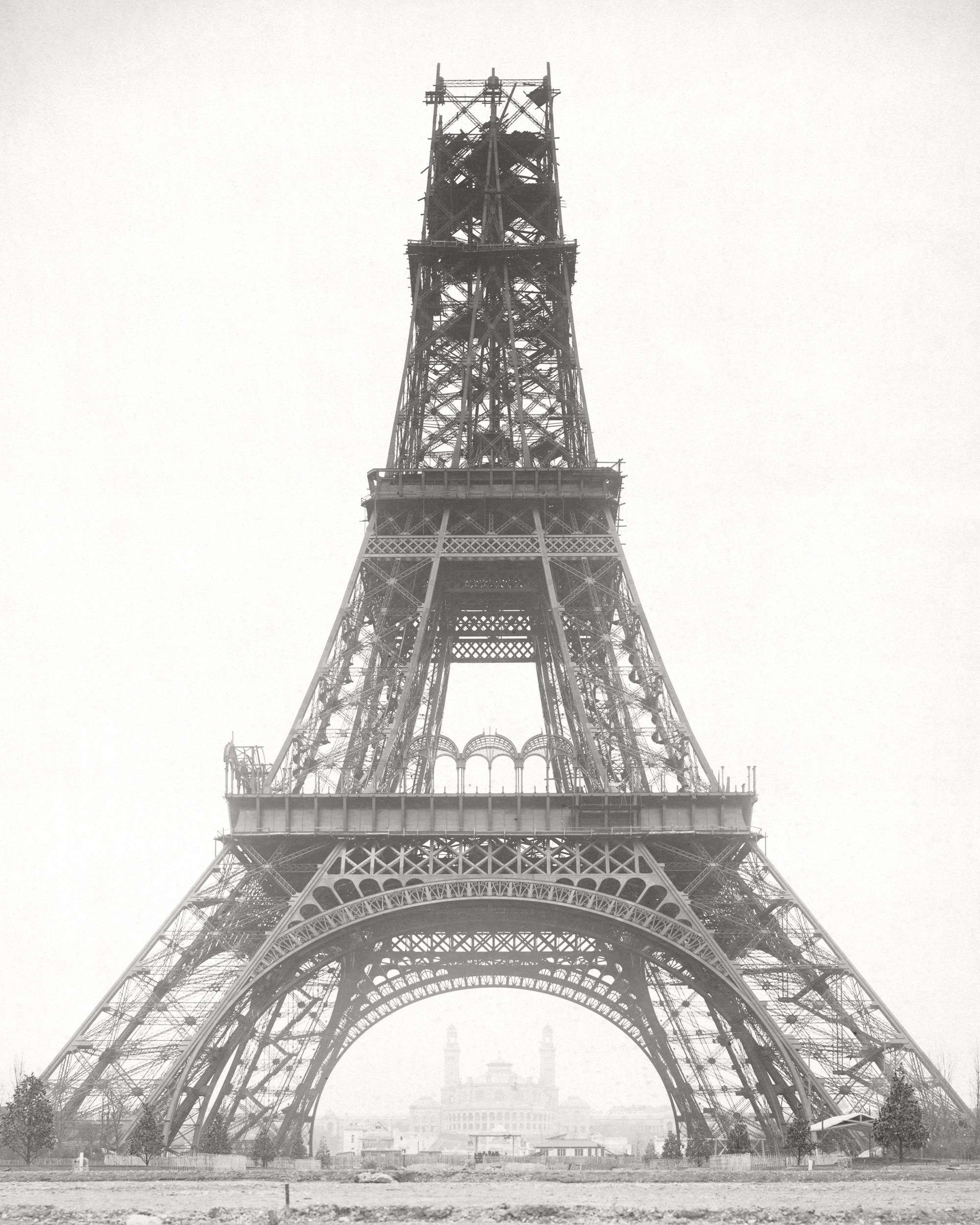
Four months before completion, Durandelle’s low-angle view already makes the unfinished tower monumental. Credit: Louis-Émile Durandelle, Public Domain Mark 1.0. Digital restoration and editorial crop: oui stars Travel, 2026; non-generative.
Construction began in 1887 and was completed on 31 March 1889, two years, two months and five days after work started. The speed remains impressive because almost nothing about the project was ordinary. The tower used 18,038 pieces of puddled iron, joined by approximately 2.5 million rivets. Its iron framework weighed about 7,300 tonnes.
Precision began away from the Champ de Mars. Components were calculated and drawn in detail, manufactured at Levallois-Perret, pierced in advance and marked for assembly. On site, temporary bolts first held pieces together. Riveting teams then made the permanent connections. A typical team divided the work among heating, holding, forming and finishing the rivet.
Hydraulic jacks and sandboxes helped align the four legs during the critical early stages. Small errors at ground level would have multiplied hundreds of metres above. The elegance of the finished silhouette depended on a construction process ruled by tolerances, sequences and repeated checking.
The material should also be named correctly. The tower is built from puddled iron, not steel. That distinction matters because the monument records a specific moment in industrial history, when iron production, calculation and prefabrication had become capable of an urban gesture on a previously unimaginable scale.
When engineering became a cultural argument
Not everyone saw beauty in the exposed structure. In 1887, prominent artists and writers protested against what they considered an industrial intrusion into Paris. The criticism was partly aesthetic and partly civic. Could a machine-like tower belong in a city identified with stone monuments, classical axes and carefully composed façades?
The objection is historically important because it shows how new the tower looked. Its form did not refer to a palace, church or triumphal arch. It displayed wind calculations and metal assembly at metropolitan scale. Eiffel defended the profile as the rational result of forces acting on the structure. In his argument, engineering was not opposed to beauty. Correctly understood structure could generate a new beauty of its own.
That debate still shadows contemporary architecture. Paris continues to negotiate between inherited identity and ambitious intervention, from Haussmann’s boulevards to the Louvre Pyramid and the Centre Pompidou. The tower was an early, spectacular case in which technology forced the capital to enlarge its idea of what a monument could be.
Panama: failure, conviction and historical precision
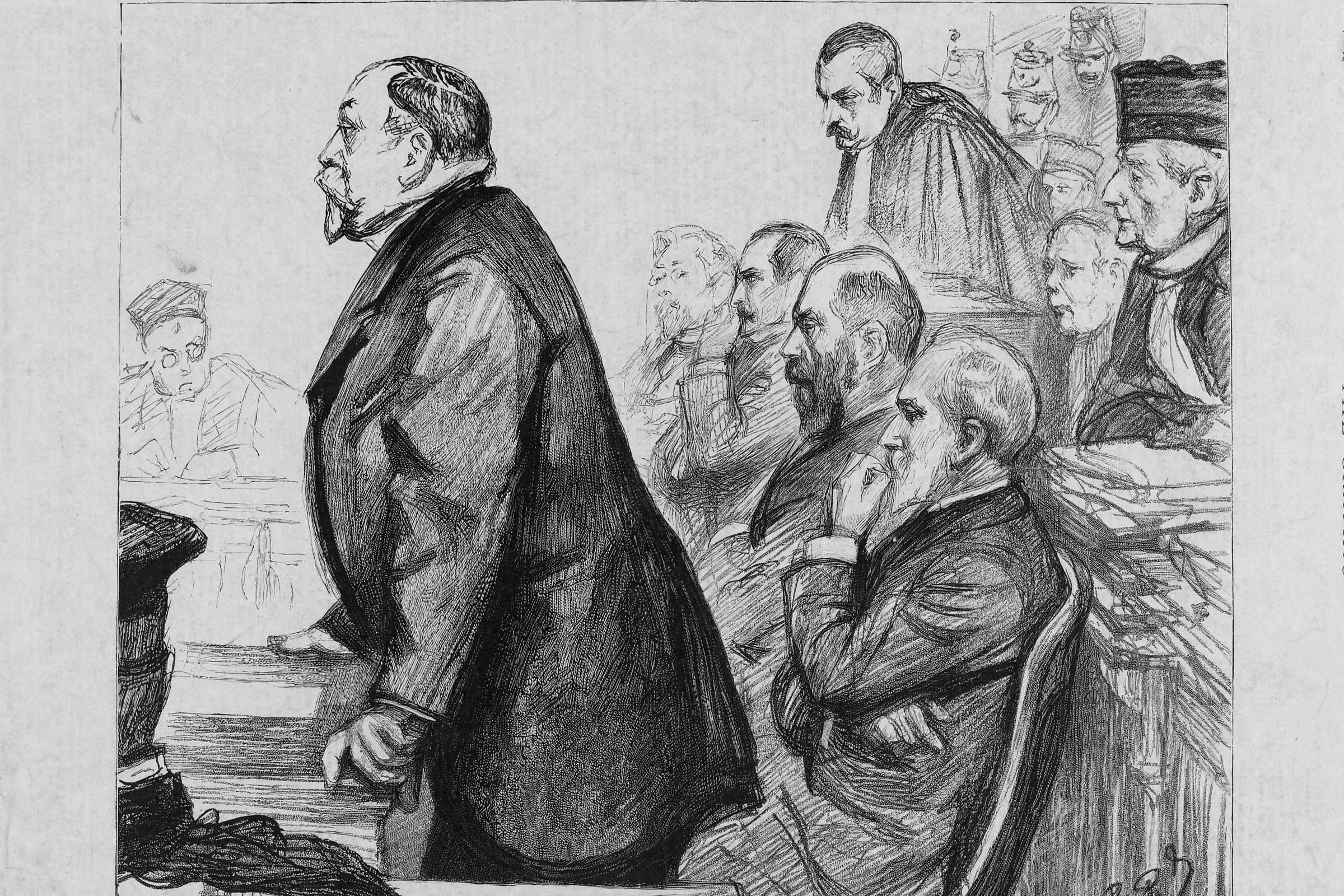
The Panama Canal Company directors’ trial at the Palais de Justice in 1893: the episode that nearly erased Eiffel’s public standing. Credit: Paul Renouard, anonymous engraver / The Graphic / Paris Musées, Musée Carnavalet, CC0 1.0. Digital restoration and editorial crop: oui stars Travel, 2026; non-generative.
Eiffel’s career cannot be reduced to triumph. In 1887 he accepted a contract connected with the failing French attempt to build the Panama Canal, proposing a lock-based solution after the original sea-level plan had encountered catastrophic difficulties. The canal company collapsed in 1889 amid financial ruin, political scandal and accusations of corruption.
Eiffel was drawn into the resulting prosecutions. On 9 February 1893, an appeal court convicted him of abuse of trust. He was detained while the case proceeded. On 15 June 1893, the Cour de cassation quashed the judgment because the prosecution was time-barred. This was not an acquittal based on a new finding about the merits of the allegations, and it should not be presented as one.
The scandal damaged his public reputation and helped end his direct career as a major contractor. It also opened a less familiar chapter. Eiffel turned increasingly toward scientific research, using the tower and his own resources as instruments.
The scientific second life of Gustave Eiffel
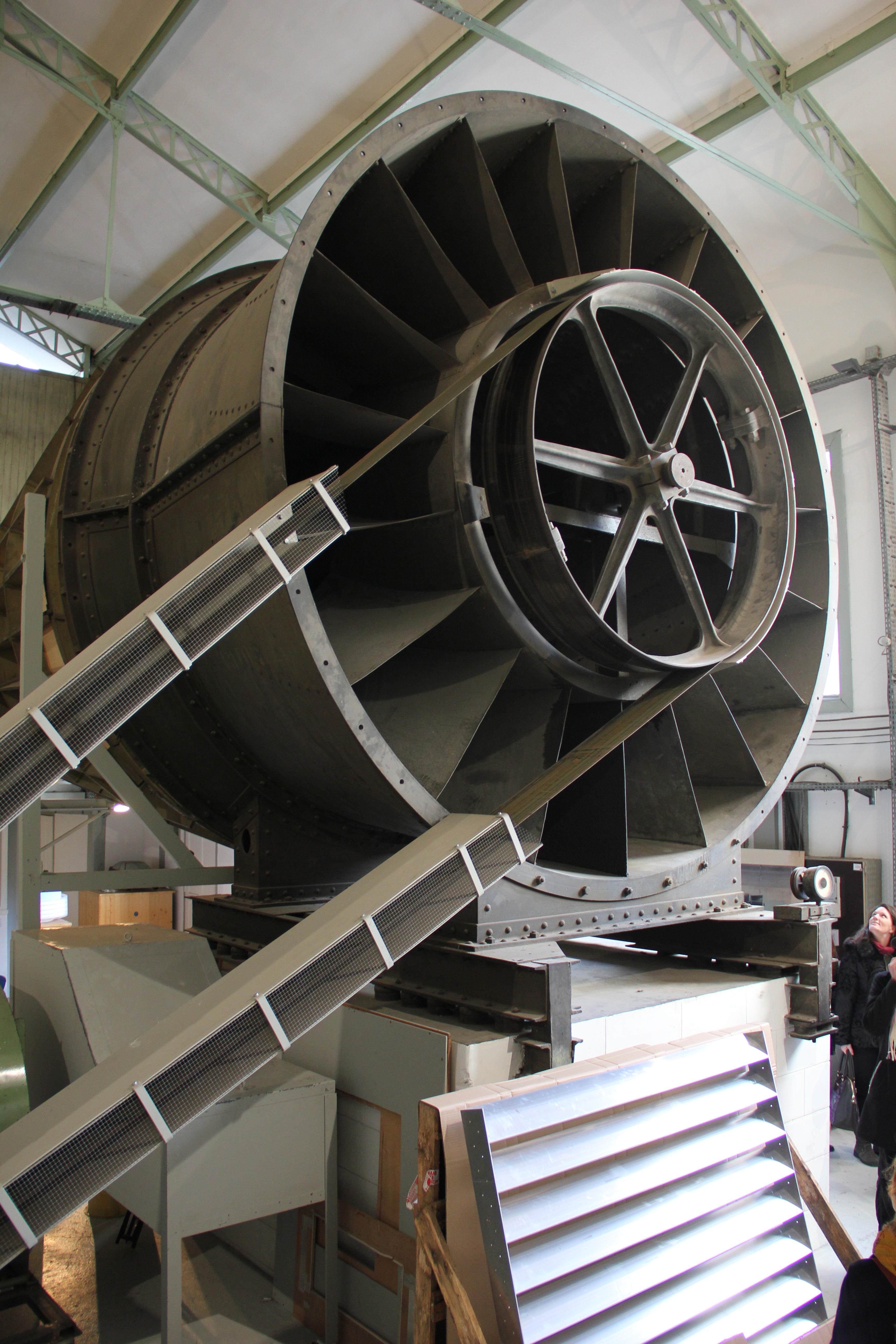
Eiffel understood that the tower needed a purpose beyond spectacle. Its height made it an exceptional laboratory. Meteorological observations began there, while experiments in wireless communication demonstrated its strategic value. In 1898, Eugène Ducretet established a radio link between the tower and the Panthéon. From 1903, Captain Gustave Ferrié pursued military radio tests from the monument. The permanent station that followed helped make demolition far less likely.
Eiffel’s own research concentrated increasingly on air resistance and aerodynamics. He conducted drop experiments from the tower, then built a wind tunnel near its base in 1909. In 1912, the laboratory moved to Auteuil, where the facility associated with his name continues to operate at 67 rue Boileau.
These experiments linked structural engineering to the emerging worlds of aviation and automotive design. Eiffel tested shapes in controlled airflow and published results intended to be reproducible. The same intellectual habit runs through the bridges, the tower and the laboratory: replace intuition with measurement, but never lose sight of form.
Major works and the people behind them
| Work | Date | Eiffel’s role and essential shared credit |
|---|---|---|
| Garonne railway bridge, Bordeaux | 1858 to 1860 | An early site responsibility that established Eiffel’s experience with major foundations, logistics and railway construction. |
| Maria Pia Bridge, Porto | Completed 1877 | Built by Eiffel et Cie from the design of Théophile Seyrig. A defining example of the firm’s international bridge work. |
| Garabit Viaduct, Cantal | Built in the 1880s | Created with engineer Léon Boyer; Maurice Koechlin contributed major structural calculations within Eiffel’s organisation. |
| Statue of Liberty internal structure, New York | Completed in France in 1883 | Eiffel developed the internal iron support for Bartholdi’s copper sculpture after Viollet-le-Duc’s death. |
| Nice Observatory dome | 1880s | Eiffel engineered the mobile iron dome for the observatory complex designed by architect Charles Garnier. |
| Eiffel Tower, Paris | 1887 to 1889 | Initial concept by Maurice Koechlin and Émile Nouguier, architectural refinement by Stephen Sauvestre, realised through Eiffel’s advocacy, financing and industrial organisation. |
| Auteuil aerodynamic laboratory, Paris | From 1912 | A research facility that carried Eiffel’s experimental work into modern aerodynamics. |
Where to see Gustave Eiffel’s work
These places reveal different sides of Eiffel’s career. Access conditions change, so confirm official information before travelling. The practical details below were checked on 18 September 2026.
| Place | Address and access | What to notice |
|---|---|---|
| Eiffel Tower Paris, France | 5 avenue Anatole France, 75007 Paris. Official hours checked for 18 September 2026: 09:30 to 23:00. Adult rates shown by the official site: €14.80 by stairs to the second floor, €23.50 by lift to the second floor, €28 by stairs plus lift to the summit, and €36.70 by lift to the summit. Book through the official tower website and recheck on your visit date. | Look past the silhouette. From beneath the monument, the four piers show how loads travel into the foundations. On the upper levels, the lattice becomes a constantly changing frame for Paris. |
| Aérodynamique Eiffel Paris, France | 67 rue Boileau, 75016 Paris. This is an operating laboratory, not a conventional museum and not open for casual walk-in visits. Access is generally limited to prearranged groups or announced heritage programmes. | The surviving wind tunnel connects Eiffel’s late scientific work with modern research into buildings, vehicles and airflow. |
| Garabit Viaduct Cantal, France | Viewpoints are accessible from local approaches including the D909 and D13, and from the Garabit area on the A75. The Maison du Cantal presents a permanent display. The railway remains operational, so visitors must not enter the tracks or structure. | See the relationship between the great parabolic arch, the slender deck and the scale of the Truyère valley. Late light intensifies the viaduct’s red ironwork. |
| Observatoire de la Côte d’Azur Nice, France | 96 boulevard de l’Observatoire, 06300 Nice. Historic buildings are normally visited through guided, advance-reservation programmes. Check current dates and availability before travelling. | Charles Garnier’s architecture and Eiffel’s moving dome create an unusual conversation between monumental classicism, iron engineering and astronomy. |
| Maria Pia Bridge Porto, Portugal | Spanning the Douro between Porto and Vila Nova de Gaia. The bridge ceased carrying rail traffic in 1991 and is not an open pedestrian crossing. View it safely from public riverbank locations and recognised viewpoints. | Compare Seyrig’s concentrated arch with the broader river landscape. The bridge is essential for understanding the Eiffel firm’s achievements before the Paris tower. |
| Statue of Liberty New York, United States | Liberty Island, reached only by the authorised ferry operator. Pedestal and crown access require separate advance reservations and are subject to security and availability. | The iron support is largely hidden, but museum interpretation helps explain how Eiffel’s pylon and flexible secondary structure carry Bartholdi’s copper skin. |
A legacy larger than one silhouette
Eiffel died in Paris on 27 December 1923. By then the tower had begun to escape its original status as an exhibition structure. Radio gave it utility. Tourism gave it ritual. Photography, cinema and advertising turned it into a universal shorthand for Paris and France.
Yet his most relevant legacy is not the reproduction of the tower’s shape. It is a working culture. Calculate rigorously. Invite specialist talent. Fabricate precisely. Plan assembly before materials reach the site. Let structure express the forces it carries. Use an engineering problem as an opportunity for public imagination.
That legacy also demands accurate attribution. Théophile Seyrig belongs in the history of Maria Pia. Léon Boyer and Maurice Koechlin belong in the story of Garabit. Bartholdi remains the sculptor of Liberty. Koechlin and Émile Nouguier originated the tower concept, Stephen Sauvestre transformed its architectural presence, and hundreds of workers made it stand. Eiffel’s genius was not diminished by this constellation. His genius was his ability to bring it into alignment.
The tower is therefore both an individual brand and a collective achievement. Its iron carries a lesson that feels surprisingly contemporary: the most powerful innovation may emerge when authorship is shared, responsibility is clear and a leader knows how to recognise an idea worth risking everything to build.
Watch: the tower tells its own story
In this official Eiffel Tower production, the monument narrates its own story through the episode Le jour où je suis devenue la tour Eiffel. The video remains hosted by the official SETE publisher and is embedded here without downloading, editing or rehosting.
Continue exploring the people who shaped France
- Georges-Eugène Haussmann: The Man Who Redrew Paris
- I. M. Pei: How the Louvre Pyramid Changed Paris
- Christian de Portzamparc: A French Vision That Changed Modern Architecture
- Why the Eiffel Tower Was Not Demolished
Editorial and image-rights note
oui stars Travel uses only commissioned photography, material supplied with explicit publication permission, public-domain works, or Creative Commons images whose licences allow the intended editorial use. Every published image in this feature carries its creator, source, licence or permission basis, source URL, access date, caption and descriptive ALT text in the production record. A visible credit is retained wherever the licence requires it.
The Eiffel Tower’s physical structure is in the public domain, but its nighttime illumination is protected as a separate artistic work. A nighttime hero or commercial editorial image must not be used without confirming the necessary SETE authorization. This feature therefore uses a rights-cleared historical portrait, daylight photography and archival material. The CC BY-SA wind-tunnel photograph remains inline and must retain ShareAlike compliance.
Sources and fact-checking
- Eiffel Tower official website: Who was Gustave Eiffel?
- Eiffel Tower official website: The Eiffel Tower’s history
- Eiffel Tower official website: Maurice Koechlin, the engineer without whom the Tower would not exist
- Eiffel Tower official website: Gustave Eiffel
- Eiffel Tower official website: The Eiffel Tower and science
- Eiffel Tower official website: Key figures
- Eiffel Tower official rates and opening times
- Eiffel Tower official access information
- Archives nationales: Gustave Eiffel, l’homme de fer
- United States National Park Service: Alexandre Gustave Eiffel
- Aérodynamique Eiffel: official visitor information
- Observatoire de la Côte d’Azur: official visit information
- Saint-Flour tourism: official Garabit Viaduct information
- Infraestruturas de Portugal: Maria Pia Bridge history and status
- Association des descendants de Gustave Eiffel: biographical chronology
- Académie des sciences: historical research on Eiffel’s scientific work
- Official Eiffel Tower video: Le jour où je suis devenue la tour Eiffel
Facts, rights records, access details and embedded-media availability checked 18 September 2026. Visitor conditions and prices can change; consult each institution before travel.