












What if the most desirable summer destination is no longer the hottest one? As heat reshapes European holiday decisions, a different map is appearing: sea cliffs instead of sun-baked squares, long Atlantic evenings instead of midday retreat, and Northern France within easy reach of Paris.
The question is timely. Is Northern France becoming a summer escape for travellers seeking milder conditions-or is “coolcation” simply a fashionable label placed over destinations that were already growing?
The evidence points to a real shift in attention, but not a single cause. Hauts-de-France recorded nearly 11 million tourist nights from April to September 2025, up 6.7% year on year, according to INSEE. International nights rose 12.9%, and campsite nights jumped 15.5%. Normandy recorded 83.0 million tourist nights in 2025, its third consecutive year above 83 million; international visitors accounted for 35.2%.
First, what does “coolcation” mean in 2026?
A coolcation is a summer trip chosen partly for milder weather. The term is not an official tourism category, so it should not be treated as a perfect statistical measure. It nevertheless reflects a visible behaviour: some travellers now compare temperature, shade, sea air and sleep comfort as seriously as price.
A Polarsteps survey reported by Euronews in June 2026 said 35% of British respondents had chosen a cooler destination that summer, with more than one in five doing so for the first time. This is a commercial survey, not government data, but it supports what northern tourism organisations are seeing.
Atout France has also said climate is becoming a determining variable in destination choice. Its June 2026 outlook projected international arrivals to France up 2.6% for June–August. That national forecast does not prove Northern France is taking market share, but it provides context for a strong summer.
The numbers behind Northern France’s momentum
Hauts-de-France: growth faster than the national summer pace
INSEE’s 2025 summer review is striking. Between April and September, regional accommodation recorded nearly 11 million nights, a 6.7% increase versus 4.5% for metropolitan France. Camping passed four million nights. Pas-de-Calais-home to much of the Côte d’Opale-was among the departments contributing to the rise.
The trend did not vanish in early 2026. INSEE’s monthly series showed hotel nights up 3.0% year on year in April and 0.8% in May. These are modest gains, but they matter because they follow a record 2025 rather than a weak base.
Normandy: scale, not a niche
Normandy’s 83 million nights in 2025 include commercial and non-commercial stays. The international share increased by 0.8 percentage point to 35.2%. Peak days still fell in the traditional high season-636,700 nights on 12 July and 605,200 on 15 August-showing that the region is already a major summer destination.
None of these figures isolates weather as the reason. Heritage, proximity to Paris and the UK, major anniversaries, outdoor travel and improved promotion all influence demand. The responsible conclusion is that Northern France is well positioned to benefit from the cooler-destination trend-not that climate explains every booking.
Côte d’Opale: France’s overlooked sea-cliff summer
From Cap Blanc-Nez and Cap Gris-Nez to Wimereux, Boulogne-sur-Mer and Le Touquet, the Côte d’Opale delivers expansive beaches, chalk cliffs, dunes and maritime light. On clear days, the English coast is visible across the Strait of Dover.
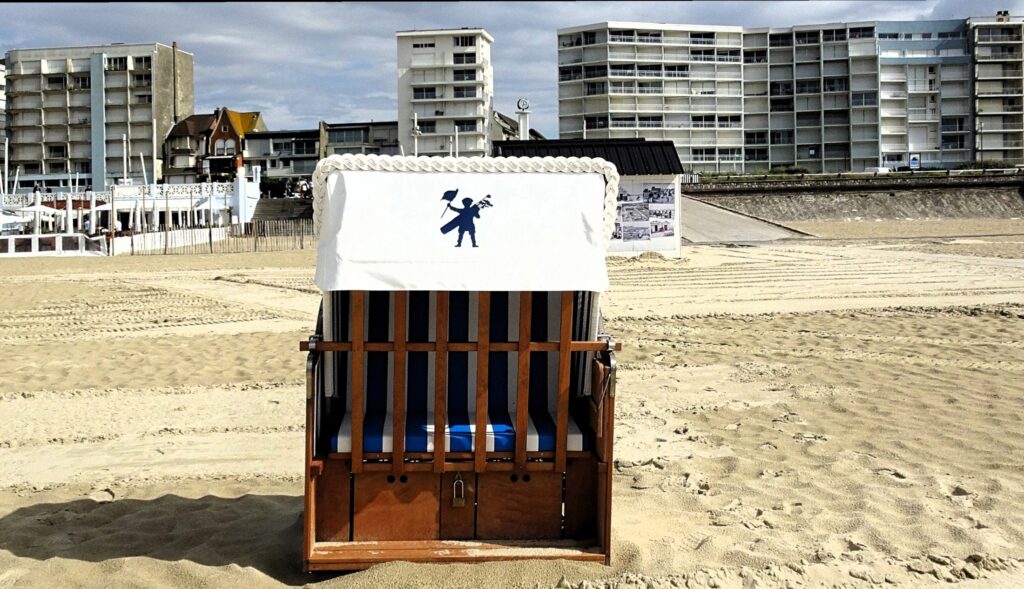
Why travellers choose it: walking, cycling, sailing, seafood, large beaches and a lower-intensity rhythm than many Mediterranean resorts. The trade-off: wind and rapidly changing weather are part of the experience. Pack a waterproof layer even when the forecast looks kind.
Le Touquet offers polished resort hotels and restaurants. Wimereux feels smaller and more architectural. Boulogne combines a working port, old town and Nausicaá. The Two Caps landscape is strongest for walkers and photographers.
Normandy: cliffs, resorts, memory and countryside
Étretat and the Alabaster Coast
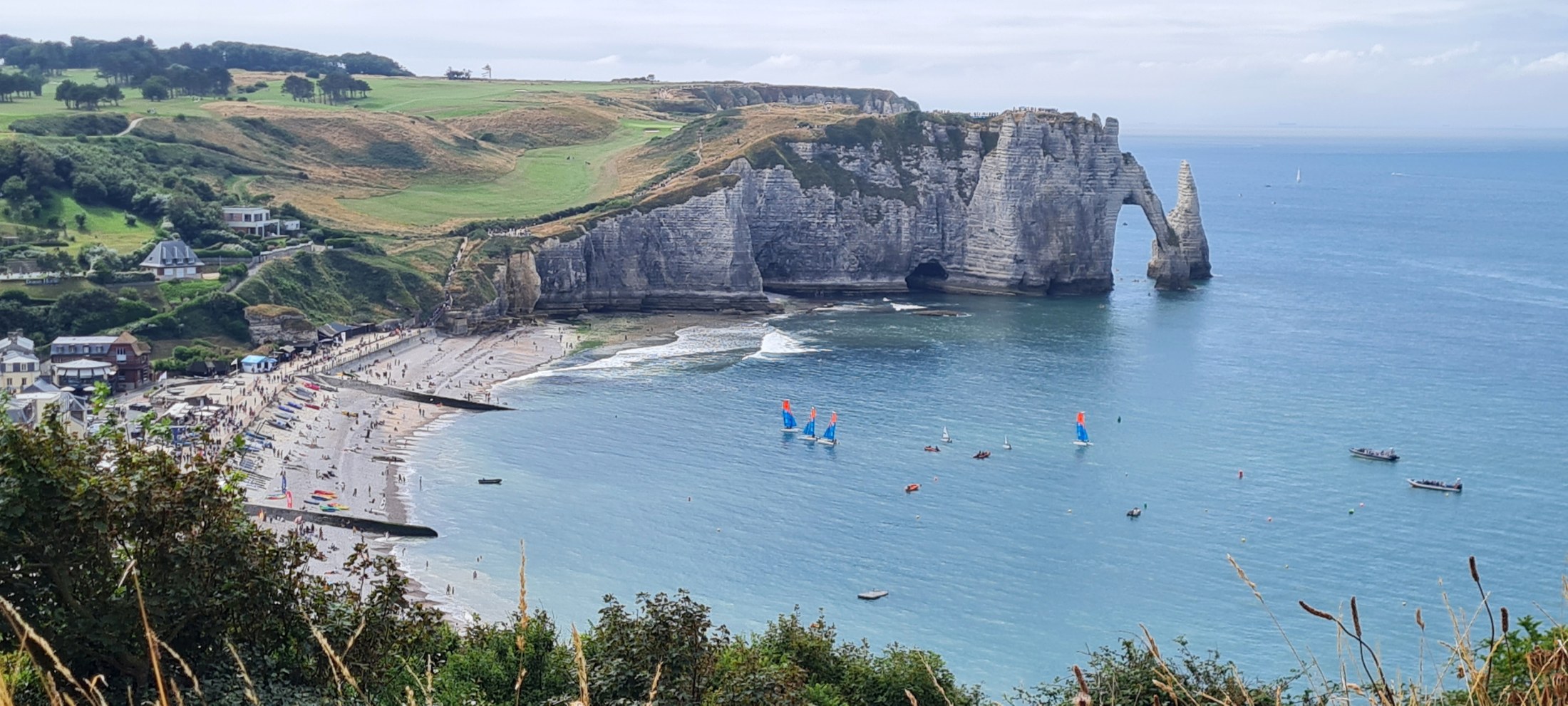
Étretat’s arches make it one of France’s most recognisable coastal landscapes. Arrive early or stay overnight: midday crowds can erase the calm that makes the cliffs extraordinary. Paths are exposed, and visitors must respect barriers and erosion warnings.
Deauville, Trouville and Honfleur
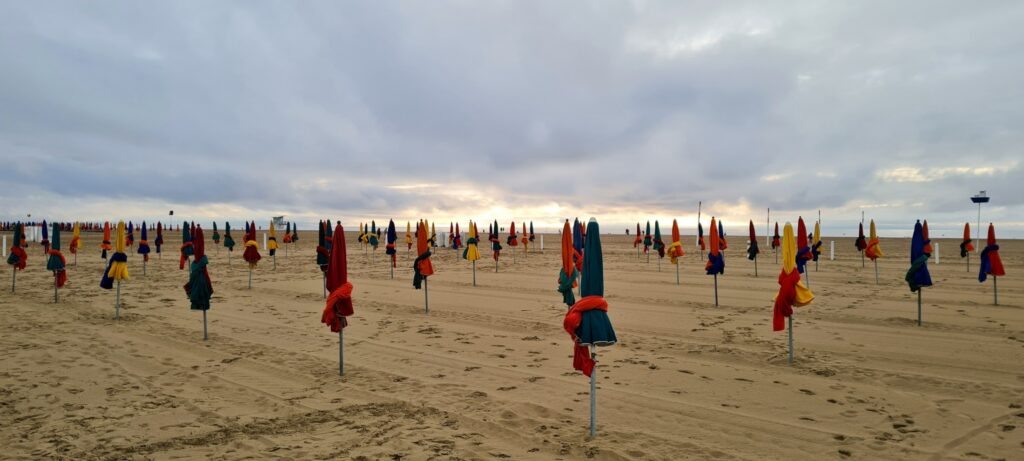
Deauville combines beach culture, hotels and events; Trouville feels more informal across the Touques; Honfleur adds a historic harbour and galleries. Together they work for a two- or three-night break from Paris.
D-Day coast and inland Normandy
The landing beaches demand time and context, not a hurried photo stop. Bayeux, Caen and the memorial landscape can anchor a deeper itinerary, while the Pays d’Auge, cider routes and villages offer a quieter second layer.
Readers planning a wider journey can use our 7-, 10- and 14-day France itineraries or our background feature on Omaha Beach and Normandy memory.
Is it actually cooler?
Often-but never guaranteed. Maritime influence can moderate daytime heat and bring cooler evenings, especially near exposed coasts. Yet Northern France can also experience heatwaves. “Cooler” is relative to hotter southern destinations, not a promise of cold weather.
Check Météo-France forecasts and heat alerts close to departure. Choose refundable arrangements, protect against sun on cliff walks, carry water and avoid treating cloud cover as protection from ultraviolet exposure.
How to plan a Northern France summer escape
- For 2 days: choose one coast-Côte d’Opale or the Deauville–Honfleur axis.
- For 3–4 days: combine a coastal base with one inland heritage day.
- By train: major gateways include Lille, Calais, Boulogne, Le Touquet-Étaples, Rouen, Deauville-Trouville and Caen; local connections require planning.
- By road: a car is valuable for cliffs, villages and memorial sites, but summer parking fills early.
- Book early: weekends, festivals and August peaks compress coastal inventory.
From Paris: when private transport makes sense
Rail is excellent for a city-to-city stay. A vehicle becomes more useful when the itinerary includes several coastal viewpoints, rural hotels, luggage, children or memorial sites in one day.
OUISTARS offers private chauffeur and tailored ground transport from Paris, including routes that can be built around Normandy. It is a commercial option, not a requirement; independent rail travel remains the right choice for many readers.
OUISTARS editorial verdict
Northern France is not suddenly “new.” Its coastlines, resorts and cultural landscapes have attracted travellers for generations. What is new is the value travellers place on summer comfort-and the data showing strong regional demand.
The Côte d’Opale and Normandy can credibly compete for visitors who want air, space, heritage and a flexible alternative to extreme heat. But their future advantage depends on protecting landscapes, managing peak days and avoiding the overcrowding that pushed travellers to look north in the first place.
Frequently asked questions
Is Northern France cooler than Southern France in summer?
Coastal Northern France is often milder, particularly at night, but heatwaves can still occur. Check the forecast rather than treating the region as guaranteed cool weather.
What is the best time for the Côte d’Opale?
Late spring through early autumn offers the widest range of outdoor options. July and August are busiest; June and September can feel calmer.
Can Normandy be visited as a day trip from Paris?
Yes, but choose one focused area. A multi-stop coast or D-Day itinerary is more rewarding with an overnight stay.
Are tourism numbers rising in Northern France?
Yes. INSEE recorded 2025 summer nights up 6.7% in Hauts-de-France, while Normandy maintained more than 83 million annual nights for a third year.
Sources
- INSEE: 2025 summer attendance in Hauts-de-France.
- INSEE: monthly hotel attendance, 2026.
- Normandie Tourisme: 2025 attendance.
- Atout France: June 2026 outlook.
- Euronews: 2026 coolcation survey context.
\n