

















A modern visitor’s guide to Omaha Beach, the Normandy American Cemetery, Pointe du Hoc and the D-Day sites that continue to draw American families to France.
From the bluff above Omaha Beach, the sea looks impossibly calm. Below, tide meets sand; behind, white crosses run across immaculate grass. An American visitor holds a page bearing a grandfather’s name. For a moment, Normandy is neither itinerary nor history lesson. It is distance made personal: one ocean crossed today, another crossed under fire.
That is why Americans still come. Some carry family stories; others know only a unit, photograph or date. Almost everyone leaves understanding that the D-Day landing beaches are living landscapes where sacrifice, gratitude and Franco-American friendship remain visible.
Omaha Beach: Where Geography Becomes History
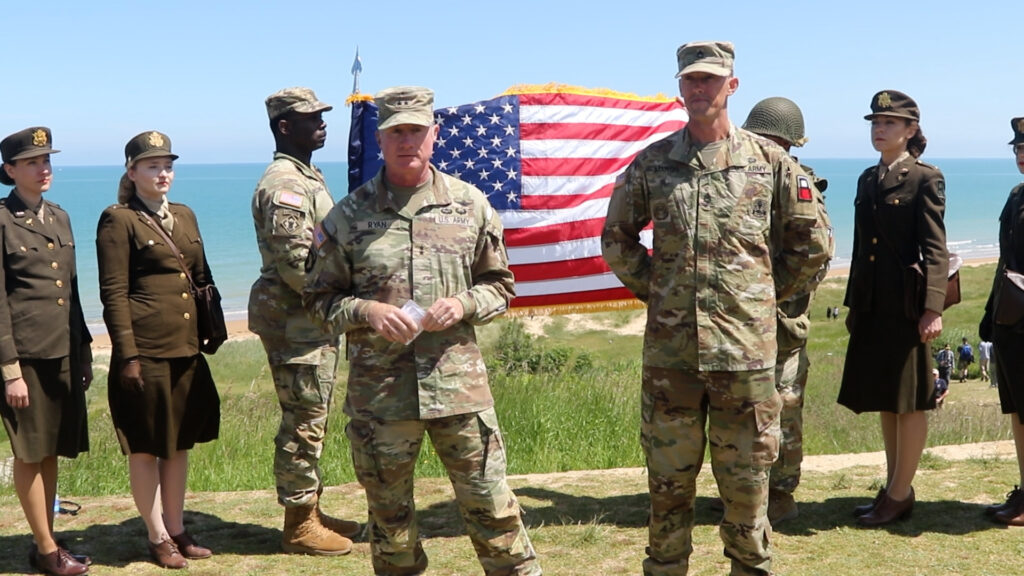
Walk onto Omaha Beach France at low tide and the scale becomes clear. The bluffs are farther away than photographs suggest; the open sand offers little shelter. On June 6, 1944, American troops faced a heavily defended coastline here. Today, wind and walkers occupy the space. That contrast makes an Omaha Beach tour from Paris so affecting.
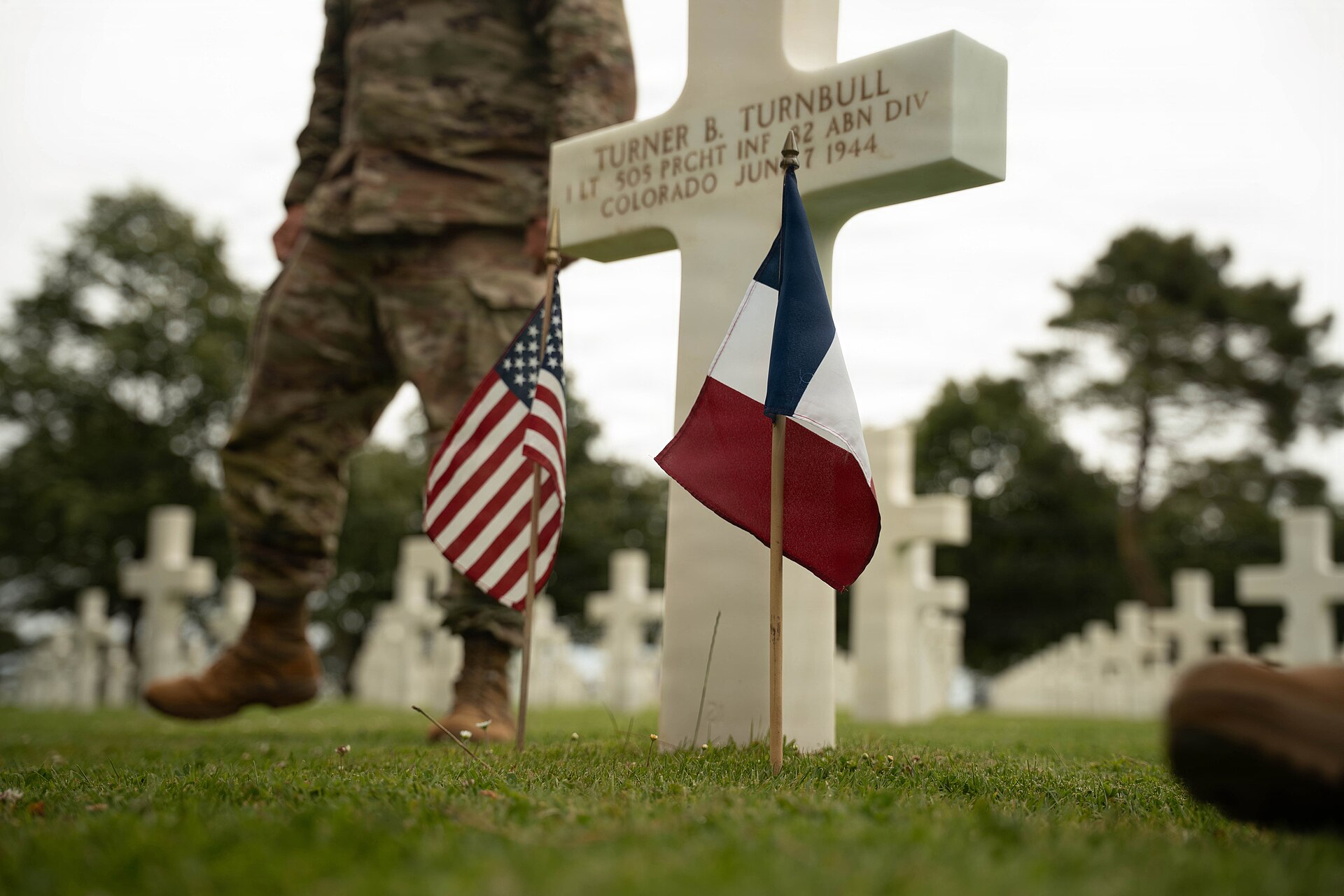
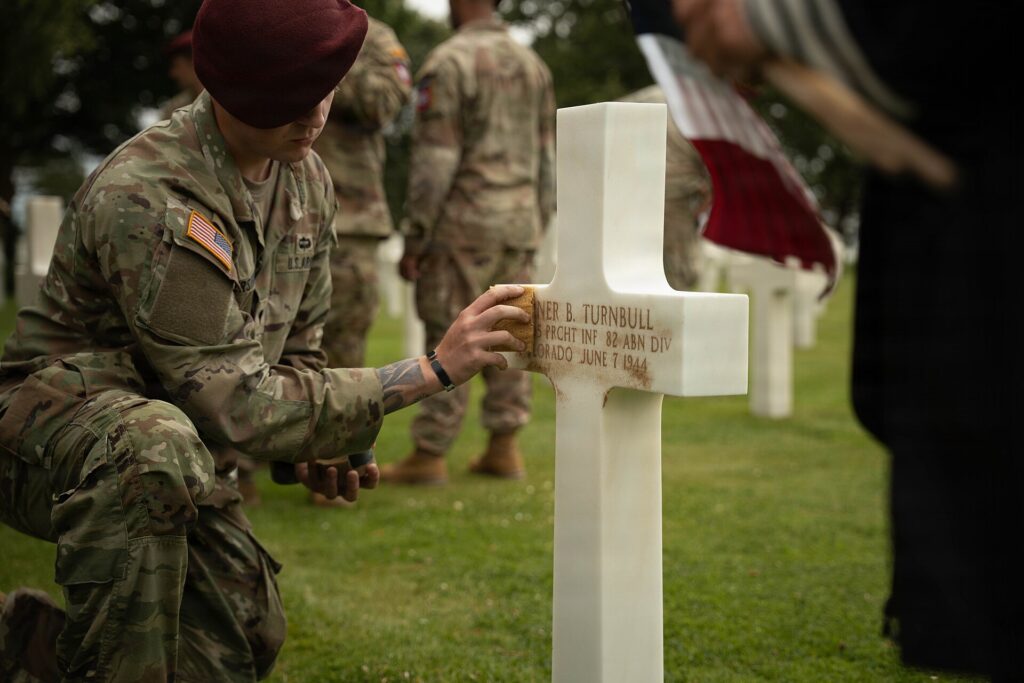
Above the shore at Colleville-sur-Mer, the Normandy American Cemetery and Memorial contains 9,389 graves; 1,557 names appear on the Walls of the Missing. The visitor center gives context before the lawns give it human scale. Remember that this is a burial ground, not a backdrop; the ABMC asks visitors to keep photography respectful.
The Essential Normandy D-Day Tour Route
Pointe du Hoc: The Edge of Courage
West of Omaha, Pointe du Hoc rises above the Atlantic. U.S. Army Rangers scaled its cliffs to silence German artillery positions. Bomb craters, bunkers and the Ranger Monument reveal why the mission seemed impossible. Paths are uneven and exposed, so bring sturdy shoes and a windproof layer.
Utah Beach and Sainte-Mère-Église
Continue west to Utah Beach, the second American landing sector, then inland to Sainte-Mère-Église. The 82nd and 101st Airborne Divisions landed around the town during the night of June 5–6. The Cotentin Bay Tourist Office calls it the first French commune liberated by American forces. Its church and memorials shift the story to the dangerous hours behind the coast.
Longues-sur-Mer and Arromanches-les-Bains
East of Omaha, the Longues-sur-Mer Battery retains original German guns overlooking the Channel. At Arromanches-les-Bains, remnants of the Mulberry artificial harbour still punctuate the water. These sites widen a Normandy D-Day tour beyond the American sectors, revealing the engineering and multinational coordination that sustained the Allied advance.
Connecting every major Normandy World War II site in one day reduces powerful places to parking stops. Choose Omaha Beach, the American Cemetery Normandy and Pointe du Hoc. With two days, add Utah Beach, Sainte-Mère-Église, Longues-sur-Mer and Arromanches.
Paris to Omaha Beach: The Best Route and Timing
Paris to Omaha Beach requires about three hours by road, depending on traffic. The official ABMC route follows the A13 toward Caen, then the N13 toward Bayeux and Formigny. Trains reach Bayeux from Paris Saint-Lazare, but local public transportation is intermittent; arrange onward and return transport before departure.
A private Normandy tour is valuable because the sites are dispersed and emotion cannot be scheduled. A Normandy tour with private driver allows time at a family grave, museum or quiet coastal stop. Relatives should contact the cemetery in advance; staff can locate graves, while special visits and wreath-laying requests require coordination.
oui stars, a travel and destination management company, can coordinate private transportation from Paris, hotel pickup and return, airport-to-Normandy transfers and tailored multi-site itineraries. Mercedes E-Class vehicles suit individuals, V-Class vehicles give families and small groups more luggage space, and S-Class vehicles offer discretion. English-speaking chauffeur support and customized stops help the day flow; request a qualified guide for detailed battlefield interpretation.
For broader planning, connect the journey with our guides to day trips from Paris, a premium CDG arrival or the standards behind private chauffeur travel in France.
Where to Stay and Eat in Normandy
Bayeux is the most practical base: walkable and well placed between eastern and western sites. Port-en-Bessin offers a quieter harbour near Omaha and the cemetery. Stay two nights for family research or museums; an early start reveals the coastline before day-trip crowds arrive.
Look for seafood in Port-en-Bessin, market produce in Bayeux, Norman cheeses and apple desserts. Reserve dinner during summer and June commemorations. Keep lunch simple, but never eat inside the cemetery grounds, where only water is permitted.
Why Younger Generations Still Need Normandy
For younger visitors, these World War II memorial sites gain power through specificity. A carved name, a soldier’s age, the distance from surf to bluff—each turns war into an individual consequence. Begin with one person rather than a catalogue of weapons: what did they leave behind, and what did their service make possible?
The best Normandy travel guide cannot manufacture emotion, and should not try. It can only create the conditions for attention: enough time, accurate context and silence where silence belongs. OUISTARS Travel Magazine treats Normandy not as an excursion to complete, but as a journey to carry home.
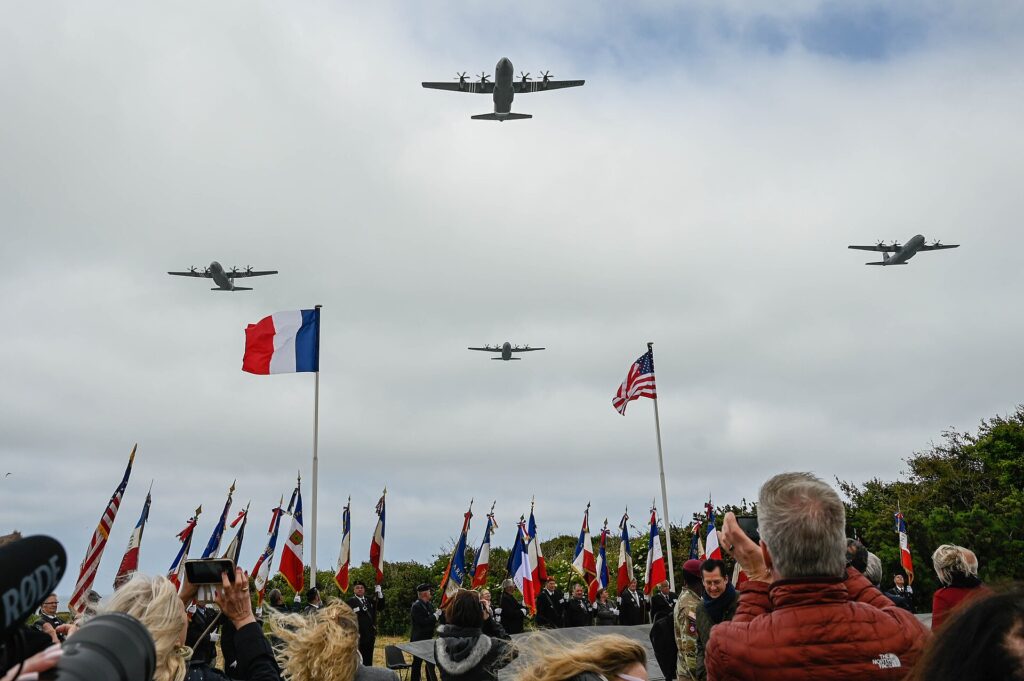
At day’s end, the crosses cast long shadows toward the sea. Gratitude is renewed each time an American family reaches France, a French flag stands beside an American one, and a younger visitor promises to remember a name they learned that morning.
Frequently Asked Questions
Can you visit the D-Day beaches from Paris in one day?
Yes. A long day can cover Omaha Beach, the Normandy American Cemetery and Pointe du Hoc. Two days are better for Utah Beach, Sainte-Mère-Église, Arromanches and Longues-sur-Mer.
Is the Normandy American Cemetery free to visit?
Yes. Admission is free. It is generally open daily except December 25 and January 1, but visitors should confirm current hours and operational notices with the ABMC.
How long is the drive from Paris to Omaha Beach?
Allow roughly three hours each way in normal conditions, with extra time for Paris traffic, breaks and summer or anniversary-period congestion.
What is the best Omaha Beach tour from Paris itinerary?
For a focused first visit, combine Omaha Beach, the American cemetery and Pointe du Hoc. Add Utah Beach and Sainte-Mère-Église on a second day.
Why choose a Normandy chauffeur service?
A Normandy chauffeur service coordinates widely separated sites, luggage, hotel pickup and flexible timing. A specialist historical guide can be added when in-depth interpretation is required.
OUISTARS private touring: Travellers planning a Normandy journey can explore OUISTARS chauffeur options for Normandy for a private vehicle, long-distance comfort and an itinerary tailored to the day.







.jpg)
.jpg)
.jpg)
.jpg)