












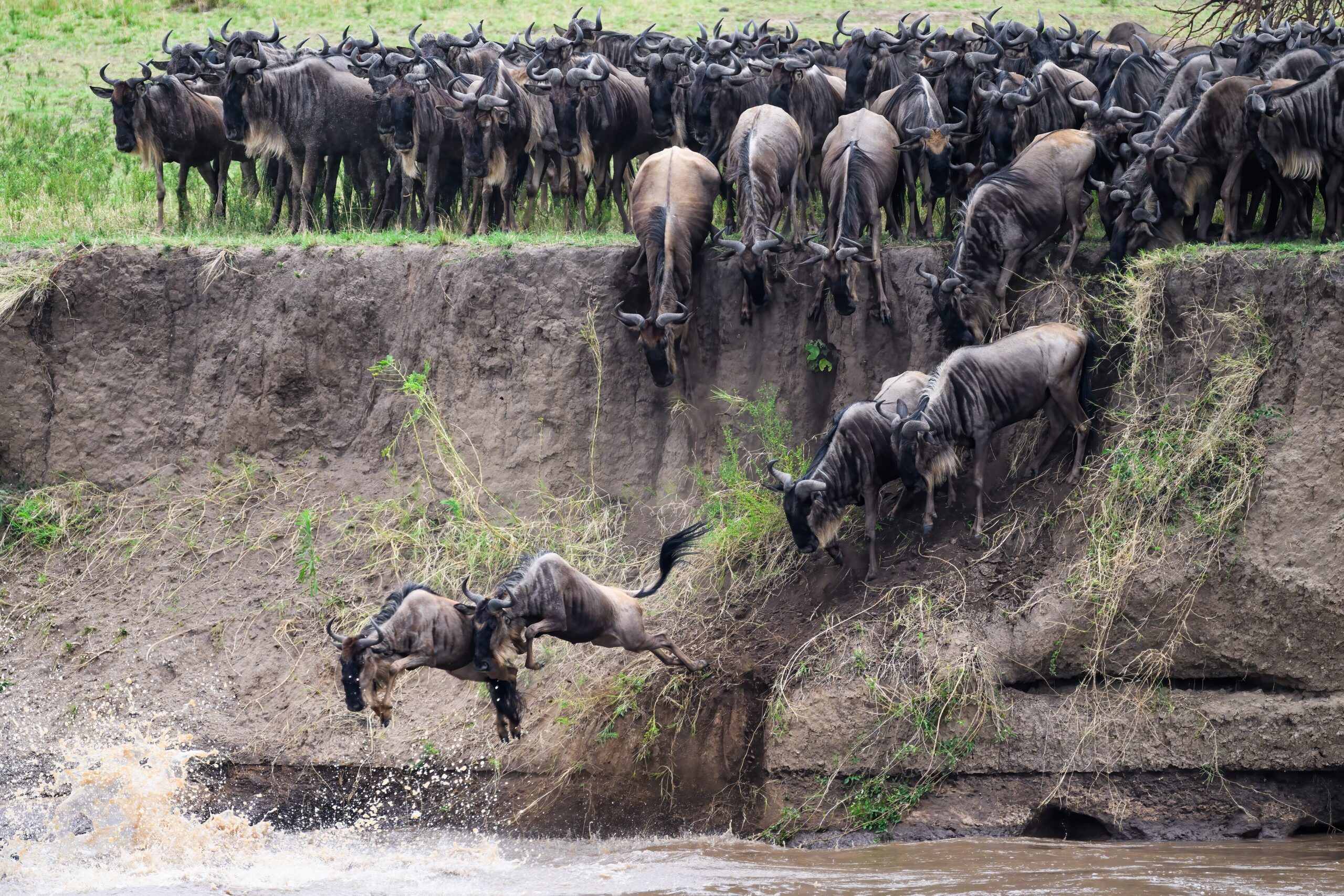
At first, nothing moves. The Mara River cuts a dark line through northern Serengeti, its surface carrying the quiet threat of current and crocodile. On the bank, thousands of wildebeest compress into a restless wall of horns, dust and instinct. One animal steps forward, retreats, and disappears back into the herd. Then another jumps. The bank seems to break open.
Within seconds, the silence becomes thunder. Bodies strike the water. Calves fight to keep their mothers in sight. The animals do not know about camera shutters, safari schedules or the travellers who have crossed continents to watch. They know only that grass and water lie somewhere beyond the obstacle in front of them.
This is not a spectacle staged for visitors. It is survival in motion—an ancient journey shaped by rain, hunger, birth and risk.
The Great Migration in Tanzania is often reduced to a single dramatic image: wildebeest plunging into the Mara River. The real story is larger. It is a year-round ecological cycle moving through southern, central, western and northern Serengeti, across a connected landscape that reaches into Kenya’s Maasai Mara and then turns south again. According to UNESCO’s Serengeti World Heritage assessment, more than one million wildebeest and hundreds of thousands of other ungulates complete an annual circular trek of approximately 1,000 kilometres. UNESCO describes it as the world’s largest remaining unaltered animal migration.
What Is the Great Migration?
The Great Migration is not a departure on one date and an arrival on another. It is a continuous search for grazing and water across the wider Serengeti–Mara ecosystem. Wildebeest form the numerical heart of the movement, accompanied by large numbers of zebras and gazelles. Predators—including lions, cheetahs, leopards and hyenas—follow opportunity rather than a route printed on a map.
The scale matters. UNESCO identifies Serengeti National Park as 1.5 million hectares of savannah at the centre of a much larger ecosystem. Its “endless plains,” rivers, woodlands and rocky kopjes support one of the planet’s most consequential predator–prey relationships. The migration fertilises grasslands, redistributes nutrients and sustains life far beyond the moving herds.
Great Migration: the essential facts
- Distance: approximately 1,000 km in an annual circular movement.
- Core landscape: Serengeti National Park and the wider Serengeti–Mara ecosystem.
- Main drivers: rainfall, fresh grass and access to water.
- Signature moments: calving on the southern short-grass plains, predator encounters, Grumeti movement and Mara River crossings.
- Most important planning truth: the migration has no fixed timetable.
A 1,000-Kilometre Cycle Written by Rain
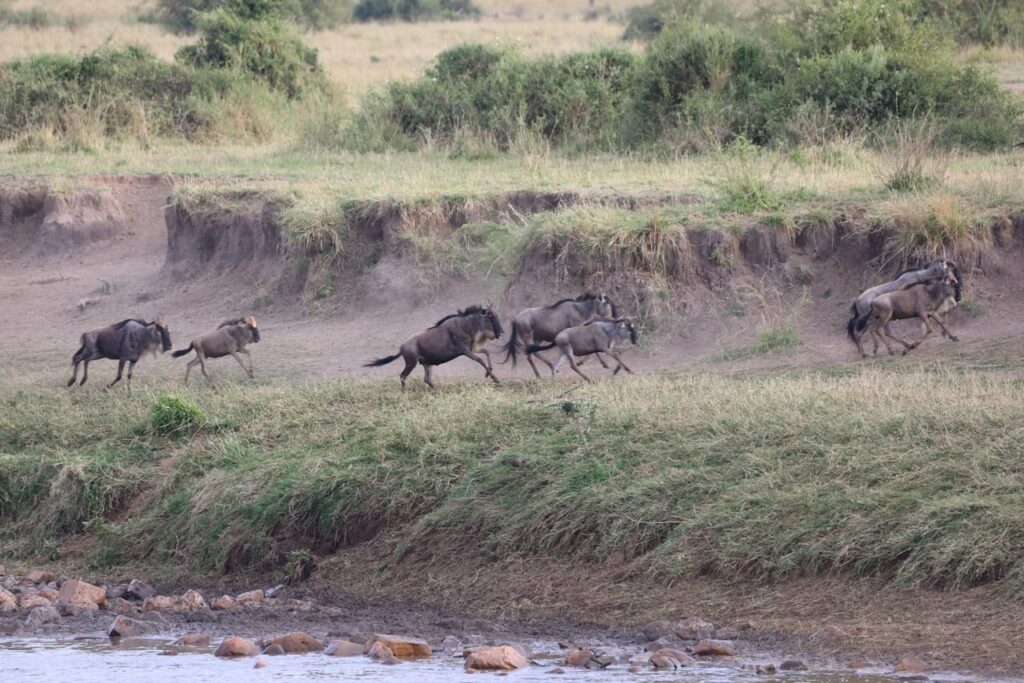
Maps often draw the migration as a neat clockwise loop. Nature is less tidy. Rain may fall early, late or unevenly. Grass can remain productive in one area while another dries. Separate columns of animals may take different routes, pause or disperse. The broad seasonal pattern is useful for planning, but it is a probability map—not a promise.
Southern Serengeti and the calving season
Early in the year, the short-grass plains spanning southern Serengeti and the Ngorongoro Conservation Area become one of the migration’s great nurseries. UNESCO confirms that huge numbers of wildebeest pass through this shared landscape and calve on plains straddling the two protected areas. Nutrient-rich grasses support mothers and newborns, while the concentration of vulnerable calves draws predators.
“Calving season” does not mean a gentle documentary scene. Birth and mortality coexist. A calf may stand within minutes, because remaining still is dangerous. For travellers, the emotional force lies not only in the quantity of animals but in seeing an ecosystem renew itself in real time.
Central Serengeti: movement, dispersal and predators
As conditions change, the herds begin moving through central sectors. This period can produce long files of wildebeest, dust-lit horizons and intense predator activity. Yet central Serengeti is not merely a transit corridor. Its resident wildlife makes it rewarding even when the main migration front is elsewhere.
The western corridor and the Grumeti
The official Tanzania Tourism portal notes that many animals cross the western corridor’s Grumeti River as the herds move north from southern breeding grounds. These crossings can be powerful, but the river, landscape and viewing conditions differ from the steeper, more famous Mara River scenes.
Northern Serengeti and the Mara River
By the northern phase, travellers focus on river zones along the Tanzania–Kenya borderlands. A crossing may begin suddenly after a long stand-off. It may happen at a distant bend. A herd may approach, turn away and return the following day. Crocodiles, current, steep banks and panic create obvious danger, but trampling and separation are equally real.
Why the Migration Cannot Be Put on a Timetable
The internet is full of month-by-month calendars. They are useful only when read as seasonal guidance. Rainfall controls grass growth and water availability; both influence where the herds go next. A storm many kilometres away can change grazing conditions. A dry spell can hold animals back. The Mara River itself is vital dry-season water, making the ecosystem particularly sensitive to drought and water-flow disruption.
This is why responsible safari planning uses current field information, geographic flexibility and enough time in the likely region. Anyone selling a guaranteed river crossing is selling certainty that the ecosystem does not provide.
When to Travel: Choose the Experience, Not Just the Month
| Broad period | Likely focus | What to expect | Planning reality |
|---|---|---|---|
| January–March | Southern Serengeti / Ndutu region | Calving, large nursery herds, predator activity and green plains | Excellent for life-cycle drama; local rains influence distribution. |
| April–May | Central and western movement | Green landscapes, shifting columns and fewer vehicles in some areas | Rain can affect roads and flight logistics; movement is fluid. |
| June–July | Western to northern progression | Large herds, drier conditions and possible river activity | Exact location varies; combine recent guide intelligence with a flexible route. |
| August–October | Northern Serengeti / Mara River zone | The best-known window for seeking northern river-crossing drama | High demand and no crossing guarantee; allow several nights. |
| November–December | Return southward with short rains | Freshening plains, dispersed movement and changing light | Rainfall determines speed and route; the cycle does not “end.” |
These periods are broad ecological patterns, not fixed appointments. Check current park conditions with licensed, field-based professionals before confirming camp locations.
What Travellers Can Realistically Expect
A serious migration safari is an exercise in attention. Some mornings deliver an immense horizon of animals. Others are spent reading tracks, circling toward reports from another sector or waiting beside an apparently empty riverbank. Wildlife viewing can begin before sunrise and involve hours on rough roads. Dust, heat, rain and distance are part of the experience.
Travellers should ask practical questions before booking:
- Is the camp positioned for the likely seasonal movement, or chosen mainly for price?
- How many nights are allocated in the relevant Serengeti region?
- Will the vehicle be private or shared, and what are the luggage limits on bush flights?
- How does the operator receive current information from guides in the field?
- What happens if rain shifts the herds?
- Are park fees, transfers, domestic flights and conservation charges clearly itemised?
For photographers, patience matters as much as equipment. For families, realistic drive times, child-appropriate camps and private-vehicle flexibility can transform the journey. For honeymooners and luxury travellers, an extraordinary lodge is valuable—but location and guiding remain more important than thread count.
Tanzania Beyond the Herds
The migration makes Tanzania globally recognisable, but it should not make the rest of the country invisible. A well-designed northern circuit can connect Serengeti with Ngorongoro, where wildlife, geological drama and human history share the same protected landscape. Tarangire adds baobab country and elephant-rich safari scenery. Kilimanjaro offers a different physical and emotional challenge; the Tanzania Tourist Board records its height at 5,895 metres and identifies it as Africa’s highest mountain.
Zanzibar changes the rhythm again: Indian Ocean light, Swahili culture and island time after days of dust and dawn departures. The combination explains Tanzania’s strength as a major safari destination: it can join wildlife, mountain, culture and coast without forcing every traveller into the same itinerary.
Conservation, Communities and the Cost of a Great View
Being present in Serengeti creates responsibility. UNESCO warns that tourism pressure—including infrastructure, traffic, waste and disturbance—can threaten the integrity of protected landscapes. Responsible travel therefore means more than choosing an “eco” label.
- Never ask a driver to crowd, block or chase wildlife.
- Respect viewing distances and park-road rules.
- Keep noise low at sensitive encounters and riverbanks.
- Reduce waste and avoid single-use materials where possible.
- Choose guides who explain ecology and culture, not only sightings.
- Support local employment and community-linked experiences that are conducted respectfully.
- Accept that an animal’s welfare is more important than a photograph.
The Ngorongoro landscape also reminds visitors that northern Tanzania is lived-in cultural territory. UNESCO recognises the coexistence of wildlife and semi-nomadic Maasai pastoralism in the conservation area. Cultural visits should be based on consent, dignity and genuine exchange—not treating people as scenery beside the safari.
Local Contributor: James Tours Africa
Local perspective and company information for this feature were contributed by James Tours Africa. Wildlife, geographic and conservation claims in this article were independently checked by OUISTARS Travel Magazine against UNESCO, Tanzania National Parks and official Tanzania tourism sources.
James Tours Africa was founded in 2021 by James Mjwahuzi Felix, Founder & Director, and is based in Tanzania. The company works across Tanzania, Kenya and Uganda. Its services include wildlife safaris, Great Migration journeys, Kilimanjaro trekking, Zanzibar holidays, cultural experiences, camping, family and honeymoon travel, luxury safaris and tailor-made itineraries.
- Website: James Tours Africa
- Instagram: @jamestoursafrica
- Facebook: James Tours Africa TZ
- TikTok: @jamestoursafrica
This contributor note is included for transparency. The Great Migration and Tanzania—not any single operator—remain the subject of this independent editorial feature.
Nature Does Not Wait for Us
Long after the last safari vehicle turns toward camp, the migration continues. Somewhere beyond the headlights, a mother calls for a calf. A line of wildebeest changes direction after rain. Predators wait. Grass rises where the herds have passed, and the great circle quietly redraws itself.
Travellers can choose a season, a camp and a guide. They can study maps and improve their odds. But they cannot command the river or summon the herd. That is precisely why the Great Migration endures as something greater than an attraction: it refuses to perform on human time.
Nature keeps moving. The privilege is not to control the journey, but to witness it responsibly.
Frequently Asked Questions
What is the Great Migration in Tanzania?
It is the continuous, circular movement of wildebeest and other grazing animals through the Serengeti–Mara ecosystem in search of fresh pasture and water. UNESCO describes a roughly 1,000-kilometre annual trek involving more than one million wildebeest and hundreds of thousands of other ungulates.
What is the best time to see the Great Migration?
There is no single best month for every traveller. The southern plains are associated with calving early in the year; the western and northern corridors become important as herds move north; and Mara River crossings are most often sought in the northern dry-season window. Rainfall can shift locations and timing.
Are Mara River crossings guaranteed?
No. Crossings are wild events, not scheduled performances. Herds may gather for hours or days, move to another point, cross before a vehicle arrives or not cross at all. A flexible itinerary and enough nights in the right region improve the odds, but no ethical operator should promise a crossing.
Is the Great Migration only in Tanzania?
The wider cycle is transboundary. Most of the annual movement unfolds in Tanzania’s Serengeti ecosystem, while some herds enter Kenya’s Maasai Mara before returning south.
How many days should a Serengeti migration safari last?
For a migration-focused journey, several nights in the region matching the likely seasonal movement are more realistic than a rushed one-night stop. Many travellers combine Serengeti with Ngorongoro, Tarangire, Kilimanjaro or Zanzibar according to time and interests.
How can travellers make a safari more responsible?
Choose licensed local expertise, follow park rules, keep respectful viewing distances, never pressure guides to crowd wildlife, avoid litter and support itineraries that value conservation and local communities as well as sightings.
Authoritative Sources
- UNESCO World Heritage Centre: Serengeti National Park
- UNESCO World Heritage Centre: Ngorongoro Conservation Area
- Tanzania National Parks (TANAPA): Serengeti
- Tanzania Tourist Board: Serengeti National Park
- Tanzania Tourist Board: Preserved Nature Landscapes
Continue exploring: Read more in Travel, Luxury Travel and OUISTARS Experiences & Advice.