











Series: The World, One Street at a Time
Deck: At breakfast, Rue Montorgueil is fruit crates, warm pastry and café voices. Behind that appetite lie the road that supplied Les Halles, an oyster economy, a royal pastry house, Monet’s river of flags and a painful human memory. This is the street’s full story—and a practical route for tasting it without reducing it to a checklist.
Byline: Osama Samaha — Editor-in-Chief, OUISTARS Travel
Fact-checked: 19 October 2026
At eight in the morning, Rue Montorgueil is still being assembled.
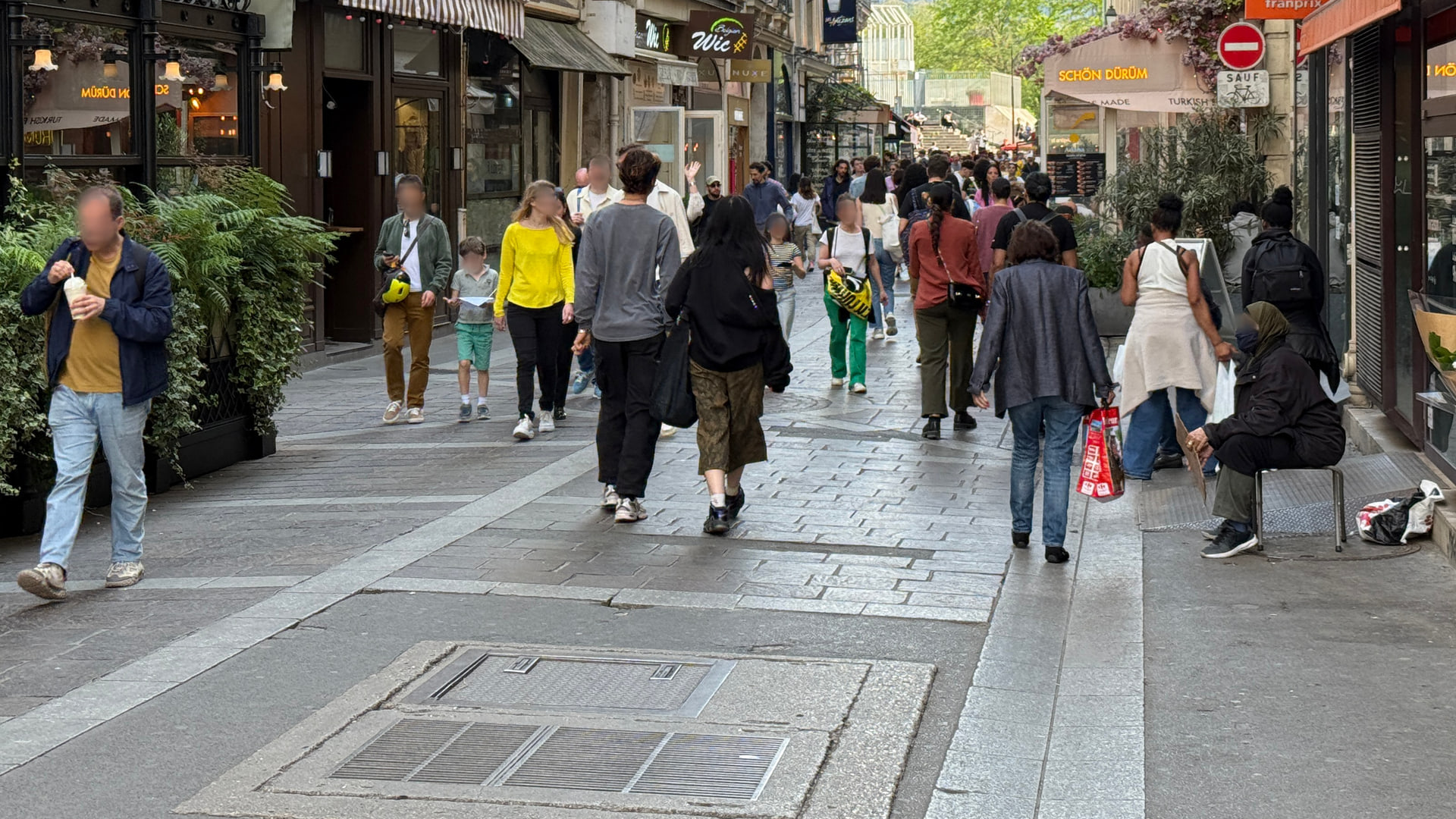
Shutters rise. Produce moves from crates to tilted displays. A delivery vehicle advances at walking pace through a zone where pedestrians have priority. At a café, the first cups are already on the terrace; at a pâtisserie, the day appears in polished glass before it appears on the pavement. Later, chairs, conversations and camera phones will tighten the passage. For now, the street belongs equally to work and appetite.
It is only 360 metres long. A determined walker could cross it in five minutes and leave with the wrong story.
Rue Montorgueil is often sold as ready-made “authentic Paris”: fruit, cheese, flowers, oysters, striped awnings and tables facing the street. The image is not false. It is incomplete. This was infrastructure before it was atmosphere—a route tied to the wholesale system that fed Paris, a place where coastal produce became metropolitan spectacle, and eventually a pedestrian success whose popularity changed the neighbourhood it preserved.
It also carries stories that do not fit on a menu. Here a young Republic turned itself into Monet’s river of tricolours. Near the northern end, a memorial recalls Jean Diot and Bruno Lenoir, arrested in this district in 1750 and executed for homosexuality. Between those layers stand a royal pastry house, a gilded snail, a protected oyster restaurant and the everyday businesses that keep the street from becoming a museum of its own reputation.
The best way to understand Rue Montorgueil is not to ask where to eat first. Ask what kind of city had to exist for this much history to arrive at the table.
Rue Montorgueil was infrastructure before it was atmosphere.
Why “Montorgueil”? A proud hill—and a literary rival
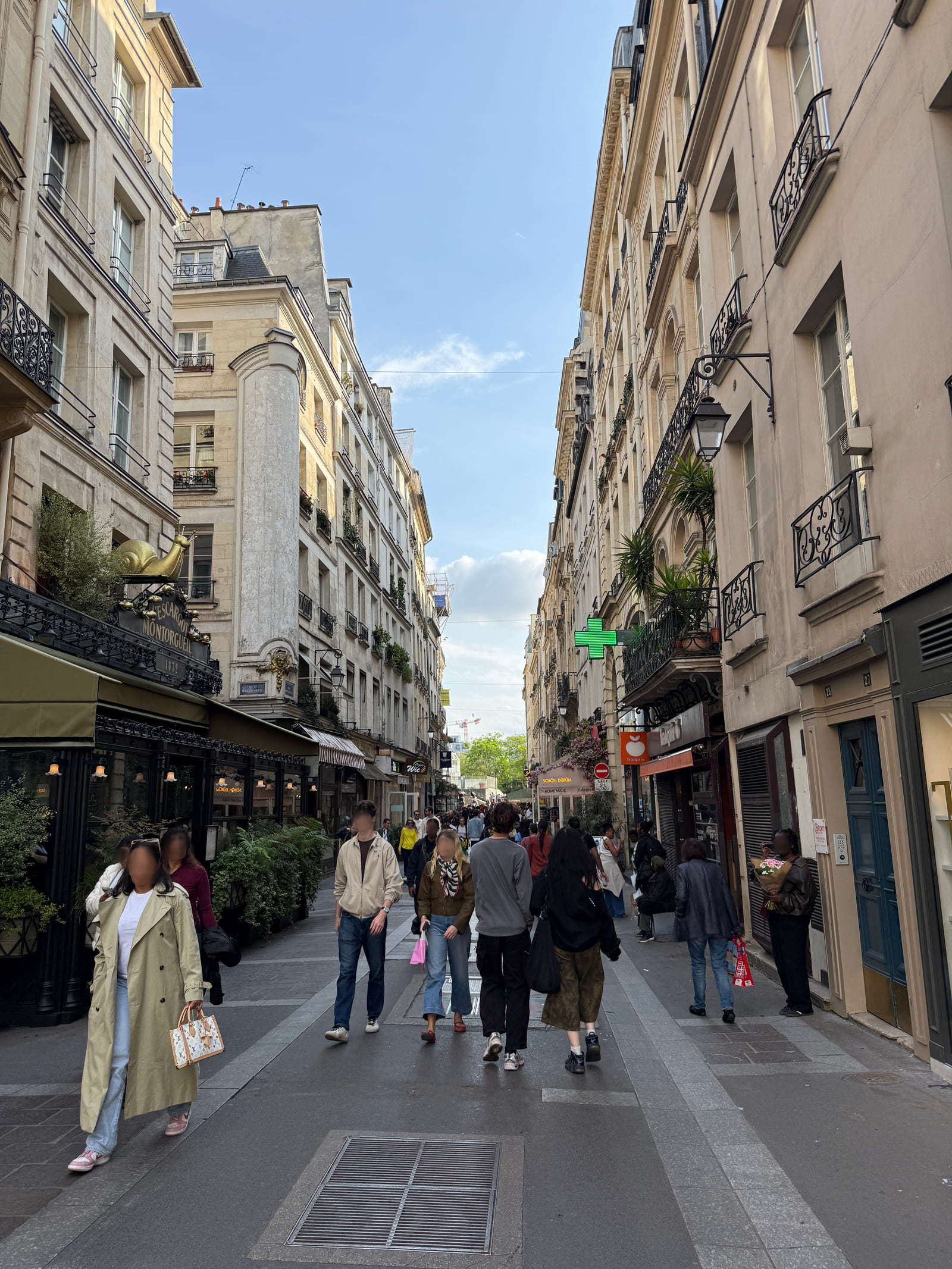
The City of Paris traces the name to the medieval Vicus Montis Superbi: the street of the “Proud Mountain,” or Mont Orgueilleux. The road pointed towards a rise whose summit lies around today’s Rue Beauregard, north of the present street.
The alternatives are more comic, which may be why they refuse to disappear. One tradition imagines a monumental refuse heap. Victor Hugo, in Les Misérables, offers a mechanical answer: an orgueil, he writes, was a kind of jack or support used to lift heavy loads. It is irresistible wordplay in a district built around carrying, hoisting and unloading.
It is not enough to overturn the municipal record. The honest version preserves the pleasure of the dispute: the City traces the name to a height; the rubbish heap and lifting tool survive as later hypotheses and literary afterlives.
The street itself was stitched together. Its southern section once carried versions of Rue au Comte- or Comtesse-d’Artois. It was joined to Montorgueil during the Revolution, separated after the Bourbon restoration and definitively reunited in 1830. Paris did not simply inherit this street. It edited it.
The boundary most guides walk straight past
The legal street begins behind Saint-Eustache, at 2 Rue Montmartre and 124 Rue Rambuteau. Rue Étienne-Marcel marks the passage from the First to the Second Arrondissement. Montorgueil ends at 1 Rue Léopold-Bellan and 59 Rue Saint-Sauveur.
The attractive pedestrian axis continues north, but its name changes to Rue des Petits-Carreaux. Calling the whole corridor “Rue Montorgueil” is convenient; it is also inaccurate. In a series built around streets and names, the line where one identity becomes another matters.
The road that carried fish and oysters into the belly of Paris
In 1137, Louis VI ordered Paris’s principal market moved to the Champeaux, the open ground that would become Les Halles. The Archives de Paris places the future market close to the crossroads of Rue Montmartre and Rue Montorgueil and identifies this axis with the road towards the Channel ports.
That geography shaped the street’s appetite. Fish and oysters travelled south from the coast into a city growing faster than its food system could comfortably handle. Rue Montorgueil was not a quaint destination on the edge of Les Halles. It was part of the machinery.
In the nineteenth century, oysters became both supply chain and street theatre. Municipal archives preserve an 1843 project by Victor Baltard for an oyster market here, followed by an 1845 ordinance regulating the opening and policing of an oyster hall. Images held by the Musée Carnavalet show the economy at human scale: baskets and shells, sellers and diners, wine, carts and food consumed in public.
The scene explains the modern terrace before the modern terrace existed. Eating could be public, noisy and socially mixed because wholesale food was all around it.
There was visual commerce too. The Bibliothèque nationale de France identifies a group of woodcut makers and print sellers active on Rue Montorgueil around 1550–1560, producing large popular images distinctive enough to be described as a “Rue Montorgueil school.” Long before streets became social-media feeds, this one manufactured images as well as meals.
Three addresses, three centuries of appetite
The famous façades reward precision. Rue Montorgueil is full of seductive claims of uninterrupted continuity. Its real history is more interesting: lineages break, businesses move, rooms are redecorated and a name can outlive its original address.
No. 38: the golden snail, with two dates attached
L’Escargot Montorgueil presents its story as beginning in 1832. The Ministry of Culture dates the restaurant at the present address to 1875 and its major decorative phase to around 1900, under Théodore Lecomte. Both dates belong in the story; they do not mean the same thing.
What the visitor sees at 38 Rue Montorgueil is a protected ensemble. The ground-floor rooms, frontage and ornaments were listed as historic monuments in 1998. Above the corner, the giant golden snail turns a dish into urban signage—an emblem legible before the menu.
The restaurant’s official site currently gives daily opening from noon to 11pm. Treat that as planning information, not a promise carved in stone: check again on the day, especially around holidays or private events.
No. 51: a royal pastry shop that learned to become a myth
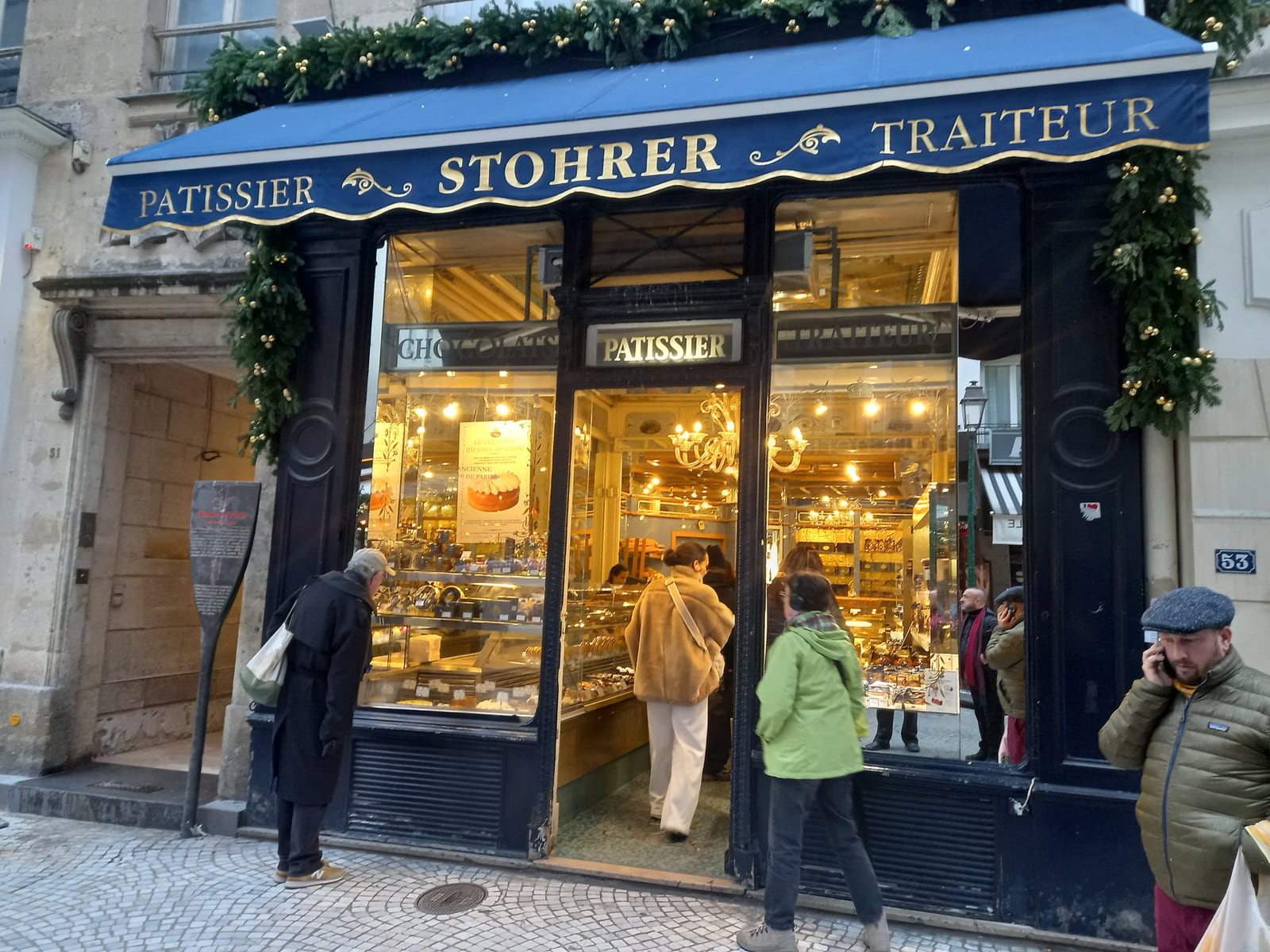
Stohrer was founded here in 1730 by Nicolas Stohrer, pastry chef to Louis XV. The house calls itself the oldest pâtisserie in Paris, a description also used by the official tourism office. “Pâtisserie” matters: it is not permission to inflate the claim into “the oldest bakery in Paris.”
The Ministry of Culture protects the street frontage, façade and interior decoration and attributes the painted décor to Thivot du Mur. That legal record takes precedence over looser descriptions associating the decoration with the circle of Paul Baudry.
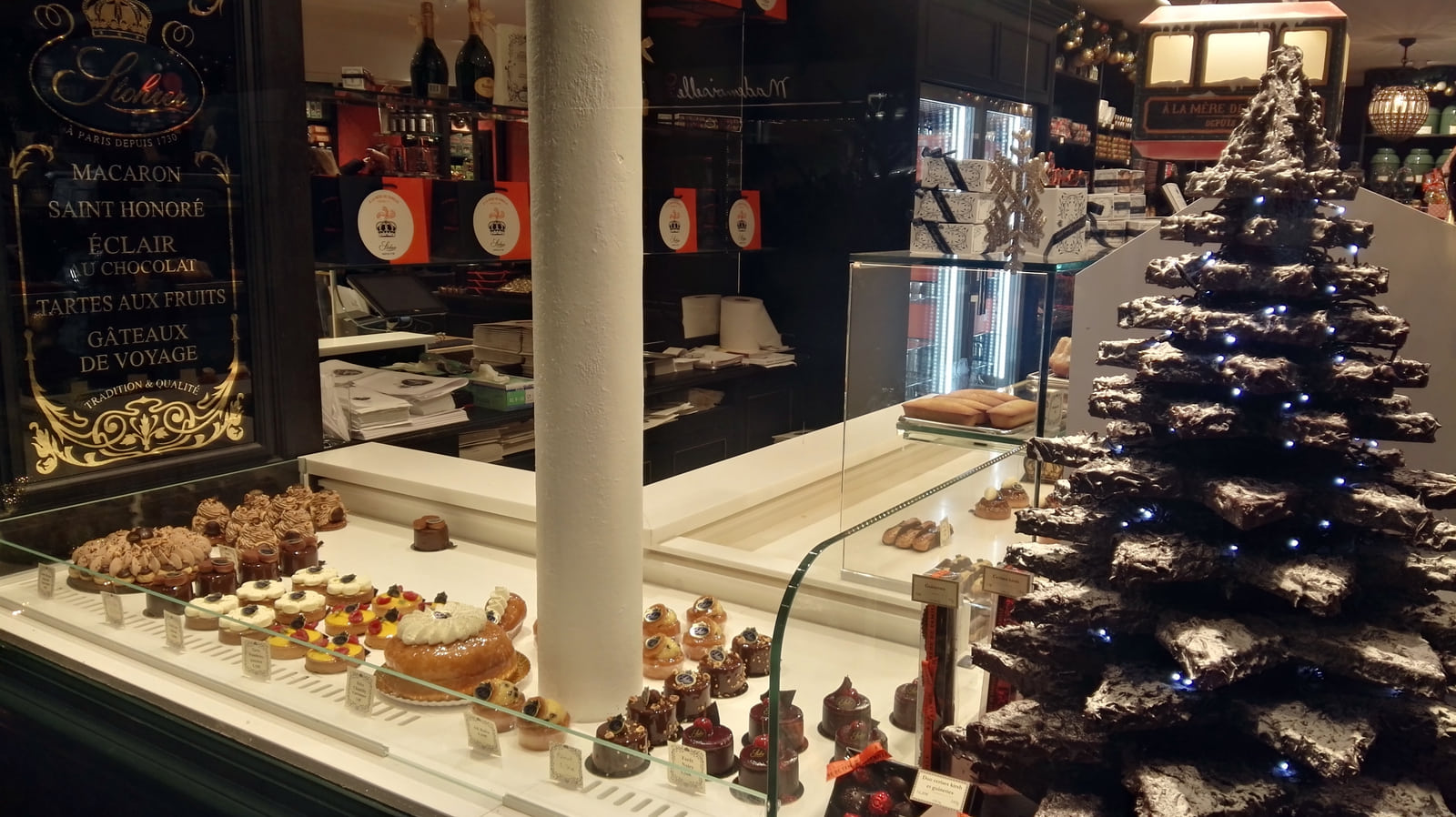
Stohrer’s own history credits its founder with the baba and other classics. Recipe origins are house tradition, not laboratory results. What is beyond dispute is the shop’s ability to turn continuity into a sensory experience: gilt, painted panels, pastry, packaging and a narrow threshold between heritage monument and working counter.
Current official hours are Monday–Saturday, 8am–8.30pm, and Sunday, 8am–8pm. Buy one thing you genuinely want. The most respectful form of heritage tourism is sometimes a transaction rather than a photograph.
No. 78: the Rocher de Cancale is a succession, not a single room
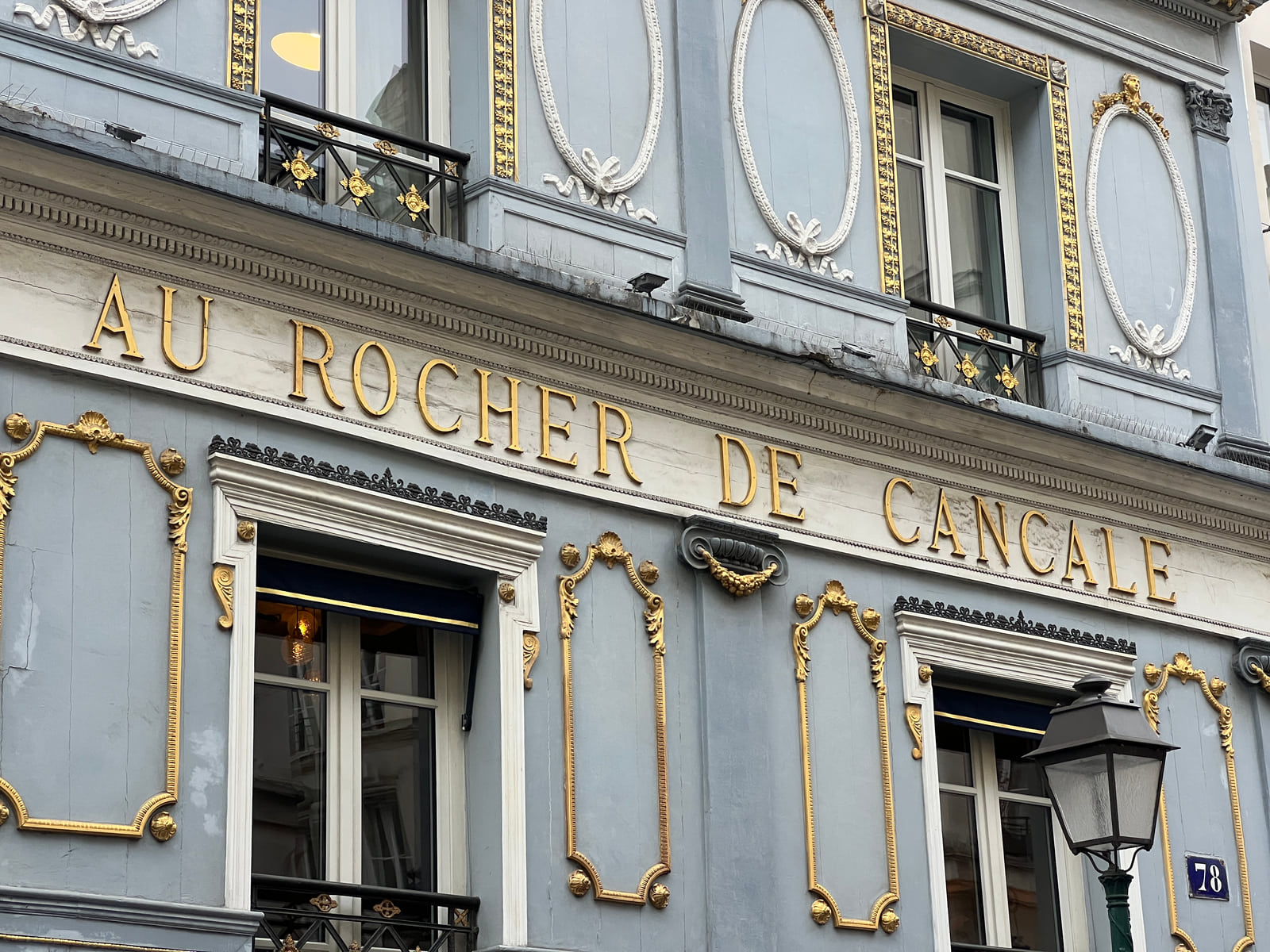
The original Rocher de Cancale opened in the early nineteenth century and became one of the great restaurant names of its age. Balzac helped carry it into literary Paris. But the Ministry of Culture records that the first establishment closed in 1846 and that the present successor opened immediately afterwards in a seventeenth-century building at 78 Rue Montorgueil.
That distinction protects the story from a tempting mistake. It is fair to say Balzac made the original Rocher famous. It is not fair, without stronger evidence, to place him at a particular table in the present dining room.
The surviving address has more than borrowed fame. Its mid-nineteenth-century shopfront and interior include painted panels attributed to Gavarni; the façades, corresponding roofs, corner sign and first-floor apartment were classified as historic monuments in 1997. Blue, gold and oyster memory meet at the corner of Rue Greneta.
At the time of research, no reliable first-party page for current hours was available. Admire the exterior freely; verify service directly before planning a meal.
Monet’s flags: 30 June 1878, not Bastille Day
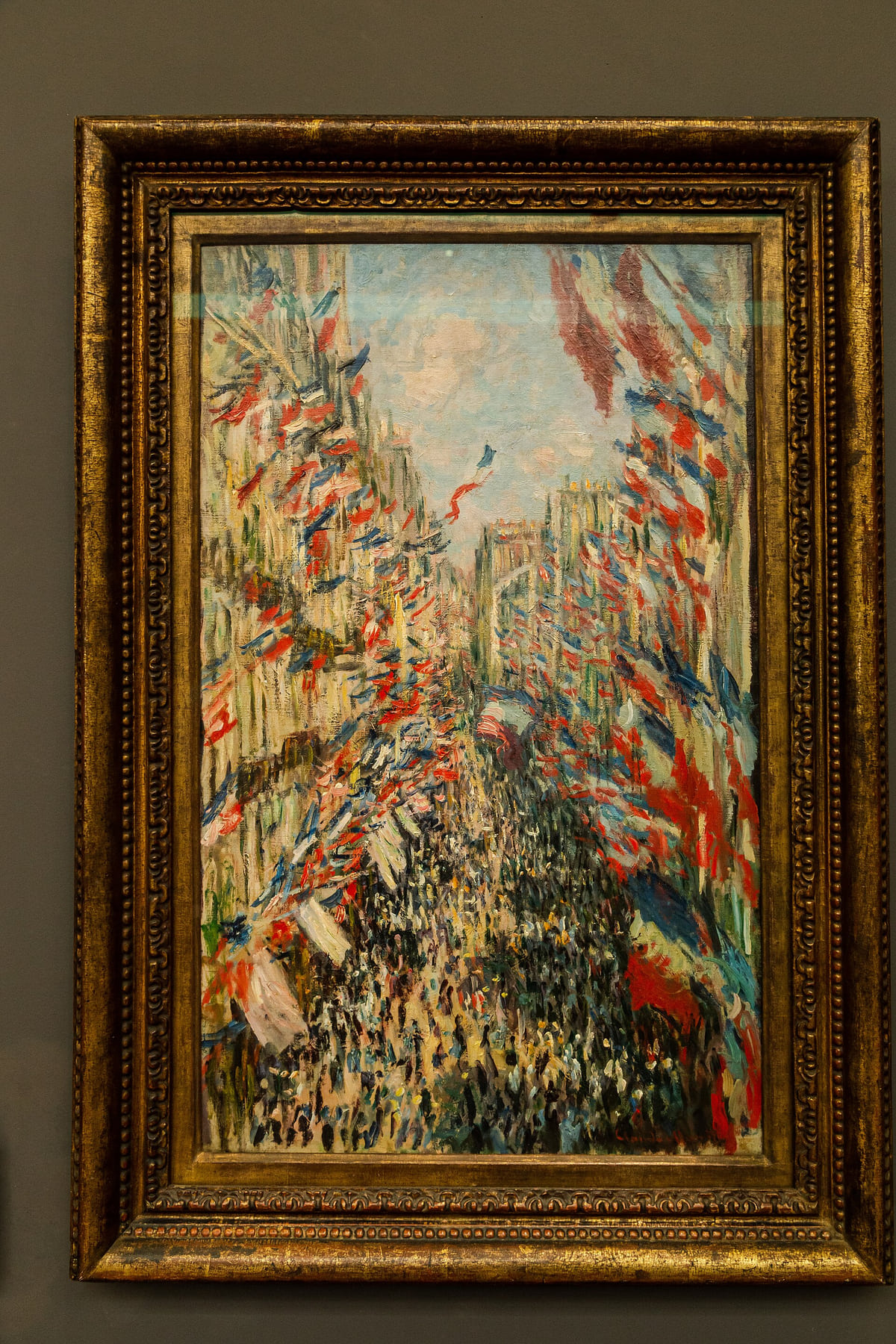
Claude Monet’s La Rue Montorgueil, à Paris. Fête du 30 juin 1878 is one of the most reproduced views of a Paris street in celebration. It is also repeatedly mislabelled.
The date was not 14 July. France did not adopt 14 July as its national holiday until 1880. Monet painted the government-decreed festival of 30 June 1878, organised during the Universal Exhibition to celebrate “peace and work,” project recovery after the defeat of 1870 and strengthen a Republic that was still politically fragile.
From a high window, the crowd dissolves into motion. Flags are not illustrated one by one; they vibrate through touches of red, white and blue. The Musée d’Orsay reads Monet’s distance from the crowd as part of the work’s modernity. He behaves almost like a reporter, registering mass politics as weather: a street transformed by colour, density and movement.
The elevated viewpoint also prevents a sentimental reading. The painting is jubilant, but not politically innocent. The Republic is using the city as an image of itself, and Monet is making that image unforgettable.
The Musée d’Orsay’s official record said the painting was not on display when this feature was checked. Never travel on the promise of seeing it: consult the work page before any visit.
Myth: Monet painted a Bastille Day parade on Rue Montorgueil.
Fact: He painted the “peace and work” festival of 30 June 1878. Bastille Day became the national holiday two years later.
The plaque most diners walk past
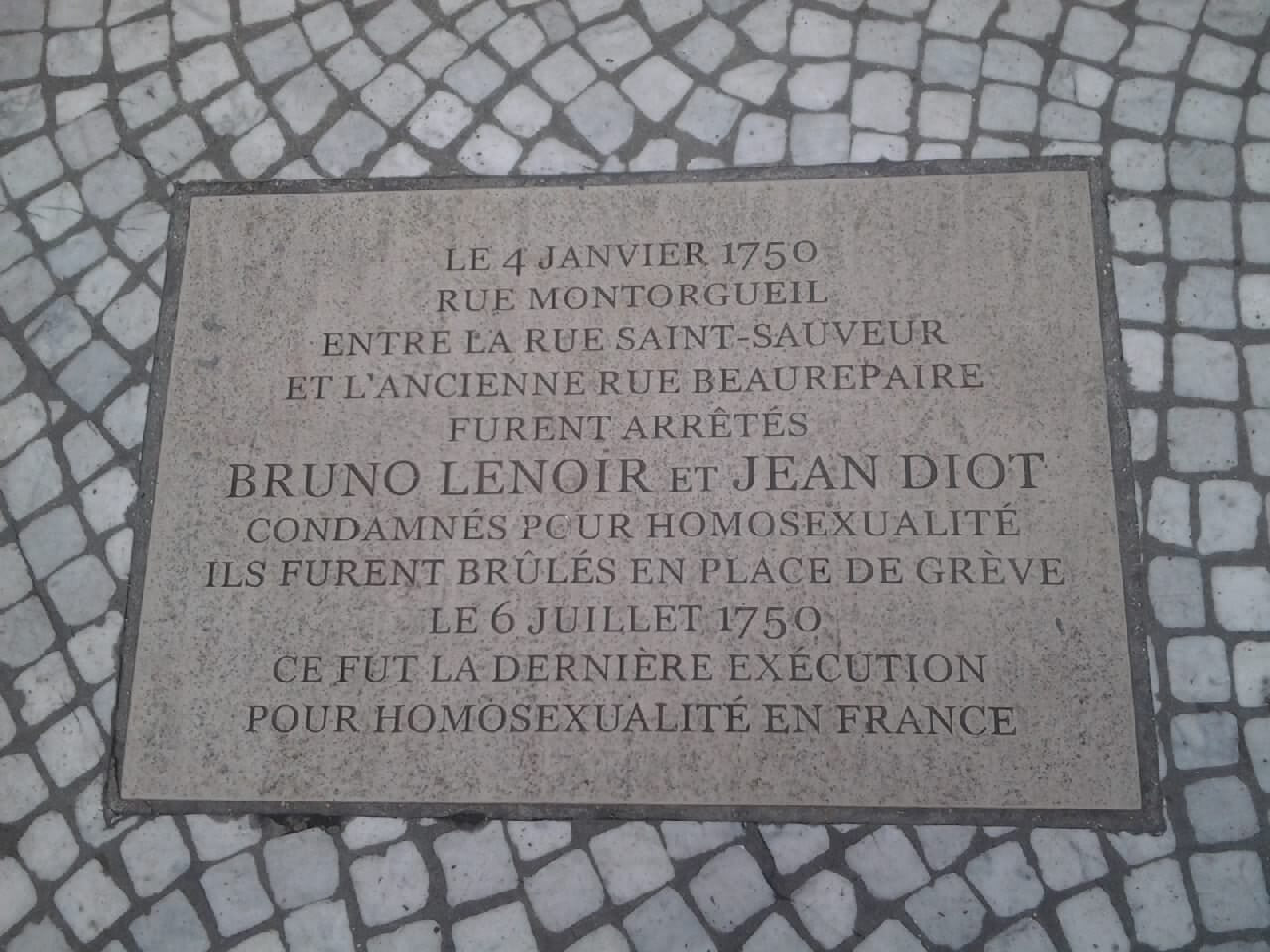
Montorgueil’s public memory is not confined to food and paint. In 1750, Jean Diot, a domestic servant, and Bruno Lenoir, a shoemaker, were arrested in this area and prosecuted for homosexuality. They were executed at Place de Grève on 6 July 1750 and are remembered as the last people put to death for homosexuality in France.
Paris voted to commemorate them in 2013, and the pavement plaque was installed on 18 October 2014 outside 67 Rue Montorgueil, at Rue Bachaumont. Its adopted text identifies their deaths as France’s last execution for homosexuality. It changes the emotional scale of the walk. A district praised for conviviality also contains evidence of who was once denied safety in public space.
Stop long enough to read it. Do not turn it into a picturesque backdrop. A memorial is not another item for a visitor to collect; it restores names to people whom the state reduced to an offence.
When the stomach of Paris moved south
Les Halles did not vanish in one dramatic night. The state decided in 1959 to transfer the wholesale market. The move to Rungis began in March 1969, and the final meat, offal and poultry wholesalers left in January 1973.
The longer chronology matters. A food system is not a theatre set that disappears between performances. It is jobs, delivery routes, night shifts, storage, waste, smells, rents and the small businesses that depend on proximity. When the wholesale market moved, Rue Montorgueil did not stop selling food; it lost the giant industrial organism that had given the selling its original scale.
Saint-Eustache is the right starting point because its history held both sides of Les Halles: the working population of the markets and wealthy parishioners nearby. After the Baltard pavilions disappeared, the church stood exposed as a dominant monument where a dense economic landscape had been.
The street survived by changing register. What had been supply became identity. Food moved from necessity towards experience; delivery route became promenade; commercial sign became heritage.
A living market street—or a stage for visitors?
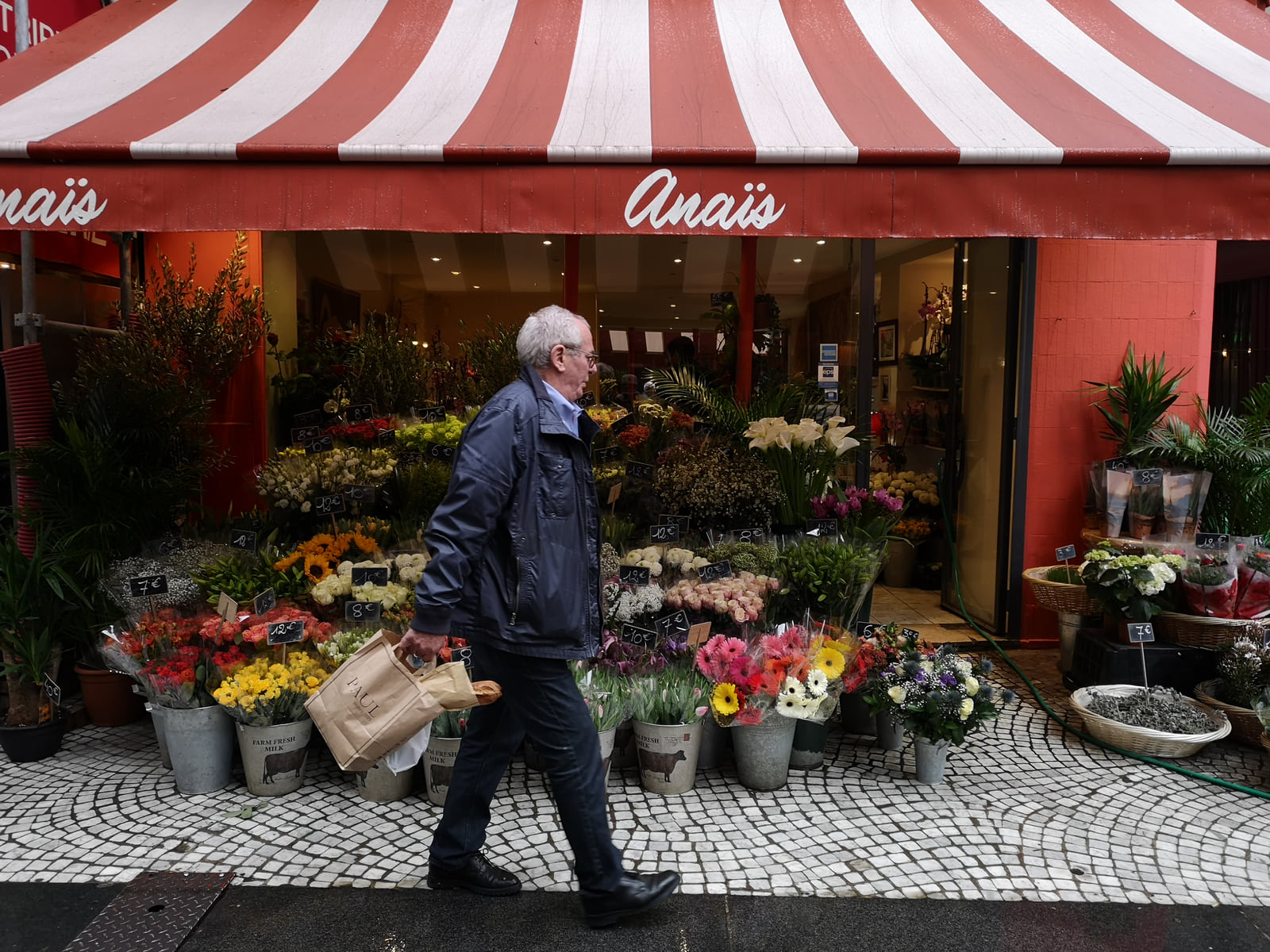
The pedestrian district is a genuine urban achievement. Montorgueil became a pioneer in the early 1990s, when access was reduced and public space was reclaimed from through traffic and parking. A 2021 APUR study of the wider district—not only these 360 metres—counted 5,132 residents, 6,570 jobs and 488 businesses. It found improvements in public space, accessibility, air quality and traffic noise.
Success has a price. Between 2000 and 2020, APUR recorded fifty additional bars and restaurants across the district while wholesale clothing and textile activities fell from 76 to 19. Food retail remained broadly stable in number but changed in composition. Tourism increasingly competed with residential use from the mid-2000s, and vacant housing rose after 2007 faster than the Paris average.
None of that proves every new restaurant is harmful or every visitor displaces a resident. It shows that the atmosphere people travel to consume is produced by a neighbourhood under pressure. The street can be both a commercial success and a warning about success.
The responsible visit is not joyless. Come hungry. Sit at a terrace. Buy pastry, fruit or cheese. But distinguish a working counter from a photo set. Do not block doors, photograph staff or strangers at close range without permission, or treat residential entrances as extensions of the pavement.
Walk it by appetite: 60, 90 or 150 minutes
These durations include looking and short purchases, not a seated lunch. Start at the southern end and finish towards Sentier so the story moves outward from Les Halles.
60 minutes: the essential spine
Begin outside Saint-Eustache and locate the former market landscape. Enter Rue Montorgueil at its legal southern limit, then pause at L’Escargot, No. 38, for the golden sign and the 1832/1875 correction. Cross Rue Étienne-Marcel into the Second Arrondissement. At Stohrer, No. 51, inspect the protected interior and choose one takeaway pastry. Continue to the Rocher de Cancale, No. 78, for the oyster story. Finish at Rue Saint-Sauveur and Rue Léopold-Bellan, where the street becomes Rue des Petits-Carreaux.
90 minutes: food, art and the Republic
Give Saint-Eustache twenty minutes inside and out, subject to services and access. Follow the lower street and its Les Halles supply story. After L’Escargot, use a lawfully reproduced image of Monet’s painting to understand the high viewpoint and the real date of the flags. Stop at Stohrer, glance into Rue Tiquetonne and Rue Marie-Stuart, then continue to the Rocher de Cancale and the Diot–Lenoir memorial. End near Sentier.
150 minutes: the full urban-history walk
Start in Jardin Nelson-Mandela to locate the vanished wholesale market, then visit Saint-Eustache. Enter Montorgueil slowly, adding the surviving crescent sign at No. 9 and, if current opening conditions work, a short detour towards Tour Jean-sans-Peur. Continue through L’Escargot, the Monet reading point and Stohrer. Use the side streets—Tiquetonne, Mandar and Greneta—to understand that the pedestrian district is larger than its postcard axis. Finish at the Rocher de Cancale, then walk a short distance up Rue des Petits-Carreaux towards Sentier to see where the food corridor meets the former textile-wholesale district.
Accessibility: the axis is generally level and pedestrian-priority, but crowds, terraces, deliveries, paving and historic thresholds can create obstacles. Do not assume every interior is step-free; confirm directly with each venue.
Addresses, Métro, hours and reservations
- Rue Montorgueil: 360 metres, from 2 Rue Montmartre / 124 Rue Rambuteau to 1 Rue Léopold-Bellan / 59 Rue Saint-Sauveur. Public and free.
- Traffic status: pedestrian-priority, not absolutely car-free. Authorised residents, services and regulated deliveries may enter.
- Métro/RER: Les Halles and Étienne-Marcel (Métro 4); Sentier (Métro 3); Châtelet–Les Halles (RER A, B and D).
- Saint-Eustache: 146 Rue Rambuteau; main public entrance currently on Rue du Jour. Entry is free. Schedules can vary with services, so check the same day.
- L’Escargot Montorgueil: 38 Rue Montorgueil. Officially advertised daily, noon–11pm when checked on 19 October 2026. Reservation sensible for a planned meal.
- Stohrer: 51 Rue Montorgueil. Official hours checked 19 October 2026: Monday–Saturday 8am–8.30pm; Sunday 8am–8pm.
- Rocher de Cancale: 78 Rue Montorgueil. Exterior visible freely. Verify current service directly.
- Monet painting: Musée d’Orsay inventory RF 1982 71; the official page said it was not on display when checked. Recheck before visiting.
- Rue des Petits-Carreaux: begins where Montorgueil ends; it continues the pedestrian experience but is not the same legal street.
Is there one Rue Montorgueil market timetable?
No. This is a permanent market street made up of independent businesses with different hours. It is not a single municipal market. The separate City-run Marché Les Halles operates nearby on Rue Montmartre—currently Thursday 10am–8pm and Sunday 7am–2.30pm. Confirm on the City of Paris market list before travelling.
For Muslim visitors, classic French recipes may contain wine, spirits, pork or animal gelatin, including in sauces and pastries. Ask about the exact product; never infer halal status from the absence of an obvious ingredient.
Watch the old belly of Paris breathe
INA’s official archive film Les nouveaux habitants des Halles de Paris returns to the district on 22 August 1973, after the wholesale market had left and redevelopment work had begun. Through the residents, craftspeople and merchants who remained—and the newcomers entering emptied premises—it restores the human scale missing from today’s elegant food street.
Official publisher: INA Société — verified YouTube channel
Film: Les nouveaux habitants des Halles de Paris — Archive INA
Official YouTube page: https://www.youtube.com/watch?v=skFnfnOVJEY
For a longer archival account, INA’s official 1969 programme Les halles centrales runs 12 min 29 sec: https://www.ina.fr/ina-eclaire-actu/video/cpf88004721/les-halles-centrales
Rue Montorgueil: quick answers
Where is Rue Montorgueil?
It begins behind Saint-Eustache and Les Halles, crosses from the First into the Second Arrondissement at Rue Étienne-Marcel and ends at Rue Saint-Sauveur/Rue Léopold-Bellan.
Is Rue Montorgueil a market?
It is best described as a permanent market street. Food shops, cafés, restaurants and other businesses operate on their own schedules; there is no universal opening time.
What is it famous for?
Its link with the old Les Halles food system, historic addresses including Stohrer, L’Escargot and the Rocher de Cancale, and Monet’s painting of the 30 June 1878 festival.
Is Rue Montorgueil pedestrian-only?
It is pedestrian-priority with tightly controlled motor access, not a street from which every vehicle is absent. Deliveries and other authorised traffic remain possible.
How long does the walk take?
The legal street takes about five minutes without stops. Allow 60 minutes for its historical spine, 90 minutes with art and a food purchase, or 150 minutes for Les Halles and the side streets.
When is the best time to visit?
A weekday morning shows deliveries and neighbourhood shopping with fewer leisure crowds. Weekend late morning is livelier but busier. Check each business because there is no universal market schedule.
Did Monet paint Bastille Day here?
No. He painted the festival of 30 June 1878, celebrating “peace and work” during the Universal Exhibition. France adopted 14 July as its national holiday in 1880.
Continue the street series
- Rue de Rivoli: From Napoleon’s Victory to the Street Paris Reclaimed
- Rue des Martyrs: The Saint, the Market and the Street That Refuses to Become a Museum
- The Champs-Élysées: From Marshland to the Street Where France Steps Into History
Add OUISTARS Travel as a preferred source on Google
Sources and fact-checking
Practical details were checked against first-party and institutional sources on 19 October 2026 and must be rechecked on publication day.
- City of Paris street nomenclature/open data: https://opendata.paris.fr/explore/dataset/denominations-emprises-voies-actuelles/
- Archives de Paris, history of Les Halles: https://archives.paris.fr/offre-pedagogique/ressources-pedagogiques/les-halles-de-paris–vie-et-transformations-dun-espace-economique-1135-1974/de-la-halle-aux-halles-xiisupesup-milieu-du-xixsupesup-siecle
- Archives de Paris, oyster-hall records: https://archives.paris.fr/_depot_ad75/_depot_arko/ead/INV0403.pdf
- Bibliothèque nationale de France / Gallica, sixteenth-century printmaking and the “Rue Montorgueil school”: https://gallica.bnf.fr/selections/fr/html/images/lestampe-aux-xve-et-xvie-siecles
- Ministry of Culture POP: Stohrer PA00086069; L’Escargot PA75010006; Rocher de Cancale PA00125451.
- Stohrer: https://stohrer.fr/notre-maison/ and https://stohrer.fr/nos-boutiques/
- L’Escargot: https://www.escargotmontorgueil.com/en/
- Musée d’Orsay, Monet record: https://www.musee-orsay.fr/fr/oeuvres/la-rue-montorgueil-paris-fete-du-30-juin-1878-10896
- City of Paris deliberation on Jean Diot and Bruno Lenoir: https://cdn.paris.fr/paris/2022/06/15/4ab9cc203cc555846e646d0035699743.pdf
- Archives de Paris and City of Paris, transfer to Rungis: https://archives.paris.fr/offre-pedagogique/ressources-pedagogiques/le-demenagement-des-halles–amenagement-oppositions-et-conservation-du-patrimoine and https://www.paris.fr/pages/rungis-et-paris-une-histoire-commune-6744/
- APUR, Montorgueil pedestrian-district assessment: https://www.apur.org/fr/mobilites-espace-public/usages-espace-public/retour-experience-quartier-montorgueil
- Paris Centre pedestrian-zone rules: https://mairiepariscentre.paris.fr/pages/aires-pietonnes-zones-de-rencontre-rappel-des-regles-de-bonne-conduite-17431
- City of Paris market list: https://www.paris.fr/pages/les-marches-parisiens-2428
- Saint-Eustache: https://www.saint-eustache.org/histoire-et-patrimoine/histoire-de-leglise/ and https://www.saint-eustache.org/preparer-sa-visite/
- INA official video: https://www.youtube.com/watch?v=skFnfnOVJEY and https://www.ina.fr/ina-eclaire-actu/video/cpf88004721/les-halles-centrales
Rue Montorgueil no longer feeds the whole capital. It still teaches the capital—and anyone willing to slow down—how food becomes public life.
Osama Samaha
Editor-in-Chief, OUISTARS Travel