









THE WORLD, STREET BY STREET
The story behind the name. The city beyond the address.
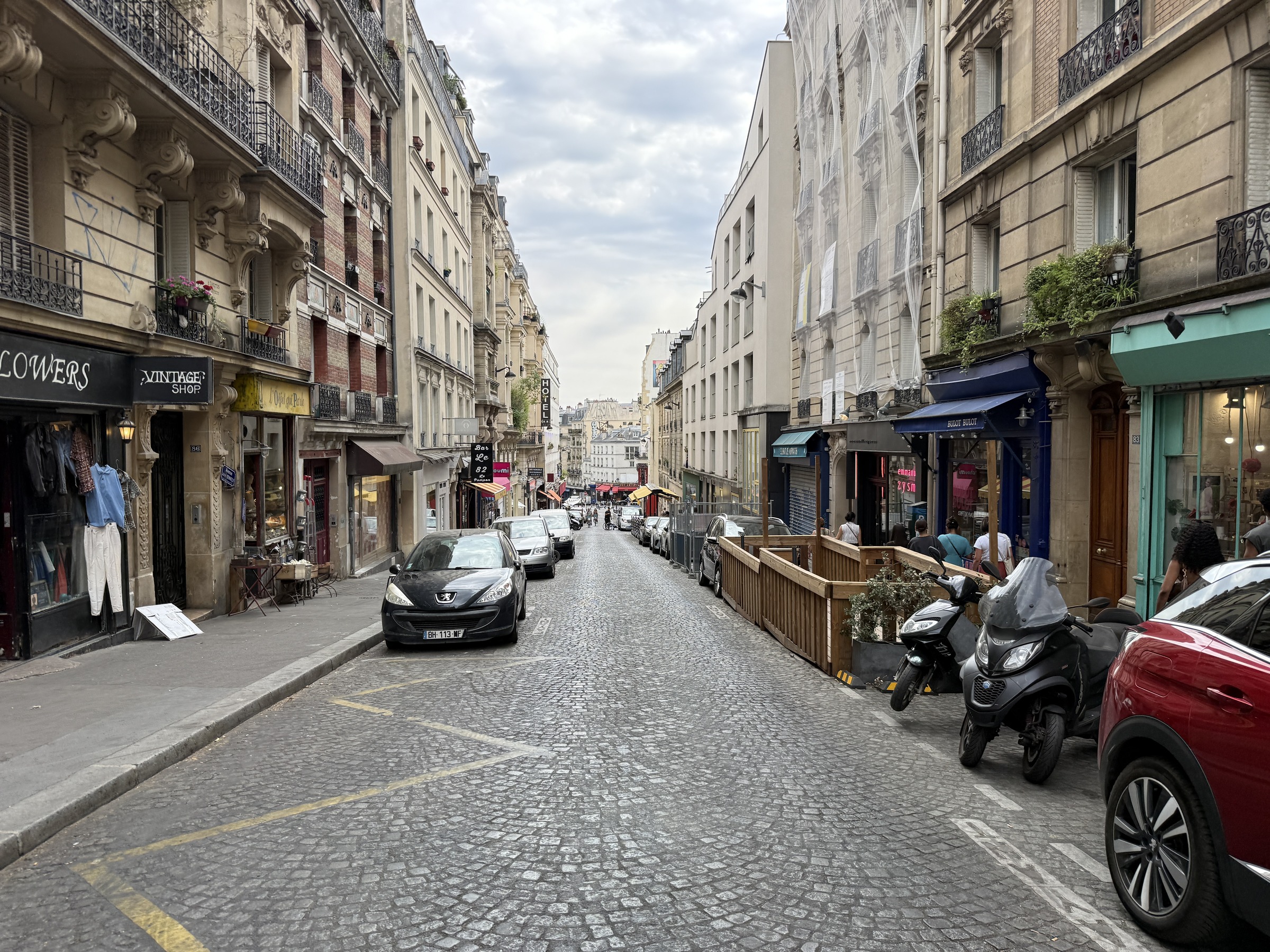
Above Boulevard de Clichy, the street narrows and climbs into Montmartre’s theatre and nightlife quarter. Photo: Chabe01, CC BY-SA 4.0, via Wikimedia Commons. Faithfully cropped or resized and colour-managed by OUISTARS Travel. Source · Licence: CC BY-SA 4.0.
The story in one minute
This uphill street connects the Ninth Arrondissement with Montmartre, mixing food shops, artists’ addresses and cabaret history. Saint Denis belongs to its legend; archives reveal the road’s changing names and working life. Allow one to two-and-a-half hours, with a pause at the restored advertisements at No. 10.
A medieval legend sends Saint Denis uphill carrying his severed head. The verifiable story is no less extraordinary: 885 metres of food shops, ghost advertisements, Romantic painters, queer cabaret and a Paris neighbourhood fighting to remain alive.
At the southern mouth of Rue des Martyrs, the slope is still gentle enough to ignore. Bread travels under arms, fruit brightens the pavement, and the pale façade of Notre-Dame-de-Lorette holds the bottom of the frame. Look north and the street begins to rise. Before it reaches Montmartre, it will change character several times: neighbourhood market, artists’ address, stage door, place of resistance, visitor magnet.
The official distance is only 885 metres. That is barely a quarter of an hour without stopping. But nobody should walk Rue des Martyrs without stopping, because its story does not stand at the end like a monument. It survives in addresses: two advertisements discovered behind a wooden structure; a courtyard that must remain private; a theatre façade descended from the age of Toulouse-Lautrec; a blue cabaret that no longer exists in its original form.
This is why Rue des Martyrs matters. It has the material required to become a picturesque museum of Paris—and still insists on behaving like a street.
First comes the miracle. Then comes the evidence
The irresistible story is that Denis, traditionally regarded as the first bishop of Paris, was beheaded on Montmartre with his companions Rusticus and Eleutherius, picked up his severed head and walked north while preaching, eventually reaching the place where the Basilica of Saint-Denis stands. A popular version makes the present Rue des Martyrs part of that sacred route.
It is a legend, not a documented walk. The Centre des monuments nationaux describes the head-carrying episode as a medieval cephalophore tradition, consolidated by Abbot Hilduin’s ninth-century rewriting. Denis was probably martyred in the third century; there is no evidence that he climbed the modern street.
Even the name Montmartre is not an open-and-shut case. The City of Paris notes competing explanations—“mount of martyrs” and “Mount of Mars” among them. Rue des Martyrs has carried its current name since the eighteenth century because it leads towards Montmartre, but uncertainty is part of the honest story.
The legend should not be discarded. It tells us how a city makes geography memorable. We simply keep the poetry and label it correctly.
An old road that Paris repeatedly renamed
The official Paris street record begins the street at 2 Rue Notre-Dame-de-Lorette and 64 Rue Lamartine, then carries it uphill to 14 Rue La Vieuville. A path is visible here on Jouvin de Rochefort’s 1672 map. It was first known as Rue des Porcherons, later Rue des Martyrs, and from 1793 to 1806—during and after the Revolution—as Rue du Champ-de-Repos.
The Farmers-General wall then split the route into two civic realities. The upper section beyond the wall was called Chaussée des Martyrs; a prefectural order reunited it with the lower street on 2 April 1868. Walk across today’s Boulevard de Clichy and the old divide is still legible in the change of rhythm: the lower Ninth Arrondissement trades in provisions and routines; the upper Eighteenth climbs into the mythology and nightlife of Montmartre.
The gradient was also a form of labour. In 1921, Agence Rol photographed a cheval de renfort here with its handler—a reinforcement horse kept ready to help vehicles up the climb. The BnF archive turns today’s picturesque slope back into what it once was for deliveries and movement: physical work.
The street does not end at Sacré-Cœur. Its official northern finish is Rue La Vieuville. That small correction protects the street from being reduced to a picturesque approach road to somebody else’s monument.
Breakfast is the street’s first performance
Rue des Martyrs is described by the Ninth Arrondissement as a rue-marché: not a daily line of temporary stalls, but a market street whose food shops make a continuous public room. In the morning, the real choreography belongs to deliveries, shopping bags, regulars, school runs, trays, tongs and brief conversations at counters.

At No. 9, La Chambre concentrates fruit into preserves, jellies and condiments. Arnaud Delmontel at No. 39, whose first shop opened here in 1999, anchors the route with bread and pâtisserie. Rose Bakery at No. 46, its first Paris address, has spent more than two decades translating an Anglo-French appetite into cakes, salads and a tea-room pause. Near the upper end, Pain Pain at No. 88 is a bakery and takeaway—not a sit-down restaurant—and a reminder that the street keeps feeding people even when the queue has become part of the scenery.
The best way to experience this abundance is not to “collect” every celebrated counter. Choose one breakfast, one loaf or one jar. Leave room on the pavement. A market street stays alive through transactions, but also through the unphotographed routines that tourism can easily crowd out.
No. 10: the advertisements that came back from the wall
Turn your eyes towards the gable at the corner of Rue Hippolyte-Lebas. When a wooden structure was removed in 2012, three painted advertisements were revealed at 10 Rue des Martyrs. Two could be conserved: a Bénédictine liqueur advertisement painted by Defoly in 1907 and a Ripolin paint advertisement by Eugène Vavasseur in 1909.
Their colour survived because the wall had been covered. The French Ministry of Culture listed the two works as Monuments historiques in September 2012; after a long campaign involving the building’s co-owners, public bodies, heritage groups and private support, the restoration was completed and unveiled in 2024.
They are commercial images that became heritage by accident. That paradox suits Rue des Martyrs: the street has always sold things, but time keeps changing which sales pitch deserves to be saved.
No. 23: look at the façade, respect the door
Théodore Géricault established a studio at 23 Rue des Martyrs in 1812, in the district later known as the Nouvelle Athènes. He lived farther uphill at No. 49. The artist’s association with the street matters not because it creates another celebrity plaque, but because it places Romantic painting inside the working geography of theatres, studios, cafés and rented rooms below Montmartre.
The courtyard at No. 23 is private. The correct visit is an exterior pause, not an attempted entry. A 1920 Musée Carnavalet photograph preserves the inner court and fountain for anyone who wants to see beyond the closed door without violating it.
In the nineteenth century, the old Brasserie des Martyrs became a major space of bohemian sociability, where writers, journalists and artists made professional networks look like nightlife. Yet the street was never only a salon. Victor Hugo records barricades here during resistance to the December 1851 coup. Paris museum collections document barricades again around Rue Notre-Dame-de-Lorette, Rue Saint-Lazare and Rue des Martyrs during the Liberation of Paris in August 1944. The same slope that carried reputations also carried conflict.
Nos. 75 and 80: Paris changes costume after dark
At 75 and 75 bis Rue des Martyrs, performance history reaches back at least to the Musette de Saint-Flour in 1830. By 1893, the address had become the Divan Japonais, the café-concert whose audience and performers Henri de Toulouse-Lautrec compressed into one of his most famous posters. The image is now in the Bibliothèque nationale de France, but the address never stopped reinventing the night.

Madame Arthur opened next door in 1946 and became one of post-war Paris’s defining drag-cabaret stages. Coccinelle, Galia and Bambi performed here. In 1954, Serge Gainsbourg took his father’s place at the piano. Madame Arthur and the neighbouring Divan du Monde merged in 2015; today the official programme combines live French song, cabaret and club nights. Treat historic venue names as chapters, not as a list of separate businesses still operating.
At No. 80, Michel Catty—Michou—took over a bar-restaurant in 1956 and turned it into a Montmartre institution. His performers built affectionate, irreverent star parodies in a tiny room that television made famous. The original Chez Michou closed in July 2024. It did not reopen as the same dinner-cabaret: in 2025 the address became the Choumi Comedy Club, while the nearby Promenade Michou was inaugurated on 24 June 2025. A living city honours a name without pretending that nothing has changed.
The living market and the postcard are now competing for space
Rue des Martyrs has been marketed as the village street tourists hope Paris will still contain. That reputation is not invented: independent food shops, performance venues and daily errands remain visible. But popularity also changes the thing it celebrates.
A 2014 academic study, based mainly on fieldwork from 2007 to 2011, used Rue des Martyrs as a clear corridor of commercial gentrification in the emerging “SoPi” identity south of Pigalle. Specialist and concept stores were gaining ground while older popular businesses faced pressure from rents and changing demand. The street contained 31% of the food shops in the study perimeter. That figure is a historical snapshot, not a 2026 count, but the mechanism remains useful to understand.
In 2025, Le Monde reported on accelerating visitor pressure across Montmartre and noted a street-level response at Pain Pain: a faster line for bread-only purchases amid tourist queues. One bakery does not prove that every block has become an attraction. It does show what happens when an ordinary purchase and a destination experience must occupy the same doorway.
Visitors help support shops and stages. The danger begins when a neighbourhood is optimised for its image rather than for the people who use it daily. The thoughtful response is practical: come early, buy with purpose, do not photograph strangers at close range, keep entrances clear, and never treat a private courtyard as part of the admission price to Paris.
Three ways to walk Rue des Martyrs
60 minutes: the whole story at street level
Begin outside Notre-Dame-de-Lorette, 18 bis Rue de Châteaudun, then enter Rue des Martyrs at its official southern start. See La Chambre at No. 9, the restored painted advertisements at No. 10 and the exterior of Géricault’s former studio at No. 23. Continue past No. 39 and No. 46 without joining a queue, cross Boulevard de Clichy, pause at Madame Arthur at No. 75 and the former Chez Michou at No. 80, then finish where the street meets Rue La Vieuville. This is a brisk, exterior-only route with no seated stop.
90 minutes: food, façades and one proper pause
Follow the same uphill line, but choose one tasting stop: preserves at No. 9, pâtisserie at No. 39 or a tea-room pause at No. 46. Give the wall at No. 10 time to reveal its layers; use the Carnavalet image to understand the private court at No. 23; then read the façades at Nos. 75 and 80 as a sequence from café-concert to drag cabaret to contemporary comedy. Finish near Abbesses rather than rushing on to Sacré-Cœur.
150 minutes: the street as a living archive
Start at about 10am on Saturday or Sunday, when the Paris Respire traffic restriction is in force. Have breakfast, walk the full 885 metres, and allow time for an actual purchase rather than a photographic stop at the food addresses. Compare the lower market street with the upper entertainment district; add the short climb to Place des Abbesses after reaching Rue La Vieuville. If you want a performance at Madame Arthur or Choumi, book it separately for the evening—the show is not part of a two-and-a-half-hour walk.
For a downhill version, begin near Abbesses and reverse the sequence. The gradient is easier in that direction, but Abbesses Métro is deep and stair-heavy; “downhill” should not be mistaken for step-free access.
Practical addresses, current hours and access
- Street limits: 2 Rue Notre-Dame-de-Lorette / 64 Rue Lamartine to 14 Rue La Vieuville; 885 metres across the Ninth and Eighteenth Arrondissements.
- Best weekend window: Saturday or Sunday from 10am. Under Paris Respire, motor traffic is restricted on both days from 10am to 6pm throughout the year. Residents, deliveries and authorised vehicles may still enter; this is calmer traffic, not a promise of a completely car-free street.
- Transport: Notre-Dame-de-Lorette, line 12, for the lower end; Pigalle, lines 2 and 12, for the nightlife section; Abbesses, line 12, for the upper end. Check current RATP access and service conditions.
- Notre-Dame-de-Lorette: 18 bis Rue de Châteaudun. Treat it as an exterior prologue unless current church access has been confirmed that day; the City does not publish stable regular visiting hours.
- La Chambre: 9 Rue des Martyrs. Monday–Tuesday 11am–2pm and 3–7.30pm; Wednesday–Friday 11am–2pm and 2.30–7.30pm; Saturday 10am–2pm and 2.30–7.30pm; Sunday 9.30am–1.30pm.
- Painted advertisements: 10 Rue des Martyrs, best seen from the public pavement at the Rue Hippolyte-Lebas corner.
- Former Géricault studio: 23 Rue des Martyrs. Private courtyard; exterior viewing only.
- Arnaud Delmontel: 39 Rue des Martyrs. Open daily, 7am–8.30pm.
- Rose Bakery: 46 Rue des Martyrs. Monday–Friday 8.30am–4.30pm; Saturday–Sunday 8.30am–6pm.
- Madame Arthur: 75 Rue des Martyrs. The currently published pattern is Thursday–Saturday doors at 8pm, show at 9pm; Friday and Saturday club nights can continue to 6am. Programming changes: use the official calendar before booking.
- Choumi Comedy Club: 80 Rue des Martyrs. Times depend on the performance; consult the official programme. Do not look for the former Michou dinner-cabaret under a new name.
- Pain Pain: 88 Rue des Martyrs. Tuesday–Sunday 7.30am–7.30pm; closed Monday. Takeaway bakery, not a restaurant.
Opening hours above were checked against official venue pages on 11 October 2026. Holidays, private events and programme changes can override them.
Watch: inside No. 80 in 1969
Inside 80 Rue des Martyrs in 1969: Michou’s cabaret in an ORTF report preserved by INA.
Quick answers
Why is it called Rue des Martyrs?
The name has been used since the eighteenth century because the road leads towards Montmartre. A medieval legend associates the hill with the martyrdom of Saint Denis and says he carried his severed head north, but the City of Paris also notes a competing “Mount of Mars” etymology. The legend is not proof that Denis walked the modern street.
Is Rue des Martyrs in Montmartre?
It crosses two arrondissements. The lower market section is in the Ninth; after Boulevard de Clichy, the upper section climbs into the Eighteenth and the Montmartre area. The street ends at Rue La Vieuville, not at Sacré-Cœur.
When is the best time to visit?
Weekend mornings combine open food shops with Paris Respire’s 10am–6pm traffic restrictions. Weekday mornings feel more local and are often easier for photography. For Madame Arthur or Choumi, return after dark with an advance booking.
Is Rue des Martyrs pedestrian-only?
No. Traffic is restricted under Paris Respire at specified weekend hours, but authorised and resident access remains. Stay alert and keep the carriageway clear.
How long do I need?
The street itself can be walked in 15 minutes, but allow 60 minutes for the key façades, 90 minutes with one food stop, or 150 minutes for the full living-archive route.
Is Chez Michou still open?
No. The original cabaret closed in July 2024. The address reopened in 2025 as Choumi Comedy Club, a new stand-up venue; it should not be described as the old dinner-cabaret continuing unchanged.
Continue the street-story series
Follow another Paris axis from royal power to everyday movement in Rue de Rivoli: the street that taught Paris to walk in a straight line, then read the Champs-Élysées beyond the postcard.
Sources and fact-checking method
The street length, limits and historical names were checked in Paris Open Data. The name’s disputed etymology comes from Paris.fr’s heritage service; the Saint Denis tradition is labelled according to the Centre des monuments nationaux. The 1921 reinforcement horse is documented by Agence Rol in Gallica/BnF. No. 10 was verified through the Ministry of Culture’s POP record, the Ninth Arrondissement restoration dossier and its official post-unveiling report. Géricault’s address was checked through Paris je t’aime’s Nouvelle Athènes walk and Musée Carnavalet.
The No. 75 venue history was cross-checked with the BnF catalogue, its Toulouse-Lautrec poster record and Madame Arthur’s official history. Michou’s transition and memorial were checked through the City of Paris, the current venue through Choumi, and the archival film through INA. Current visitor framing and transport context were checked with Paris je t’aime and Paris Respire.
The gentrification passage distinguishes a 2014 historical study, based mainly on 2007–2011 fieldwork, from present conditions. *Le Monde*’s 2025 reporting is used as Montmartre context, not as proof about every business. All practical hours were rechecked on official venue pages on 11 October 2026. No unattributed quotation is used.
OUISTARS Travel
Editorial team
Cite this article
When citing the text or analysis, include the magazine, title, original URL and publication date. Preserve the stated attribution of statistics and photographs.