









Paris, one street at a time
Three kilometres, two empires, a palace, a department store, an artists’ stronghold and a bicycle revolution: Rue de Rivoli is the line on which Paris has repeatedly redrawn the meaning of its centre.
Begin at Place de la Concorde in clear morning light. The Tuileries trees are on your right; a disciplined wall of cream stone and shadowed arcades is on your left. Ahead, cyclists, shoppers, museum visitors and people on their way to work all occupy the same astonishingly straight line.
Rue de Rivoli looks inevitable, as though Paris had always known it needed this street. It did not. The avenue was imposed, extended, burned, rebuilt, commercialised, jammed with cars and then reclaimed. Its beauty is inseparable from that argument.
Why Rue de Rivoli deserves more than a shopping list
Rue de Rivoli runs for roughly 3,070 metres from Place de la Concorde to Rue de Sévigné in the Marais. The official Paris tourism office describes it as one of the capital’s most emblematic and busiest streets. Yet its importance is not measured by footfall alone.
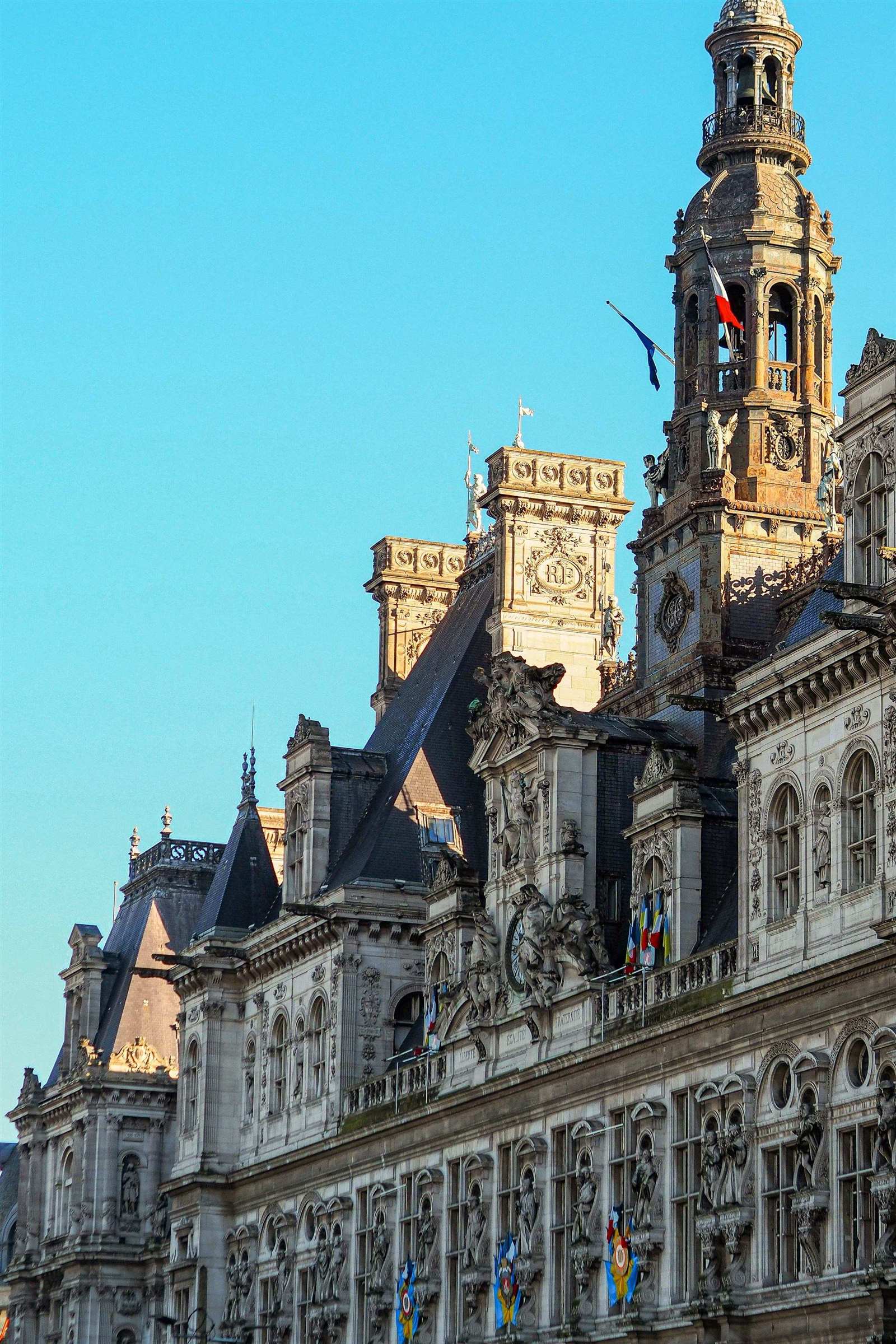
Walk it from west to east and you pass the Tuileries, the Louvre, the Musée des Arts Décoratifs, the Palais-Royal quarter, 59 Rivoli, the Tour Saint-Jacques, Hôtel de Ville and the BHV before the street ends at Rue de Sévigné. Place Saint-Paul is only a few minutes farther into the Marais. In one afternoon, the route moves from imperial composition to popular shopping, civic power and contemporary art.
1797–1804: Napoleon turns a victory into an address
The name commemorates the French victory at Rivoli in northern Italy in January 1797. Under Napoleon, the new street beside the Tuileries became an urban monument to power: not a statue in a square, but a long perspective that organised how the capital was seen and crossed.
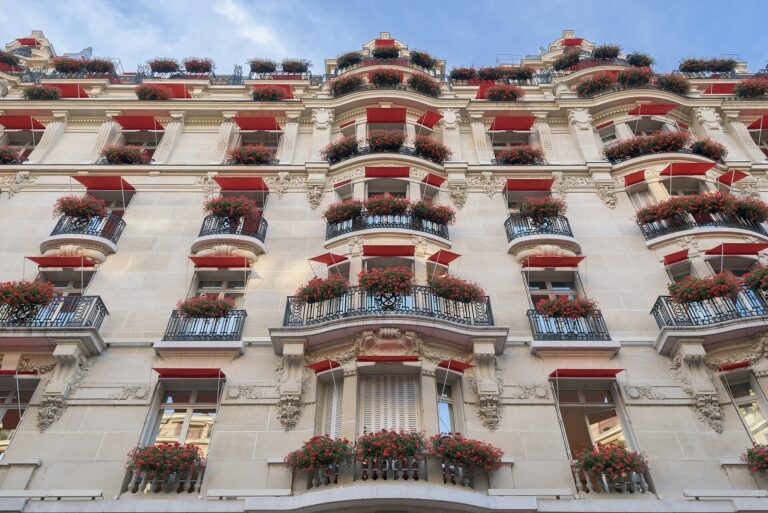
The western section was laid out from 1800 and developed through the early nineteenth century. Architects Charles Percier and Pierre-François-Léonard Fontaine imposed a remarkably controlled façade: repeated arches, aligned cornices and a continuous rhythm opposite the royal garden. Even signs were originally restricted so commerce would not disturb the composition.
The result is one of Paris’s great visual tricks. The buildings are separate properties, yet the arcades persuade the eye to read them as one palace-length façade.
The grand extension—and the people erased from the plan
The first imperial stretch did not yet reach the Marais. Under Napoleon III and Baron Haussmann, the street was driven east from the Louvre toward Rue de Sévigné and the Marais. A City of Paris heritage study records that the extension, carried out mainly between 1848 and 1857, required the demolition of about 490 buildings and cost the city tens of millions of francs.
That statistic changes the tone of the walk. The long view created speed, light and a new civic axis, but it also cut through the dense fabric of old Paris. Rue de Rivoli is therefore both an architectural achievement and a document of displacement—the same double truth that follows Haussmann’s wider transformation of the city.
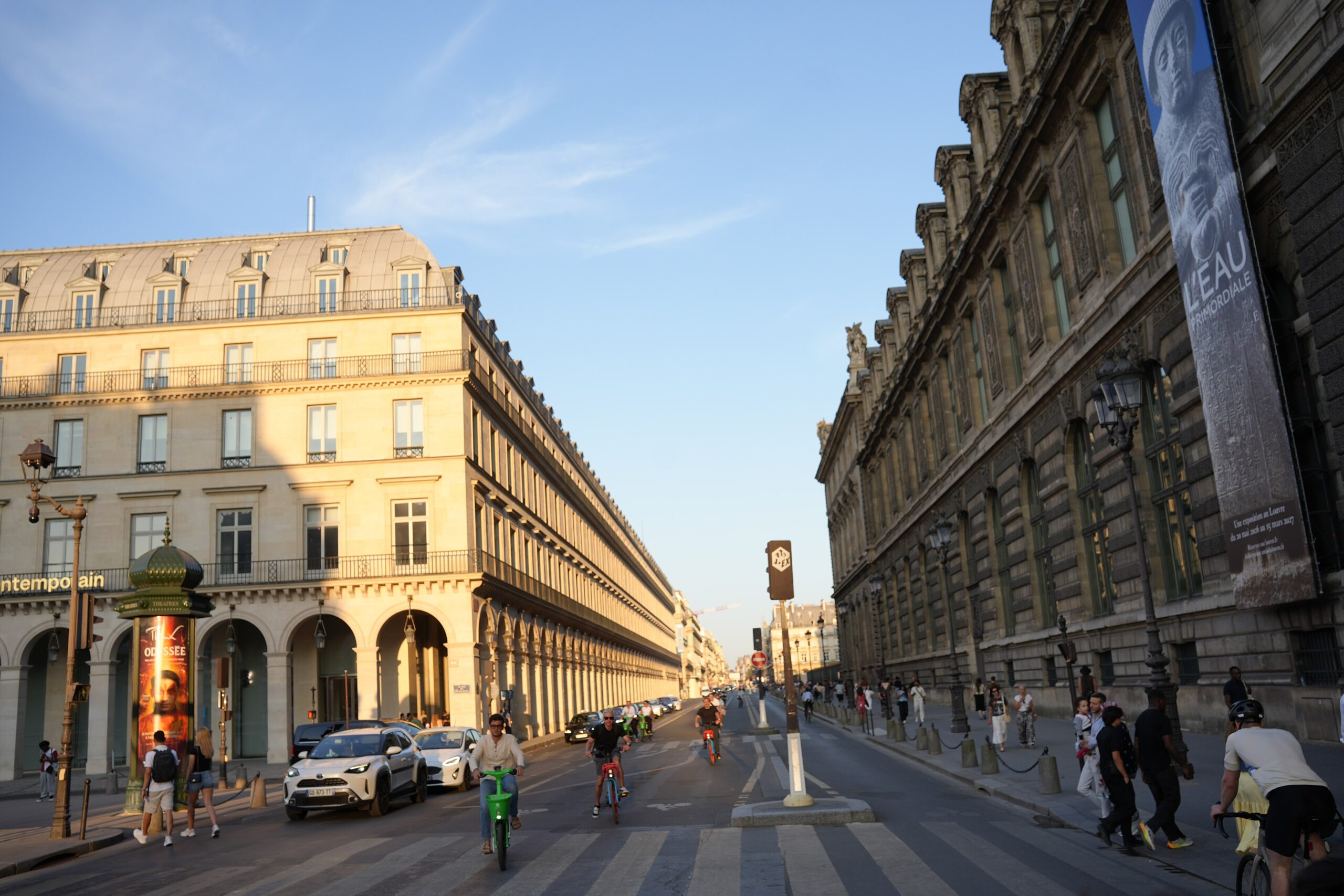
The tension is still visible. West of the Louvre, the street behaves like a formal architectural composition. Toward Châtelet and Hôtel de Ville, it becomes more commercial, more crowded and more openly urban.
Before global brands, Rivoli was already selling desire
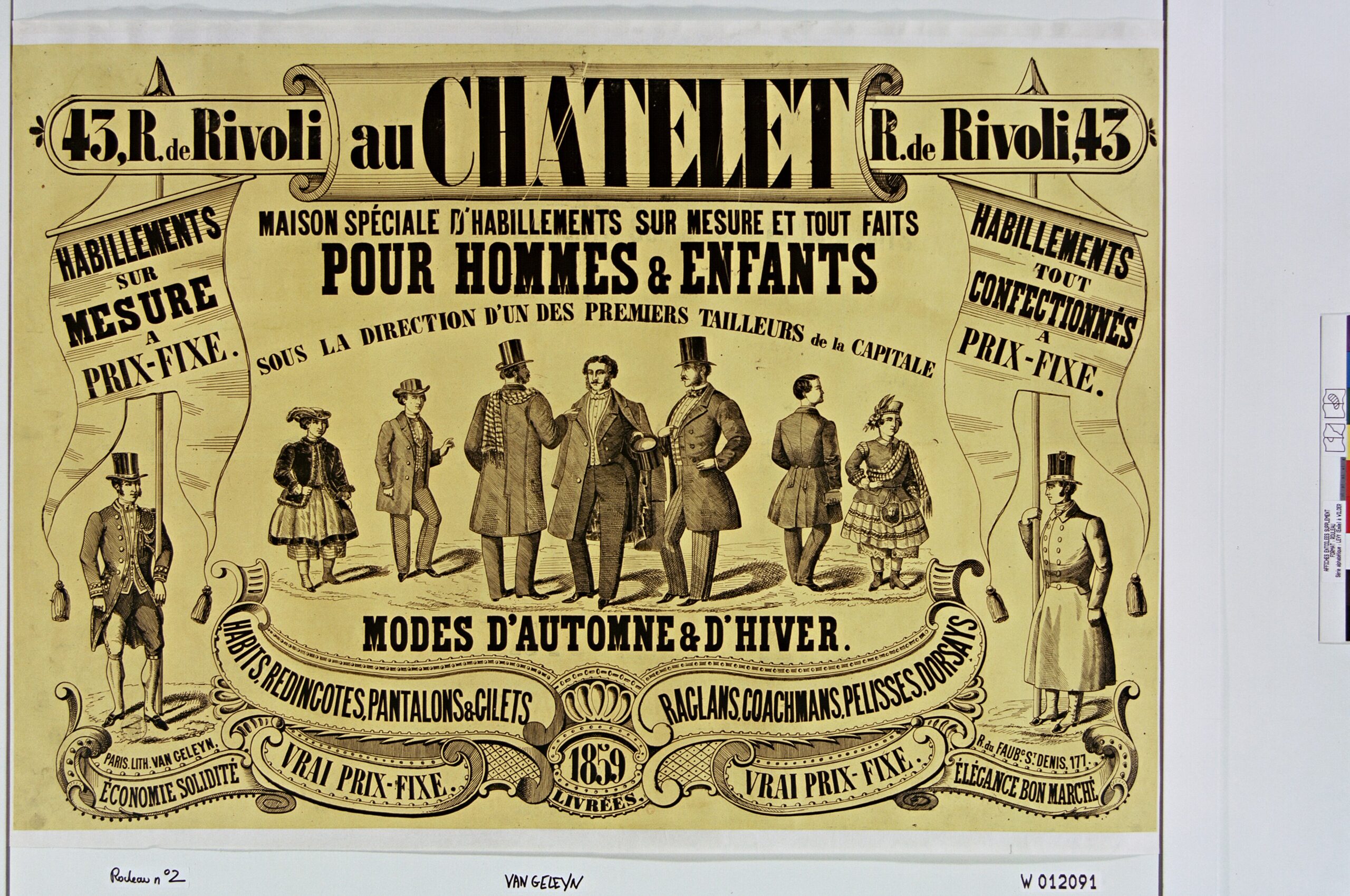
The arcades protected pedestrians from rain and sun and turned strolling into a commercial ritual. An 1859 fashion advertisement for a tailor at 43 Rue de Rivoli already used the address as a promise: fixed prices, seasonal modes and ready-made elegance in the new centre of Paris.
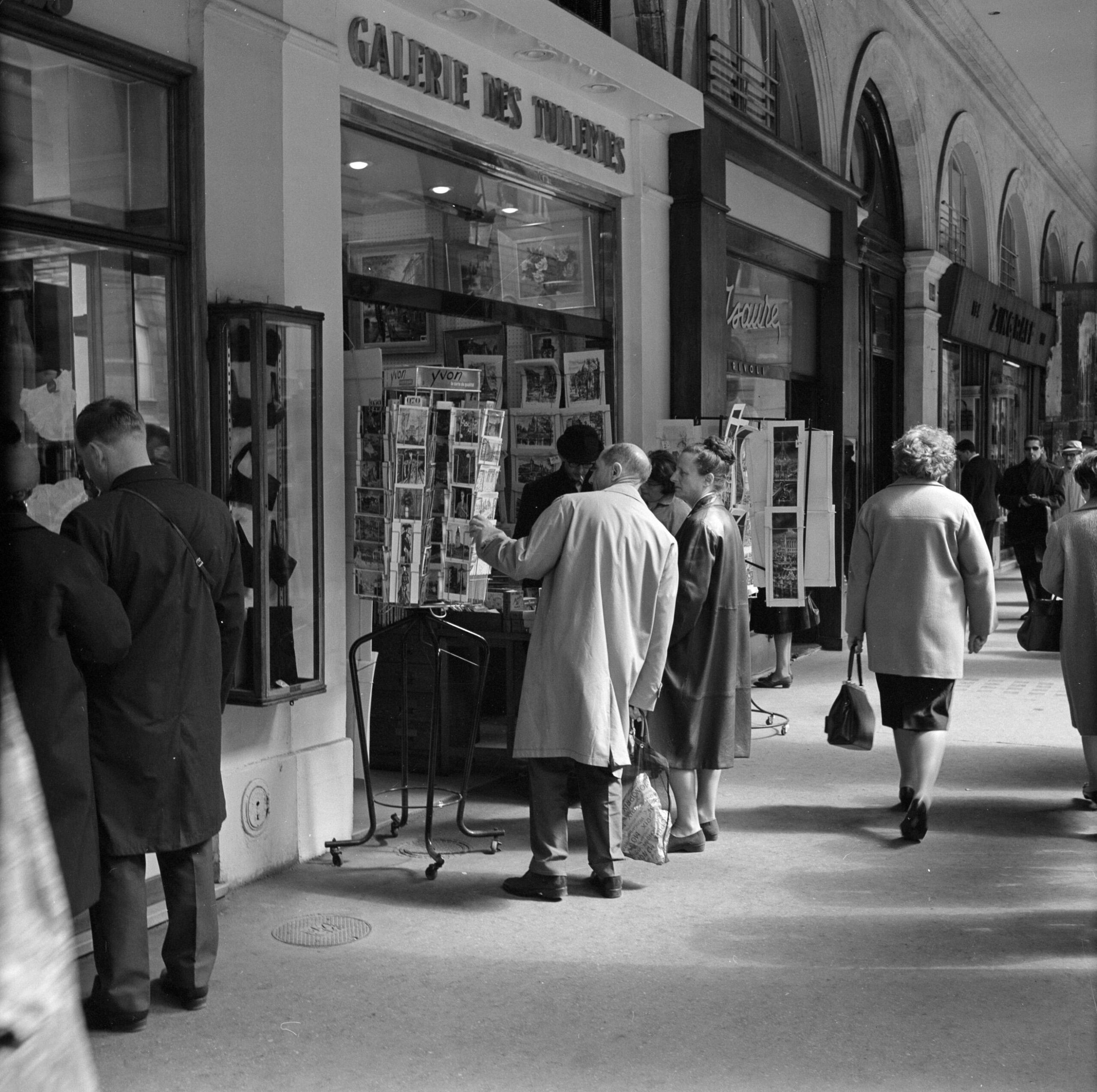
A century later, shoppers moved past galleries and windows beneath the same arches. The merchandise changed; the choreography did not. Rue de Rivoli taught retail a lesson Paris would repeat elsewhere: architecture can make the act of looking feel ceremonial.
The arcades: Paris as a repeating frame
Do not rush this section. The pleasure lies in repetition: column, shadow, window, passer-by; then the sequence begins again. The arcades flatten bad weather, amplify footsteps and constantly reveal oblique views toward the Tuileries and the Louvre.
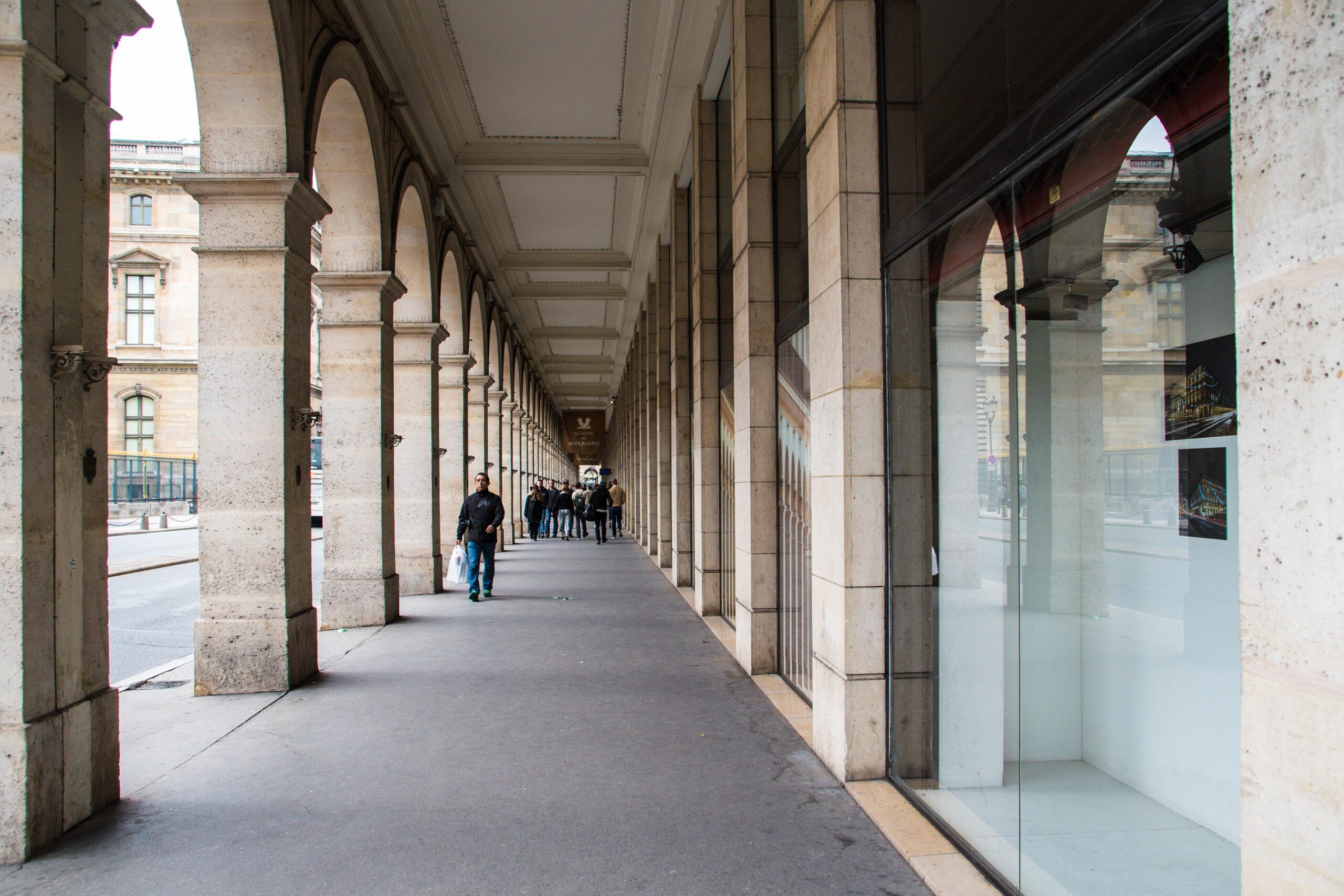
They also create a social border. On one side are hotel doors, cafés and shops; on the other, the road and the garden. The pedestrian inhabits both worlds without fully entering either. This is why the arcades feel cinematic even when nothing “happens.”
1871 and 1944: the street when Paris fought over itself
During the Paris Commune in 1871, fires and fighting damaged the Hôtel de Ville area and buildings along the eastern section. The municipal palace was rebuilt, but the episode exposed what the street had become: an axis of state power that could also be contested in the street.
In August 1944, the liberation of Paris again made the Rivoli corridor strategic. German command occupied Le Meurice at No. 228, and decisive negotiations unfolded nearby before the surrender. The elegant hotel façades and the memory of combat now occupy the same address—one reason a simple luxury reading of Rivoli is never enough.
59 Rivoli: the crack in the polished façade
At No. 59, the street breaks character. Artists occupied an empty former bank building in 1999 and turned it into an improvised vertical studio. The City later acquired and renovated the property, preserving a public-facing home for creation rather than allowing only the highest commercial bidder to define the address.
Today, 59 Rivoli says it hosts 30 resident artists and opens its studios free to visitors six days a week. Its colourful, restless identity matters because it keeps the street from becoming a museum of expensive surfaces. Rivoli can still shelter experiment as well as prestige.
From traffic canyon to the street Paris reclaimed
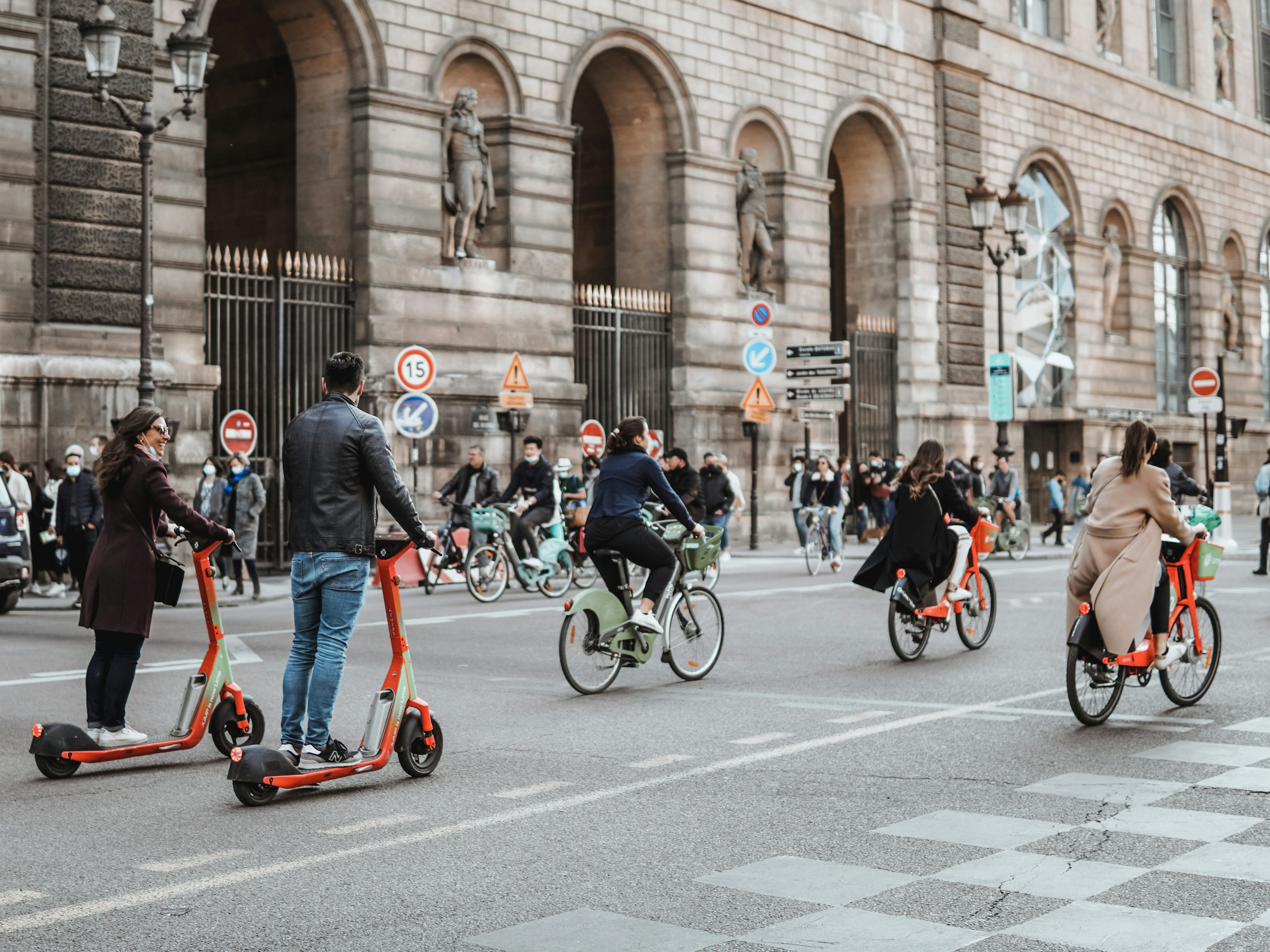
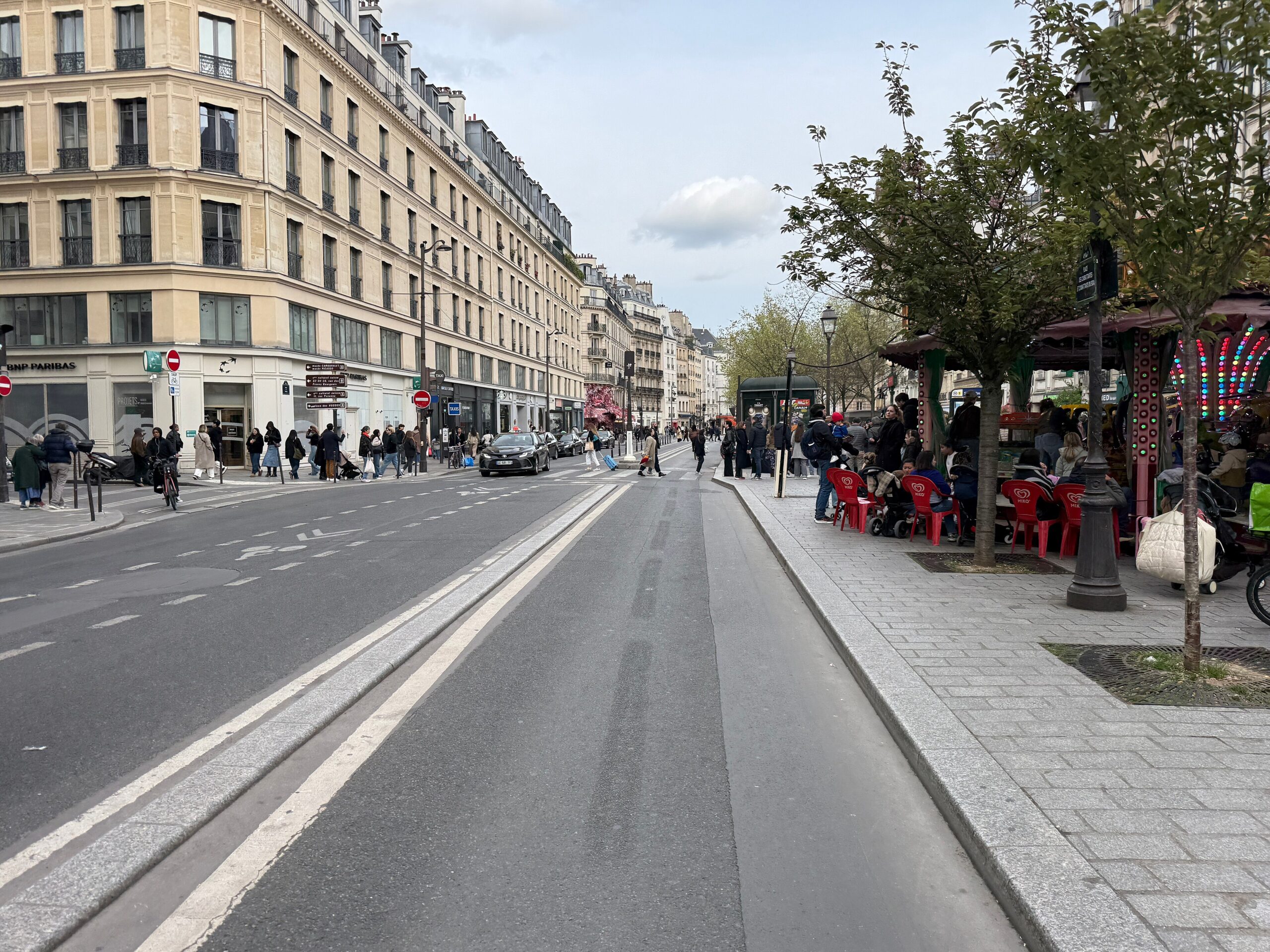
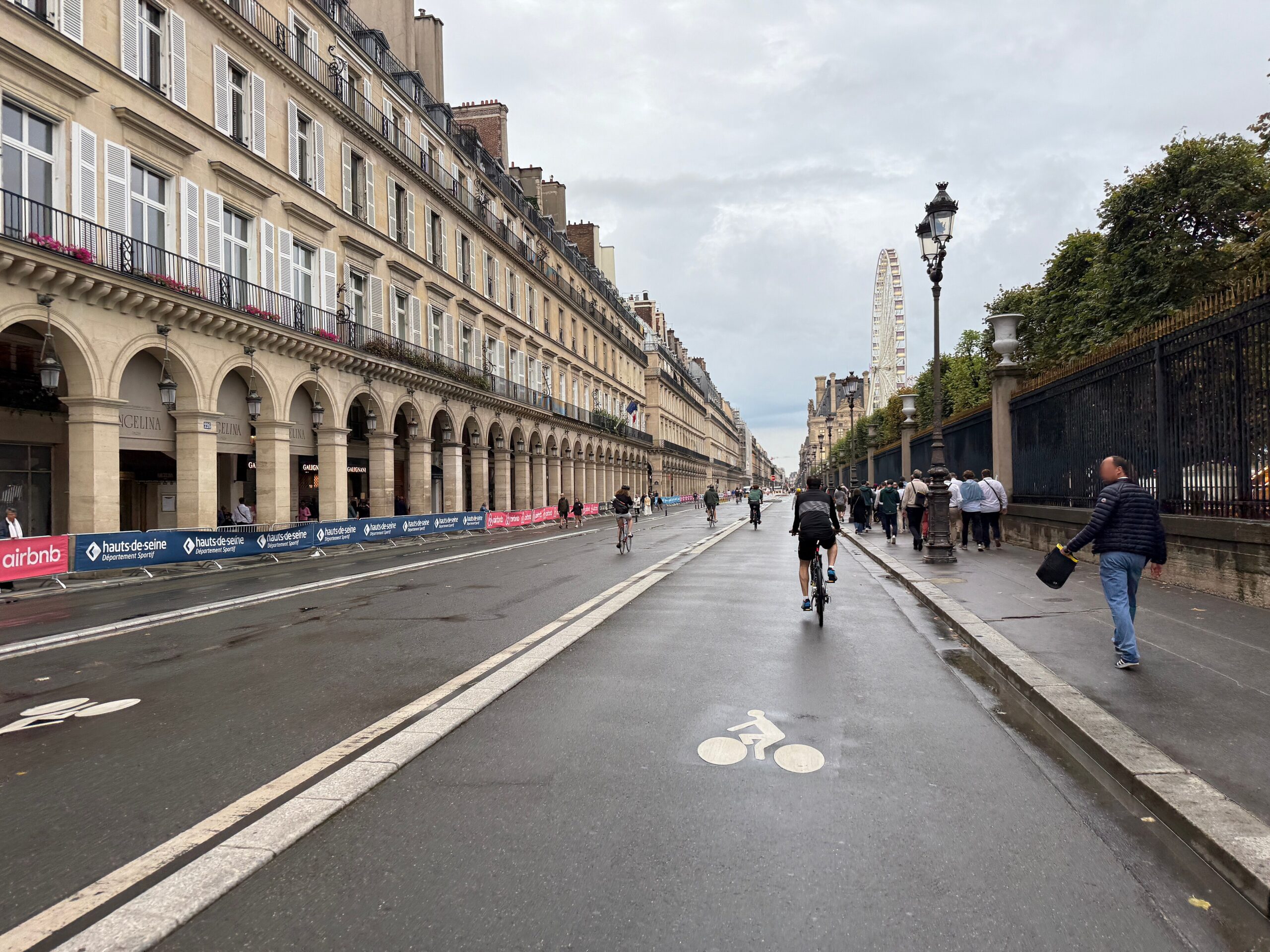
For decades, Rue de Rivoli was consumed by motor traffic. The City of Paris now reserves the full route primarily for pedestrians, bicycles and authorised vehicles, with a major bidirectional cycle axis through the centre. The change is not merely technical: it has altered the sound, speed and social ownership of the street.
The debate is real. Deliveries, taxis, buses, residents, cyclists and walkers compete for finite space, and the temporary-looking separators do not match the elegance of Percier and Fontaine. Yet the broad result is unmistakable: people can once again read the architecture instead of watching it through a windscreen.
Walk it as a story: the route we recommend
75 minutes: the essential line
Start at Concorde, stay on the arcade side past the Tuileries and Louvre, then finish at Hôtel de Ville. Best when time is tight.
Two hours: the full street plus Saint-Paul
Continue from Hôtel de Ville to the Rue de Sévigné terminus, then walk a few minutes farther to Saint-Paul. Add 59 Rivoli and Tour Saint-Jacques from outside.
Half a day: culture and shopping
Add the Louvre or MAD, lunch beneath the arcades, 59 Rivoli and BHV. Reserve museum admission before you go.
Open the recommended Rue de Rivoli walk in Google Maps. The mapped route deliberately continues a few minutes beyond the Rue de Sévigné terminus to Place Saint-Paul. Walk west to east in the morning so the sun often works with the façades and the story progresses from imperial order to the living Marais.
Practical guide: what is open, what is free
- The street itself: public and free, at all hours. For photographs and calmer pavements, begin around 8–9am.
- Louvre: Rue de Rivoli/Carrousel access at 99 Rue de Rivoli. The museum currently opens 9am–6pm on Monday, Thursday, Saturday and Sunday; until 9pm Wednesday and Friday; closed Tuesday. Timed booking is recommended.
- 59 Rivoli: 59 Rue de Rivoli; free entry; Tuesday–Sunday, 1–8pm according to the venue. Closed Monday.
- BHV Rivoli: 52 Rue de Rivoli; currently Monday–Saturday 10am–8pm, Sunday 11am–7pm. Check same-day hours.
- Tour Saint-Jacques: 88 Rue de Rivoli. The tower is visible from the square but official visits are closed until further notice because of works.
- Métro: Concorde, Tuileries, Palais Royal–Musée du Louvre, Louvre–Rivoli, Châtelet, Hôtel de Ville and Saint-Paul all serve different parts of the route.
- Cycle lane: busy at commuter hours. Cross only at marked points and look both ways; bicycles can approach quickly.
Opening hours and traffic rules were checked on 30 September 2026 and can change. Always confirm with the official venue on the day of your visit.
Watch Rue de Rivoli before the bicycle revolution
The City of Paris embeds this archival film of Rue de Rivoli overwhelmed by cars in 1971. It is the perfect counter-image to today’s cyclists and pedestrians. We embed the official YouTube source only; the video has not been downloaded or re-hosted.
Frequently asked questions
Is Rue de Rivoli a good shopping street?
Yes. It combines international brands, the BHV department store, arcaded shopfronts and access to the Carrousel du Louvre. Its real advantage is that shopping is mixed with major architecture and museums.
How long does it take to walk Rue de Rivoli?
A direct walk takes about 45 minutes. Allow two hours for a meaningful route and half a day if you include a museum, 59 Rivoli or a meal.
Which end should I start from?
We recommend starting at Place de la Concorde, walking east to Rue de Sévigné, then continuing a few minutes to Saint-Paul. The architecture unfolds clearly and the route ends naturally in the Marais.
Is Rue de Rivoli pedestrian-only?
No. It is strongly prioritised for pedestrians and bicycles, but authorised buses, taxis, deliveries, residents and emergency vehicles still use parts of it. Stay alert when crossing.
What should I not miss?
The western arcades, the Louvre frontage, 59 Rivoli, Tour Saint-Jacques from the square, Hôtel de Ville and the transition into the Marais.
Which Rivoli do you want to meet?
Napoleon’s formal street, Haussmann’s cut through old Paris, the 1960s shopping corridor or the bicycle avenue of today? Tell us which layer you would follow—and share this story with someone who searches for the name without yet knowing what lies behind it.
Travel service
Turn the story into your own Paris day
For a private Paris route, museum planning, shopping assistance or a tailored experience built around your time and budget, explore OUISTARS services. This service space is separate from our editorial choices and fact-checking.
Sources, image rights and method
This feature was reviewed on 30 September 2026 against official and primary sources. It uses seven documented real visual assets: six recent or archival photographs and one historical advertising print. None is AI-generated. Files were faithfully resized for web delivery; no people, buildings or historical evidence were added or removed. Full-resolution source references, creator, date, licence, processing disclosure and SHA-256 are stored with each media record for future print production.
- Paris je t’aime: Rue de Rivoli route, landmarks and transport
- City of Paris heritage study: Rue de Rivoli between the Louvre and Hôtel de Ville
- Musée Carnavalet: early Rue de Rivoli and the Percier–Fontaine façades
- City of Paris: current pedestrian, bicycle and authorised-traffic arrangement
- Musée du Louvre: current hours and booking guidance
- 59 Rivoli: artists, access and hours
- BHV Rivoli: address and current opening hours
- City of Paris: Tour Saint-Jacques closure and access
- City of Paris: open-access cultural images policy
OUISTARS Travel
Editorial team