




















Information checked: 21 October 2026. Announced schedules and facilities may change; confirm the offer for your dates.
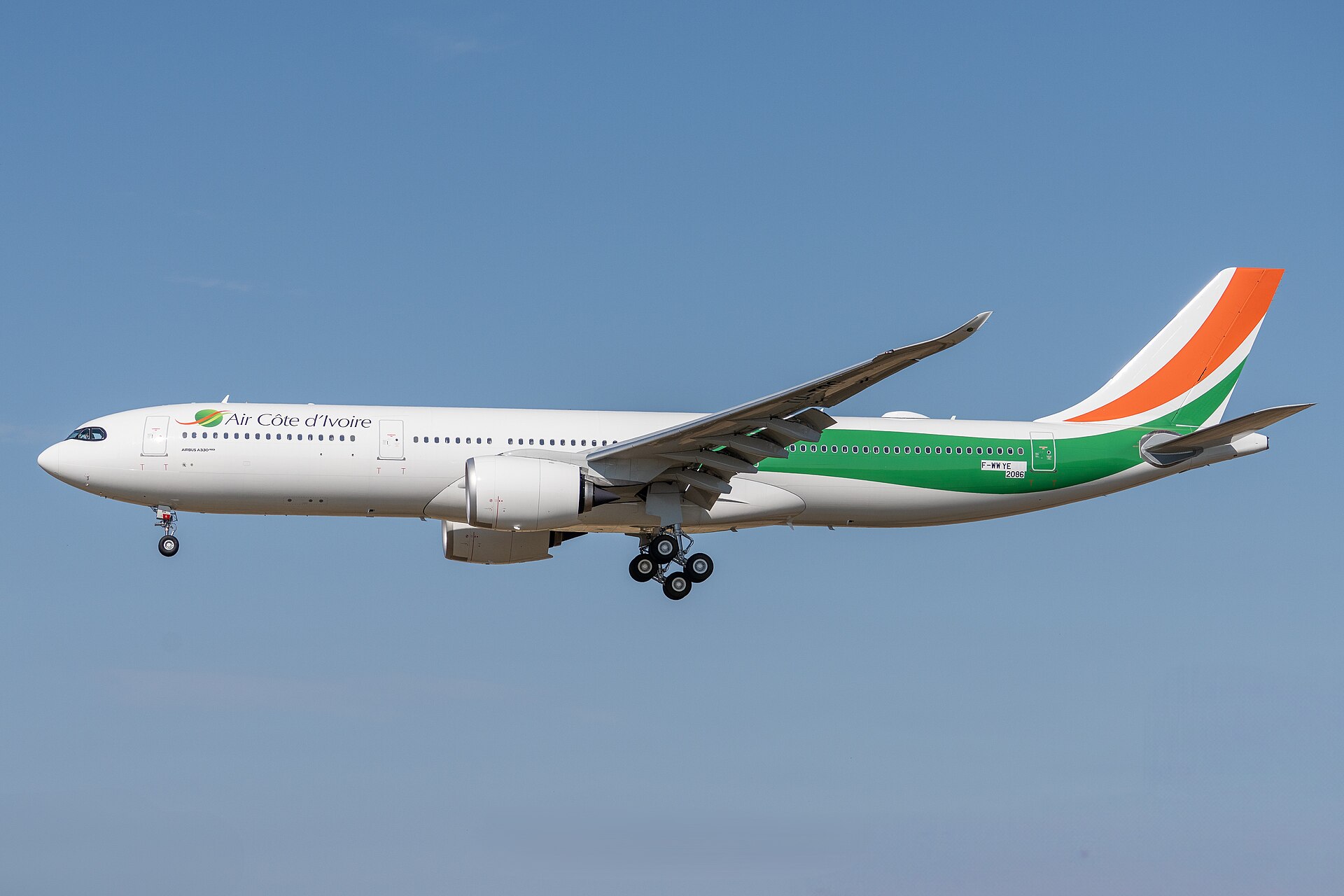
Cover photograph: Air Côte d’Ivoire A330-941 in flight at Toulouse, August 2025. Florent Péraudeau · 5 August 2025 · Air Côte d’Ivoire A330-941 at Toulouse, temporary registration F-WWYE. Archive image; resized only. Wikimedia Commons · CC BY-SA 4.0.
A flight number is only the beginning of a business trip. On Paris–Abidjan, the new agreement between Air France and Air Côte d’Ivoire makes the airline operating the aircraft a particularly important line to read before paying. Here is what changes, what remains a future promise, and how to compare a premium or corporate booking.
The news: one route, two marketing networks
Air France announced the reciprocal arrangement on 16 October, for a start on 25 October 2026 between Paris–Charles de Gaulle (CDG) and Abidjan Félix Houphouët-Boigny (ABJ). Each airline can sell flights operated by the other under its own code. The announcement combines existing schedules in the sales offer; it should not be read as proof that extra flights have been added. Read the dated announcement.
For the traveller, the useful question is whether the new offer makes the right departure and return easier to book. For a company, that may mean a wider choice within its travel-agency channel. Neither benefit automatically changes the fare conditions of a particular ticket.
Marketing airline and operating airline: the distinction that matters
The marketing airline supplies the flight code on the offer. The operating airline flies the aircraft. A familiar code on a booking therefore does not, by itself, identify the cabin, crew or onboard product. Before choosing a Business fare, open the flight details and read the “operated by” line for every sector, including the return.
Compare the actual seat description and aircraft configuration, baggage allowance, lounge access and airport procedures shown for that fare. Ask for written clarification if an advertised benefit is important to the journey. Status recognition, a lounge invitation and a flat-bed seat are separate questions; none should be inferred from the codeshare alone.
Loyalty: keep the timetable separate from the flight launch
The airlines plan loyalty cooperation between Flying Blue and sMiles for the end of 2026. That is a different milestone from the codeshare’s October start. Expansion to additional destinations is also a future phase, announced for before the end of the first half of 2027. Check the current programme rules before pricing a trip around expected mileage earnings.
For a frequent traveller, save the booking class, operating carrier and membership number alongside the receipt. Ask whether the specific fare earns miles, which programme receives them, and whether a redemption is actually available on the desired dates. A general partnership announcement cannot answer those booking-level questions.
A corporate comparison that goes beyond the headline price
Request comparable quotations for the same dates and cabin. Include the total amount payable, permitted changes, refund conditions and any charge for a schedule adjustment. Record who will handle the ticket if the outbound flight changes after departure: the selling airline, the travel agency or another designated contact.
Separate the travel budget from the cost of time. A cheaper departure can be less useful if it forces an extra hotel night or puts the first meeting immediately after a long journey. Build the agenda from the address and time of the appointment backwards, allowing for arrival formalities, luggage and the transfer rather than treating touchdown as arrival at the office.
Premium travel: what to ask before choosing a fare
If privacy or sleep is the reason for paying more, request the operating carrier’s seat plan for that flight. Check whether the preferred seats can be selected immediately, whether selection costs extra and what happens after an aircraft change. For colleagues travelling together, avoid assuming adjacent seats will remain available later.
For a delegation, nominate one person authorised to approve changes and additional waiting. Give the transfer provider the confirmed flight details and a contact number, and specify luggage volume and the final address. A well-documented arrival can be more valuable than a premium label without a clear service description.
Our assessment: useful distribution, with benefits to verify
The durable value of this news is not simply another code on a departures board. It is the opportunity to compare departures through more sales channels while keeping sight of who actually delivers the journey. That can help repeat travellers and companies with regular Paris–Abidjan traffic.
We would judge the partnership’s practical progress by what becomes bookable: usable schedules, clearly displayed operators, published loyalty conditions and effective ticket support. These are criteria to monitor, rather than a forecast of lower prices or guaranteed service improvements. Recheck them whenever an itinerary or travel policy is renewed.
Questions before booking
Does the agreement necessarily add flights?
No. Codesharing is a sales arrangement; the announcement alone does not establish additional frequencies.
Are Flying Blue and sMiles benefits already effective on 25 October?
The announced loyalty launch is planned for the end of 2026. Verify the applicable rules and fare before booking.
Which airline’s cabin will I fly in?
Read the operating carrier for each flight. The marketing code alone does not identify the cabin.
Official sources and verification
Add OUISTARS Travel as a preferred source on Google
Official video — archive context
Air France archive film, September 2019: introduction of its first A350. Aircraft context only; this is not footage of the codeshare launch or a promise about the aircraft assigned to a booking.