

The visit in 60 seconds
- Dates: 12 December 2026–17 October 2027.
- Place: Palais Galliera, 10 avenue Pierre-Ier-de-Serbie, Paris 16th.
- Opening: Tuesday–Sunday, 10am–6pm; Friday until 9pm; closed Monday.
- Tickets announced: €14 full price, €12 reduced; combined ticket €17/€15; free under 18.
- Why go: more than 300 rarely shown objects reveal the engineering inside fashion.
Fashion is often presented from the outside: a silhouette, a runway image, a perfect photograph. En volume! Giving Shape to Fashion reverses the view. Opening at the Palais Galliera on 12 December 2026, it asks visitors to look beneath the surface and understand how fabric, structure and craft make a body appear different.
What the exhibition actually covers
The official programme brings together more than 300 works rarely displayed: garments, accessories, photographs, drawings, tools, patterns, toiles and prototypes. The route spans the 17th century to the present, moving from a structured 19th-century frock coat and a Second Empire crinoline to Madame Grès draping, Sonia Rykiel knitwear and contemporary experimental silhouettes.
This is not simply a parade of famous names. The curators organise the story around three construction languages—tailoring, flou or soft dressmaking, and knitwear. Each handles volume differently. Tailoring builds a framework; flou cuts and drapes supple cloth around the body; knitwear can stretch, contract and follow movement. Together they explain why two garments of similar size can create completely different postures and proportions.
The most revealing view may be the inside
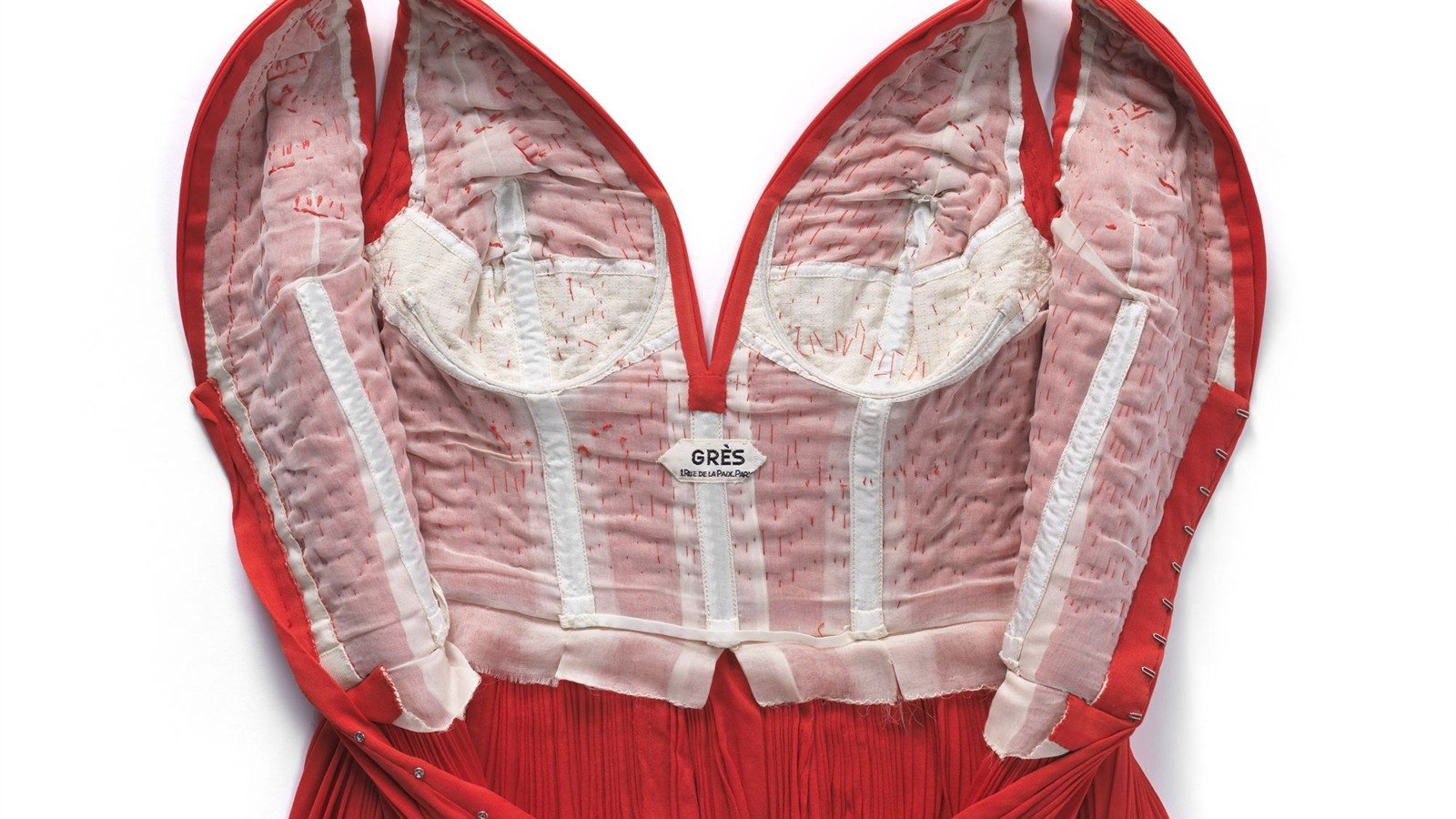
The image chosen for this guide shows the reverse of a Grès cocktail dress from spring–summer 1961. Its red exterior disappears. What remains is an intimate map of boning, cups, seams and hand stitches. It is an honest picture of couture: the apparent effortlessness on the body depends on a hidden system doing precise work.
The exhibition repeatedly exposes what fashion photography normally conceals. Some pieces are displayed flat or opened so that visitors can read their construction. Patterns and prototypes show that the finished look is only the last step in a chain of drawing, measuring, testing, correcting and making.
Five centuries of fashion—and a question about bodies
Volume is never neutral. A crinoline expands the body into public space. A fitted jacket disciplines the shoulder and waist. A soft jersey garment can move closer to the wearer instead of imposing a rigid outline. By placing these choices side by side, the museum also asks who fashion has been designed to fit.
The official presentation connects the rise of ready-to-wear with the standardisation of sizes. Mass production made fashion more accessible, but simplified sizing never represented every body. The route considers silhouettes outside thinness norms, disabled bodies and bodies that change through pregnancy, childhood or age. This makes the exhibition useful beyond costume history: it links technique to inclusion and to the everyday frustration of finding clothes that genuinely fit.
From hand skills to artificial intelligence
Traditional craft is only one part of the story. The museum invited artist Pierre Giner to research the collections with artificial intelligence and develop an interactive installation in which garments regain virtual bodies, periods mix and new combinations emerge. The device does not replace the historic objects; it tests how a digital tool can reactivate an archive.
That contrast is worth watching closely. A 3D simulation can generate countless forms, while the opened Grès dress records hours of physical labour in thread. The visitor can compare speed with touch, recombination with authorship, and digital possibility with the limits and intelligence of material.
How to plan the visit
Palais Galliera is at 10 avenue Pierre-Ier-de-Serbie in the 16th arrondissement. The museum lists Métro line 9 stations Iéna and Alma-Marceau, and RER C at Pont de l’Alma. Opening hours are Tuesday to Sunday from 10am to 6pm, with Friday late opening until 9pm. It is closed on Monday. The exhibition runs until 17 October 2027, giving travellers more flexibility than a short Fashion Week event.
The announced solo ticket is €14 at full price and €12 reduced. A combined ticket with A Wardrobe of One’s Own is listed at €17/€15, with free admission for visitors under 18. At the time of this guide, the exhibition page said online ticketing would open soon, so check the official booking site before choosing a time.
Build a Paris fashion day without rushing
Allow at least ninety minutes for the exhibition and longer if you book both shows. From Galliera, Avenue Montaigne is an easy continuation for looking at the retail language of major houses after studying construction inside the museum. Cross toward the Seine for the Palais de Tokyo, or continue to the Triangle d’Or without turning the day into a race.
For a wider itinerary, combine this visit with our three-day Paris fashion and shopping route. The Yohan Serfaty display at MAD Paris offers a sharper contemporary counterpoint, while the 2027 fashion-week travel calendar helps visitors avoid booking the city’s busiest dates by accident.
Why this matters to Paris tourism
A long museum season spreads fashion travel beyond invitation-only runways. Visitors can build a reason to stay, dine and shop in Paris without claiming access to a private show. The exhibition also strengthens the city’s authority as a place where fashion is not only sold but preserved, researched and explained.
The strongest promise here is not glamour. It is literacy. After seeing how a sleeve is set, how a bodice is supported or how knitwear changes with movement, a visitor returns to the street with a better eye. That makes the museum stop useful to students, professionals, curious travellers and anyone who has ever wondered why a garment works.
Primary sources
- Palais Galliera: official exhibition page
- Palais Galliera: official press release
- Paris Musées: official ticketing portal
 Add OUISTARS Travel as a preferred source on Google
Frequently asked questions
When does En volume! open at Palais Galliera?
It opens on 12 December 2026 and runs through 17 October 2027.
How many objects are in the exhibition?
The museum announces more than 300 works, including garments, accessories, photographs, drawings, tools, patterns and prototypes.
What are the opening hours?
The museum lists Tuesday to Sunday, 10am–6pm, Friday until 9pm, and closure on Monday. Check the official page before travel.
How much is admission?
The announced solo ticket is €14 full price and €12 reduced; a combined ticket is €17/€15, and admission is free for under-18s.
Is this an official Paris Fashion Week show?
No. It is a public museum exhibition with its own ticketing and a long run, not an invitation-only runway show.
Cite this article
When citing the text or analysis, include the magazine, title, original URL and publication date. Preserve the stated attribution of statistics and photographs.