




Hidden Landmark Stories — Episode 2
An assassination attempt, an unknown architect, an underground reservoir and a staircase designed as social theatre: inside the palace where architecture became the performance.
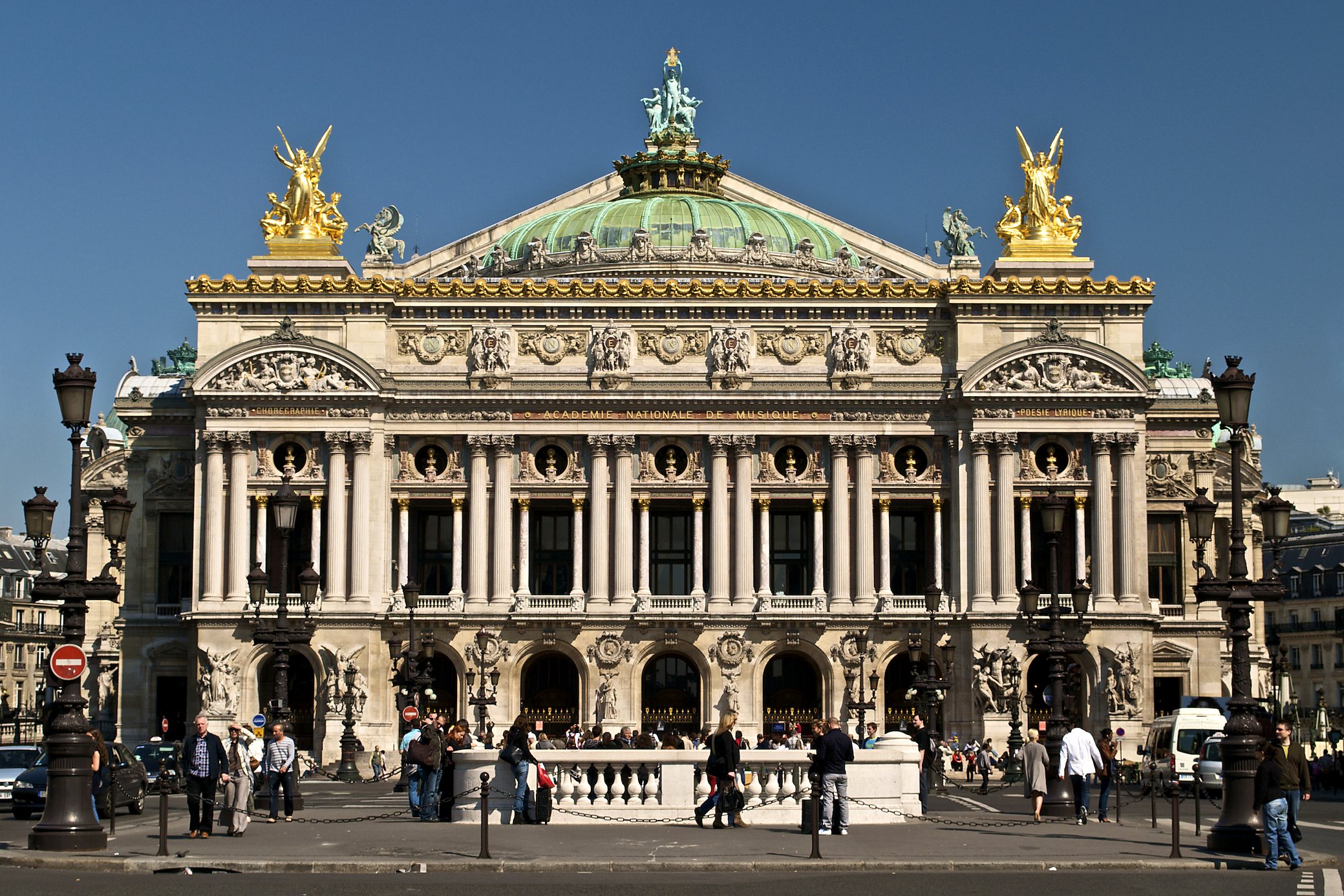
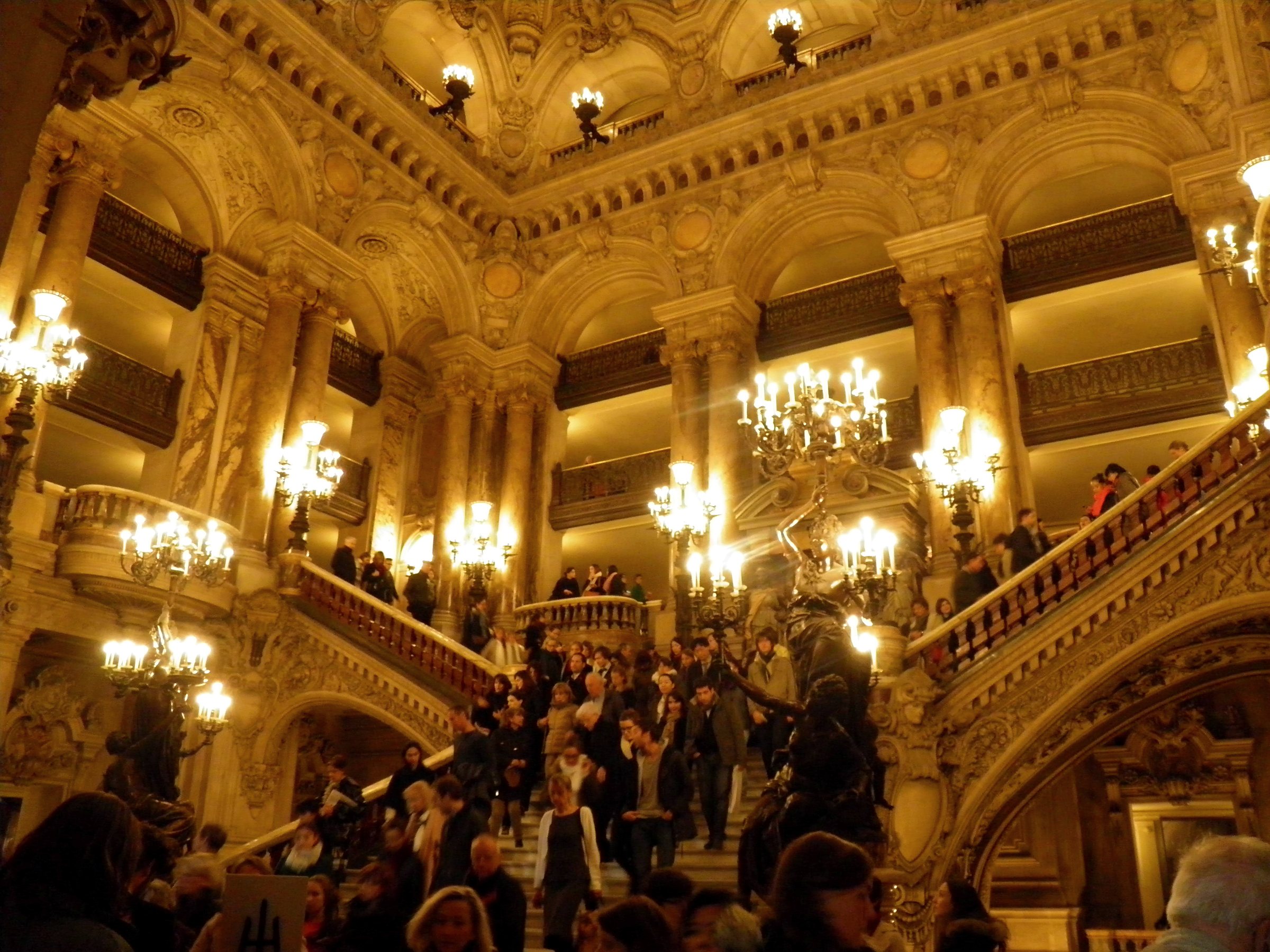
Halfway up the Grand Staircase, almost everyone pauses. The auditorium is still beyond the doors, yet the performance has begun. Below, new arrivals divide around the marble balustrade. Above, people lean over balconies beneath onyx, coloured stone and electric gold. One visitor photographs the ceiling; another turns toward the room, suddenly aware that she too is visible.
This is Charles Garnier’s most seductive idea. The Palais Garnier was not designed simply to contain opera. It was designed to turn arrival into theatre—and its audience into a second cast.
Paris had other reasons for building it: security, imperial prestige, urban transformation and the need to replace an inadequate opera house. But Garnier gave those ambitions a form so theatrical that the building became more famous than many works performed inside it. The façade is a prologue. The staircase is an entrance scene. The foyer is an interval parade. Even the red velvet of the horseshoe auditorium was chosen, the Opéra notes, for the way it flattered complexions.
Behind that beauty lies a more complicated story: a bomb attack, an outsider’s competition victory, groundwater, war and revolution, a vast creative team, and two events transformed into The Phantom of the Opera.
The night security became architecture
On 14 January 1858, Napoleon III and Empress Eugénie were arriving at the old Salle Le Peletier when the Italian revolutionary Felice Orsini and his accomplices threw three bombs. The imperial couple survived; the attack killed and injured scores of people.
Paris already needed a better opera house. The Salle Le Peletier was cramped, vulnerable and understood to be temporary. The attack did not create that need, but it made the project politically urgent. The next day, according to the Opéra national de Paris, Napoleon III decided on a new hall. Its setting would also matter: a broad, controlled approach from the Tuileries offered ceremony, clear sightlines and fewer opportunities for another ambush.
That avenue—the future Avenue de l’Opéra—was part of the remaking of Paris associated with Baron Haussmann. It would produce one of the city’s grandest vistas, but only after existing blocks had been demolished and residents displaced. Monumental Paris was never made on an empty stage. Read how Haussmann redrew the capital.
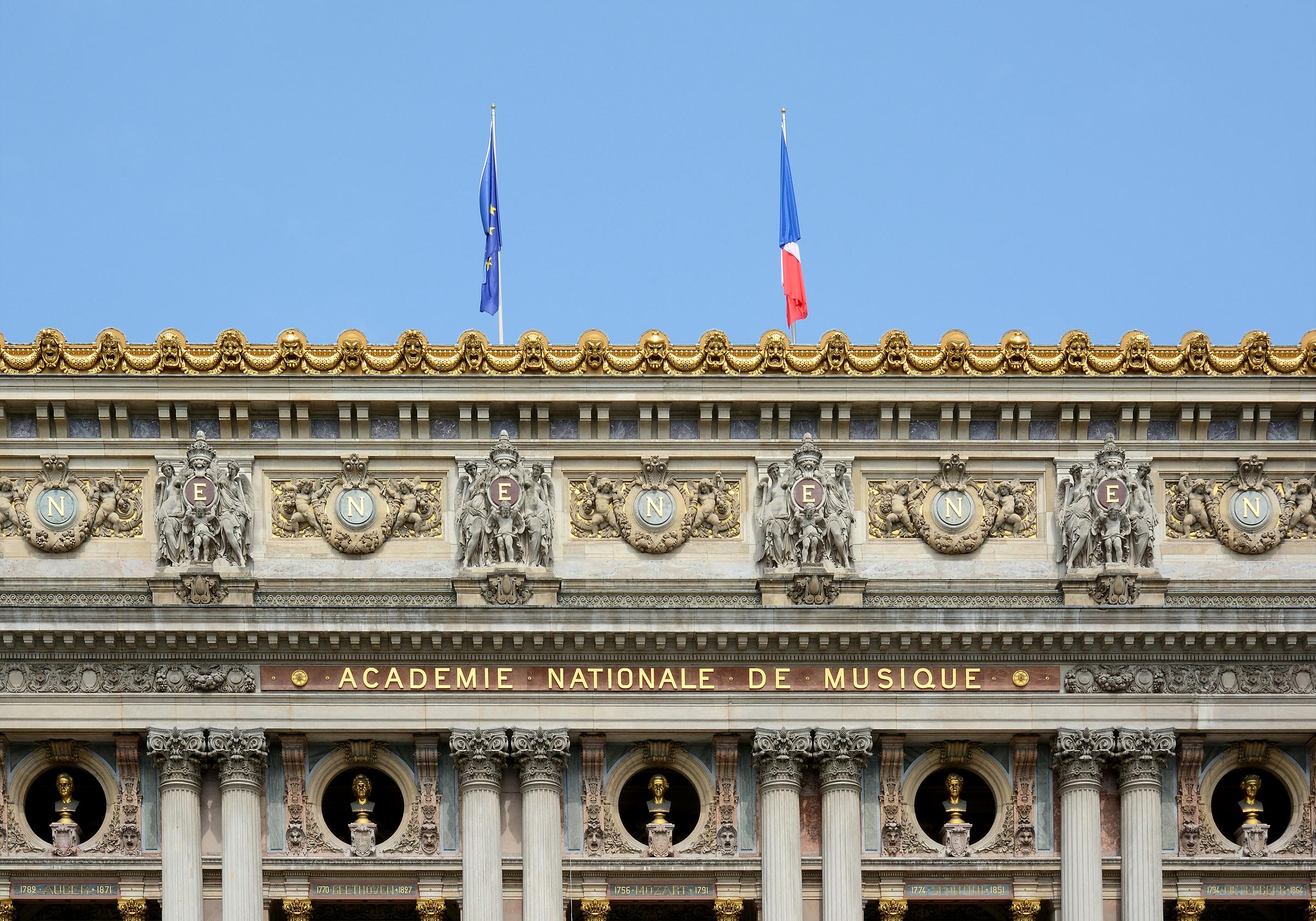
171 entries—and the unknown 35-year-old
The international competition drew 171 entries. Among the expected names stood Eugène Viollet-le-Duc, favoured by Empress Eugénie. The winner, announced on 30 May 1861 after two rounds, was instead a little-known 35-year-old named Charles Garnier.
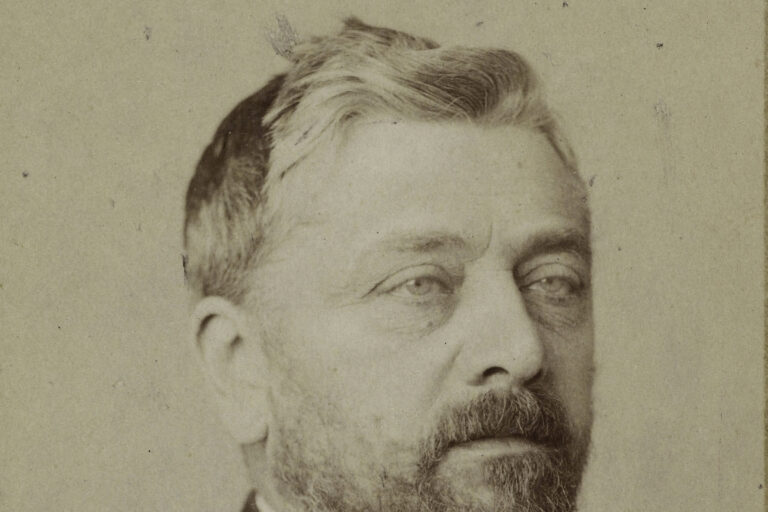
Garnier was not an amateur who had appeared from nowhere. Born in Paris in 1825 to an artisan family, he entered the École des Beaux-Arts at 17, worked as a draughtsman in Viollet-le-Duc’s studio, won the Premier Grand Prix de Rome in 1848 and spent five formative years in Italy. What he lacked was a portfolio of major completed buildings. The Opera turned a promising architect into the author of imperial Paris’s most visible room.
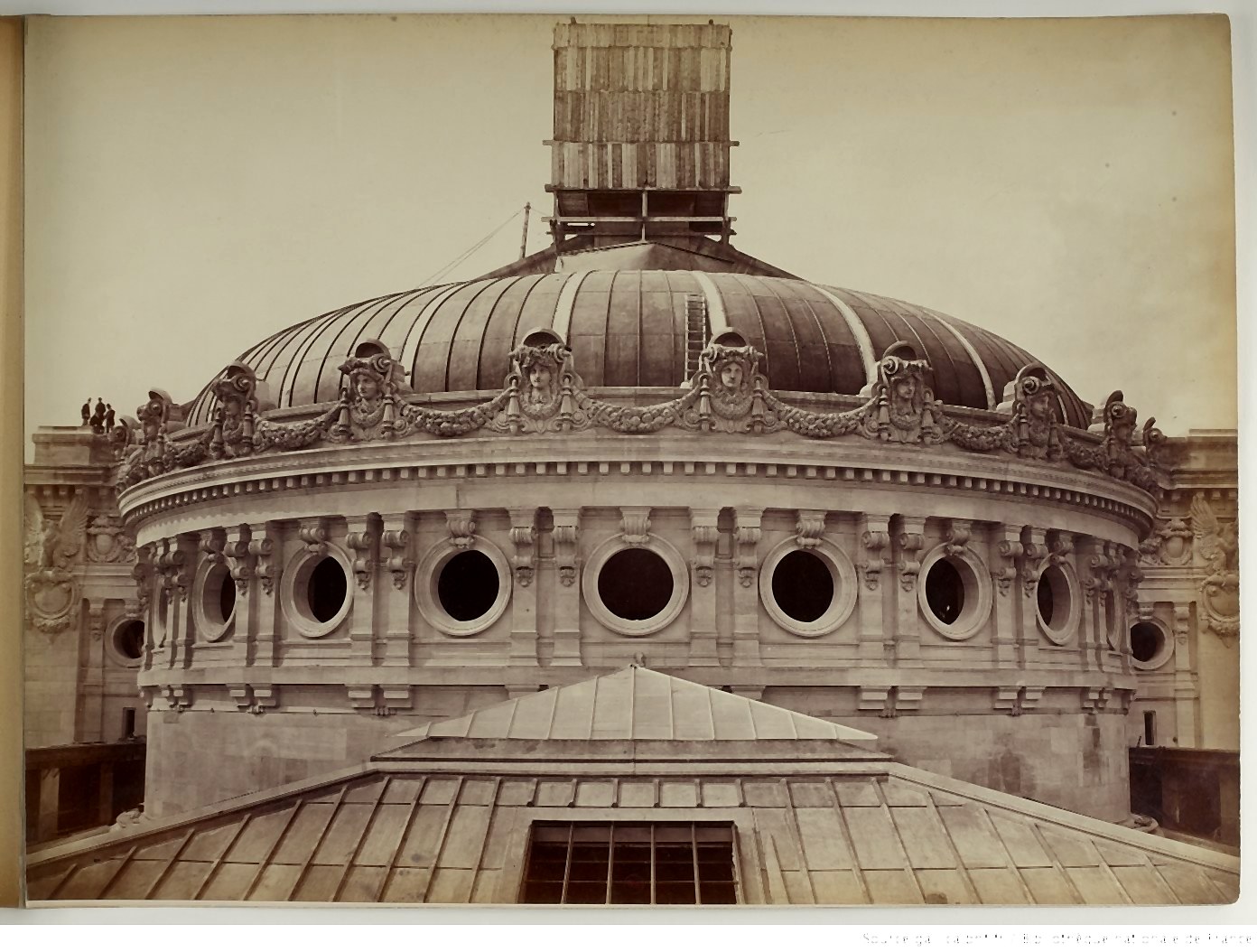
His winning plan was persuasive beneath the ornament. It separated and connected three great systems: the public sequence from entrance to staircase and foyer; the auditorium, stage and fly tower; and the backstage world of dance, administration and production. The exterior volumes reveal those functions. Domes, gables and pavilions are not simply decoration; they make the building’s inner machinery legible from the city.
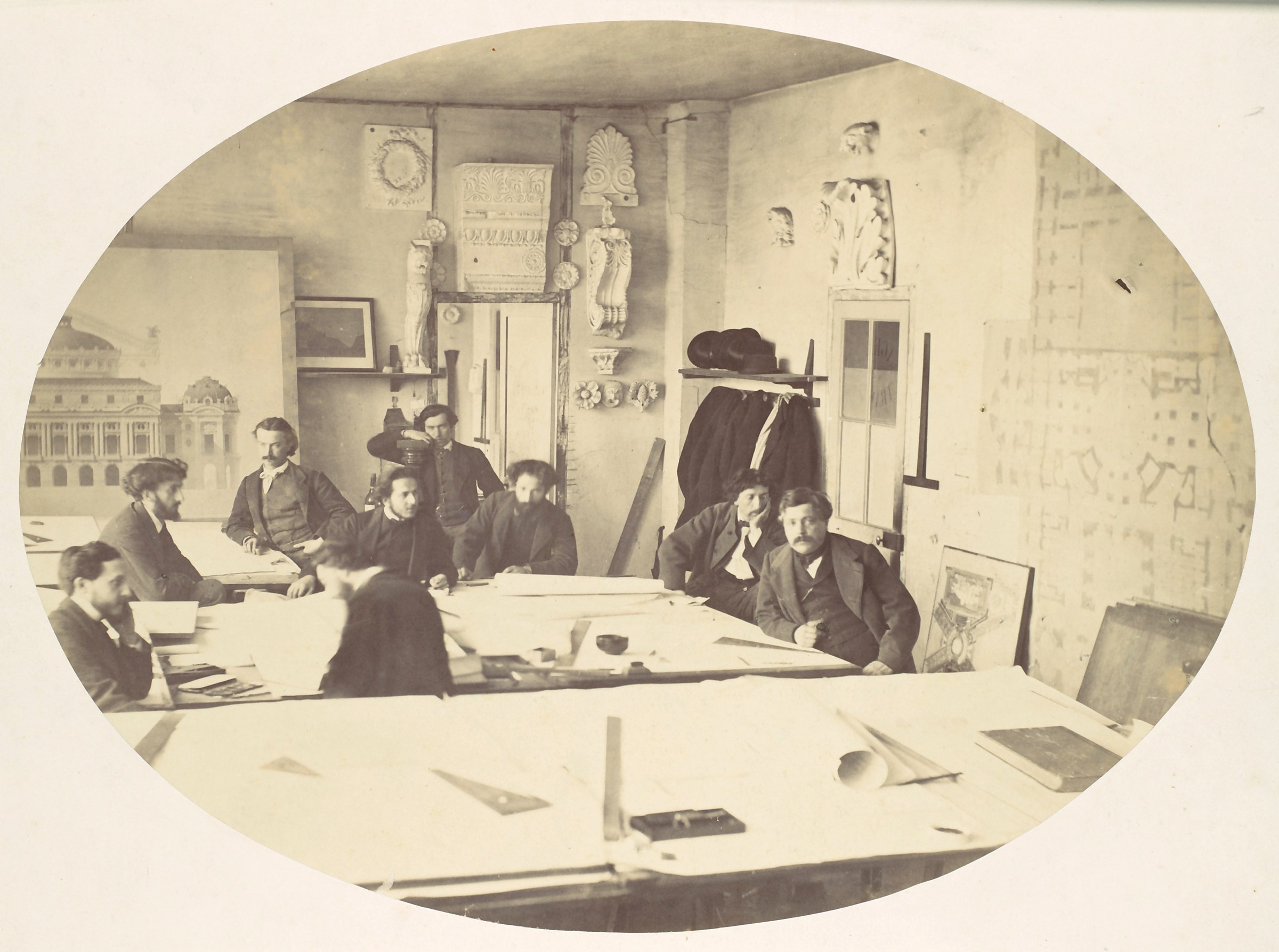
A building that casts its audience
The Palais Garnier is often labelled “Napoleon III style,” a phrase associated with a famous, possibly embellished exchange between the architect and the Empress. A more useful description is eclectic Second Empire architecture: classical order, Renaissance colour and Baroque movement assembled around a modern plan and iron structure.
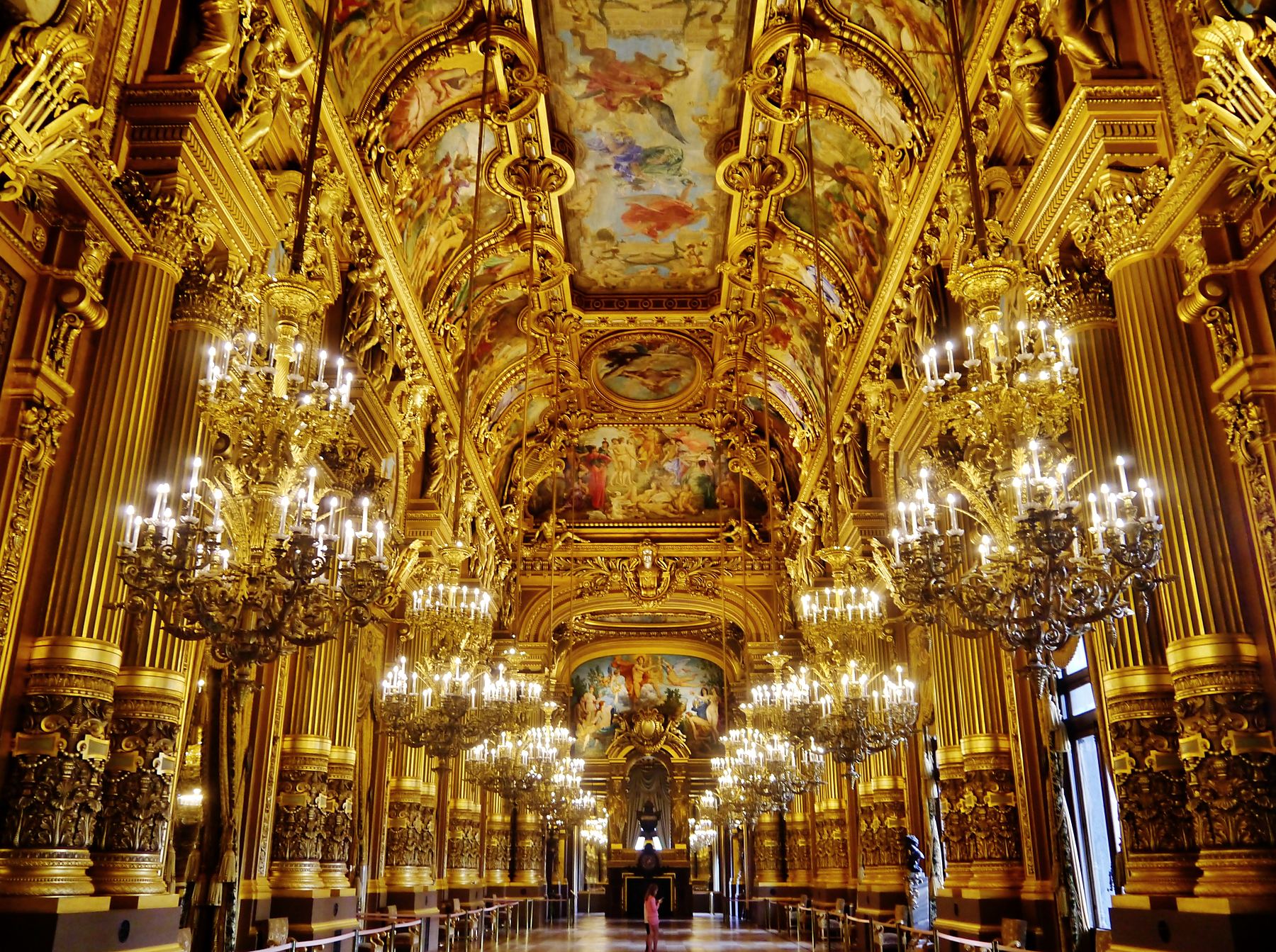
Garnier choreographed people as carefully as space. Subscribers entered through a covered route on the east. An imperial pavilion announced sovereign access on the west. Inside, routes revealed rank before anyone reached a box. The Grand Staircase slowed the crowd, divided it, lifted it and offered balcony after balcony from which to observe. The Grand Foyer, with mirrors facing windows, extended the social promenade into apparent infinity.
It was architecture for looking—and for being looked at. Fashion, jewellery, title and companionship could be read across the room. That visual economy was thrilling, but not innocent. The Opera’s elite audience occupied boxes and privileged routes while dancers, many from modest backgrounds, worked within a ballet culture shaped by unequal access and patronage. Garnier’s velvet-and-mirror spectacle encoded the class and gender assumptions of its century.
Garnier conducted; hundreds made the music
To call the Palais Garnier the work of one man is to misunderstand it. Garnier acted more like a conductor of architecture, painting, sculpture, mosaic, textiles, metal and light.
Beneath the staircase, La Pythie commands a basin. Its sculptor was Adèle d’Affry, who worked under the name Marcello—a crucial female presence in a programme too often narrated as an all-male triumph. Paul Baudry painted the Grand Foyer’s immense musical cycle. Isidore Pils worked above the staircase. Jules-Eugène Lenepveu created the auditorium’s original ceiling; Georges Clairin painted the Salon du Glacier. Auguste Rubé and Philippe Chaperon made the stage curtain to Garnier’s directions.
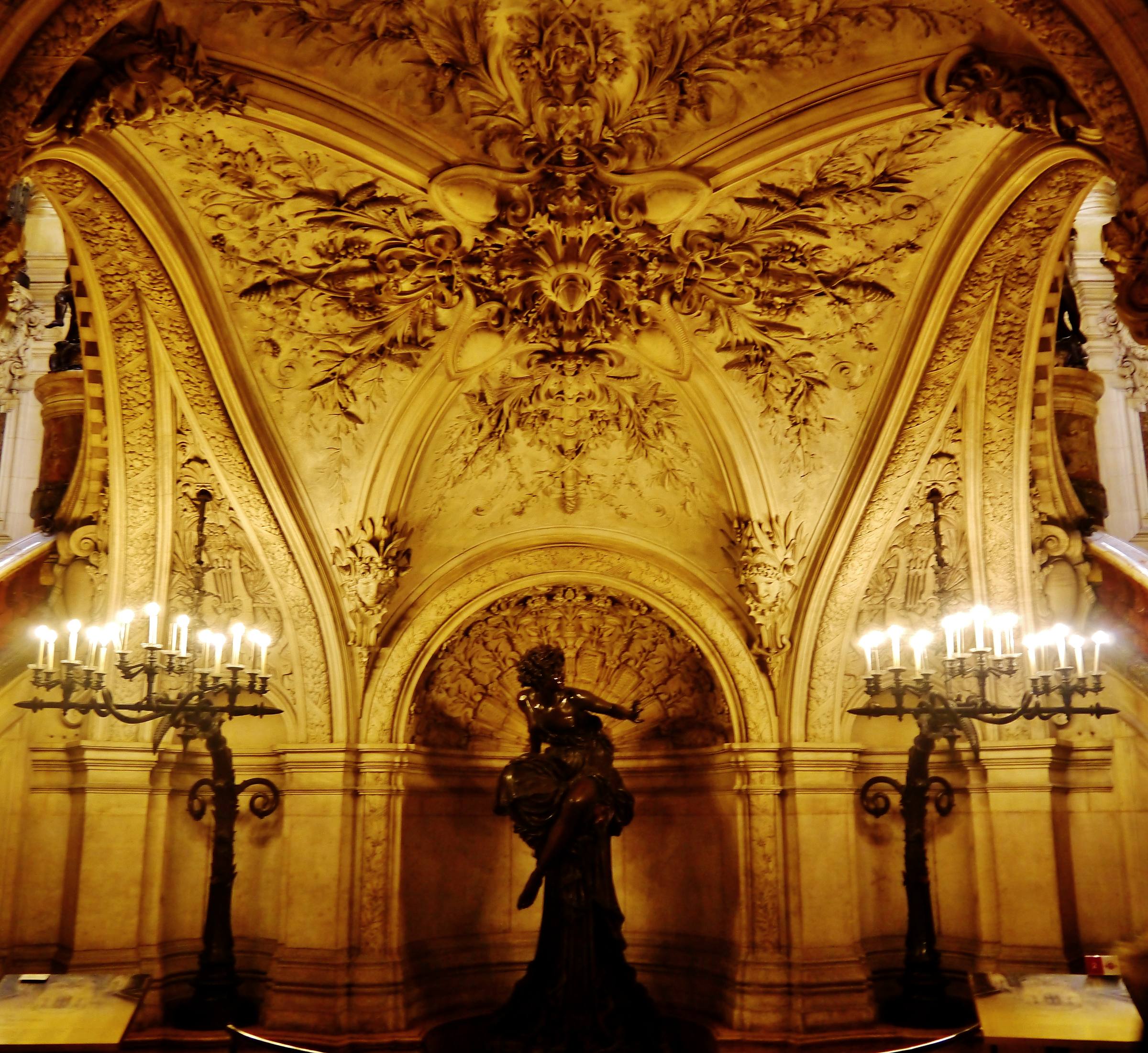
On the façade, Jean-Baptiste Carpeaux’s La Danse caused outrage for the movement and nudity of its figures; it was attacked with ink in late August 1869. The original was removed from the façade in 1964 and is now at the Musée d’Orsay. What visitors see outside today is Paul Belmondo’s copy.
And behind those credited names stood masons, mosaicists, metalworkers, carpenters, glaziers and decorators. The palace is a “total work of art” because many arts—and many hands—remain visible at once.
Water below, war above
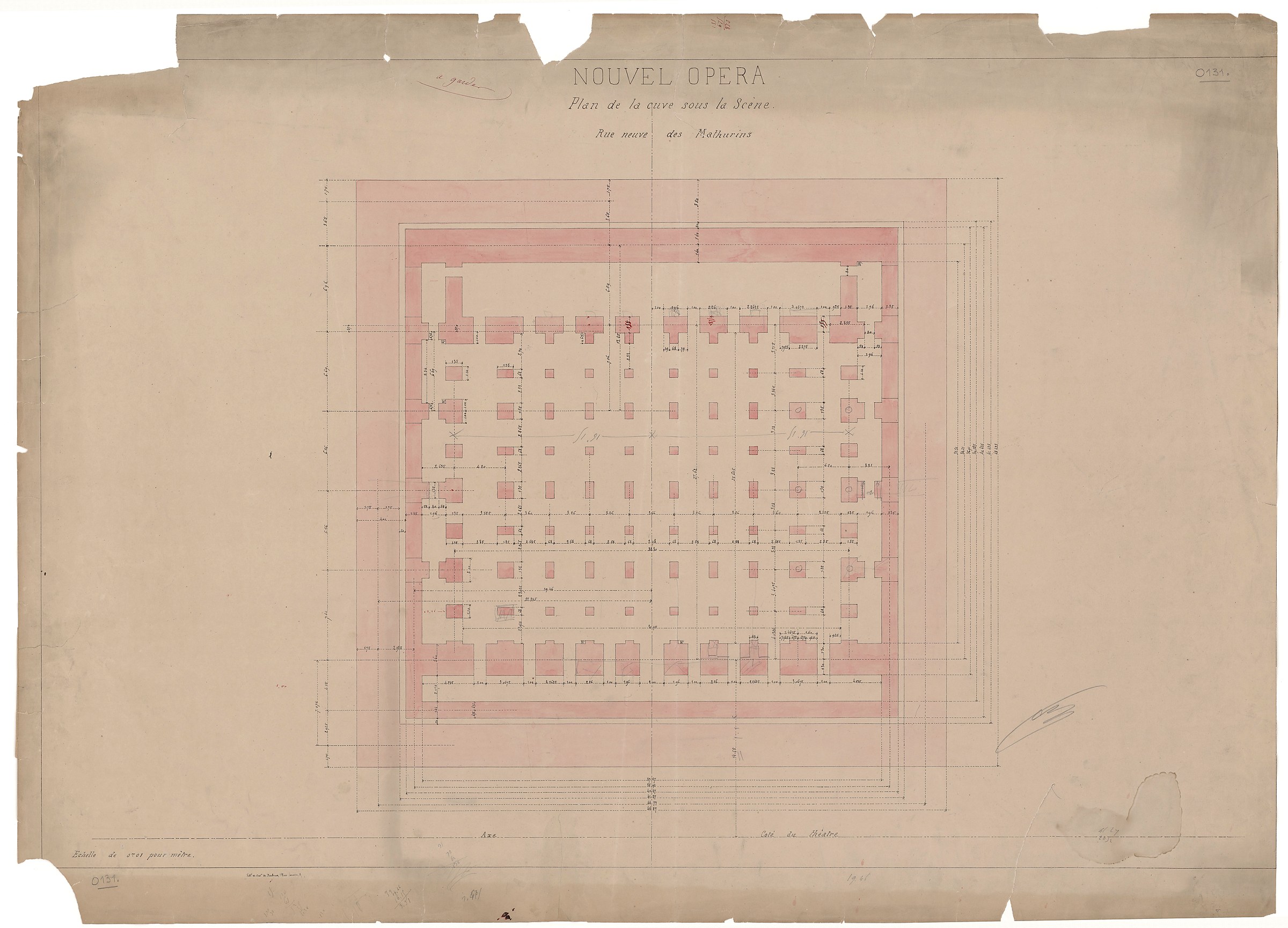
The glamour nearly foundered before it rose. In spring 1862, groundwater invaded the excavations. Pumps ran day and night for months. Engineers eventually created a watertight foundation system incorporating a water-filled reservoir beneath the building.
Then history moved above ground. The Siege of Paris stopped construction in 1870. The unfinished Opera served first as a hospital and later as a military store. Napoleon III fell; imperial emblems had to be removed. During the Commune, Fédérés occupied the site. Work resumed, and the destruction by fire of the Salle Le Peletier in October 1873 made completion urgent.
On 5 January 1875, President Patrice de MacMahon inaugurated an imperial commission as a monument of the Third Republic. The building had cost just over 35 million gold francs, yet the imperial entrance, gallery and Salon du Glacier were still unfinished. The Opéra recounts one exquisite final humiliation: Garnier was not formally invited and paid 120 francs for his own box. Paris applauded the palace while its architect watched as a customer.
The “lake,” the chandelier and the making of a phantom
There is water beneath the Palais Garnier, but there is no natural underground lake crossed by a masked genius in a boat. The “lake” is the reservoir and cistern system born from a difficult water table, later useful to the building’s safety. Engineering became rumour because engineering hidden beneath an opera house was already halfway to fiction.
A second fact was distorted even more dramatically. On 20 May 1896, part of the chandelier mechanism failed during a performance of Hellé. A heavy counterweight fell through the ceiling and killed a spectator. The chandelier itself did not crash into the audience.
Gaston Leroux joined these fragments—the reservoir, the fatal accident, a labyrinthine stage house and decades of press-fed legend—in his 1910 novel The Phantom of the Opera. The fiction is unforgettable because its raw materials were real. The truth is no less compelling: a building designed as spectacle generated its own mythology.
When Chagall entered the auditorium
The palace did not stop changing in 1875. In 1962, Culture Minister André Malraux commissioned Marc Chagall to create a new ceiling for the auditorium. Unveiled on 23 September 1964, it set Chagall’s bright modern universe against Garnier’s nineteenth-century interior and provoked fierce argument.
The intervention was deliberately reversible. Chagall’s structure was mounted below Lenepveu’s original ceiling, which remains preserved above it. The result is not the erasure of one age by another, but a tense superposition: Empire, Republic and twentieth-century cultural policy occupying the same air.
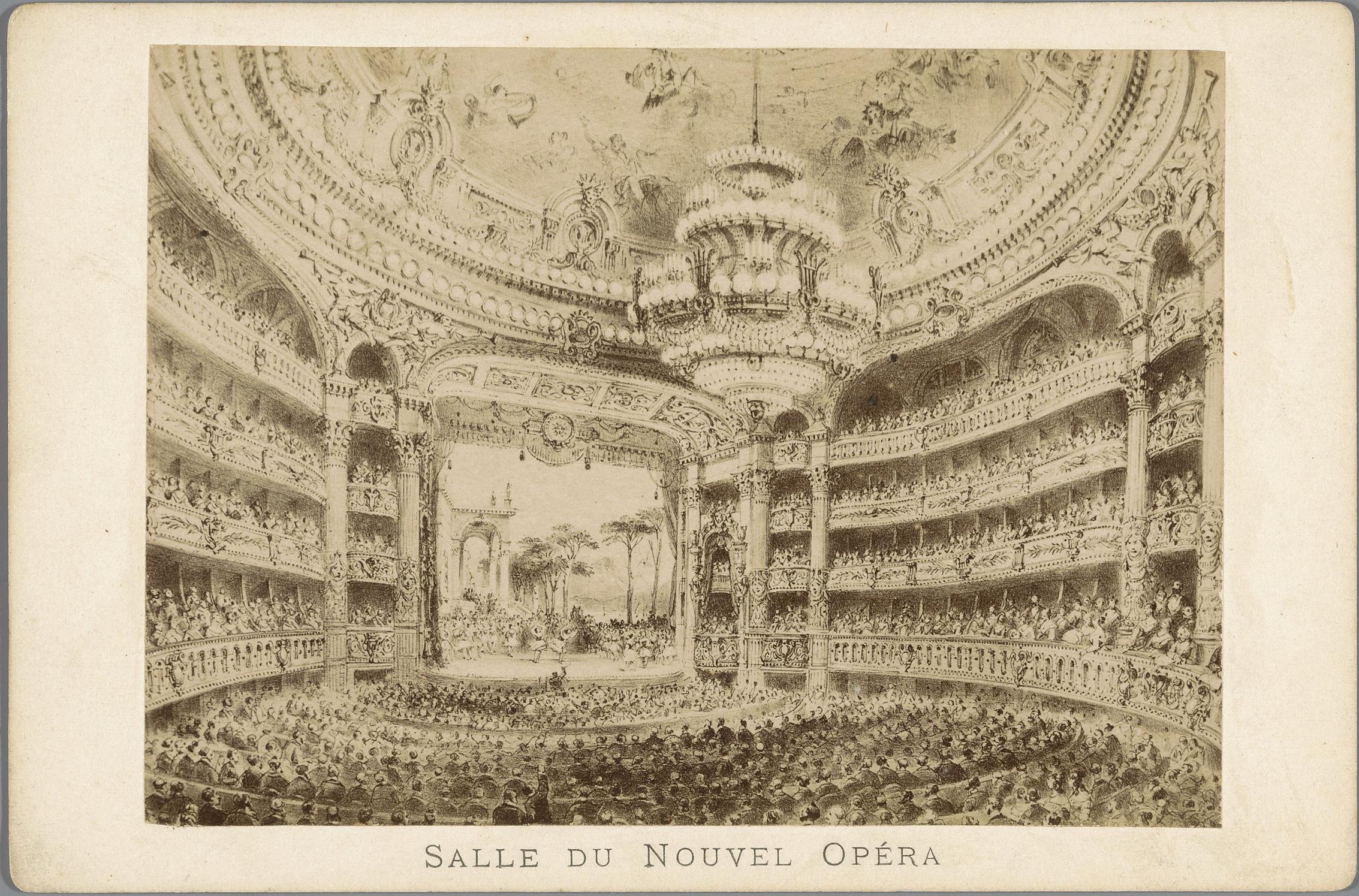
> Image-rights note: Chagall’s 1964 ceiling remains separately protected by copyright. A licence for a modern photograph does not by itself clear the artwork when it is a substantial visible element. This feature therefore uses a pre-1964 Rijksmuseum view of the auditorium.
Beauty, power—and what the gold can hide
The Palais Garnier was never universally adored. Critics compared it to a confectionery, a casino and a necropolis. Degas, though a subscriber and one of the great artists of the ballet world, rejected its decorative excess and the regime it represented. Carpeaux’s dancers were treated as a moral threat before opening night.
Those objections sharpen the building rather than diminish it. Garnier produced a remarkably clear circulation machine dressed as a dream. Yet the dream advertised imperial authority, depended on urban demolition and staged social hierarchy as entertainment. Its beauty could make inequality look effortless.
That contradiction is part of its continuing force. Classified as a historic monument in 1923, the Palais Garnier remains a working theatre rather than a preserved shell. The opening of Opéra Bastille in 1989 strengthened Garnier’s association with ballet, but opera, concerts and other performances still inhabit it. More than a million people visited in 2023, according to the Opéra; in 2025 the building marked its 150th anniversary.
Its next chapter will require intervention again. A state programme announced in 2025 plans major stage modernisation, with a stage closure currently scheduled from summer 2027 to summer 2029 while visits are intended to continue. Dates and access should be checked before travel.
Where to see it: Palais Garnier visitor guide for 2026
Address: Place de l’Opéra, 75009 Paris Visitor entrance: corner of Rue Scribe and Rue Auber, behind the Charles Garnier statue Metro: Opéra (lines 3, 7 and 8); Chaussée d’Antin–La Fayette (7 and 9) RER: Auber (RER A)
Visits: The standard official schedule verified on 3 October 2026 is daily, 10:00–17:00, with a summer extension to 18:00. Last entry is one hour before closing; evacuation begins 15 minutes before closing. Performance activity and exceptional closures can alter access.
Booking: Online reservation is currently mandatory, and the live official page states that visit tickets are not sold on site. Tickets normally open for the next 30 days. Entry may begin up to 30 minutes after the time printed on the ticket; later admission is not guaranteed, and there is no re-entry after leaving. The auditorium can close without notice for rehearsals or technical needs; a timed ticket does not guarantee entry to it and this does not trigger a refund.
Self-guided admission verified for 2026: €15 for adult residents or nationals of France/EEA; €25 for other adults; €10 for ages 13–25 from France/EEA; €20 for other visitors aged 13–25. Children through age 12 and several eligible categories enter free with proof. Prices and conditions are dynamic: check the official Palais Garnier visitor page on the day you book.
Accessibility and bags: Lift access is available, although the temporary-exhibition area and shop are not wheelchair-accessible. Cloakrooms are closed during visiting hours, and suitcases or travel bags are prohibited.
The following 60-, 90- and 150-minute routes are OUISTARS Travel editorial itineraries, not official visit products. Book an entry slot first and never build the plan around guaranteed auditorium access.
If you have 60 minutes: the social-theatre route
Spend five minutes reading the façade from Place de l’Opéra, then move through the Subscribers’ Rotunda and Marcello’s Pythia. Give the Grand Staircase 15 minutes: climb halfway, turn, then look back from a balcony. Continue through the Avant-Foyer to the Grand Foyer. If the auditorium is open, finish at its door; if not, study the architectural model rather than racing the staff.
If you have 90 minutes: the complete interior rhythm
Follow the same route slowly, adding the Sun and Moon salons, Glacier Rotunda and the Library-Museum gallery. Reserve about 15 minutes for the auditorium and ceiling if accessible, or for the model and current exhibition if it is closed. Ninety minutes matches the Opéra’s stated standard self-guided duration.
If you have 150 minutes: architecture, myth and city
Begin with 20 minutes outside: compare the subscriber and former imperial pavilions and identify Belmondo’s copy of La Danse. Allow 90 minutes for the interior. Afterwards, walk south along Avenue de l’Opéra for 20 minutes, reading the vista as both urban theatre and security corridor. Use the final 20 minutes to separate the building you have seen from the myths: reservoir, not romantic lake; counterweight, not falling chandelier. The underground infrastructure is not part of the ordinary visit.
Watch: the Palais Garnier as a performance in itself
In this official 150th-anniversary film, the Opéra national de Paris presents the building as a spectacle in its own right.
Source: Opéra national de Paris on YouTube.
Palais Garnier FAQ
Is there really a lake under the Palais Garnier?
There is a water-filled engineering reservoir beneath the building, created in response to groundwater. It is not a natural, navigable lake like the one in The Phantom of the Opera.
Did the Palais Garnier chandelier fall?
No. In 1896, a heavy counterweight associated with the chandelier mechanism fell through the ceiling and killed one spectator. Later retellings turned that fatal component failure into the fall of the whole chandelier.
How long should a Palais Garnier visit take?
Allow 90 minutes for a well-paced self-guided visit. Sixty minutes covers the essential social spaces; about 150 minutes lets you study the exterior, interior and Avenue de l’Opéra without rushing.
Can you always enter the auditorium?
No. Rehearsals, performances and technical work may close it unexpectedly, even to ticket holders. The Grand Staircase and foyers remain the core of the architectural experience.
What is the nearest station?
Opéra Métro station, served by lines 3, 7 and 8, is directly beside the monument. Auber on RER A is also close.
Sources and fact-checking
This feature was checked against the Opéra national de Paris history of the building, its Charles Garnier biography, the current official visitor information, the Bibliothèque nationale de France’s 150th-anniversary research, the Musée d’Orsay architectural dossier, its record for Carpeaux’s La Danse, the Fondation Napoléon account of the Orsini attack, Le Matin of 21 May 1896 on Gallica, the French heritage register, and the Ministry of Culture record of the Chagall ceiling.
Visitor hours, ticket rules, prices, access and planned works can change. They were last verified on 3 October 2026 and should be reconfirmed on the official site immediately before publication and travel.
Continue the series: Why the Eiffel Tower Was Not Demolished.
OUISTARS Travel
Editorial team
Editorial metadata
- SEO title: Palais Garnier: History, Architecture & Visit Guide
- Meta description: Enter the true story of the Palais Garnier: Charles Garnier, the Grand Staircase, underground reservoir, Phantom myths and a practical Paris visit guide.
- Slug:
palais-garnier-paris-history-architecture-visit-guide - Primary keyphrase: Palais Garnier Paris
- Secondary intent: Opera Garnier history; Charles Garnier architecture; Palais Garnier tickets and hours; Grand Staircase; Phantom of the Opera true story; underground lake; chandelier accident; Chagall ceiling.