









Creators Who Left Their Mark | Normandy
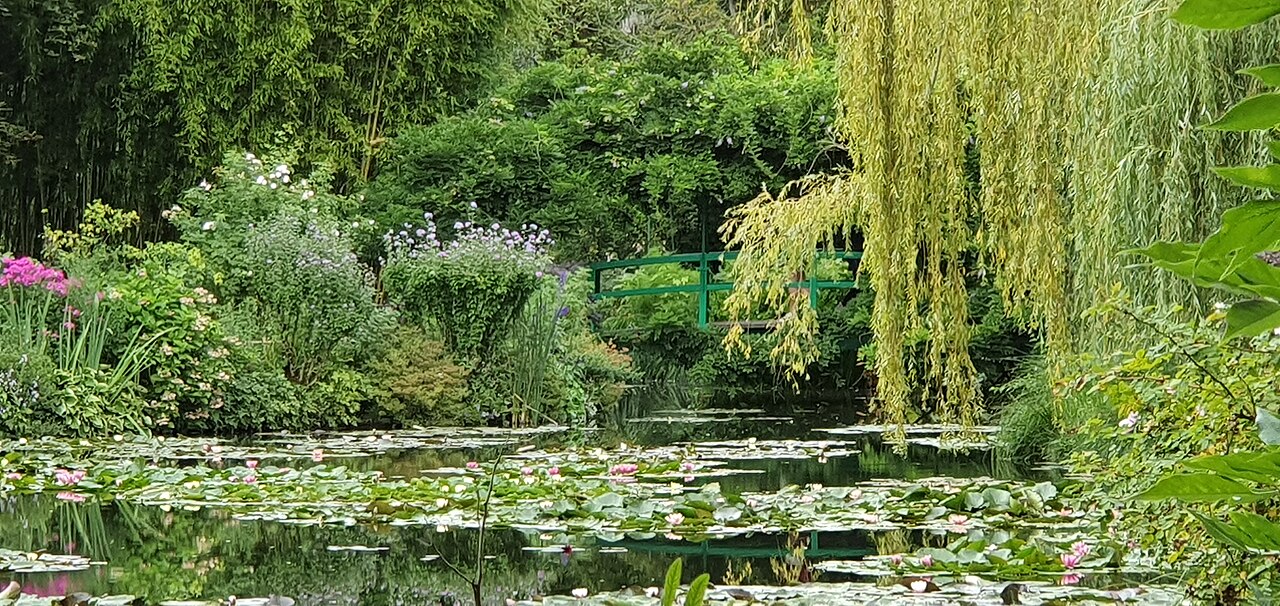
The water lilies needed an administrative decision before they became a subject for painting. In 1893, Claude Monet bought land below his property at Giverny, beyond the road and railway, and sought permission to dig a pond supplied by a branch of the Epte. Behind a scene now recognised across the world lay a practical decision to make a landscape.
Monet arrived in the Normandy village on 29 April 1883. Years separated that arrival from the water garden’s creation. The place did not come ready-made in the form that travellers would later photograph.
From orchard to painted subject
The garden in front of the house had been an orchard. Monet retained its broad structure while replacing fruit trees with densely planted flowers. In the new water garden, he planted coloured water lilies ordered from the Latour-Marliac nursery. The pond was enlarged in 1901.
The garden was an active part of the work. Before deciding where a colour would sit on canvas, Monet had made choices about what would grow in front of him. Planting shaped the pond’s surroundings; its size determined the space available for reflection. Gardening helped establish the conditions of painting.
The Fondation Monet describes his interest in nursery catalogues and plant exhibitions, and his exchanges with friends who knew horticulture. A seemingly effortless view depended on knowledge and continuing care. The work that kept plants alive rarely enters the visitor’s photograph, although it made that photograph possible.
Light follows no garden plan
A plant can be placed. What happens on the water cannot be fixed in the same way. Sky enters the gaps between leaves, and movement breaks up a reflection. The part Monet shaped meets something that changes from day to day.
That encounter helps explain the garden’s visual power. In an ordinary landscape, the eye looks for sky above land. On the pond, sky and vegetation occupy the same surface. Near and far mingle; a single glance cannot easily separate them.
By the end of the nineteenth century, the pond had become central to Monet’s work. He was considering a large decorative project in which painted walls would extend the experience of water. That idea connects with the great Water Lilies now held at the Musée de l’Orangerie in Paris.
The garden that had to be saved
After Monet’s death, his son Michel inherited the property. Over time, the house and garden fell into neglect. Gérald Van der Kemp began the rescue in 1977, and the garden opened to the public in 1980.
A visit therefore encounters both the artist’s creation and the effort that preserved it. Plants do not remain unchanged for decades. Maintaining a garden requires work, and its appearance shifts with season and weather. An old photograph cannot promise the same flowers on the day a traveller arrives.
That variability is part of the place’s value. Visitors enter a living garden, linked to Monet’s paintings without being frozen inside them.
At Giverny, the difference between a photograph and a painting becomes tangible. One records a moment; the other carries its maker’s choices about what was seen. Between them stands a garden that required land, permission and years of work, before everything could appear as fleeting as light.
Monet kept water within the painting. The garden still lets it change.
Sources : Giverny: the garden · Fondation Monet · Monet’s early years in Giverny
Cover photograph: The green Japanese bridge and water-lily pond in Monet’s garden at Giverny. Qwertzu111111 · CC BY-SA 4.0 Image source and licence

.jpg)