











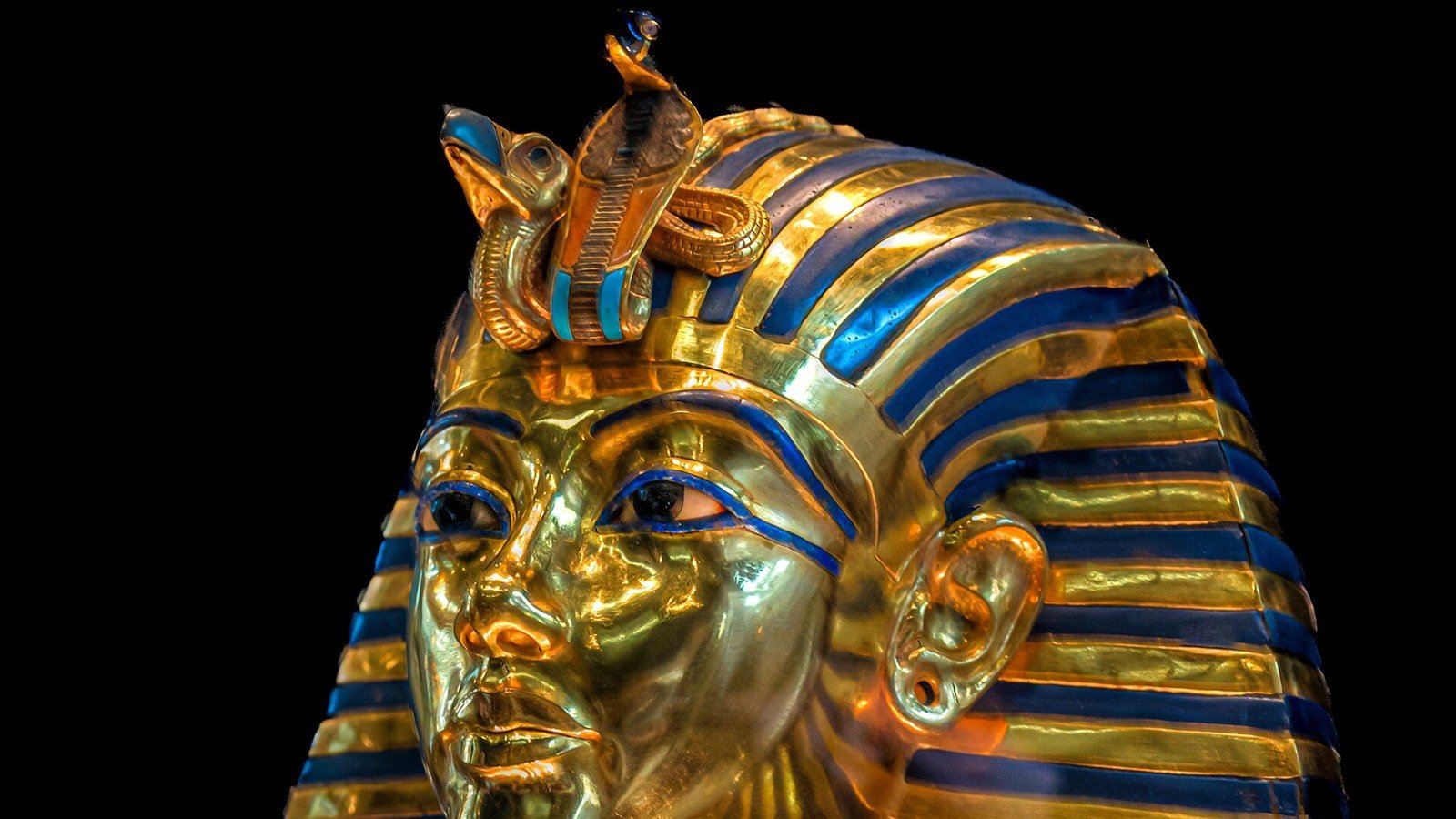

Tutankhamun’s golden funerary mask. Photograph: Tarekheikal, Wikimedia Commons, CC BY-SA 4.0. Photograph and licence · CC BY-SA 4.0
On 4 November 1922, the first stone step emerged beneath the dust of the Valley of the Kings. More than a century later, Tutankhamun is no longer simply the young ruler found inside a remarkably intact tomb. He has become the most recognisable face of ancient Egypt—and the Grand Egyptian Museum now brings his treasures together to tell the story at unprecedented scale.
Tutankhamun in one minute
- Reign: approximately 1336–1327 BC, about nine years.
- Age at death: around 18; the cause remains uncertain.
- Tomb: KV62 in the Valley of the Kings, with four principal chambers.
- Discovery: the first step appeared on 4 November 1922; the famous first view came on 26 November.
- Contents: roughly 5,000 registered objects.
- At the GEM: more than 5,000 objects across about 7,500 square metres of dedicated galleries.
Who was Tutankhamun before he became the Golden King?
Tutankhamun came to the throne as a child near the end of Egypt’s Eighteenth Dynasty. He was first called Tutankhaten, then changed his name as the court restored the cult of Amun and reopened temples after Akhenaten’s religious revolution. His reign was short, and in life he was neither Egypt’s greatest conqueror nor its longest-serving pharaoh. What survived his death, however, preserved an extraordinary record of royal ritual, craftsmanship and daily life.
He died in his late teens. Egypt’s Ministry of Tourism and Antiquities places him at around 18, but the cause remains unresolved. Claims of a chariot accident, murder or a single definitive disease should therefore be treated as hypotheses rather than settled fact.
The discovery: sixteen steps to a sealed doorway
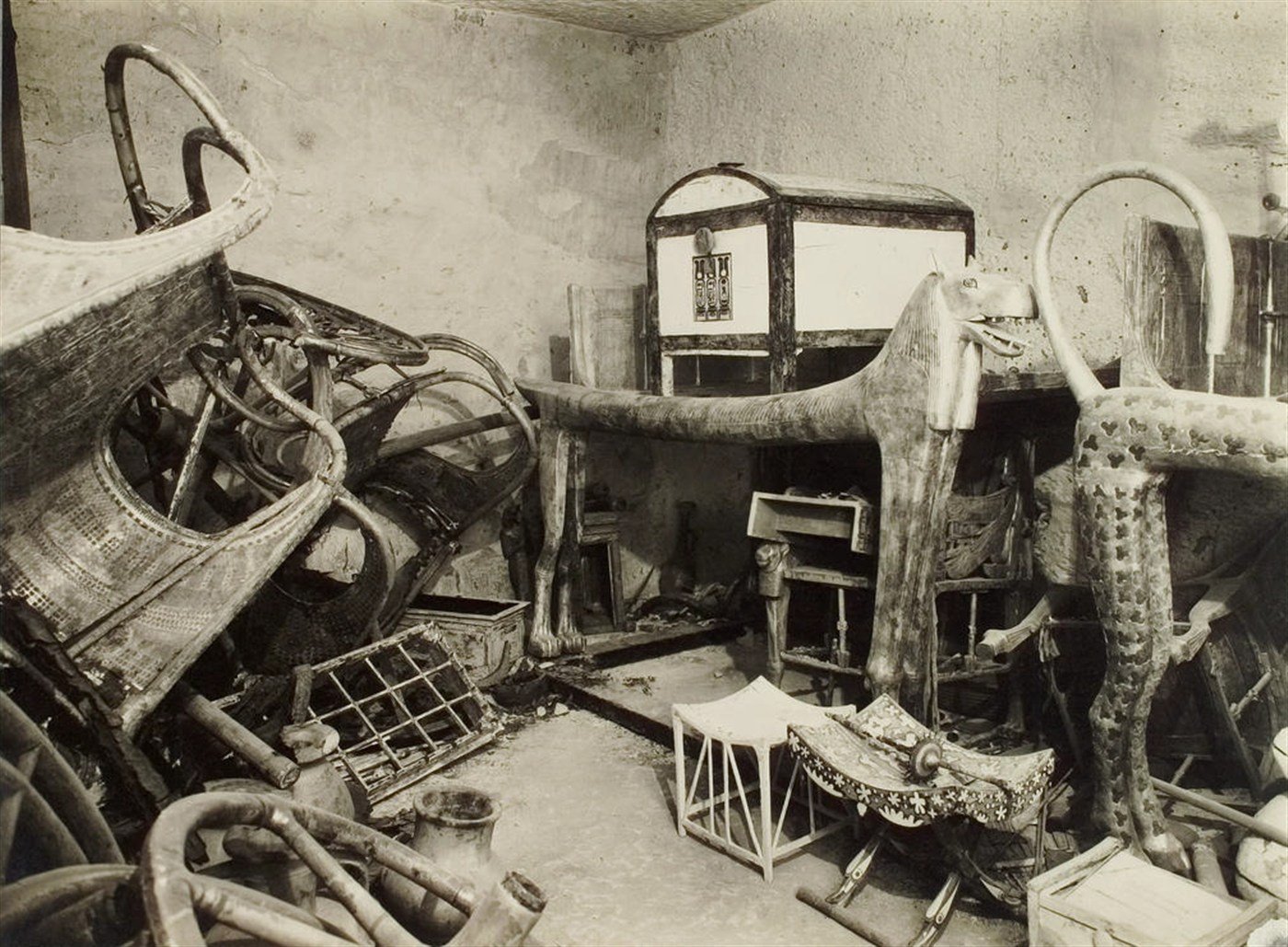
The Griffith Institute’s archive gives the drama a precise chronology. Howard Carter reached Luxor on 28 October 1922 and excavation resumed on 1 November. The first step appeared on 4 November; by the next day, a flight of sixteen steps led to a sealed doorway. Lord Carnarvon arrived on 23 November, and on the evening of 26 November Carter made the celebrated first inspection through the second doorway. The burial chamber itself was formally opened on 16 February 1923.
But this was never the work of one man. Egyptian labourers and specialists, conservators, photographers and draughtsmen made the excavation, movement and recording of the collection possible. A responsible account acknowledges that collective enterprise instead of reducing the discovery to Carter’s famous answer about seeing “wonderful things”.
Why did the tomb astonish the world?
KV62 is comparatively small and was packed almost beyond imagination. The antechamber held funerary beds, chariots, boxes and statues; only the burial chamber carried painted wall decoration. Inside, nested shrines and coffins protected the king. The innermost coffin was made of solid gold and weighs 110.4 kilograms, according to Egypt’s Ministry of Tourism and Antiquities.
Approximately 5,000 objects were recorded: jewellery, clothes, sandals, games, food, weapons, chariots, vessels and amulets. This is not merely a gold treasure. It is an archive of a royal household, revealing manufacturing techniques, fashion, belief, diplomacy and signs of use on things made for a young king.
Six objects that explain the legend
- The golden mask: not a modern portrait but an eternal identity, combining the king’s features with emblems of divine protection and rule.
- The three coffins: nested layers of protection culminating in the solid-gold inner coffin.
- The golden throne: an intimate scene of the king and Ankhesenamun brings court life into a story often dominated by death.
- The chariots: symbols of movement, hunting and royal display that still invite debate about their practical use.
- Clothes and sandals: they turn an icon into a young person with dimensions, tastes and a daily life.
- Games and amulets: leisure sits beside the protective language of rebirth.
What do the gold, blue and royal emblems mean?
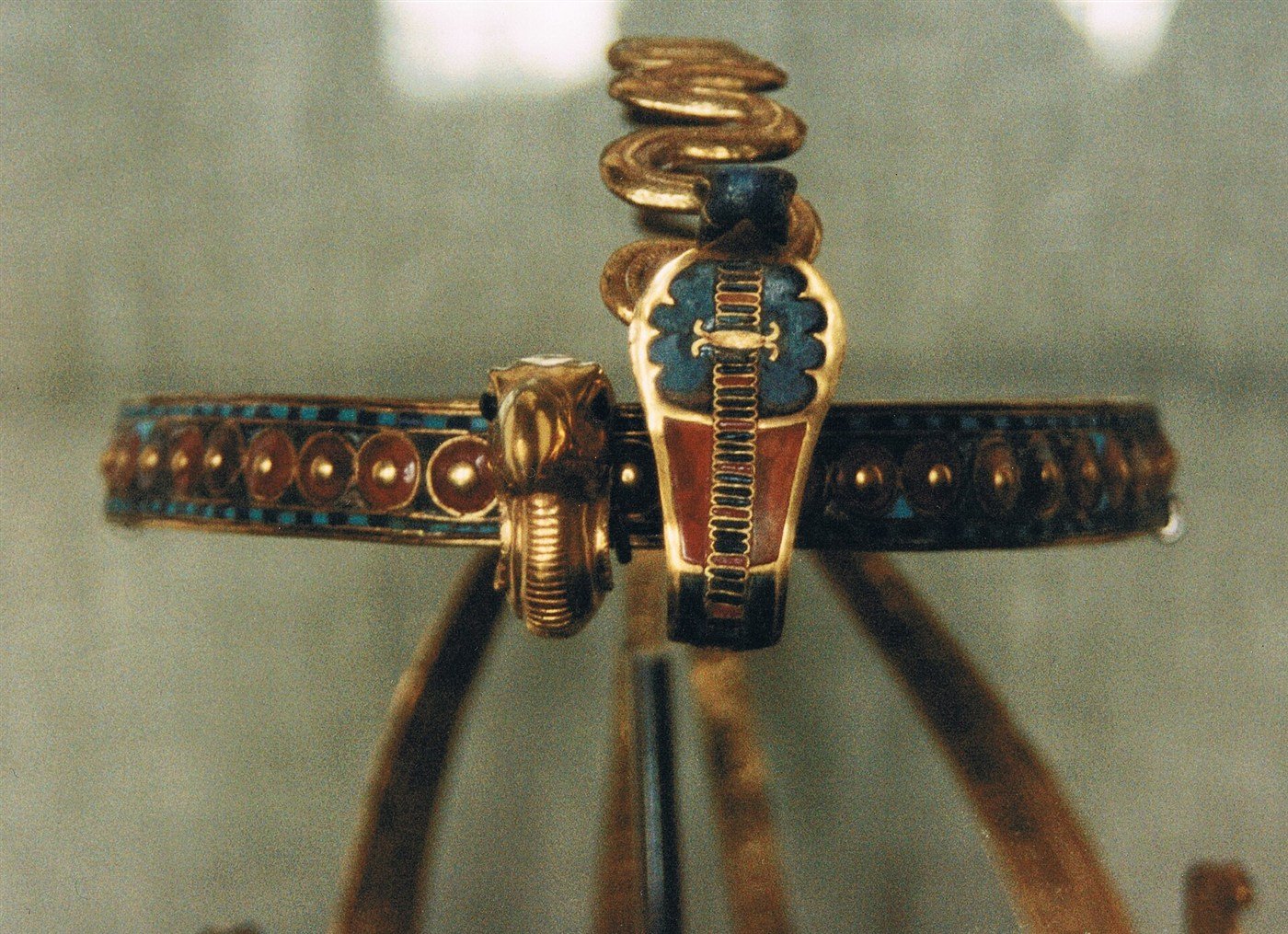
Gold was associated with the flesh of the gods and with a material that did not corrode—appropriate for a body intended for eternity. Blue evoked the sky, the Nile and regeneration. The cobra and vulture on the mask’s brow expressed protection and sovereignty over Upper and Lower Egypt. Scarabs, lotus forms, collars and amulets added a visual vocabulary of rebirth, order and defence.
The inlaid diadem is also a reminder that “Tutankhamun’s crown” is not one object in one story. Royal insignia changed with ritual and setting. The collection becomes more meaningful when read as a complete symbolic system rather than as a line of isolated masterpieces.
The pharaoh’s curse: a media story, not archaeology
Lord Carnarvon’s death after the tomb opened fuelled newspaper headlines about a curse. Yet no reliable inscription on the doorway condemns every visitor to death, and many members of the team lived for decades. The myth says much about the early twentieth-century appetite for mystery; it does not explain the excavation and should not replace archaeology, conservation or documentation.
The Grand Egyptian Museum: the story becomes whole
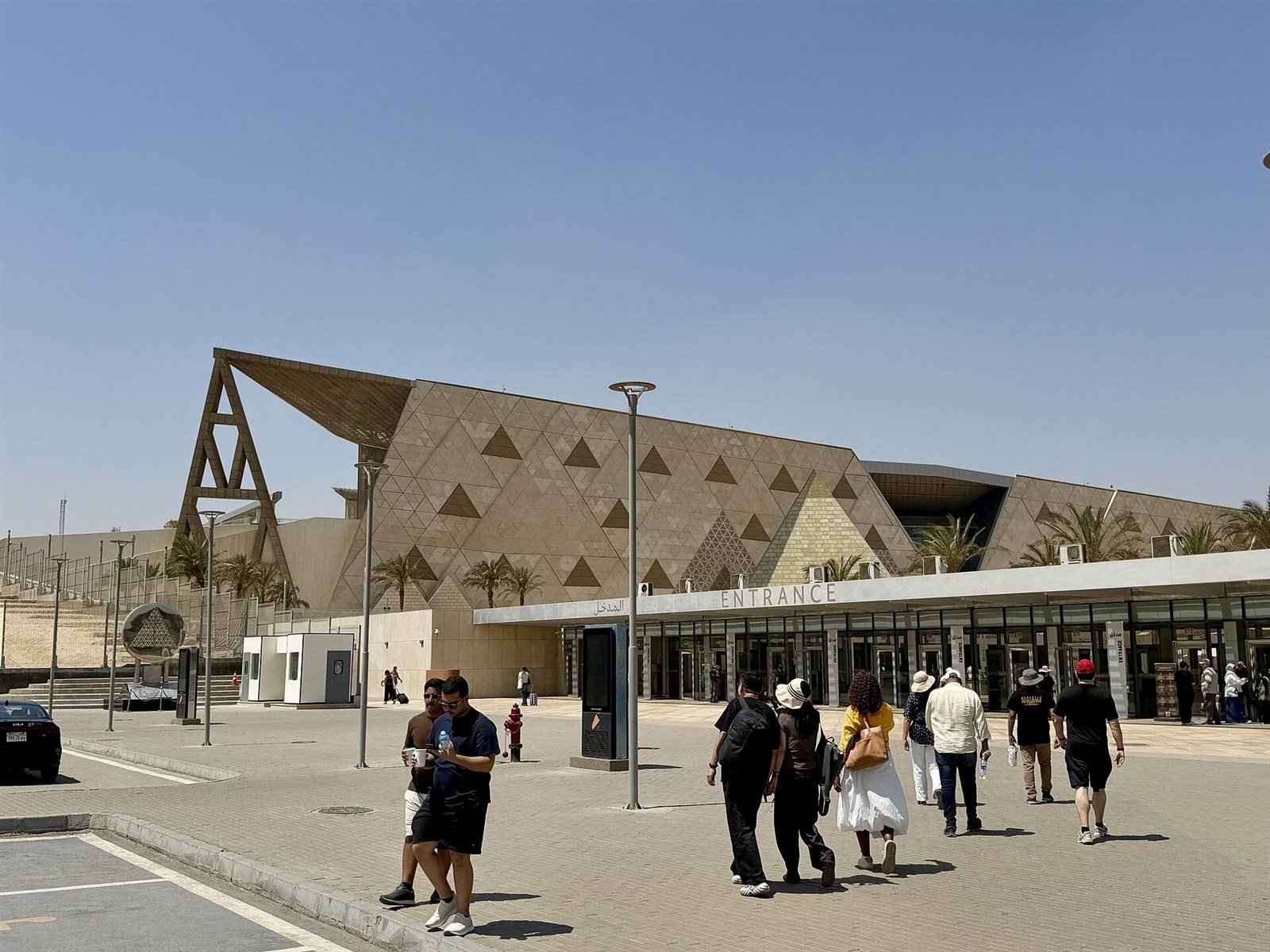
On the edge of the Giza Plateau, the Grand Egyptian Museum sits inside one of the world’s most important heritage landscapes. Egypt’s presidency describes a site of approximately 490,000 square metres holding more than 57,000 objects. Tutankhamun’s galleries extend across roughly 7,500 square metres and bring together more than 5,000 pieces. Twelve main galleries cover about 18,000 square metres, alongside the Grand Hall, Grand Staircase and Khufu Boats Museum.
This is the decisive change. Instead of meeting the mask as an isolated icon, visitors can follow the king’s life, death, beliefs and makers through thousands of connected objects. The museum does not create Tutankhamun’s importance; it provides a scale and narrative context that dispersed displays and storage could not.
Visitor numbers: what is actually confirmed?
The latest official first-year statement says the Grand Egyptian Museum welcomed more than five million visitors, alongside around 60 high-level official visits. That demonstrates exceptional demand, but footfall alone is not proof of complete local economic value. The larger return comes when a museum visit produces longer stays, spending in hotels, restaurants, transport and crafts, and a better distribution of travellers across Cairo, Giza and Luxor.
The museum’s future therefore reaches beyond ticket sales. It depends on crowd management, conservation, protection against fake booking sites and a coherent journey from airport to hotel, museum and pyramids. As a tourism investment, success should be measured by experience quality and locally retained value as well as entries through the gate.
Sphinx Airport and the future of Giza’s tourism cluster
The Egyptian government presents Sphinx International Airport as a modern gateway serving western Cairo and improving access to the pyramids and the Grand Egyptian Museum. Its significance is not an often-conflicting distance figure found online. It is the possibility of an alternative arrival corridor that can reduce pressure on central Cairo and support organised trips, short visits and links to new cities and resorts.
Combined with dependable transport, transparent official booking, a broad hotel base and itineraries linking Giza with Luxor and the Red Sea, Tutankhamun can become the beginning of a longer Egyptian journey rather than a brief photo stop. This is where heritage meets the visitor economy: the object creates desire, while infrastructure and service turn desire into durable value.
How to visit the Grand Egyptian Museum
- Tickets: use the official platform only, tickets.gem.eg. The museum has warned about unauthorised websites.
- Usual gallery hours: 9:00–18:00 on Sunday, Monday, Tuesday, Thursday and Friday; until 21:00 on Wednesday and Saturday. The complex opens earlier and closes later. Holiday schedules may differ.
- Time needed: a standard official guided tour is about two hours, but the Tutankhamun galleries, main galleries and Khufu boats deserve at least three to four hours.
- Best sequence: arrive early, give the Tutankhamun galleries proper time, then continue to the Grand Staircase and main galleries.
- Before travelling: recheck the official website the day before for any operational change.
Frequently asked questions
How many objects were found in Tutankhamun’s tomb?
About 5,000. Official bodies sometimes use “more than 5,000” for the displayed collection, so the number is best understood as an archival estimate rather than a simple fixed counter.
Did Howard Carter discover the tomb alone?
No. Carter directed the Carnarvon-funded project, but Egyptian workers and specialists, alongside conservators and documentarians, made the excavation possible.
Was Tutankhamun murdered?
No final scientific conclusion proves murder. He died at around 18, and the cause remains debated.
Where are Tutankhamun’s treasures now?
The collection is presented in the Tutankhamun galleries at the Grand Egyptian Museum in Giza, where thousands of related objects can be seen together.
Official and research sources
- Egyptian Ministry of Tourism and Antiquities — Tomb of Tutankhamun
- Egyptian Ministry of Tourism and Antiquities — Tutankhamun’s gilded coffin
- Griffith Institute, University of Oxford — First excavation season, 1922–1923
- The Metropolitan Museum of Art — Discovering Tutankhamun
- Grand Egyptian Museum — FAQ and visitor information
- Official Grand Egyptian Museum ticket platform
- Presidency of Egypt — Grand Egyptian Museum project
- Egypt State Information Service — More than 5 million visitors in the first year
- Egypt State Information Service — Sphinx International Airport as a modern gateway
- Egyptian Ministry of Tourism and Antiquities — Virtual tour of the Tutankhamun collection