




THE STORY BEHIND THE HOTEL · PARIS, EPISODE 7
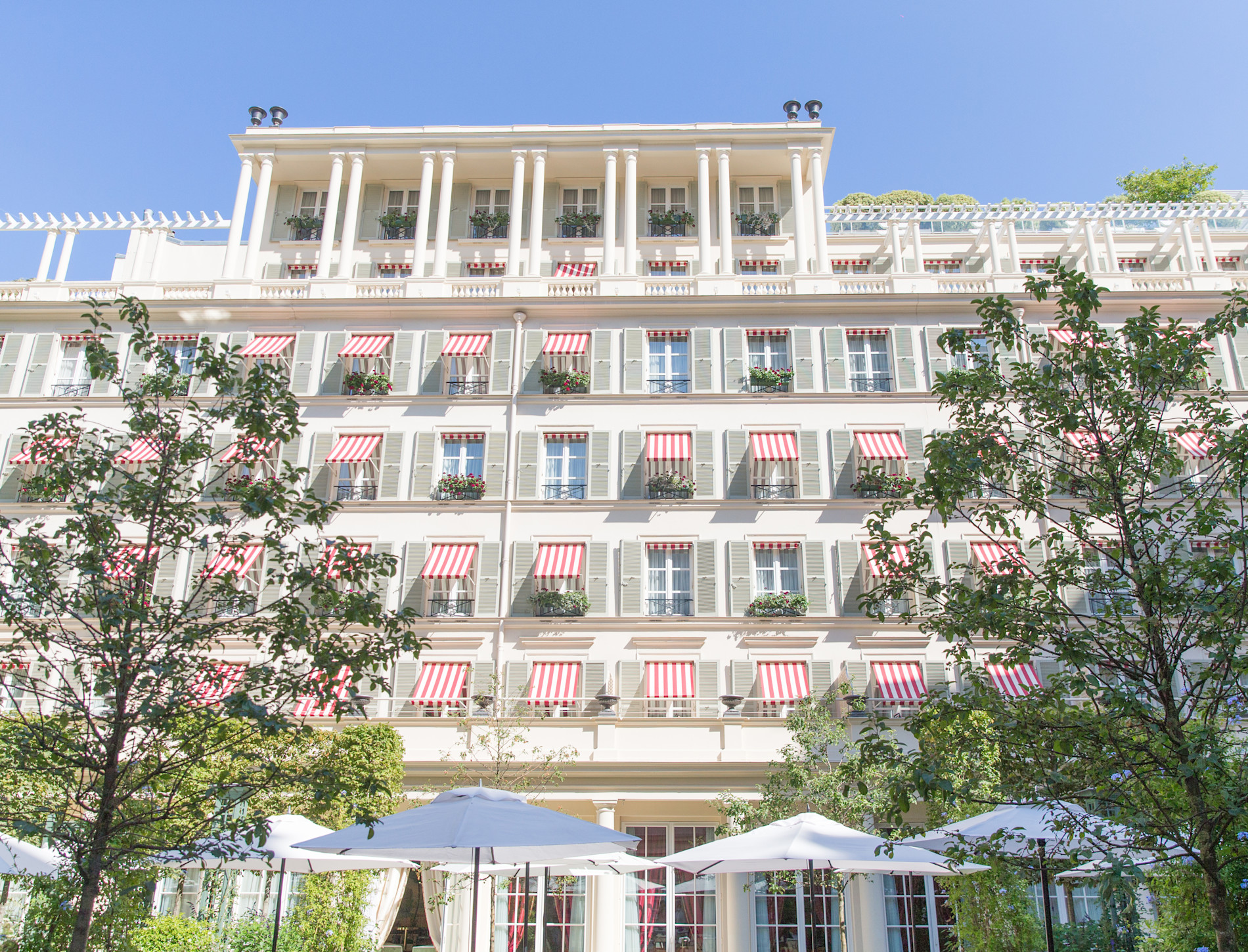
For years during the German occupation of Paris, Room 106 officially did not exist. Its number disappeared, its occupant stayed hidden by day, and after dark he walked the silent corridors drawing the future of the hotel that concealed him. Le Bristol Paris still carries part of his work in its wrought-iron lift. The most powerful luxury in this palace is not gold. It is memory protected by discretion.
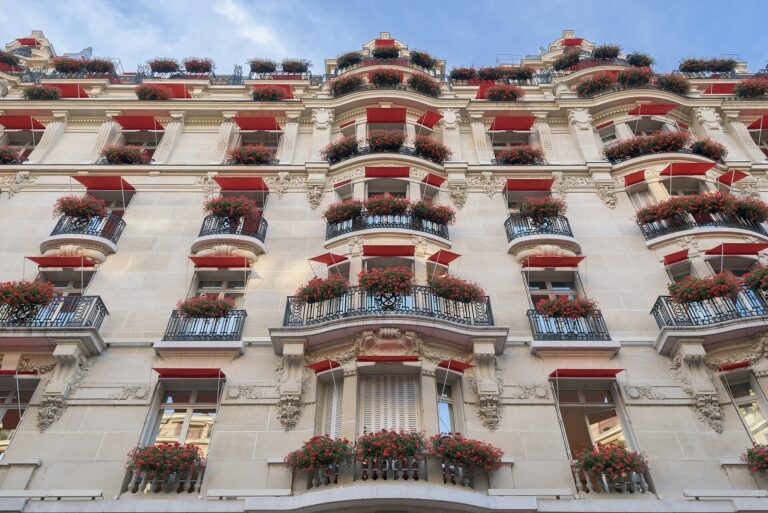
At 112 rue du Faubourg Saint-Honoré, Le Bristol presents a composed face to one of Paris’s most watched streets. The Élysée Palace is nearby, couture houses line the district, and the hotel’s doors open onto a world of gardens, Louis XVI furniture, Michelin-starred dining and a swimming pool suspended above the roofs.
Yet its true story is not a straight ascent into glamour. It begins with a private mansion, becomes an ambitious family hotel in the Roaring Twenties, survives occupation through a diplomatic gamble, passes between two hotel dynasties and repeatedly enlarges itself without surrendering the manners of a private Parisian house.
This is not a hotel review and it is not advertising. It is the documented story of Le Bristol Paris, including the years when hospitality became an act of protection.
Before the palace, a private house
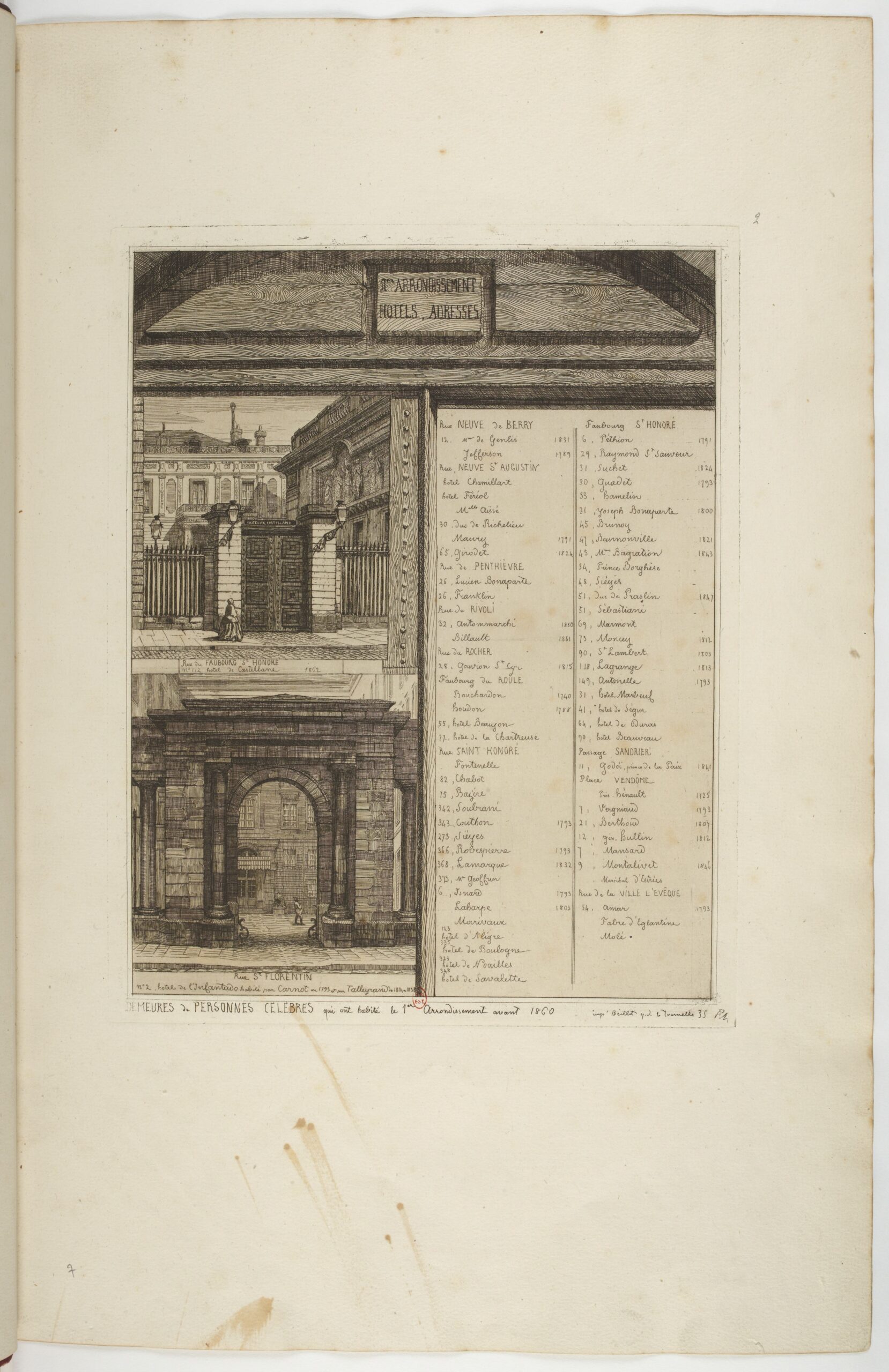
The address belongs to the long transformation of the Faubourg Saint-Honoré. After the French court returned from Versailles in the early eighteenth century, fields beyond the old city gave way to aristocratic houses. The property that would become Le Bristol was associated with the residence of Count Jules de Castellane, complete with the layered rooms and private social spaces of a grand Parisian mansion.
In 1923, hotelier Hippolyte Jammet bought the property with a precise ambition: to create one of the most luxurious hotels in Paris. He chose the name Bristol in honour of Frederick Hervey, fourth Earl of Bristol, the eighteenth-century traveller whose demanding taste for comfort had made his title a European shorthand for refined accommodation.
The hotel opened in April 1925. Paris was in the full rhythm of the années folles, with jazz, new fashion, cinema and modern art recasting the city. Le Bristol was not conceived as a monumental railway hotel or an international stage. Its proposition was quieter: the scale and privacy of a residence, equipped with the most modern comforts its founder could obtain.
Architecture designed to lower its voice
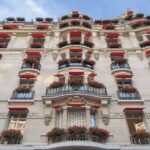
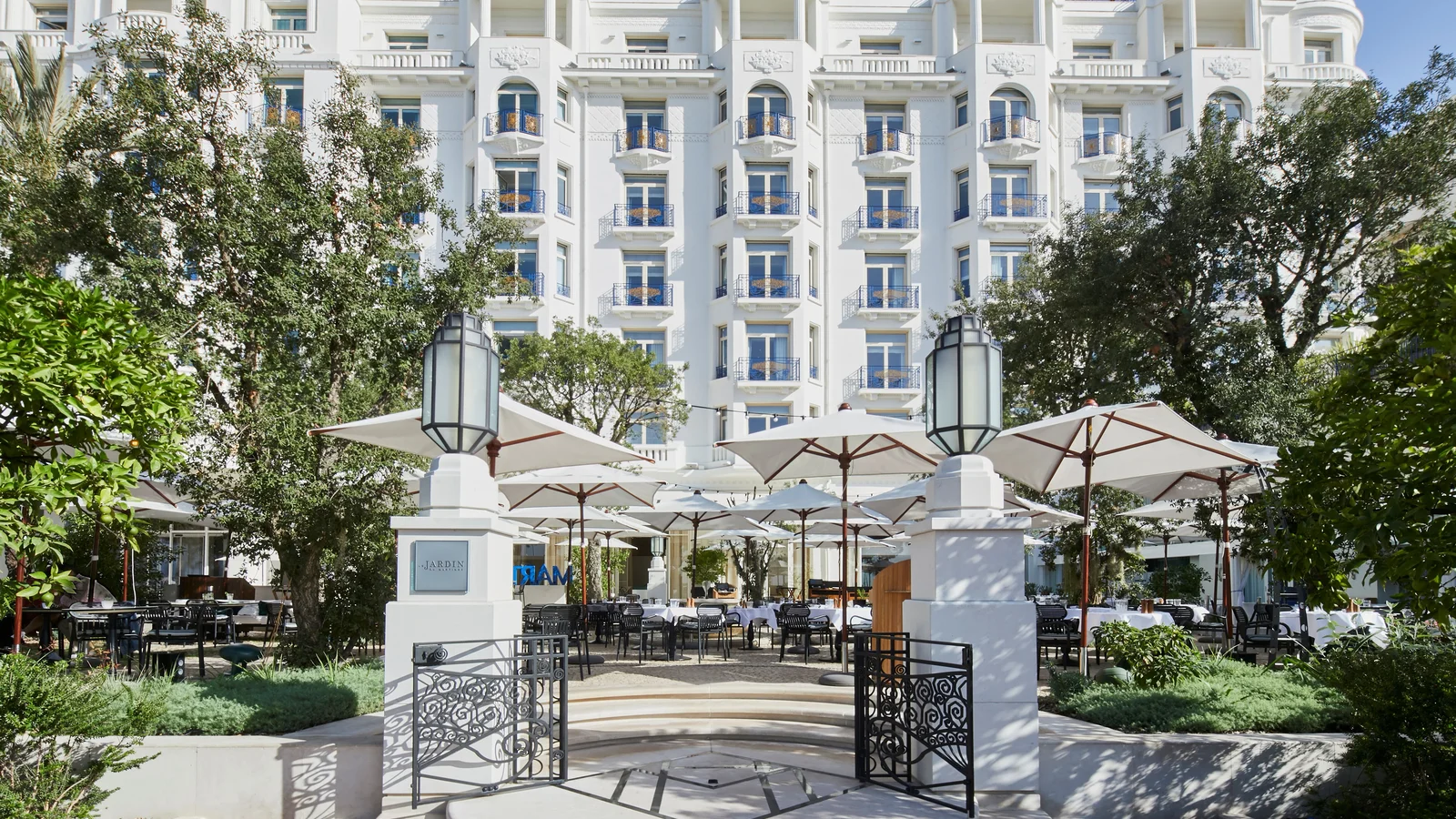
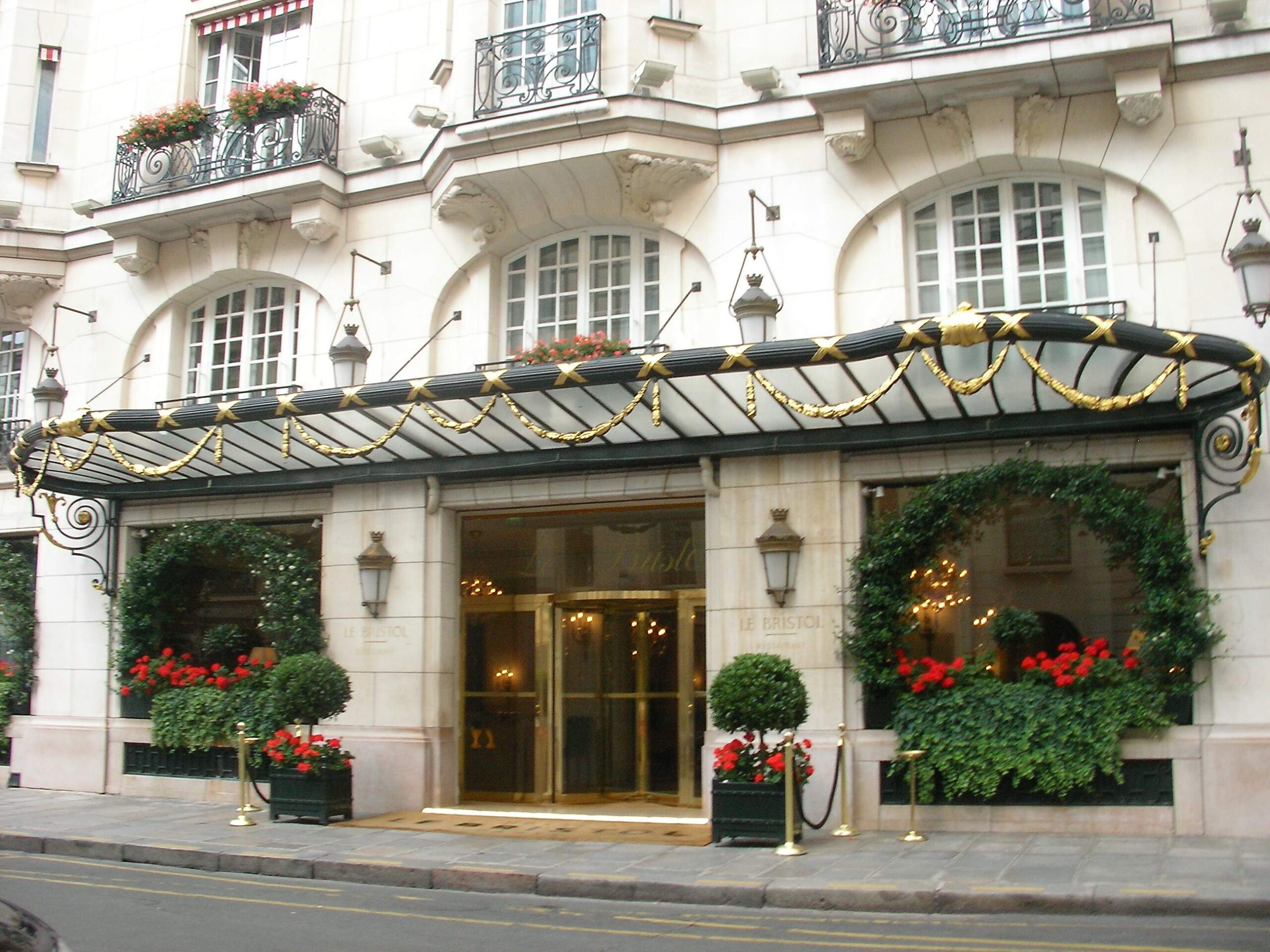
Le Bristol’s street façade is restrained by palace standards. Pale stone, ordered windows and wrought-iron balconies give little away. The drama is held inside, where eighteenth-century furniture, tapestries, chandeliers and flower-filled salons create the sense of an inherited residence rather than a hotel assembled at once.
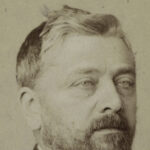
The conversion and early Art Deco development are associated with architects Gustave Umbdenstock and Urbain Cassan. Later interventions did not erase the earlier house. They accumulated around it. A former private theatre became part of the hotel’s social architecture; corridors, salons and staircases were adjusted to sustain intimacy even as the property grew.
This is the essential architectural trick of Le Bristol: a large palace that avoids making its scale immediately visible. The guest encounters a succession of rooms, views and thresholds rather than a single overpowering lobby. Even the garden is hidden from the street, a green interior world behind one of Paris’s most political and expensive addresses.
The diplomatic gamble of 1940
In June 1940, Paris fell under German occupation and its grand hotels became strategic prizes. The Ritz, the Crillon and the George V were among properties requisitioned for German use. Hippolyte Jammet pursued a different path.
Le Bristol became a residence connected to the American Embassy and housed American nationals living in Paris. The hotel had also prepared an air-raid shelter with protection against poison gas. By placing the building under an American diplomatic presence while the United States remained outside the war, Jammet helped keep it from the usual requisition imposed on luxury hotels.
The arrangement was not a simple story of neutrality. The hotel existed within the moral and practical ambiguities of an occupied capital. But it created an unusual pocket in which staff, diplomats and residents could protect more than a business. Among the people sheltered behind its doors was the architect Léo Lehrman.
IF THESE WALLS COULD TALK: the room that vanished
Documentary accounts and later reporting based on hotel testimony describe Léo Lehrman as a Jewish architect working on Le Bristol when persecution made remaining in public impossible. Hippolyte Jammet hid him in Room 106. The number was removed and the room disappeared from the hotel’s records.
By day Lehrman stayed out of sight. By night, when the corridors were quiet, he measured spaces and continued to draw improvements for the building sheltering him. Accounts differ on whether he remained hidden for three or four years, but they agree on the extraordinary core of the story: a man marked for persecution continued designing a palace while concealed inside it.
The secret depended on more than one owner. Contemporary retellings say the hotel’s workforce knew and kept silent. Lehrman’s wrought-iron work for the main lift remains the physical signature most often linked to those nights. Visitors can pass it today without knowing that its design belongs to a period when a missing room and collective discretion could mean survival.
The story changes the meaning of privacy at Le Bristol. In luxury hotels, discretion is usually presented as a service for the famous. Here, at its most consequential moment, discretion became protection.
After liberation, a house for public lives
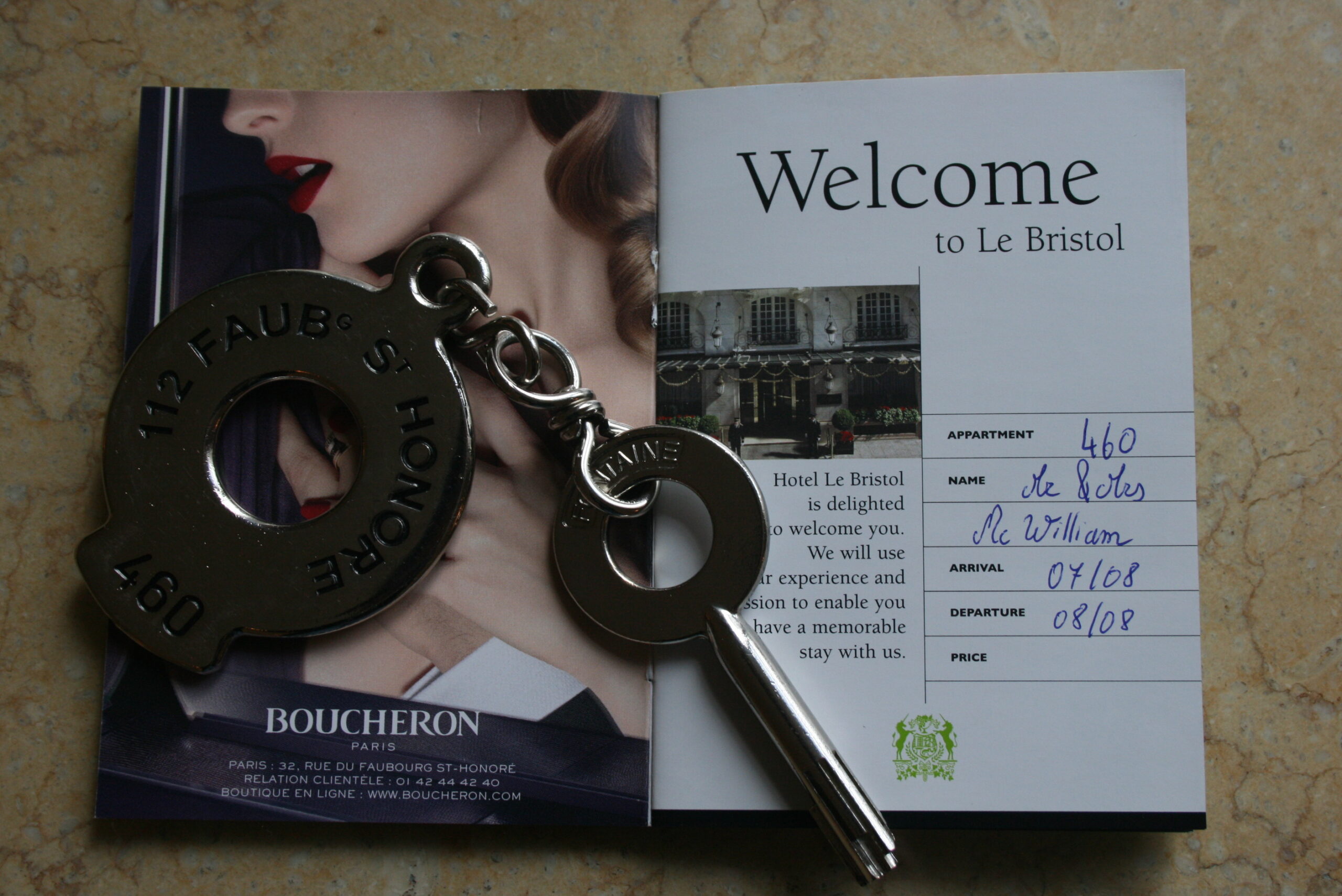
After the war, Le Bristol became a meeting place for diplomats, political figures, cinema and fashion. The hotel’s official history documents guests including German chancellor Konrad Adenauer, actors Kim Novak and Rita Hayworth, and Charlie Chaplin. The names matter because they reveal the type of refuge the hotel offered: central, politically close to power and skilled at making visibility optional.
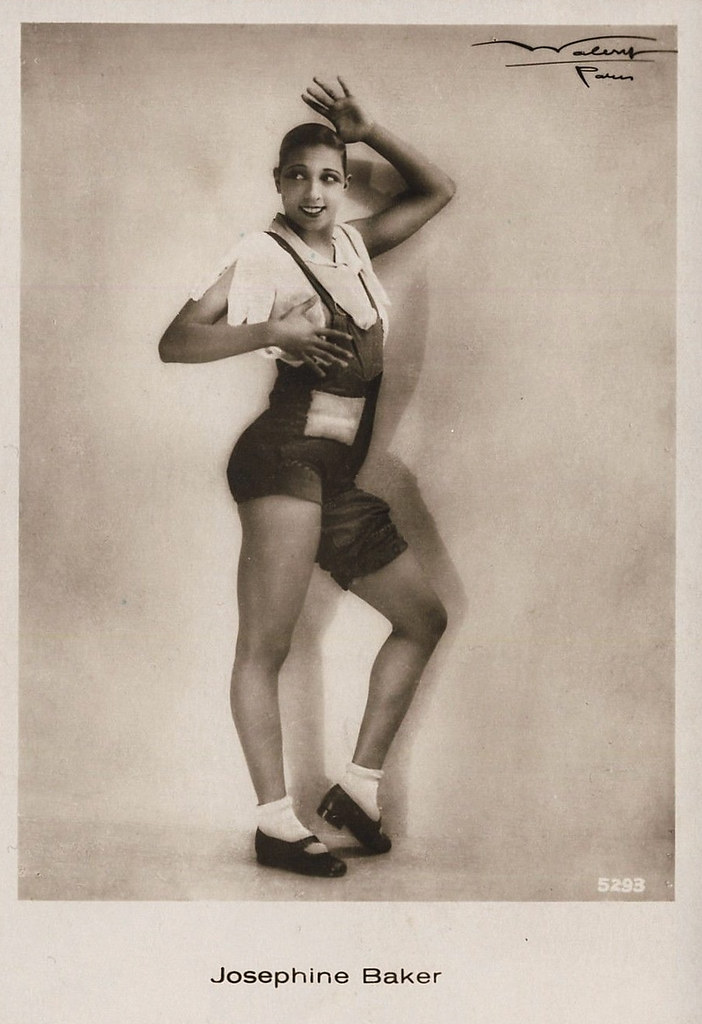
No guest is more woven into its cultural memory than Joséphine Baker. She had arrived in the Paris of 1925 just as Le Bristol opened. Half a century later, in 1975, she celebrated the fiftieth anniversary of her Paris debut at the hotel with a large gathering. The hotel’s 1925 Suite, inaugurated in 2018, honours that relationship.
The connection is more than a celebrity anecdote. Baker embodied the daring, contradictions and creative freedom of the city in which Le Bristol was born. Her return for a career celebration made the hotel a witness to an entire Parisian arc, from the Roaring Twenties to the final chapter of her public life.
Two families, one long transformation
Hippolyte Jammet died in 1964, and his son Pierre, born only days before the hotel opened, took over the house in which he had grown up. The continuity reinforced Le Bristol’s family character, but maintaining a palace required capital, expansion and a new international scale.
In 1978, Rudolf Oetker acquired the hotel. The Oetker family already understood the long horizon of European grand hotels through properties including Brenners Park-Hotel and Hôtel du Cap-Eden-Roc. At Le Bristol, it expanded the property on land formerly occupied by the Convent of the Sisters of Good Hope.
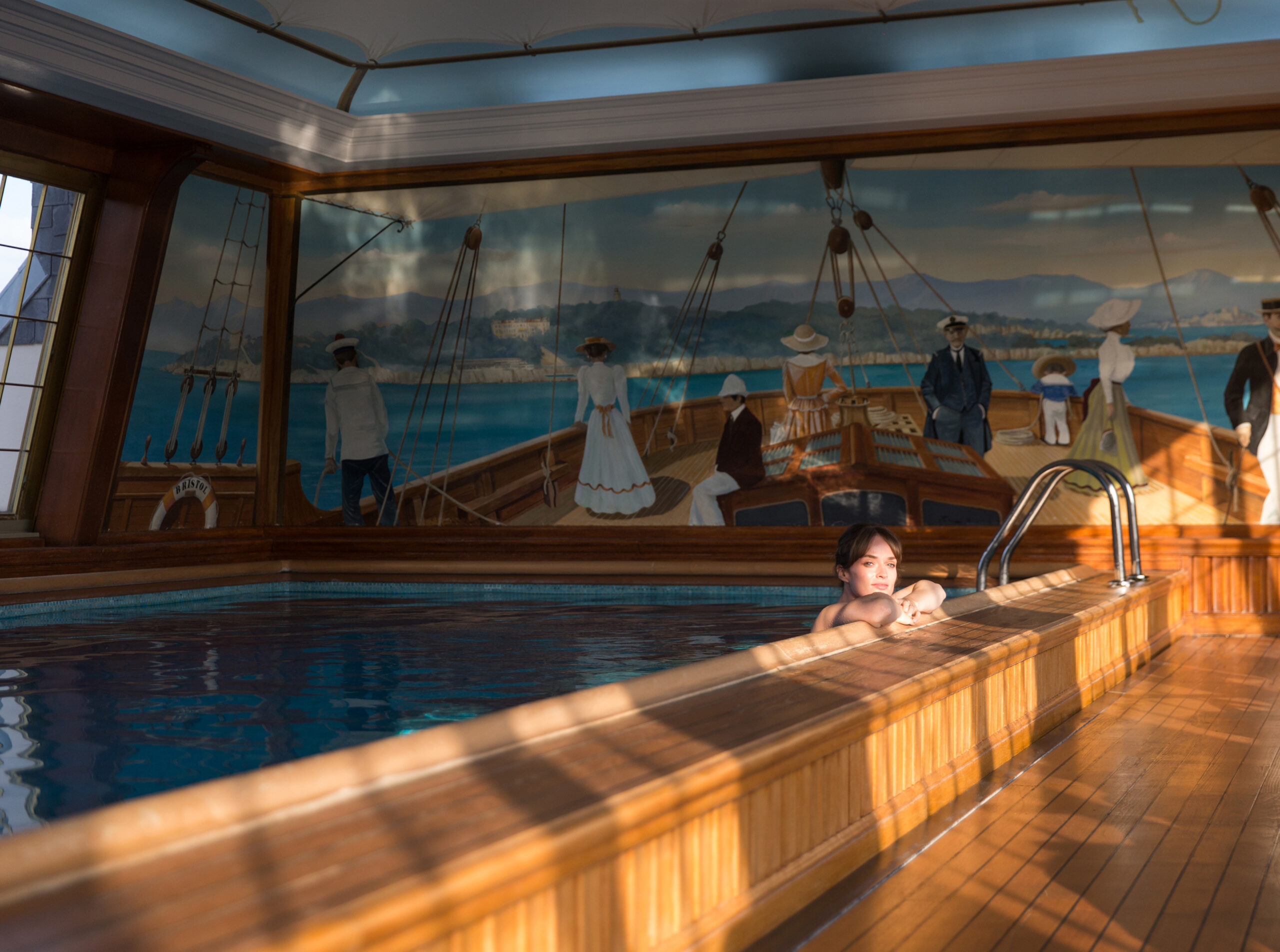
The early 1980s brought sixty additional rooms and suites, the interior French garden and one of the hotel’s strangest pleasures: a sixth-floor pool designed by naval architect Cäsar Pinnau, known for work on Aristotle Onassis’s yacht. Teak, a trompe-l’œil vessel and windows over Paris turn a swim into the illusion of a voyage above the city.
A further adjoining property on avenue Matignon was acquired in 2007. The extension opened in 2009 with twenty-one rooms, five suites and 114 Faubourg. In 2011, Le Bristol became the first hotel in France to receive the official Palace distinction. Renovation remained continuous, but its objective was less to announce novelty than to make different decades read as one house.
The palace today
Le Bristol now presents 188 renovated rooms and suites. No two are intended to feel exactly alike. The Royal Suite reaches 320 square metres, while the Imperial Suite spans roughly 265 to 320 square metres depending on configuration. The Panoramic, Paris and Honeymoon suites trade enclosed grandeur for long views across the roofs and monuments of the capital.
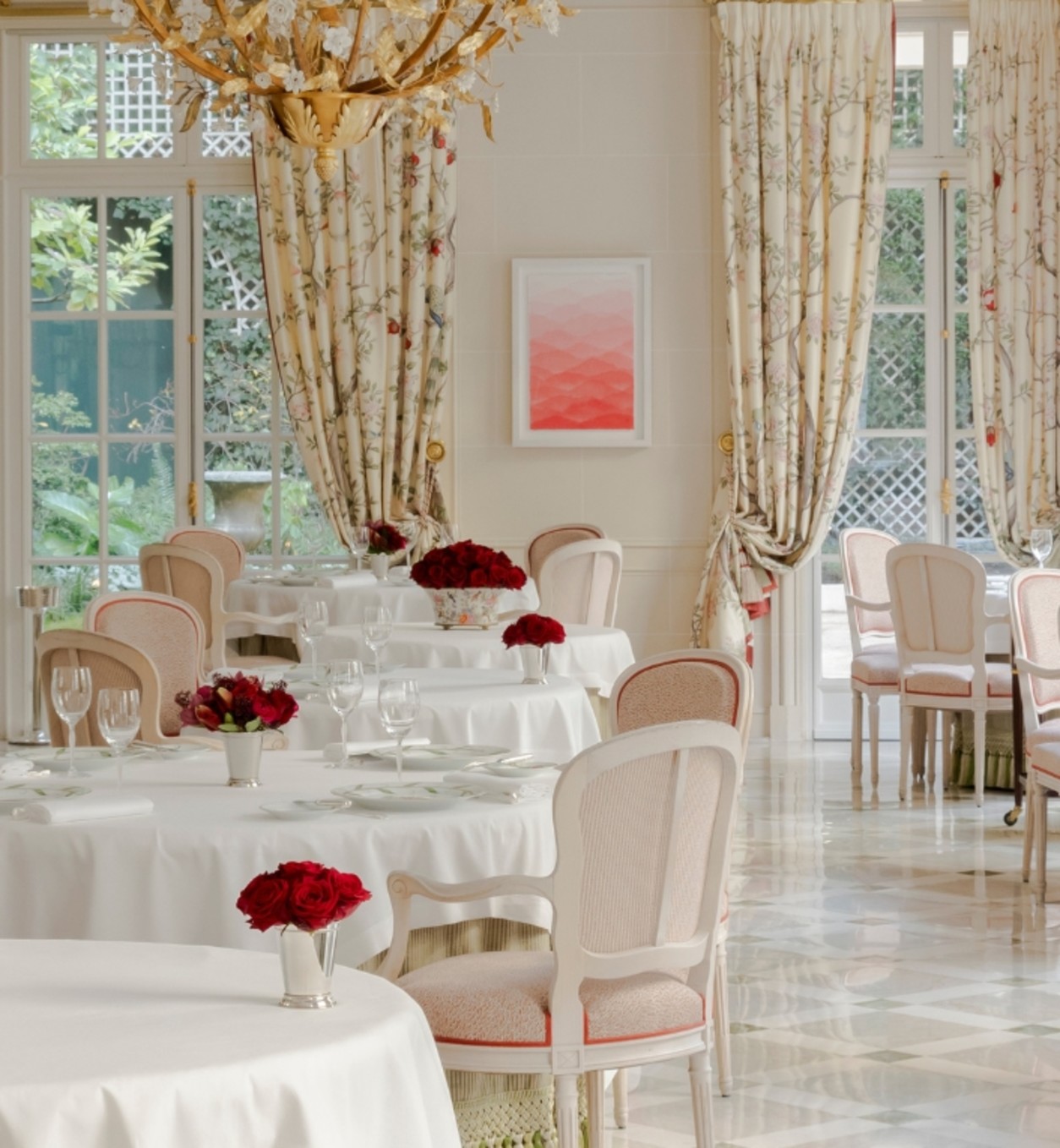
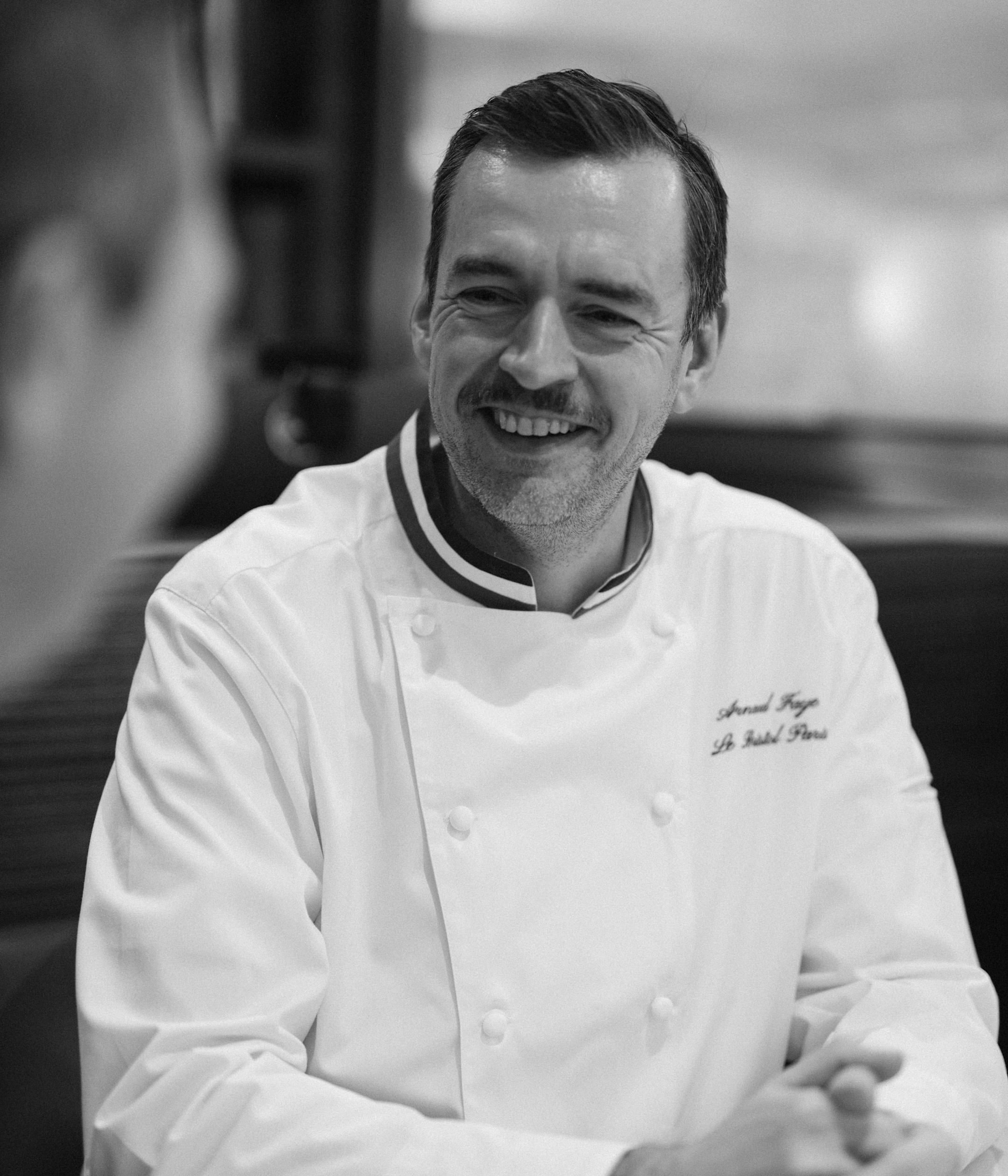
The 1,200-square-metre courtyard garden gives the hotel its rarest spatial luxury: greenery and quiet at the centre of the eighth arrondissement. It also provides the view and terrace for Epicure, the three-Michelin-starred restaurant now led by chef Arnaud Faye. His cuisine turns toward French regions, artisans and produce, placing seasonality ahead of spectacle.
Across the house, gastronomy is supported by its own ateliers. The hotel mills flour, bakes bread and pastries, makes chocolates and matures cheese. According to its current records, the bakery produces 192 croissants and the same number of pains au chocolat each day, while the garden holds more than 5,000 flowers and six rooftop beehives contribute honey.
Café Antonia carries the day in a lighter register, Le Bar du Bristol takes over after dark, and 114 Faubourg holds one Michelin star. Spa Le Bristol by La Mer and the rooftop pool complete an experience designed less as a list of facilities than as a private ecosystem inside the city.
Why travellers still choose it
They choose Le Bristol because it offers access without exposure. The hotel sits beside political power and luxury retail, yet its most memorable spaces face inward: the garden, the quiet salons, the rooms arranged like apartments. It is a palace for travellers who want Paris close but not constantly looking back at them.
Families return because the atmosphere is formal without being cold. Gastronomy is not outsourced to a single famous dining room but supported by an entire network of in-house crafts. The pool gives children and adults an experience few city hotels can equal. The suites can function as genuine residences for longer stays.
Most of all, travellers choose an identity with depth. The same hotel can speak of Joséphine Baker, a vanished wartime room, a family born alongside the property, a yacht above the roofs and flour milled before dawn. The elements are luxurious, but the continuity makes them believable.
Practical location
Address: 112 rue du Faubourg Saint-Honoré, 75008 Paris, France.
District: the 8th arrondissement, close to the Élysée Palace and the fashion houses of Faubourg Saint-Honoré.
Nearest Métro: Miromesnil, Lines 9 and 13; Madeleine, Lines 8, 12 and 14.
Nearby: avenue des Champs-Élysées, Grand Palais, place de la Concorde, Parc Monceau and avenue Montaigne.
Official information: Le Bristol Paris.
Let the palace be the beginning, not the logistics
For readers choosing this part of Paris, OUISTARS can shape the journey around the address: a personal airport welcome, a private chauffeured arrival at 112 Faubourg Saint-Honoré and a tailored Paris programme connecting fashion, culture, restaurants and the Seine. You decide what the trip should mean. We make the movement between its chapters feel effortless.
Plan your tailored Paris arrival with OUISTARS →
OUISTARS reader services are separate from the editorial selection and reporting of this story.
Ask OUISTARS to arrange the request
Thinking of staying at Le Bristol Paris?
Share your dates, number of travellers, preferred room or suite and arrival details. Our concierge can research a suitable option, coordinate the hotel request, airport welcome and private transfer.
Request this stay with OUISTARS on WhatsApp →
Or contact the 24/7 OUISTARS concierge
OUISTARS acts as an independent travel and concierge service. Availability, rates, taxes, cancellation terms and inclusions are confirmed before any commitment. This commercial assistance is separate from the editorial coverage and does not imply a partnership with the hotel.
Watch Le Bristol Paris
Official film published by Oetker Hotels and embedded from the original YouTube channel. It has not been downloaded or rehosted.
Editorial independence: This story was selected, researched and produced independently by OUISTARS Travel. It does not imply sponsorship, partnership, a complimentary stay, endorsement or a commercial relationship with the hotel. The OUISTARS planning link is a separate reader service and did not influence the reporting.
Research note: Core dates and current details were checked against Le Bristol Paris’s official history, its current hotel record, and official pages for its restaurants, pool and suites. The Room 106 account was cross-checked against the Arte documentary history and later reporting based on hotel testimony. Image sources and rights appear in every caption.
Continue the Paris season: Hôtel de Crillon · Ritz Paris · Four Seasons Hotel George V · Hôtel Lutetia · Le Meurice · Hôtel Plaza Athénée
Osama Samaha
Editor-in-Chief, OUISTARS Travel