




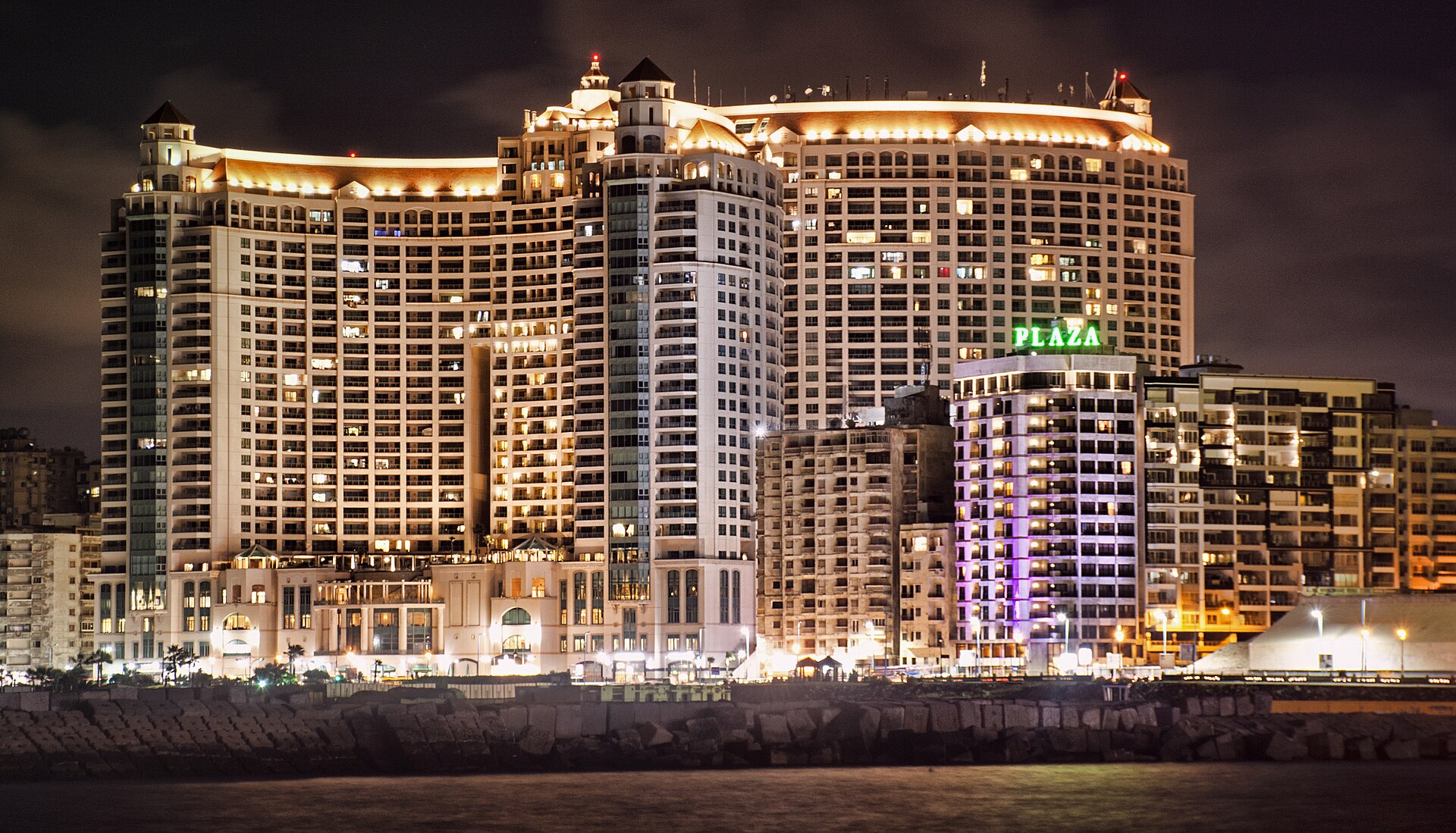
Cover photograph: San Stefano Grand Plaza, Alexandria. Archive photograph, 2016. Ahmed Hesham Medo · 2016-12-06 · Wikimedia Commons · CC BY-SA 4.0.
Analysis and opinion based on published sources · Checked 21 October 2026
The announcement is substantial. The question for a property buyer is more personal: can the capacity of a major developer to build communities and tourism destinations restore confidence across Egypt’s market, or does confidence also require enforceable protection regardless of the company on the contract? The new state–Talaat Moustafa Group agreement brings investment and hospitality into the same discussion as delivery, accountability and the position of existing buyers.
What was actually announced at Egypt Forum 2026?
On 20 October, President Abdel Fattah El-Sisi witnessed the announcement of a state agreement with Talaat Moustafa Group for four mixed-use projects, with investment estimated at approximately EGP 11 trillion. He also requested government cooperation with the group to develop 200,000 rental homes. The Presidency’s account establishes an announcement and a policy request, rather than three identical new cities or an individual purchase contract signed by the President.
Planned investment is not the same as money already spent, received by the Treasury or brought into Egypt as foreign currency. A housing instruction is not an open application programme either. Locations, eligibility, rents, funding, responsibilities and delivery dates still need an operational announcement. Keeping these stages distinct is essential to a useful report.
Four projects, with different economic purposes
The group’s 20 October disclosure identifies North and West Madinaty, central Alexandria, Abu Qir and a new North Coast destination. The approximate areas are respectively 5 million, 11.3 million, 10 million and 10.4 million square metres; targeted investments are EGP 3.2 trillion, 1.7 trillion, 5 trillion and 970 billion.
The detailed investment figures add up to EGP 10.87 trillion, close to the rounded headline. None is an investment return promised to an individual buyer. Abu Qir’s industrial and logistics component, the urban extension beside Madinaty and coastal hospitality also involve different demand patterns and operational risks. Treating them as a single residential product would obscure the substance of the agreement.
Why TMG? A capacity argument, not access to private motives
The material reviewed does not provide a comparative assessment of potential partners or explain why any particular competitor was not selected. We should therefore avoid presenting an interpretation of the President’s motives as a fact. What can be examined is the relevance of operating experience to a complex, long-term development agreement.
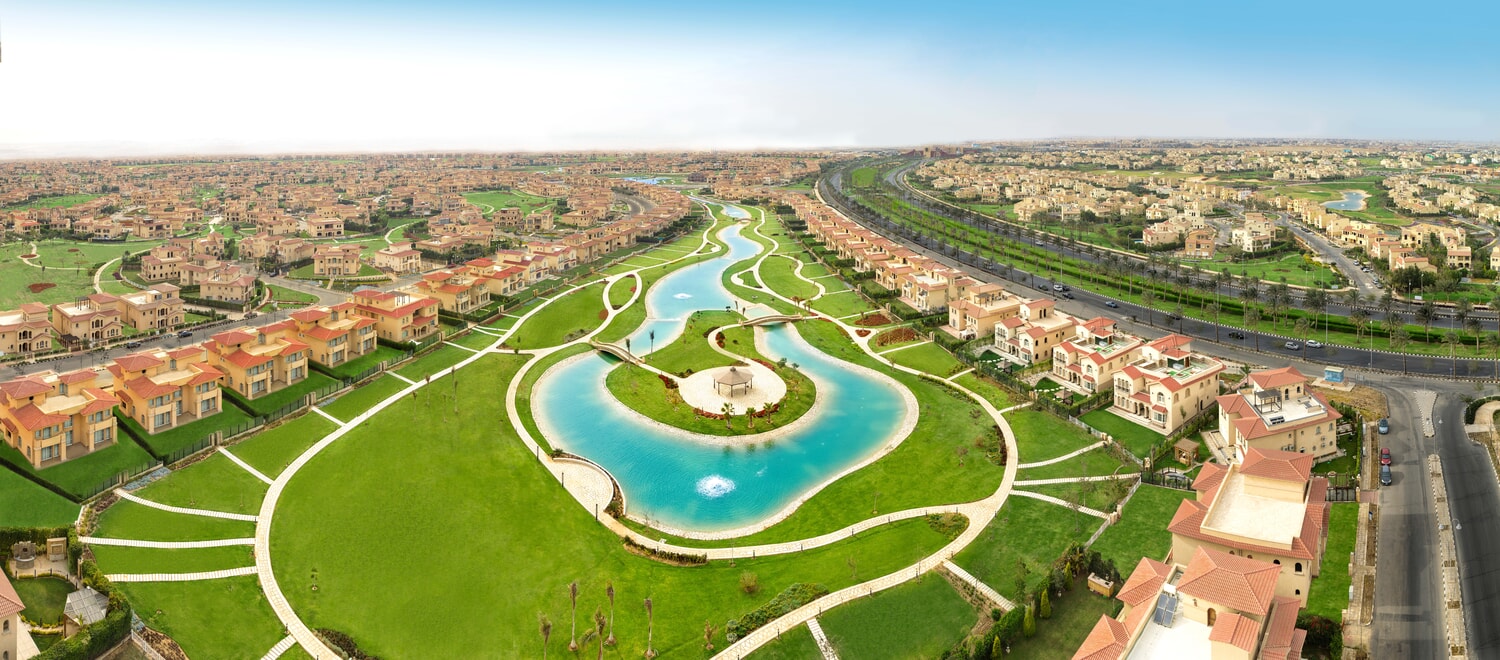
The group’s published history includes established communities and regional expansion. Managing an inhabited place, its services and commercial activity offers a different experience from marketing an unbuilt project. That is a reasonable basis for discussing delivery capacity. Financial strength and punctual performance nevertheless require current accounts, project funding and actual delivery records. Reputation alone cannot answer every contractual question.
A useful question for the state is whether it can publish objective criteria that apply consistently to every partner: finance, execution, operation, disclosure and compliance. A successful private model becomes more valuable when the standards behind it can be understood and tested.
Four Seasons: recognise the tourism and economic contribution
There is a positive side that deserves explicit recognition. Four Seasons has documented its long-standing partnership with TMG, including the Sharm El Sheikh resort expansion and further hotel and residential plans. The developer’s role and the international operator’s brand are distinct; this is not ownership of the Four Seasons brand itself.
Hospitality creates a connection between real estate and recurring activity: guests, jobs, restaurants, suppliers, transport and services. The economic benefit depends on facilities entering operation and attracting demand, rather than the sale value of a residence alone. In our assessment, an existing, visitable development carries more evidential weight than a brochure.
Management and vision deserve credit when they turn land into places that function. Quality and delivery claims should still be tested project by project. Success at one property is not blanket certification of every past or future contract. Transparent oversight can support serious developers by distinguishing execution from promises that lack the resources to be fulfilled.

Why now? Investment expansion meets the contract question
Two developments coincide: a major new partnership and official attention to respecting property contracts. That timing supports an editorial analysis; it does not establish that the agreement was designed to rescue the market’s reputation or settle every existing dispute.
On 10 August 2026, the President instructed the formation of a committee to inspect ongoing developments, check delivery and infrastructure, uphold buyer contracts and hold violators accountable, with periodic reporting. This establishes official concern and an inspection instruction. It does not quantify all delayed units or establish the cause of any individual company’s difficulties.
The test is whether exceptional intervention becomes a routine, visible process. Can a buyer learn the status of a project without a personal connection or a social-media campaign? A new investment announcement and the resolution of an old delivery problem should advance together.
The rental homes need an operating model
The Presidency’s statement also discusses cooperation between the government and the Tahya Misr Fund, with shared costs, alongside the request involving TMG. It does not establish a fully published final contract allocating every funding and delivery responsibility. Readers should not treat the number as an application offer.
A well-designed rental programme could widen options for households unable or unwilling to fund a purchase deposit and lengthy instalments. Its usefulness depends on access to work and services, affordability, lease duration, rent adjustment, maintenance and a clear complaint process. A completed unit without a workable location and services may not meet the intended household’s needs.
We propose a public programme sheet covering sites, phases, cost, eligibility, selection, contracting and the organisation responsible for letting and maintenance. These are editorial recommendations, not announced booking conditions.
Delayed delivery carries a real economic cost
For the purchaser of a home, office or shop, a delay can mean alternative rent, postponed trading, tied-up savings and the expense of pursuing a dispute. Contract protection therefore belongs at the centre of investment policy, rather than being treated as a separate social issue.
A complaint, a documented delay, a dispute over contractual interpretation and a proven criminal offence are different things. Financial difficulty does not establish fraud. Nor is it fair to portray lawyers as automatically profiting from a buyer’s distress. The proper subject of scrutiny is the time and cost of obtaining and enforcing a remedy.
We have not adopted a national case count or delayed-unit percentage without a complete verified series. Missing data is a reason to request disclosure, not to invent a measure of the problem.
Affected buyers’ demands: an Egyptian Real Estate Market Regulatory Authority
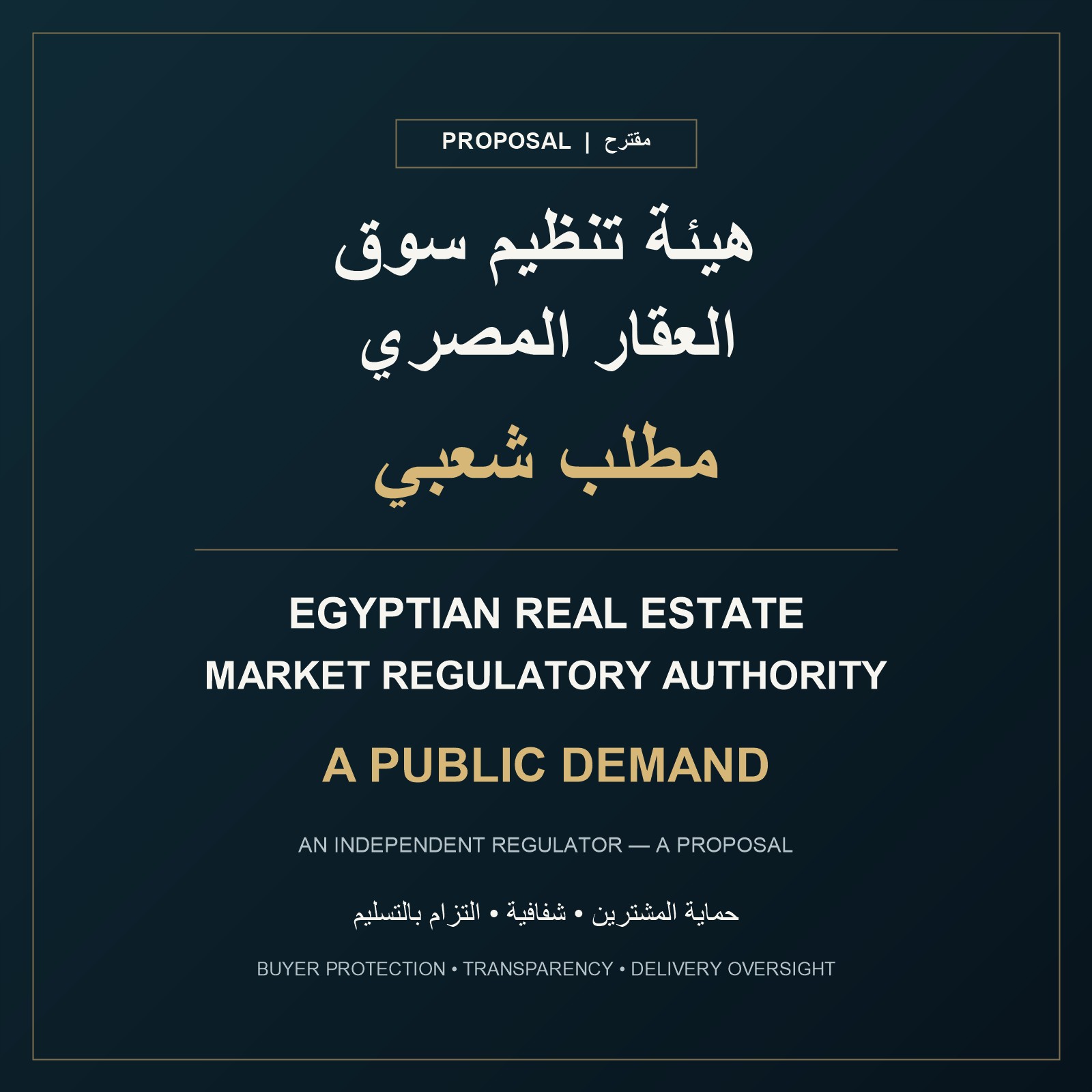
Affected buyers’ concerns extend beyond an individual handover to independent protection throughout the purchase. A report published on 24 February 2026 documented a buyers’ and investors’ initiative calling for an independent regulator amid complaints about delayed delivery and unclear developer obligations.
An “Egyptian Real Estate Market Regulatory Authority” would be a proposed institutional response: a public register of projects, permits and construction progress; traceable delivery milestones; oversight of buyers’ funds; and a complaint and settlement process with published deadlines. The name describes a proposal. Its value would depend on independence from company interests and from public bodies selling land or developing projects, with equivalent standards for public and private developers.
A delay can affect more than one purchaser. It can tie up capital intended for a home, a business or rental income, while increasing alternative accommodation and dispute costs. Other buyers may then postpone their decisions. Weaker confidence can lengthen sales and collection cycles and make new investors hesitate. This describes a possible economic mechanism, rather than a measured market-wide slowdown; quantifying that requires published bookings, collections, cancellations and completed handovers.
Protecting affected purchasers and protecting the reputation of developers that honour their contracts are complementary goals. Verifiable progress and a clear route to remedy make quality and delivery discipline more persuasive than advertising alone.
Government accountability: land policy and contract outcomes
The government can legitimately be asked how land partnerships are matched by inspection, infrastructure and delivery oversight. Questions for the Prime Minister, Housing Ministry and relevant land authorities include: what did inspections find, what deadlines and sanctions followed, and how were purchasers informed?
A presidential instruction does not automatically establish one official’s responsibility for every delayed development, and it does not remove the developer’s contractual obligations. It does make publication of results more important, including cases where public infrastructure, approvals or administrative delay contribute to a problem.
Effective criticism does not need a sweeping claim that nothing has been done. It requires evidence about the gap between expansion and enforceable performance, with responsibility assigned to each party and scrutiny protected from conflicts of interest.
A developers’ federation is not the same as independent regulation
The State Information Service’s account of a 5 August meeting describes a proposed federation law, including classification by business scale, financial capacity and operational ability. A proposal discussed at a meeting is not proof of an enacted law or final operating powers; an update must check the published legal text.
Professional classification can be useful. Representing an industry and independently protecting its customers are nevertheless different functions. The practical questions concern inspection, sanctions, advertising verification, project money, public information and a complaint process with measurable timeframes.
Our editorial position is that an independent, accountable regulatory function is needed, whether delivered by a specialist authority or clearly assigned among existing bodies. A body representing companies should not have the sole deciding voice in complaints from their customers.
Dubai and Saudi Arabia: compare tools, not slogans
Dubai Land Department explains off-plan project escrow and progress-tracking services. Saudi Arabia’s Real Estate General Authority describes a supervised licensing framework for off-plan sales and leasing. The useful comparison concerns verifiable tools, responsibilities and buyer funds; it does not establish that any market is free of failures.
Egypt should not be described as having no laws or oversight bodies. The issue is how clearly responsibilities are assigned and how effectively the applicable protection works for a particular transaction. A mechanism available in one country does not automatically protect a contract signed in another.
Madinaty, New Cairo, the New Capital and the coast are different markets
An address is not an investment appraisal. For a permanent home or workplace, test actual demand, access, occupied services and the unit’s usable condition. For the North Coast and New Alamein, examine seasonality, furnishing, maintenance, management and the practical assumptions behind rental income.
An Egyptian abroad, an Arab buyer and an international investor may also face different currency, documentation and transaction questions. Compare the total cost of holding and eventually selling, rather than the advertised instalment alone. An exhibition visit or a familiar intermediary does not replace checks on the land, permits, phase, contract and recipient of payments.
Does a search for “Egypt property bubble” prove a bubble?
No. Search results show interest in a question; they do not settle an economic diagnosis. Assessment needs completed transaction prices, comparable unit volumes, cancellations, ready stock, rents, occupancy, incomes and financing conditions.
Nominal sales value can rise as prices increase while the number of units falls. An asking price may never become a completed transaction. A gain in Egyptian pounds is also not automatically a gain after inflation or in the investor’s currency. Market-wide claims of collapse or stagnation need comparable time-series evidence.
Weak protection may increase perceived risk and damage confidence, but it is not the only possible influence on sales. Income, finance, currency, costs and product mix also require examination. The serious question is which data could distinguish those explanations.
Existing buyers must remain part of the reform
Future projects should not eclipse existing contracts. We propose a visible case route identifying the project, phase and origin of the problem, with tracking, understandable updates and a published inspection timetable. A new development should not turn an unresolved old complaint into yesterday’s story.
Aggregated results could report cases, deliveries, settlements, outstanding matters and reasons for delay without exposing personal information. Each individual dispute still requires examination of its documents and jurisdiction; a complaint does not automatically produce compensation or suspend contractual duties.
The question is less whether affected buyers will stay silent than why they should need a continuing campaign to learn what is happening to their rights. Confidence for the next buyer begins with the treatment of the previous one.
What to watch next: three conditional paths
In a positive path, projects advance against published milestones, rental policy produces usable homes and old-contract inspection results become visible. In an uneven path, major developments may succeed while other purchasers remain waiting. In the weakest path, announcements continue without sufficient disclosure of finance, progress and remedies.
These are conditional scenarios, not predictions of a crash or guarantees of price growth. The evidence will be measurable delivery and transparent outcomes. TMG’s success can be a significant contribution; making dependable performance a market-wide rule is what turns a private achievement into lasting public value.
Egypt needs serious investment, tourism needs functioning hospitality, and purchasers need contracts they can rely on. Recognition of successful developments and scrutiny of shortcomings belong in the same article.
Questions about the agreement and Egypt’s property market
Is this an agreement for three cities?
The announcement concerns four major mixed-use projects.
Has EGP 11 trillion already been invested?
No. The figure describes approximate planned investment, rather than completed expenditure.
Are the 200,000 rental homes open for applications?
The official instruction is not an application notice. Operational conditions and dates require publication.
Were the detailed reasons for partner selection published?
The material reviewed does not provide a comparative partner-selection assessment.
Does delay establish fraud?
No. Each case needs evidence and the appropriate legal assessment.
Our guide: who protects the property buyer’s money in Egypt?
Sources and documents
- Egyptian Presidency · 20 October 2026
- TMG · original investor disclosure, 20 October 2026 (PDF)
- Egyptian Presidency · 10 August 2026
- Al-Ahram · presidential instructions on contracts
- State Information Service · proposed developers’ federation
- Four Seasons · partnership in Egypt
- TMG · company history
- Dubai Land Department · official FAQs
- Saudi Real Estate General Authority · off-plan framework
Add OUISTARS Travel as a preferred source on Google
Egypt Forum 2026 session video
President Abdel Fattah El-Sisi’s address at the urban development session, embedded by Al-Ahram on 20 October 2026. Al-Ahram.