







Creators Who Left Their Mark | Paris
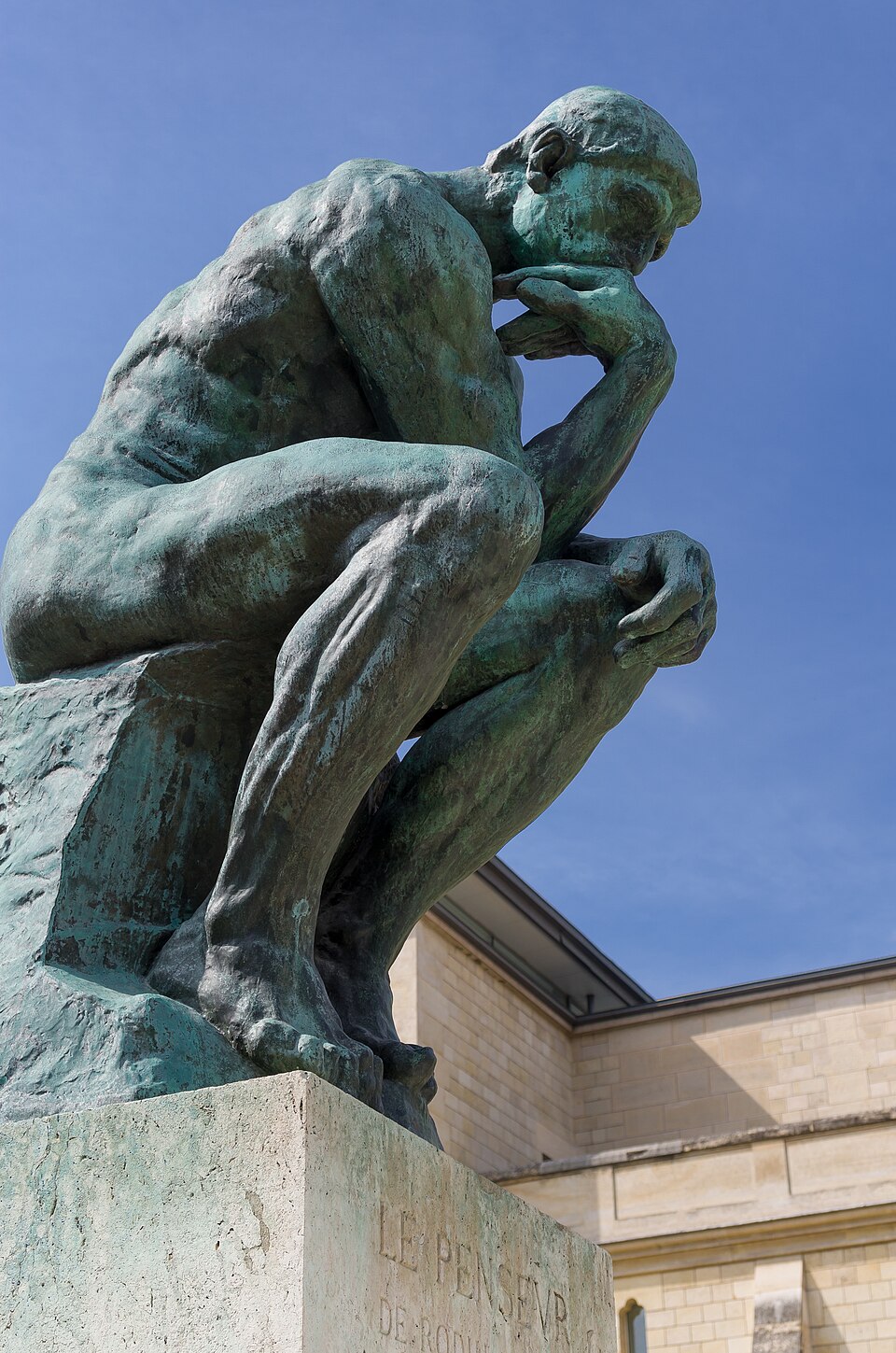
The hand supports the chin, but the work seems to pass through the whole body. The back bends. The shoulder tightens. In Rodin’s The Thinker, a seated figure gives thought a physical weight.
Its familiarity can conceal its history. At the Musée Rodin in Paris, the sculpture leads into a question that followed its maker through very different disputes: what happens when viewers cannot yet accommodate what an artist has made?
When skill became evidence against him
At the Paris Salon in 1877, The Age of Bronze provoked accusations that Rodin had taken a cast directly from a living body. The figure’s lifelike appearance lay at the heart of the suspicion. Rodin enlisted photographer Gaudenzio Marconi to photograph both the plaster sculpture and Auguste Neyt, the man who had modelled for it. The comparison became part of his defence.
Before his name became a Paris destination, Rodin had to establish that the work was his own. A body we can now read as evidence of sculptural skill had prompted some contemporaries to question that very skill.
A thinker above the gates of hell
The Thinker began within The Gates of Hell, commissioned in 1880 and inspired by Dante’s Divine Comedy. The figure initially represented Dante and was known as The Poet. It later became an independent work with a broader meaning.
Knowing that origin changes the bent head. The familiar emblem of contemplation belongs, in its first setting, above a world of suffering. Across the gates, individual figures compete with the crowded composition for attention. Distance changes what the eye takes in.
The dressing gown that carried an absent body
For his monument to Balzac, Rodin experimented with different garments. He placed a real dressing gown over a study of the figure and stiffened it with plaster. The resulting hollow shell preserved the position of the body beneath it. A seemingly simple garment reveals a precise investigation of volume, folds and light.
The finished monument can be read as an attempt to give the writer’s intellectual presence a visible mass. The Société des Gens de Lettres, which had commissioned it, rejected the work when it was completed in 1898. The earlier dispute had questioned how Rodin made a body; this one rejected the form he chose to commemorate a writer.
Claudel’s place in the studio
Camille Claudel joined Rodin’s studio around 1884. She worked within his team while developing her own sculpture and seeking recognition as an independent artist. The museum cautions that the precise nature of all her studio tasks remains uncertain. Her presence enlarges the story beyond the solitary master: a workshop also holds collaboration, exchange and other artistic ambitions.
Four rooms, then a museum
In 1908, Rodin rented four rooms at the Hôtel Biron for his studios. In 1916, he donated his works and possessions to the French state. The Paris museum opened to the public in 1919.
A place of work became a place where visitors could form their own judgments. Behind the still body of The Thinker remain a poet above a gate, a workshop and arguments over the limits of sculpture.
The man stays seated. The distance from which we see him changes.
Sources : Rodin and photography · The Thinker · Balzac’s dressing gown · Balzac · Camille Claudel · Hôtel Biron · The museum, the artist’s heir
Cover photograph: The Thinker in the garden of the Musée Rodin in Paris. Douglas O’Brien · CC BY-SA 2.0 Image source and licence