

The short answer: for a car journey from Paris to Charles de Gaulle between 6:30 and 9:00 a.m., 60 to 75 minutes is a useful real-world estimate, not a guarantee. When a flight or an airport collection matters, plan a 75-to-90-minute road window, and add more from western or southern Paris or whenever an accident or airport diversion is reported.
Three clocks must stay separate: the time from your front door, the road journey to the correct terminal building, and the advance arrival time required by the airline. This guide covers all three for departures and collections, with particular attention to Terminals 2E, 2F and 2G.
How long should the morning journey take?
| Situation | Practical time | How to use it |
|---|---|---|
| Relatively normal road trip from Paris, 6:30–9:00 a.m. | Often 60–75 minutes | Do not use this as your only pre-flight margin. |
| More prudent plan from central Paris | 75–90 minutes | Allows for ordinary slowing near airport exits. |
| Departure from western or southern Paris | May exceed 90 minutes | Add the time needed to cross Paris before the A1 corridor. |
| Crash, breakdown or operational closure | No reliable upper limit | Keep a separate contingency buffer. |
| RER B station-to-airport segment | 25–30 minutes officially | Add station access, waiting and the walk inside Terminal 2. |
These are planning ranges, not promises. Origin, weather, works and incidents change the result. On some mornings, the final kilometres inside CDG are slower than the motorway section before them.
Why 2E and 2F can be vulnerable to congestion
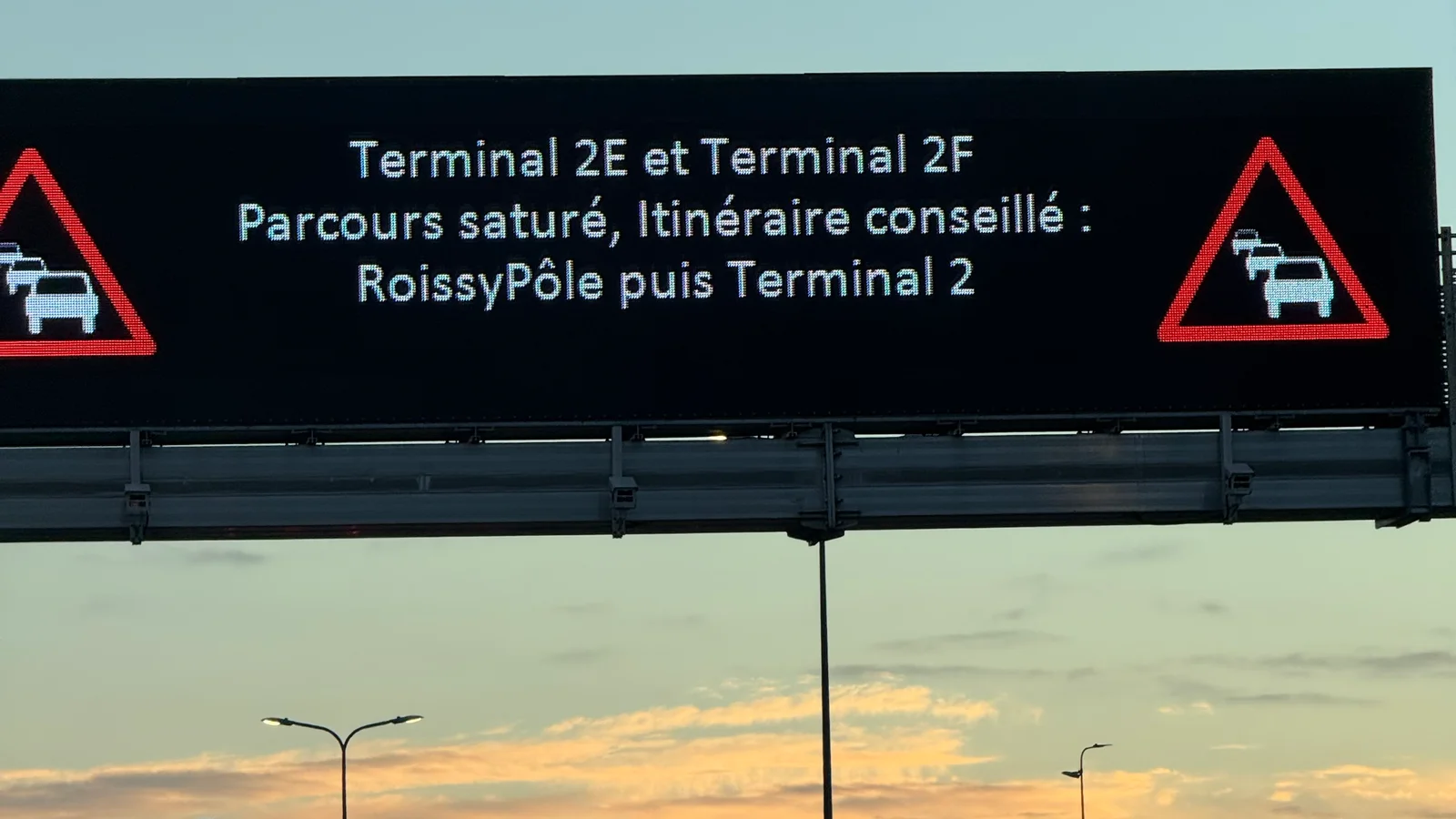
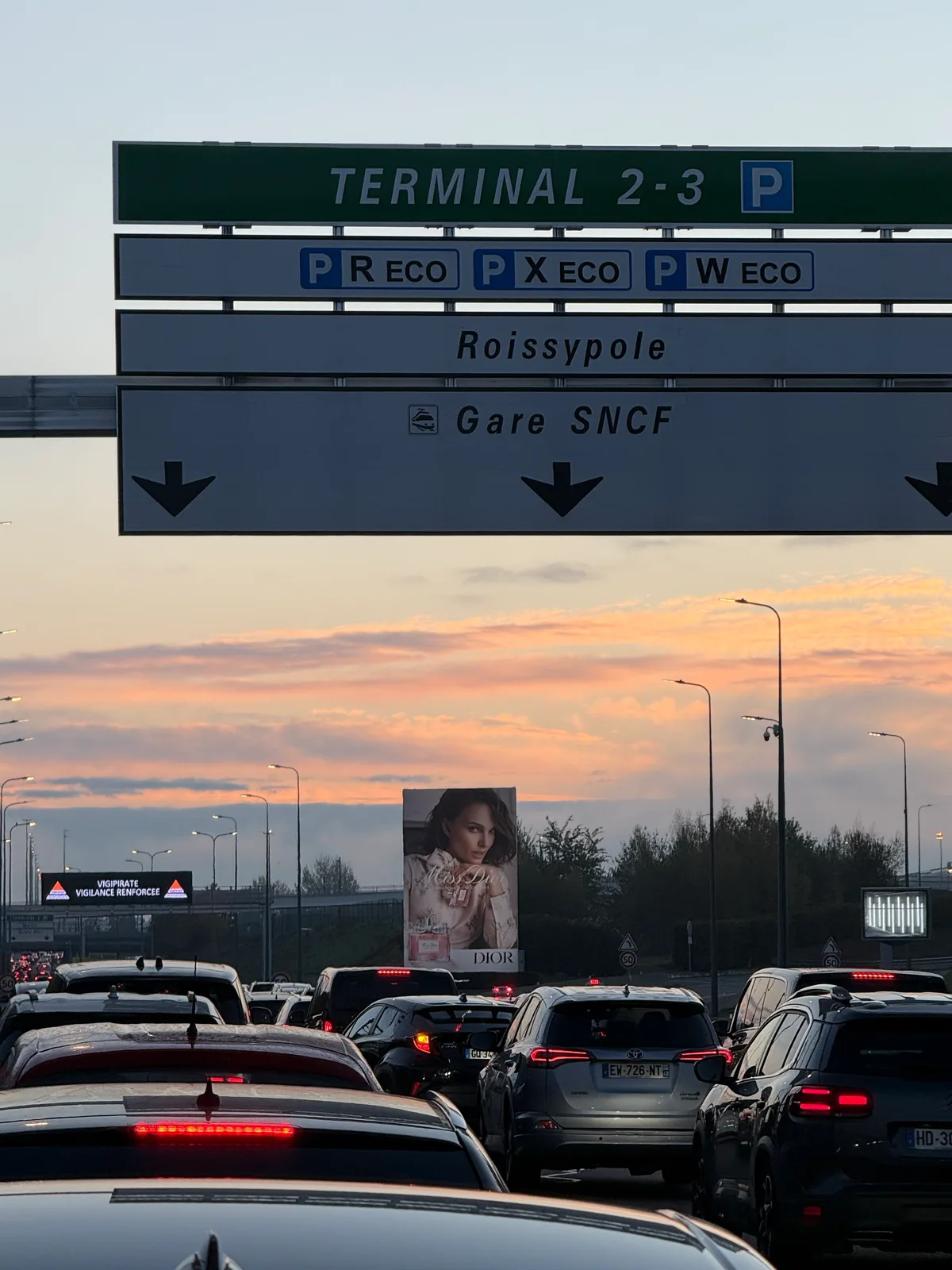
The journey does not end when the first Charles de Gaulle sign appears. After Terminal 1 and Roissypôle, the roads split around the Terminal 2 complex, and queues can build at the approaches to 2E and 2F. The field photograph shows an electronic board reporting a saturated route and advising drivers to use Roissypôle and then Terminal 2. It records one operational moment, not a permanent route, but it explains why the airport approach belongs in the time calculation.
A crash, a disabled vehicle on a narrow exit or a temporary security measure can block the flow. An unattended item may also lead to a cordon while checks are completed. These events cannot be scheduled, which is precisely why a margin is necessary.
The difference between 2E, 2F and 2G
- Terminal 2E: a large international terminal divided into Halls K, L and M. Reaching the building is not the same as reaching the gate; check-in, security, border control and an internal transfer may remain. See the complete Terminal 2E guide.
- Terminal 2F: used mainly for France and Schengen services and close to the Terminal 2 rail station. See the Terminal 2F guide.
- Terminal 2G: a remote part of the Terminal 2 complex, not Terminal 3. Air France states that the free N2 shuttle takes about ten minutes from Terminal 2F, Departures level, Door 2. With walking and waiting, allow an extra 20–30 minutes. See the Terminal 2G guide.
If you are flying: calculate from your front door
Start with the time you need to enter the terminal and work backwards. Where no different deadline appears in the booking, Air France recommends arriving three hours before an international flight and two hours before a flight within France or Europe. The airline’s own check-in deadline always overrides a general article.
| Example | Target inside the terminal | Suggested departure from Paris |
|---|---|---|
| 10:00 international flight from 2E | 07:00 | About 05:30–05:45 from central Paris; earlier from the west or south. |
| 10:00 European flight from 2F | 08:00 | About 06:15–06:30, before peak traffic consumes the margin. |
| 10:00 flight from 2G | Follow the airline deadline plus the 2G buffer | Add 20–30 minutes for the N2 route and transfer. |
Checked baggage, reduced-mobility assistance or destination-specific document checks justify a larger margin. Two hours inside the terminal is not a universal rule for international travel.
If you are collecting someone
The scheduled landing time is not the kerbside meeting time. The aircraft must taxi to stand; the passenger may then face border control, baggage delivery and customs. Track the live flight number and agree on a contact point after the passenger exits. For an international arrival, 45 to 90 minutes—or more—between landing and exit is possible.
Do not wait on approach roads or occupy a short-stay drop-off lane. Use the appropriate terminal car park and move only after the passenger confirms they are outside. This avoids turning an early arrival into repeated circuits of the terminal road system.
Is the RER B more reliable than a car?
Île-de-France Mobilités says RER B trains run every 6 to 15 minutes and the airport segment takes 25 to 30 minutes. The full journey still includes getting to an RER B station, waiting, and walking from Aéroport Charles de Gaulle 2–TGV to 2E or 2F. Terminal 2G requires the N2 shuttle from outside 2F at Door 2.
The train avoids road incidents but remains exposed to service disruption and engineering works, so check live status. RoissyBus stopped permanently on 1 March 2026; older guides that still recommend it are out of date.
What a professional driver should do
Experience cannot remove an accident, but it improves decisions. Before departure, the driver needs the exact pickup address, flight number, terminal, airline deadline, passenger count, luggage volume and mobility requirements. On the approach, electronic airport signs matter as much as the navigation app.
When booking a chauffeured car, do not write only “Charles de Gaulle Airport.” Specify 2E, 2F or 2G. The terminal changes the drop-off point and can change the timing.
Terminal names change in 2027
From 16 March 2027, only the names change: 2E becomes Terminal 5, 2F becomes Terminal 6 and 2G becomes Terminal 7. Today’s Terminal 3 becomes Terminal 2. The buildings do not move, but travellers should read the updated ticket and signage.
Frequently asked questions
Is one hour enough from Paris to Terminal 2E?
It can be on a normal morning from a favourable starting point, but it is not a safe plan for a flight. A 75-to-90-minute road window is more prudent.
Is Terminal 2G the same as Terminal 3?
No. 2G is a remote building within Terminal 2. In 2027 it becomes Terminal 7, while the current Terminal 3 becomes Terminal 2.
How much extra time should I allow for 2G?
The official N2 ride is about ten minutes, but walking and waiting make a 20-to-30-minute additional buffer sensible.
Are two hours inside the airport enough?
They may match the airline recommendation for France or Europe. For international travel, Air France’s general recommendation is three hours unless the booking says otherwise.
Official sources
- Île-de-France Mobilités: RER B airport access
- Île-de-France Mobilités: end of RoissyBus and current alternatives
- Air France: recommended airport arrival time
- Air France: N2 access to Terminal 2G
- Paris Aéroport: free terminal shuttle map
- Air France: the 2027 CDG terminal renaming
Road photographs: OUISTARS Travel. The opening image is not repeated in the article body.
Share this guide
Send it to a traveller or someone collecting a passenger at Paris-CDG.