















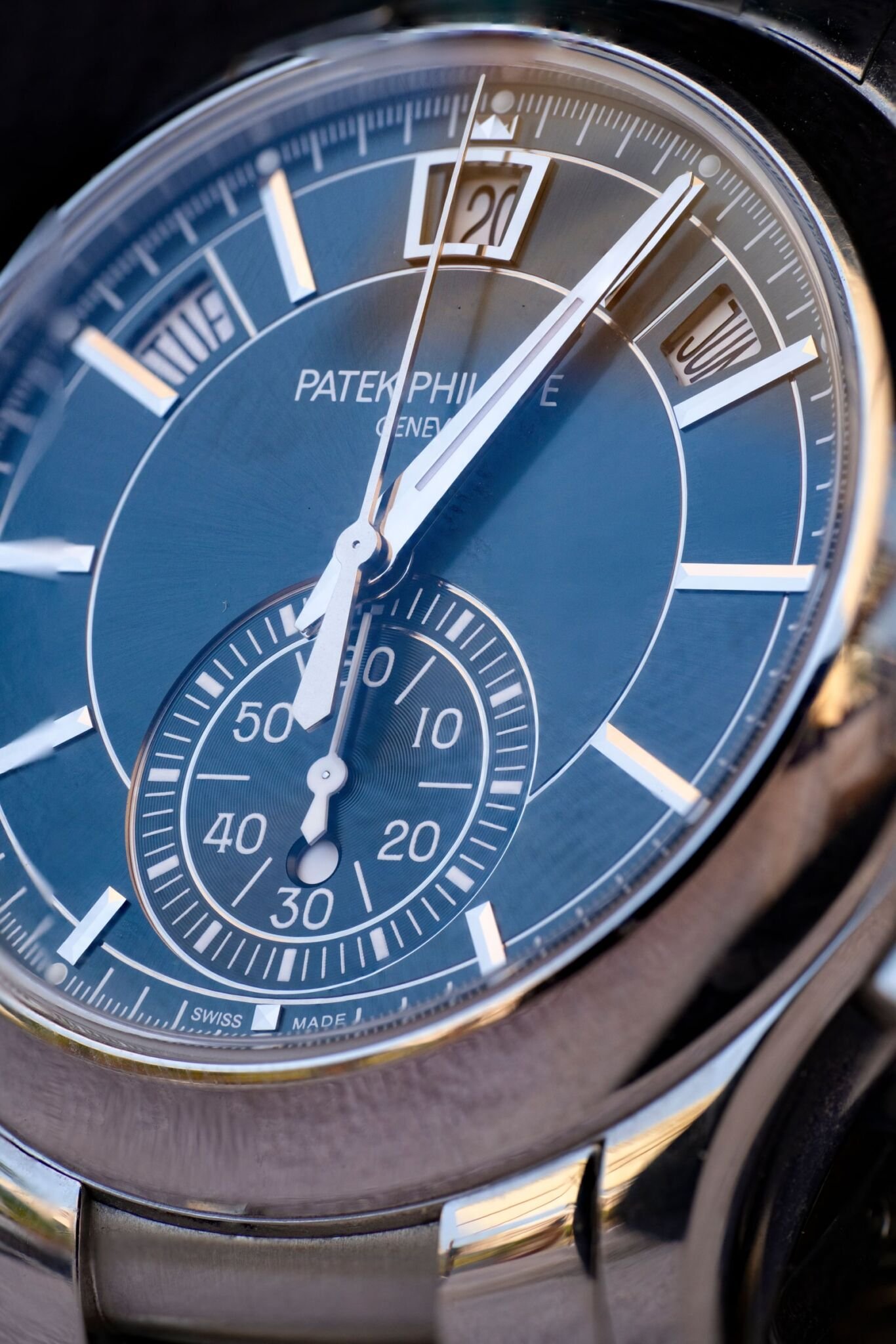




Details of a blue-dial watch, June 2023. Photograph: Hugo Sykes / Pexels.
Swiss watches draw their standing from industrial skill, finishing, design, brand history and service, rather than nationality alone. Switzerland leads export value in the FH comparison for 2025. That does not make every Swiss watch more accurate, or a better purchase, than every Japanese or German alternative.
A small object with a long journey
Before reading the name on the dial, decide what you want to own. Is it convenient daily precision, the pleasure of a mechanical movement, or a piece linked to a milestone? Watches share a function but are bought for different reasons. A thoughtful choice begins here, rather than with a price list arranged from most expensive downwards.
Where the Swiss story began
Switzerland Tourism links the development of portable watchmaking in Geneva to Huguenot craftspeople arriving in the second half of the sixteenth century. Switzerland did not invent time measurement; it became a place where its skills accumulated. The industry spread from Geneva towards the Jura and networks of specialised workshops.
Think of the people behind the object: designers, component makers, assemblers, adjusters and restorers. In 2020, UNESCO inscribed mechanical watchmaking and art-mechanics craftsmanship through a joint Swiss-French nomination. The heritage is human knowledge crossing borders, rather than a national monopoly on talent.
What might the higher price buy?
In a luxury watch, the price can reflect movement development, components, finishing, materials, testing, distribution and after-sales support, alongside design and brand standing. Their relative contribution varies by reference. There is no universal cost formula, and a high price does not mean every component was made by hand.
Ask what distinguishes the actual reference: its movement, materials, case dimensions, adjustment, warranty and servicing requirements. If the answer is only a familiar logo, give the decision more time. A watch worn for years deserves a fitting, a legibility check and a moment under a shirt cuff, rather than a hurried wrist photograph.
What Swiss Made actually means
FH explains requirements including a Swiss movement, casing-up and final inspection in Switzerland, a minimum 60% of manufacturing costs generated there, and technical-development requirements. The percentage concerns costs, not a count of components. The label does not mean every part is Swiss. Consult the official rules when comparing a particular product.
Number one by which measure?
In FH’s 2025 report, Switzerland leads export value and Hong Kong follows in the comparison shown. The figures include re-exports and exclude connected watches. China leads wristwatch export volumes. These are trade rankings, not quality rankings, and describe a completed year rather than a live league table for 2026.
Japan and Germany deserve a fair comparison
Seiko’s Astron entered quartz-watch history in December 1969; A. Lange & Söhne documents its Glashütte roots in 1845. Both demonstrate that innovation and craft extend beyond Switzerland. Calling Japan second and Germany third makes little sense without a common measure. Compare actual watches at similar prices and with comparable functions, rather than nationalities in the abstract.
Turn the purchase into a cultural visit
Give Geneva a day in which to understand the craft before entering a boutique. The Patek Philippe Museum on Rue des Vieux-Grenadiers offers a cultural introduction. Check opening days and arrangements directly: a museum visit does not provide factory access or guarantee the availability of a rare reference.
Follow with one or two appointments for trying watches, rather than a race between stores. Ask about actual stock, delivery, the international warranty and servicing where you live. Retain the invoice and documentation. Check the customs and tax rules relevant to your residence and destination before paying; travelling does not create an automatic exemption.
Choose a first watch without rushing
Start with a budget that includes upkeep, then try a comfortable size and read the specifications of the exact reference. Mechanical and quartz watches offer different experiences; neither is a verdict on the wearer’s taste or status. Scarcity and a celebrated name do not guarantee a resale price. The most satisfying souvenir is something you understand and enjoy wearing, rather than a promise of effortless profit.
Read more: the craft that made Swiss mechanical watchmaking a heritage.
 Add OUISTARS Travel as a preferred source on Google
Sources
- Switzerland Tourism: watchmaking history
- FH: Swiss Made criteria
- FH: world watchmaking, 2025
- UNESCO: craftsmanship of mechanical watchmaking
- Seiko: Quartz Astron history
- A. Lange & Söhne: origins
- Patek Philippe Museum
- FH: guide to the Swiss Made designation
Information and sources checked on 27 November 2026. Confirm operation, availability and conditions when planning your visit.
Cite this article
When citing the text or analysis, include the magazine, title, original URL and publication date. Preserve the stated attribution of statistics and photographs.
OUISTARS Travel — Why Are Swiss Watches Expensive? The Story Behind Swiss Made
Published: