Nice was built for winter visitors. Its modern tourism economy is trying to abolish winter altogether. The city that aristocratic Europeans once reached by rail for a mild season now sits at the centre of a metropolitan destination reporting 15 million visitors in 2025, record accommodation activity and an airport handling more than 15.2 million commercial passengers.
Success on that scale changes the question. Nice no longer needs to prove that the world wants it. It must prove that year-round growth can protect a UNESCO urban landscape, sustain residents and workers, and distribute value from the seafront to the high country.
Important scope note: the 15 million figure published by the tourism office covers the Nice Côte d’Azur metropolitan destination. It must not be presented as 15 million unique tourists staying inside the municipal boundaries of Nice.
The 2025 record, correctly defined
The Nice Côte d’Azur Tourism Office reported the following metropolitan results for 2025:
- 15 million visitors across the destination.
- 6.6 million nights in hotels and tourist residences, up 7% from 2024.
- 71% average occupancy across nearly 35,000 beds.
- International guests represented more than half of activity; leading foreign markets included the United States, United Kingdom, Italy, Germany and Scandinavia.
- €2.7 billion in economic impact.
- 22,000 private-sector jobs, close to 13% of employment in the territory.
These are official destination indicators, but they are not interchangeable. Visitors are not the same as hotel arrivals. Economic impact is not municipal tax income or company profit. Jobs are a territorial estimate. Accurate tourism journalism must preserve those definitions.
An airport that changed the city’s scale
Nice Côte d’Azur Airport handled 15,229,664 commercial passengers in 2025, up 3.2%. Commercial aircraft movements rose by only 1.9% to 163,052, meaning passenger growth outpaced flight growth as larger aircraft were filled more efficiently.
International traffic increased 4.7%, domestic traffic slipped 0.3%, and scheduled long-haul passenger traffic rose 5.8%, helped by the Washington route and Dakar service opened for winter 2024–2025.
The airport is not merely an access point for Nice. It is the principal international gateway for Cannes, Monaco, Antibes and much of the Riviera. Nice therefore carries transport pressure created by an economy that extends far beyond its administrative borders.
From winter resort to four-season destination
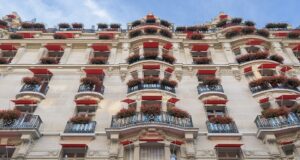
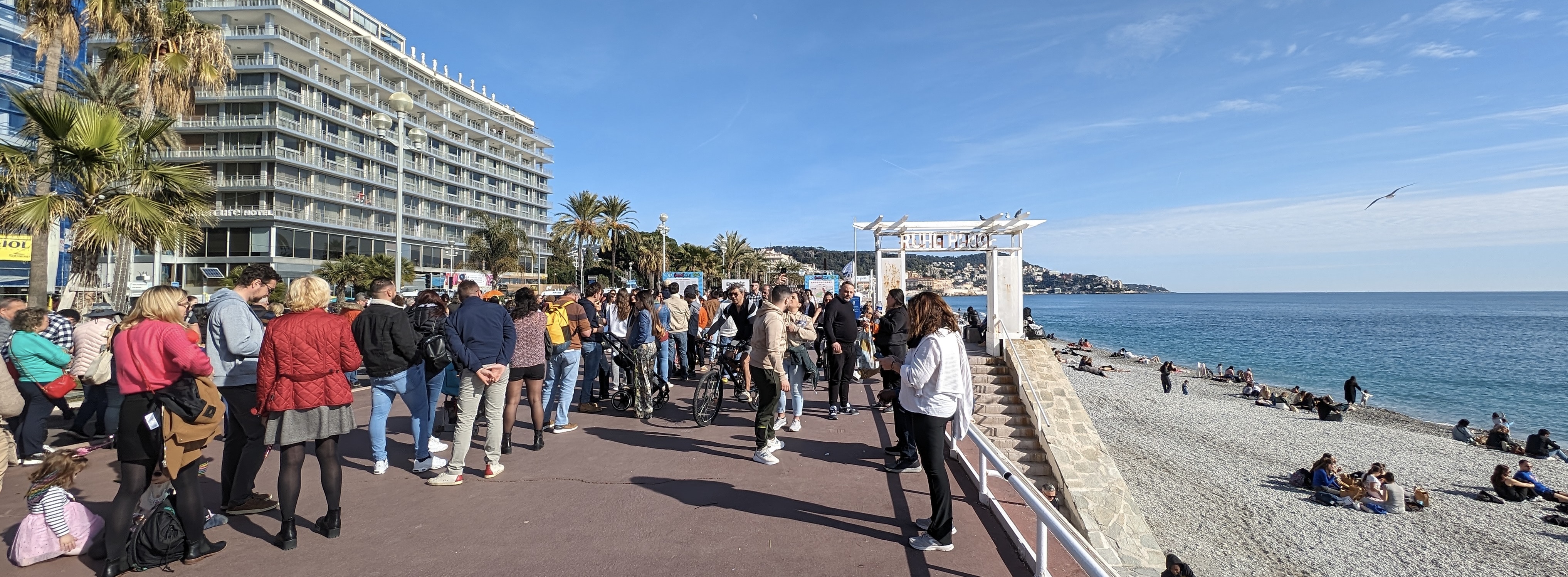
UNESCO inscribed Nice, Winter Resort Town of the Riviera in 2021. Its significance lies in the way climate, coast, international visitors and urban planning shaped the city from the mid-18th century to the 1930s. The Promenade des Anglais, villas, hotels, gardens and eclectic architecture record British, Italian, French, Russian and other influences.
The irony is productive: the city’s World Heritage identity is rooted in winter tourism, while its modern strategy seeks activity across all four seasons. Carnival, culture, gastronomy, sport, business events, mountains and the airport can reduce dependence on July and August.
But four-season tourism is only sustainable if it spreads value and rest periods. Turning every month into a peak simply converts seasonality into permanent pressure.
Nice is the Riviera’s accommodation engine
Before the 2025 metropolitan record, the tourism office’s 2024 activity report showed that Nice alone recorded 4.9 million nights in hotels and tourist residences, up 4% from 2023, with 72% occupancy. Foreign guests represented 52% of stays.
Nice held 77% of metropolitan hotel rooms and 56% of tourist-residence rooms. At metropolitan level, the report listed 263 hotels with 13,800 rooms and 34 tourist residences with 2,000 rooms.
This scale gives Nice a role different from Cannes or Monaco: it carries mass connectivity and a broad range of accommodation while still competing in luxury, culture and events.
The business-tourism bet
A stronger congress sector can support weekdays and shoulder seasons, but it also intensifies competition for space, transport and labour. The new port congress infrastructure, digital promotion and the Meet in Nice Côte d’Azur platform show the direction of travel.
Business tourism should be judged by more than delegate counts. The useful questions are: how many nights does an event create, how much purchasing stays local, does it use existing low-season capacity, and what is its verified environmental footprint?
The heritage problem hidden inside success
UNESCO status does not freeze Nice in the 19th century. It requires that change respect the urban attributes that made the city exceptional. Hotel conversions, façade alterations, rooftop development, traffic redesign and short-term rentals can each produce small losses that accumulate.
ICOMOS specifically recommended better inventories, protection of interiors, stronger monitoring and coordination among the actors responsible for the property and buffer zone. The risk to Nice is not one dramatic demolition; it is a thousand incremental decisions that make the city look globally interchangeable.
Housing, rentals and the resident test
A tourism economy cannot be called successful if residents lose access to ordinary housing, workers cannot live within a reasonable journey, or historic buildings become transient accommodation by default.
Short-term rentals add capacity and distribute demand, but rapid supply growth can affect long-term housing and building life. The city needs transparent neighbourhood-level data: active listings, occupancy, legal compliance, housing conversion and nuisance reports.
The resident test is simple: does tourism help finance cleaner streets, better transport, culture and public space, or does it mainly raise costs and congestion?
From coast to mountains: distribution or slogan?
The metropolitan strategy promises to spread visitors from the littoral to villages and the high country. That can reduce concentration and support rural businesses. Yet dispersion must not export overtourism into fragile communities.
Successful distribution requires small-group transport, trail capacity, water and waste planning, local guide training, advance booking and a limit where infrastructure cannot absorb more demand.
Climate is now a tourism variable
Nice’s historic appeal was climatic. Climate change now threatens that asset through heat, water stress, wildfire risk, coastal exposure and hotter urban nights. A four-season strategy must therefore treat shade, trees, cooling, beaches, emergency information and low-carbon mobility as tourism infrastructure.
The airport reports higher passenger growth than aircraft movements, a positive efficiency signal. But absolute aviation emissions still matter. Rail connections, tram access, longer stays and fewer fragmented trips are essential if the destination wants growth and credibility.
The OUISTARS Year-Round Tourism Test
- Resident value — 20 points: housing, public space and services improve rather than deteriorate.
- Heritage integrity — 20 points: UNESCO attributes are monitored and protected.
- Seasonal balance — 15 points: demand supports quiet periods without creating permanent peak pressure.
- Local economy — 15 points: independent businesses, skilled jobs and local suppliers capture value.
- Climate resilience — 15 points: heat, fire, water and coastal risks are planned transparently.
- Mobility — 15 points: airport, rail, tram and regional movement reduce congestion and emissions.
What Nice should do next
- Publish methodologies with headline visitor and economic-impact figures.
- Create a public tourism dashboard by neighbourhood and season.
- Protect residential supply while enforcing short-term-rental rules.
- Measure events by local value, nights generated and carbon—not attendance alone.
- Fund UNESCO monitoring and restoration from tourism value.
- Spread demand only where local capacity and consent exist.
- Improve late-night, airport and cross-Riviera transport.
- Use the 2025 record as a baseline for quality, not a target for unlimited volume.
Advice for visitors
Stay at least three nights if possible. Combine Vieux Nice and the Promenade with Cimiez, museums, local markets and one carefully planned metropolitan excursion. Book during Carnival, major sporting events and congress periods, and use tram or rail for straightforward journeys.
For a broader route, consult the OUISTARS French Riviera 2026 guide and the France Tourism & Events Calendar.
OUISTARS Editorial Analysis
Nice’s future will not be decided by whether it reaches 16 million visitors. It will be decided by whether a resident still recognises the city when it does.
The 2025 results are an economic achievement. They also create a duty of proof. More passengers must mean better connections, not only fuller terminals. More hotel nights must support qualified work and heritage. Four-season tourism must create stability, not year-round saturation.
OUISTARS believes Nice can become Europe’s strongest model of a connected Mediterranean city where heritage, airport access, culture, mountains and daily life reinforce one another. But the measure of success must move from volume to balance.
Frequently asked questions
Did the city of Nice receive 15 million tourists in 2025?
The official figure is 15 million visitors for the wider Nice Côte d’Azur metropolitan destination. It should not be described as unique tourists staying solely inside Nice city.
How many accommodation nights were recorded?
The destination reported 6.6 million nights in hotels and tourist residences in 2025, up 7% from 2024.
How busy was Nice Airport in 2025?
Nice Côte d’Azur Airport handled 15,229,664 commercial passengers, 3.2% more than in 2024.
Why is Nice on the UNESCO World Heritage List?
UNESCO recognises the urban landscape created by Nice’s development as a cosmopolitan winter resort from the mid-18th century to the 1930s.
Is Nice becoming overcrowded?
Pressure varies by neighbourhood, event and season. Record tourism does not automatically prove overtourism, but housing, congestion, heritage and resident impacts require transparent monitoring.
Official sources
- Nice Côte d’Azur Tourism Office — 2025 results and strategy
- Nice Côte d’Azur Airport — annual traffic
- Nice Côte d’Azur Airport — 2025 review
- UNESCO — Nice, Winter Resort Town of the Riviera
- Nice Côte d’Azur Tourism Office — 2024 activity report
OUISTARS Riviera travel: For airport, hotel and event journeys on the French Riviera, explore OUISTARS luxury transportation in Nice, Cannes and Monaco with professional chauffeurs and tailored routes.