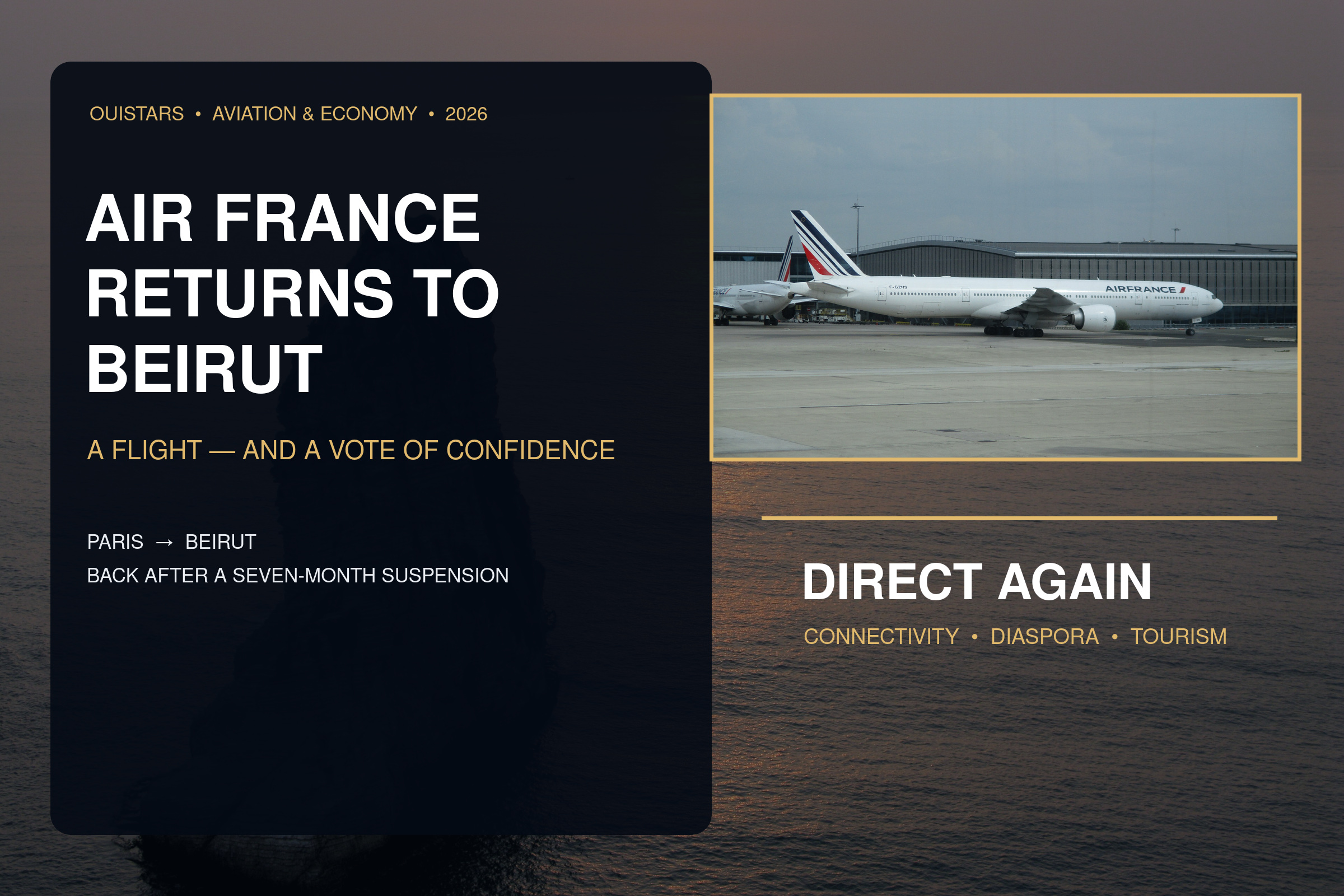
When Air France flight AF558 left Paris Charles de Gaulle for Beirut on 26 September 2026, it restored more than a four-hour air link. It put Lebanon back on the active network of a major global airline—and offered a cautious vote of confidence in a destination repeatedly pushed to the edge of Europe’s aviation map.
The Boeing 777-300ER service followed Transavia France’s return from Paris Orly one day earlier. For travellers, the news means more choice. For Lebanon’s large community in France, it means a simpler route home. For Beirut, it carries economic and political significance well beyond the number of seats on the first aircraft.
A timeline worth getting right
Some reports describe the comeback as ending a suspension of more than a year. The history is less tidy. Paris–Beirut services have been interrupted and restored several times since July 2024 as regional fighting and airspace closures changed the risk calculation.
The latest continuous suspension began on 28 February 2026, following US-Israeli strikes on Iran and major disruption to regional airspace. Air France’s return on 26 September therefore ended a break of roughly seven months. The more accurate conclusion is that the route has lacked stability for over two years—not that the airline had been continuously absent for more than twelve months.
Why the route matters
A nonstop flight from Paris to Beirut takes about four hours and fifteen minutes. Charles de Gaulle, however, makes the service more valuable than a simple city pair. It connects Lebanon with Air France-KLM’s wider network across Europe, the Americas and Africa.
Air France also has a codeshare relationship with Middle East Airlines on the route. That arrangement can widen booking and connection options while allowing flights to be marketed under both carriers’ codes. It is particularly useful for passengers whose journeys begin or end beyond Paris.
Schedules, aircraft and weekly frequencies remain subject to operational and security reviews. Travellers should therefore verify their flight directly with the airline before leaving for the airport.
A lifeline for families, students and business travellers
Paris–Beirut is not merely a leisure route. France is home to one of Europe’s largest Lebanese communities, and traffic between the countries is driven by family ties, education, healthcare, business and tourism.
When nonstop capacity disappears, an ordinary family visit can become a longer and more expensive journey through Istanbul, Amman, Cairo or a Gulf hub. Every connection adds time and another point at which passengers or baggage can be delayed.
The simultaneous return of Air France from Charles de Gaulle and Transavia from Orly serves two different markets: full-service passengers seeking global connections, and more price-sensitive travellers looking for a direct journey. Restoring both products matters more than the ceremonial arrival of a single aircraft.
Will fares fall?
Not automatically. Ticket prices depend on seasonality, available seats, demand, insurance and operating costs. Yet additional capacity generally improves choice and creates more competitive pressure than a market dominated by only a few nonstop operators.
The real test will come during Christmas, summer and university travel periods. If the route remains stable and frequencies grow, consumers may see better availability and less extreme pricing. If the schedule remains vulnerable to sudden suspension, the risk premium will stay embedded in fares.
The economic return for Beirut
Direct flights support hotels, restaurants, car rental, ground transport, conferences and family spending. They also make business travel easier and return Beirut to corporate booking systems that may have restricted the destination when reliable options disappeared.
An international carrier’s decision is based on demand, insurance, operational feasibility and security assessments. Its return is therefore read as a market signal. It tells tour operators and passengers that Beirut is again operable—although still subject to review.
The significance should not be exaggerated. One route cannot repair Lebanon’s tourism economy, modernise the airport or remove regional risk. It can, however, add capacity, competition and connectivity at a time when isolation imposes a direct cost on a service-based economy.
A political signal in French colours
France and Lebanon have deep diplomatic, cultural and personal ties. The return of the French flag carrier therefore carries more symbolic weight than an ordinary seasonal launch. It shows that movement between the two countries has not been severed and that Beirut has not been permanently removed from a leading European network.
It is nevertheless a conditional signal, not a security guarantee. Air France has repeatedly said that Middle East services depend on ongoing assessments of conditions at the destination and in the airspace used to reach it. The timetable can change quickly if the regional picture deteriorates.
Editorial view: Beirut needs continuity, not ceremony
For OUISTARS, the real story is not the first landing; it is whether the flights keep operating. Lebanon has repeatedly celebrated airline returns only to see services suspended again. Families, businesses and tourists need a timetable they can trust, not a one-day photograph.
The Lebanese government and airport authorities should treat the resumption as work to be done: improve arrivals, passport control, baggage handling, passenger information and transport from the airport. An airline can reopen the door, but the airport and the city decide whether a visitor wants to return.
International confidence is built flight by flight. Every service that operates safely and on time is more persuasive than an official speech. A full season without disruption would do more for Beirut’s image than the launch celebration alone.
What travellers should know
- Air France resumed Paris Charles de Gaulle–Beirut services on 26 September 2026.
- Transavia France returned from Paris Orly on 25 September.
- Nonstop flying time is approximately four hours and fifteen minutes.
- Schedules and fares can change; always check directly with the operating carrier.
- A confirmed booking does not replace a review of ticket conditions, insurance and official travel advice.
Verdict
Air France’s return is simultaneously an aviation, economic and political story. It restores a major hub connection, broadens consumer choice and sends a measured signal of confidence in Lebanon. It does not guarantee lower fares or mark the end of regional risk.
The decisive question begins now: will the service remain stable? If it does, this route can become more than a link between two capitals. It can help Beirut move, gradually, from isolation back towards normality.
Editorial note: Published on 27 September 2026. Airline schedules remain subject to operational and security decisions.