


















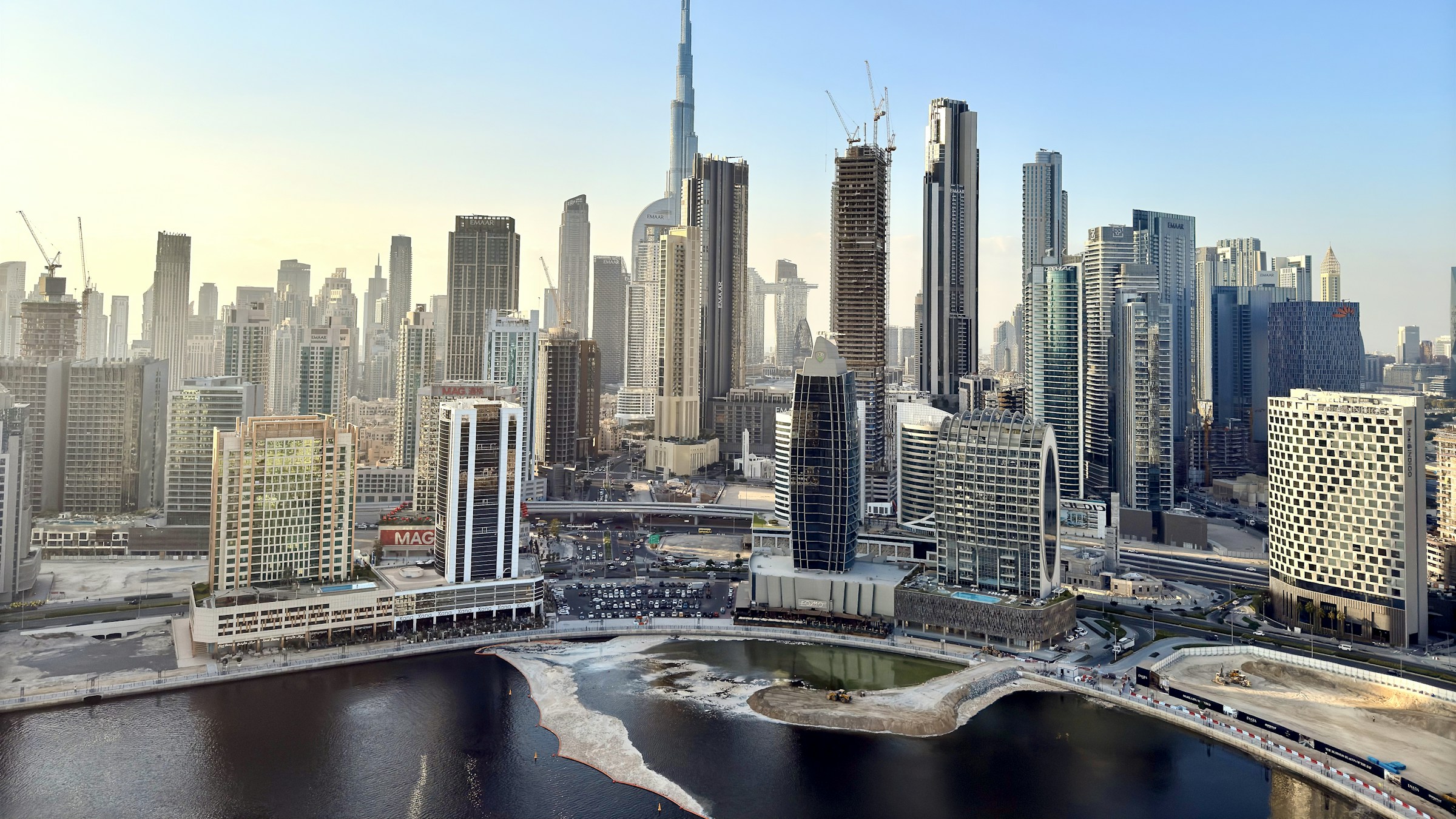
THE VISITOR-TO-INVESTOR ECONOMY — by oui stars Travel Intelligence | Dubai/UAE investigation | Verified 6 September 2026
Dubai has built one of the clearest commercial bridges between visiting, buying, relocating and operating a business. Yet the bridge is not one legal lane. Property rights depend on the emirate and zone; residence depends on a qualifying visa; company permissions depend on the licence and activity; tax depends on who earns the income and how.
| Foreign property | Dubai permits foreign freehold ownership in designated areas; other emirates use their own investment-area and usufruct rules. |
|---|---|
| Residence | AED 2 million of qualifying property can support a renewable five-year Golden Visa; separate Dubai property-residence services also apply. |
| Business | 100% foreign ownership is available for most mainland activities and in free zones, with strategic and activity-specific exceptions. |
| Protection | DLD registration is decisive; off-plan payments must enter regulated project escrow accounts. |
| Tax | Federal corporate tax is generally 0% up to AED 375,000 of taxable income and 9% above; VAT treatment differs by property type. |
| Capital | Official policy allows full profit repatriation and low exchange controls, subject to banking, AML and sanctions compliance. |
Tourism is the acquisition funnel
Dubai received 19.59 million international overnight visitors in 2025, according to the Department of Economy and Tourism. That scale keeps the city visible to future residents, founders and second-home buyers. The appeal is practical: global aviation, year-round services, widespread English and a licensing ecosystem designed for international customers.
It is also a cyclical property market with large new-build supply and material differences between developers, communities and service charges. Visitor enthusiasm is not due diligence.
What a foreign buyer actually owns
The UAE is a federation, so ownership rules are not identical everywhere. The official federal portal explains that Dubai permits non-residents and expatriate residents to acquire freehold ownership, usufruct or leasehold rights up to 99 years in designated areas. Abu Dhabi permits foreign ownership in investment areas; Sharjah’s framework differs.
In Dubai, an unregistered sale does not protect ownership. Dubai Land Department states that transactions creating or changing real-estate rights must be registered and that unregistered transactions are invalid. Buyers should verify the title, broker, developer, project status, service charges, mortgage, handover obligations and the precise right being sold.
Off-plan protection exists, but it does not remove project risk
Dubai’s escrow law requires developers selling off-plan units to place buyer and project-finance receipts into a regulated project account. DLD says the mechanism controls construction spending and protects investors; 5% is retained for one year after completion to address defects. Buyers can check a project’s status through DLD.
Escrow reduces diversion risk. It does not guarantee delivery on the promised date, rental income, resale liquidity or a contract outcome. DLD’s own guidance notes that termination disputes can require the competent real-estate court. The contract, project registration and developer record still need independent review.
Property can connect to residence
The UAE Golden Visa rules allow an owner of one or more properties worth at least AED 2 million to seek a renewable five-year residence visa without a sponsor, including qualifying purchases financed by approved local banks. The land department must certify the ownership value. Dubai also operates a property-investor residence service through DLD.
This is a renewable residence status, not citizenship and not an unconditional permanent right. The asset, valuation, insurance, identity and other eligibility conditions remain relevant. A buyer should confirm the current emirate procedure before paying a deposit.
Company ownership is broad, licence scope is decisive
The amended Commercial Companies framework permits 100% foreign ownership of most mainland companies. The official UAE portal identifies strategic-impact exceptions, including regulated financial, security and telecommunications activities. Dubai free zones also allow full foreign ownership, but Invest in Dubai warns that a free-zone company generally needs the proper mainland permission to trade directly in the UAE market.
A licence is activity-specific. A real-estate owner does not automatically have permission to broker property, operate a hotel, serve food, arrange tours or employ staff. The strongest setup starts with customers and regulated activity, then chooses mainland or free zone—not the other way round.
Tax is low by global standards, not absent
Federal corporate tax generally applies at 0% to the first AED 375,000 of taxable income and 9% above that threshold, as confirmed by the Federal Tax Authority. Free-zone treatment is conditional; the words “free zone” do not make every profit tax-free.
For natural persons, qualifying real-estate investment income outside a licensed business can fall outside corporate tax. VAT differs: commercial property supplies are generally subject to 5%, while residential supplies are generally exempt and the first supply of a new residence within the statutory period is zero-rated. Registration fees, broker commission, developer charges and annual service charges remain material.
Capital mobility and banking reality
The federal investment portal advertises 100% profit repatriation and low foreign-exchange controls. In practice, banks must understand beneficial ownership, source of wealth, sanctions exposure and the transaction’s purpose. A company licence or title deed does not guarantee a bank account. Documentary quality is part of market access.
Advantages and disadvantages
| Advantages | Disadvantages |
|---|---|
| Clear freehold zones and digital registration | Rights and rules vary by emirate and location |
| Property-linked renewable residence route | Residence depends on continued eligibility; no automatic citizenship |
| Broad foreign business ownership | Licence scope, free-zone geography and sector approvals matter |
| Low headline tax and open capital policy | Corporate tax, VAT, fees and compliance still apply |
| Powerful tourism and aviation demand | Supply cycles, service charges and off-plan execution risk |
Investor checklist
- Verify freehold eligibility and the exact title with DLD or the relevant emirate registry.
- For off-plan purchases, verify project registration and escrow before paying.
- Model service charges and realistic occupancy, not advertised gross yield.
- Confirm visa eligibility independently of sales material.
- Choose the company licence from the intended activity and trading geography.
Primary sources
- Dubai Land Department: ownership, registration and escrow.
- UAE Government: Golden Visa.
- UAE Government: full foreign company ownership.
- Federal Tax Authority: corporate tax legislation.
Continue: series hub and six-market comparison.
Independent editorial analysis, not individual legal, tax or investment advice.









[…] the series: compare Egypt with France, the UAE, Saudi Arabia, the UK and the USA, or read the UAE and Saudi Arabia […]