










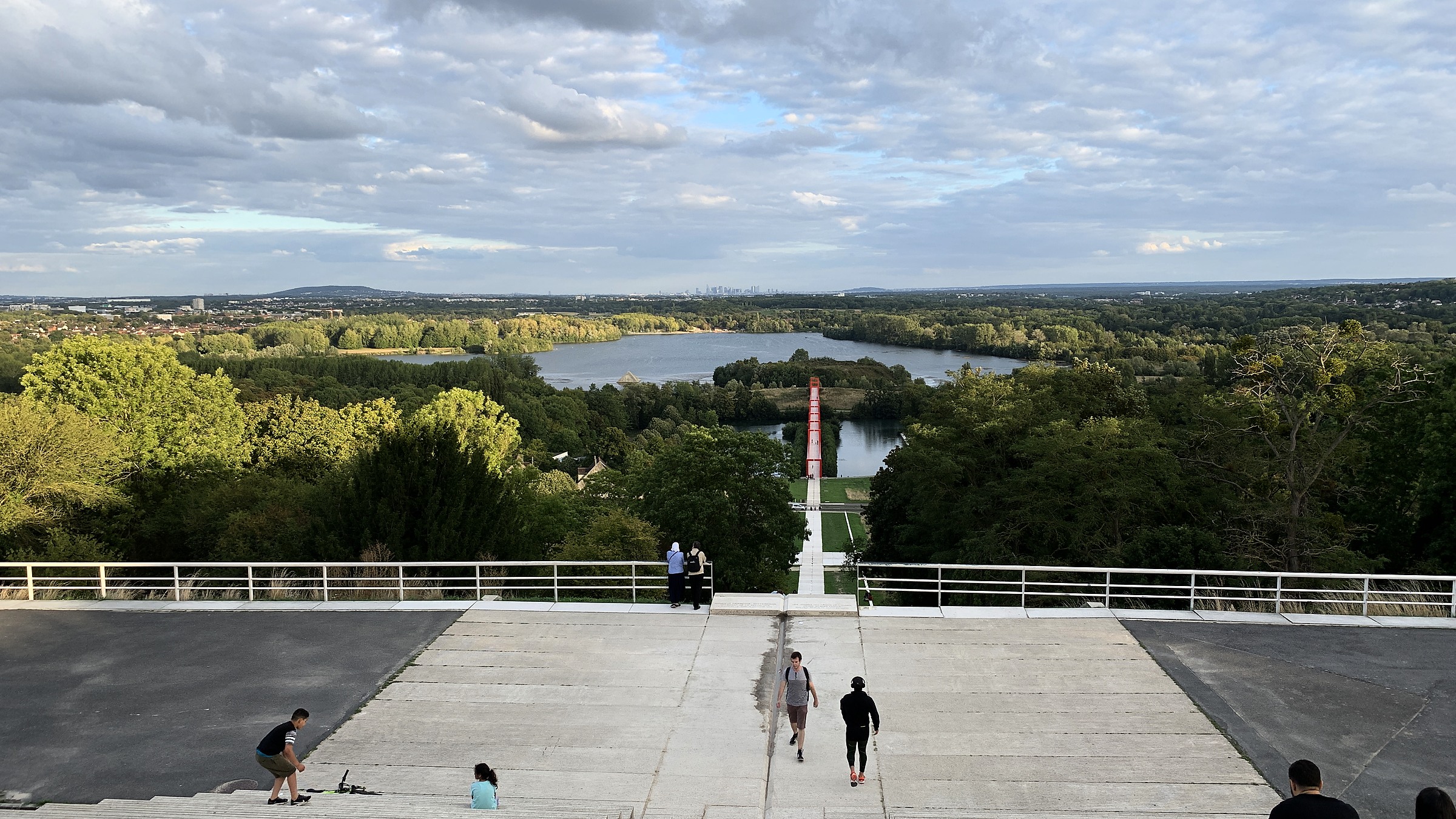
Cergy-Pontoise has spent decades being described through its distance from Paris. Twenty-five kilometres from the capital, it is a new-town economy, a university centre, the administrative capital of Val-d’Oise and the western terminus of major rail routes. Now an extraordinary leisure proposal near the former Mirapolis site at Courdimanche has raised a different possibility: could this established outer-Paris city become an international tourism destination?
Investing in France series: this report is part of the French Real Estate Investment Guide. It asks whether tourism-led change could create a property opportunity without treating an unapproved project as a guaranteed source of demand. Facts, proposals and analysis are separated. This is not individualized investment advice.
The essential caution comes first. The Île-de-France Region announced three proposed theme parks in August 2026 and referred to one as a Dragon Ball park. Qiddiya was presented as the Saudi investor. Yet Japanese rights holders had not granted a Dragon Ball licence for the French project at the latest confirmed reporting. There is no official opening date, final attraction list, ticketing plan or commercial park name.
Cergy-Pontoise already exists beyond the park headline
The Cergy-Pontoise agglomeration reports 220,279 residents, nearly 14,000 businesses and around 30,000 students. It cites 92,000 jobs in its Grand Centre development material and describes a higher-education ecosystem including CY Cergy Paris Université, ESSEC and ENSEA. This is not an empty site waiting for a tourist attraction; it is a large employment, education and residential centre.
The commune of Cergy itself had 70,906 residents in 2023, up from 65,177 in 2017, according to INSEE. It contained 33,100 homes, 87.7% of them principal residences. Owner-occupiers represented 30.9% of principal-residence households, and vacant homes 7.9% of stock. INSEE counted 36,159 jobs in the commune.
These numbers matter because the property case should not be reduced to visitors. Students, public administration, local businesses, families and commuters already generate demand. A new leisure economy would sit on top of that base rather than create it from zero.
The price base is radically different from western Paris
Notaires du Grand Paris placed the standardized price of old apartments in Cergy at €2,950 per square metre at the end of December 2025. That was down 1.9% over one year and down 2.8% over five years. The Notaires de France consumer portal, using a different rolling sample, displayed a €2,950 median across 476 old-apartment sales when checked for this report.
The figure is less than one-third of the Paris apartment benchmark and far below Puteaux or Courbevoie. That difference reflects geography, household incomes, building stock, transport time and market depth. It is not free upside.
At a lower price, rent may represent a larger share of the acquisition cost. Yet operating charges, renovation, energy performance, vacancy and tenant affordability still govern the net result. Some Cergy buildings are recent; others belong to the first decades of the new town and may require substantial collective work.
What exactly has been proposed near Courdimanche?
On 31 August 2026, the Île-de-France Region said it had worked for roughly 18 months on a plan for three new theme parks in Val-d’Oise, including a park dedicated to the Dragon Ball universe at Courdimanche. It referred to €6 billion of envisaged investment and potential for around 20,000 direct jobs. These are announcement figures and potential outcomes, not audited expenditure or delivered employment.
The proposed location is associated with the former Mirapolis site near Courdimanche and Cergy-Pontoise. Mirapolis opened in 1987 and closed after a short, difficult operating history, a reminder that capital spending and attendance expectations do not guarantee a sustainable destination.
Qiddiya’s involvement links the proposal to Saudi Arabia’s large-scale entertainment strategy. The investor’s resources and experience can make the plan consequential. They do not resolve French planning, transport, environmental review, operating economics or intellectual-property rights.
Our detailed investigation, Dragon Ball France: Could One of Europe’s Next Great Entertainment Destinations Rise Near Paris?, explains the central contradiction: a French regional announcement used the Dragon Ball name, while Toei Animation said no licence had been granted for the French project at that stage.
The tourism opportunity if a major destination is delivered
Three substantial parks could alter visitor flows in north-western Île-de-France. International families who now travel from Paris to other leisure destinations might stay closer to Cergy. Manga and anime audiences could create a new reason to visit the region. Gulf families familiar with Qiddiya’s ambitions could form part of the market. Domestic day-trippers would remain essential.
The first direct property opportunity would likely be hospitality: hotels, aparthotels, staff accommodation, restaurants, retail and mobility services. A resort-scale destination needs beds at several price levels, not only luxury inventory. Longer family stays could support serviced apartments, while employees would add pressure to the ordinary rental market.
But the visitor economy must be modeled by day and season. Theme parks create peaks, school-holiday concentration and weekend traffic. Hotels can struggle outside operating calendars if business and university demand do not fill the gap. Residential investors should not convert an attendance headline into year-round rent.
Why transport will decide more than branding
Cergy is connected to La Défense and central Paris by RER A and Transilien services, with several stations across the agglomeration. That network is a foundational asset for students, workers and visitors. It is also a constraint: journey reliability, late-night service, station capacity and the last kilometres to Courdimanche will shape the experience.
A theme-park destination cannot depend entirely on private cars without creating congestion, parking demand and environmental pressure. Coaches, shuttles, active travel, road access and links to airports would need coordination. For property, the winners may be areas with a complete route to jobs and services, not simply those closest in straight-line distance to the proposed site.
An apartment by Cergy-Préfecture, Cergy-Saint-Christophe or Cergy-le-Haut serves different routines. Courdimanche is another commune. Pontoise has a historic urban character. Neuville, Osny, Vauréal and Saint-Ouen-l’Aumône have their own housing and transport profiles. “Near the park” is not a sufficient micro-location.
The university economy is the stabilizer
Cergy-Pontoise reports 30,000 students, 1,500 teacher-researchers and 27 higher-education establishments in its current education profile. Students create recurrent demand across the academic year, while research, faculty and corporate partnerships add a professional market.
This base can soften the seasonality of leisure development. It can also create pressure on affordable housing. If tourism workers and students compete for the same small units, rents may rise without improving housing quality. Public policy should anticipate purpose-built student accommodation, workforce housing and transport rather than celebrate price appreciation alone.
For an investor, student demand is not automatic. Distance to campus, furnished-letting rules, room size, energy rating, security and management determine occupancy. A theoretical catchment of 30,000 students does not make every studio investable.
Employment: opportunity and social test
The park announcement presented up to 20,000 potential direct jobs. The scale would be transformative if delivered, but the composition matters: construction or permanent, full-time or seasonal, skilled or entry-level, directly employed or outsourced. No detailed official breakdown has yet established the final employment structure.
Cergy’s current economic data provides context. INSEE reported a 15.1% unemployment rate among people aged 15 to 64 in 2023 and a 25% poverty rate. A tourism investment should therefore be judged by training, career progression, wages, transport at shift hours and access for local residents, not only by the number in a press release.
Property appreciation can be a benefit for owners and a problem for tenants. If speculation begins before jobs and infrastructure arrive, the community may absorb higher costs without receiving the promised opportunity. A serious investment strategy needs housing supply and local inclusion.
Could Cergy become a Greater Paris tourism hub?
Cergy-Pontoise sits outside the administrative Métropole du Grand Paris, but it belongs to the functional Paris region. Its challenge is to become a destination with its own identity rather than a dormitory or a remote extension of Paris.
It already has assets: the Axe Majeur by Dani Karavan, the Oise landscape, the Île de loisirs, a historic centre in Pontoise, university life and access to the Vexin français regional natural park. A large entertainment complex could bring international marketing and investment. The risk is that the new brand overshadows these places or functions as an isolated enclave.
The better model would connect the parks to local hotels, restaurants, culture, waterfront leisure and independent businesses. Visitors who spend only inside a gated resort generate less value for the wider territory than those who stay, dine and explore.
What property types could benefit?
Hotels and aparthotels
They have the clearest tourism exposure, but require professional operations, capital and demand forecasting. An individual room sold with a leaseback promise is not equivalent to owning a diversified hotel business.
Student and workforce housing
Existing demand is measurable and could grow. Affordability, management and location are essential. Public policy may regulate supply and rent, and low wages cannot support unlimited rent growth.
Family apartments near transport
Larger homes can serve local families, professionals and long-stay visitors. Their case should work today, with schools, shops and transport, rather than depend entirely on a future park.
Houses in surrounding communes
Gardens and space may appeal to employees or families, but car dependency, maintenance and resale depth vary. The nearest house is not necessarily the best connected.
Retail and food premises
Visitor spending can support businesses, yet commercial property carries vacancy, lease and operator risk. Footfall outside park gates must be demonstrated.
The planning risks investors must price
Licence risk: Dragon Ball rights remain unresolved for France. The wider project may continue with another concept, but brand-driven assumptions could fail.
Delivery risk: no official opening date, final programme or ticketing plan has been published.
Planning and environmental risk: land use, mobility, water, biodiversity, noise and infrastructure require review and authorization.
Transport risk: visitor peaks can overwhelm existing systems if last-mile investment lags.
Demand risk: Disneyland Paris and other attractions prove that large destinations can succeed, not that every new park will.
Speculation risk: sellers may price a future that has not been secured.
Community risk: housing pressure and low-quality employment can weaken political and social support.
A three-stage investment test
Stage one: does the asset work without the parks? Use current rents, current transport and current services. If the answer is no, the purchase is a land-use bet rather than a conventional housing investment.
Stage two: which milestones are verifiable? Licensing, planning approval, financing, infrastructure contracts, construction and operator announcements should be treated separately. A press statement is not a building permit.
Stage three: who pays and who uses? Identify the realistic tenant, hotel guest, employee or buyer. Include affordability and seasonality. Model delays and a version of the project that opens without the Dragon Ball name.
Analysis: opportunity begins before the park, but not because of it
Cergy-Pontoise deserves investor attention even if the entertainment proposal changes. Its population grew 1.4% a year between 2017 and 2023, it has a substantial university economy, 36,159 jobs in the commune of Cergy and rail access to western Paris. The €2,950 notarial apartment benchmark is grounded in an existing market.
The proposed parks could add hospitality, employment and international visibility. Their effect on residential value will depend on infrastructure, job quality, housing supply and the connection between the resort and the city. A licensed global brand would strengthen marketing; a licence dispute could redirect the entire concept.
The most defensible property opportunity is therefore not to buy whatever is closest before everyone else. It is to choose a well-run asset that serves today’s Cergy-Pontoise, while retaining optional exposure to tomorrow’s tourism economy at a price that does not assume the most optimistic outcome.
If Cergy evolves from a Paris-edge centre into an international leisure destination, the winners will be properties and businesses integrated into everyday urban life. If the park story changes, those same assets must still have a reason to exist.
Sources and editorial note
- Île-de-France Region: announcement of three proposed theme parks
- INSEE: Cergy population, housing and employment, 2023
- Cergy-Pontoise agglomeration: territory, businesses and students
- Cergy-Pontoise: higher education and research
- Notaires du Grand Paris: Cergy old-apartment price, December 2025
Facts were checked on 5 September 2026. Announced investment and employment figures are potential outcomes, not completed results. The Dragon Ball licence for the proposed French project remained ungranted at the latest confirmed reporting. This is independent editorial analysis, not a property advertisement or individualized advice.
Read the previous feature, Paris 16: Why Wealthy International Families Still Choose Western Paris, and follow oui stars Travel for continuing analysis of tourism, investment, luxury and the economies shaping the way the world travels.