















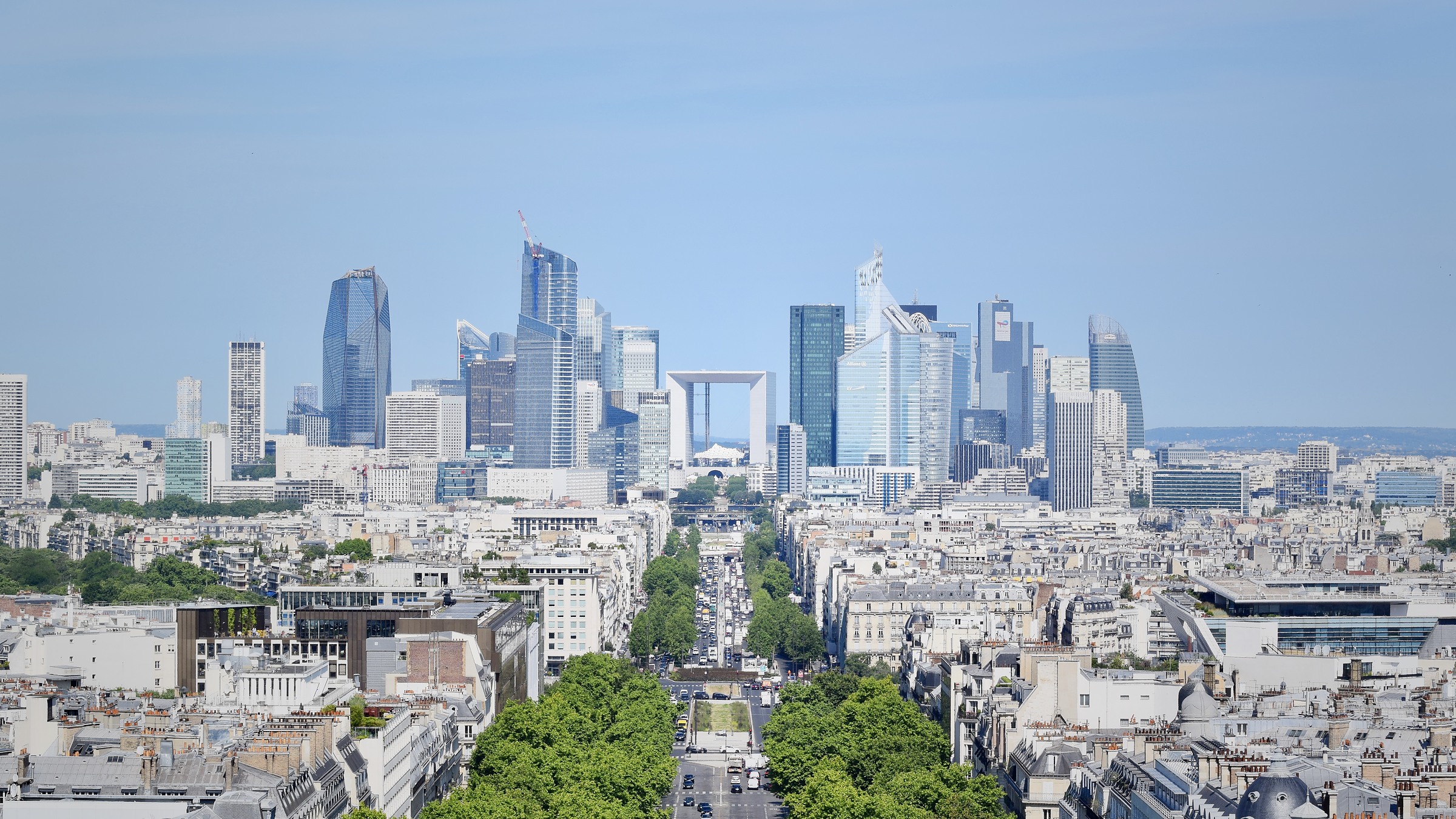
La Défense is easy to mistake for a single property market. From central Paris, its towers appear as one composition at the end of the historic axis. On the ground, however, the investment question fragments quickly: an apartment may sit in Puteaux, Courbevoie or Nanterre; a new home may be tied to an emerging mixed-use district; an older flat may depend on a 1970s co-ownership; and an office tower may face an entirely different cycle from the housing beside it.
Investing in France series: this report forms part of the French Real Estate Investment Guide. It examines La Défense as a place where business travel, transport, urban change and residential demand meet. It is editorial analysis, not individualized investment, legal or tax advice.
The central question is therefore not whether Europe’s largest business district is “good property”. It is whether the forces now changing La Défense can create durable residential value without asking an investor to ignore office vacancy, urban complexity, construction risk or the uneven quality of buildings and streets.
First, define what “La Défense property” means
Paris La Défense, the public establishment managing and developing the district, describes it as Europe’s leading business district. Its current headline figures include about 2,800 companies, 200,000 employees, 50,000 residents and more than 70,000 students across a 566-hectare territory. It also reports 3,000 hotel rooms, more than 200 restaurants and one of Europe’s largest shopping destinations, Westfield Les 4 Temps and CNIT.
Those numbers describe an economic territory, not a commune called La Défense. The core business district and the wider Seine-Arche development area cross municipal boundaries. Residential property is registered and taxed in actual communes, most visibly Courbevoie, Puteaux and Nanterre. Prices, schools, streetscape, local services, building stock and rental rules can change within a short walk.
This distinction matters. “Five minutes from La Défense” may mean a quiet Puteaux street close to a traditional town centre, a high-rise home on the slab, a Courbevoie apartment near Faubourg de l’Arche, or a new programme in Les Groues at Nanterre. They do not offer the same buyer pool, daily experience or resale risk.
The price map: below Paris, but not uniformly cheap
The Notaires du Grand Paris provide a useful reality check. For old apartments at the end of December 2025, their standardized median indicators were €6,980 per square metre in Puteaux, €6,400 in Courbevoie and €4,820 in Nanterre. Over one year, Puteaux was up 4.6%, Courbevoie down 0.4% and Nanterre down 0.7%. Over five years, the same table showed changes of minus 2.7%, minus 10.9% and minus 11.2% respectively.
These are commune-wide reference prices, not quotations for a particular tower, street, view or new development. They also show why a confident skyline narrative can mislead. The three neighbouring markets entered 2026 with different levels and different recent histories. By comparison, the same notarial table put Neuilly-sur-Seine at €11,030 per square metre, while Paris apartments were around €9,580 per square metre in the notaries’ February 2026 market communication.
The apparent discount can be meaningful for a buyer who values transport and space more than a central Paris postcode. It is not automatically a bargain. A larger apartment with high service charges, energy work ahead and a difficult pedestrian route may be less liquid than a smaller, better-run property in a conventional neighbourhood.
Why the demand base is unusually deep
La Défense has a structural advantage that many speculative districts lack: people already come here in very large numbers. The official territory says about 1.5 million people use the pedestrian platform in an average week. Six high-capacity rail lines serve the hub: RER A, RER E, Metro 1, Transilien L and U, and Tram T2. Paris La Défense says six million people have direct public-transport access to the district and 85% of employees commute by transit.
For housing, this creates several possible demand pools. Corporate employees may want shorter commutes. International executives and project teams may need furnished medium-term accommodation. Students may seek rooms near a fast-growing higher-education cluster. Families may choose Puteaux or Courbevoie for services and access to western Paris. Visitors attending concerts, trade events or business meetings create hotel and serviced-residence demand.
But a large daytime population is not the same as guaranteed residential demand at any price. Hybrid work has reduced the number of days many employees spend in offices. Corporate housing budgets vary. Students are price-sensitive. Families judge schools, parks, noise and street life, not only travel time to a tower.
Business tourism is becoming part of a wider destination
La Défense has long received international business travellers without always being treated as a destination in its own right. That is changing. Paris La Défense Arena, now branded Plenitude Arena, is a 45,000-capacity indoor venue. The district’s February 2026 economic bulletin said the arena had received more than 5.3 million visitors since opening, including more than 900,000 during the Paris 2024 Olympic and Paralympic Games. Live Nation’s acquisition of the venue reinforces the entertainment dimension.
The public realm also hosts the La Défense Jazz Festival, Garden Parvis, a large Christmas market and more than 200 events a year, according to the district. In 2025, nearly 20 restaurants opened. The Grande Arche, public-art collection, shopping centres and direct link to the centre of Paris broaden the reasons to stay.
For a property investor, the important possibility is not weekend tourism alone. It is a more balanced weekly and annual rhythm: offices during weekdays, education throughout the academic year, concerts and retail in evenings and weekends, and metropolitan tourism during holiday periods. A district that remains active beyond office hours is more likely to support useful local services and a genuine residential market.
The office-market warning cannot be edited out
The strongest argument against an uncritical investment story is visible in the office data. In 2025, La Défense recorded 106 office transactions and 149,320 square metres of take-up, down from 211,200 square metres in 2024. Its vacancy rate declined but remained high at 14.6%, with 536,000 square metres of immediately available space. The public establishment’s own bulletin, citing ImmoStat and JLL, reported an average prime face rent of €514 per square metre a year and €413 for second-hand space, alongside an average incentive rate of 38.2%.
These figures concern offices, not apartments. They nevertheless affect the district. Vacant or obsolete towers can weaken street activity, delay investment and create construction periods. Heavy incentives show that headline rents are not the whole economic story. An apartment buyer should not assume that proximity to offices guarantees an endless corporate tenant pool.
There is a more constructive reading: office stress is forcing diversification. It may produce housing, education, hotels, restaurants and better public space. Yet conversion is technically and financially difficult. Deep floor plates, façades, fire rules, daylight, cores and ownership structures can make a tower unsuitable for housing. Not every obsolete office will become a desirable home.
From office monoculture to a district of life
In 2025, Paris La Défense and French state services led an Atelier des Territoires to define a trajectory to 2040. The resulting plan says more than 450,000 square metres of offices identified as obsolete could be converted to other uses, out of an estimated one million square metres of ageing office stock.
The high-case programme is significant: up to 3,000 diversified homes, up to 3,000 student units, between 46,300 and 70,000 square metres for higher education and innovation, 5,000 to 10,000 square metres of public facilities, and up to 7,000 square metres of additional retail. These are planning ambitions, not delivered inventory or promised investment returns.
Specific projects show what diversification can look like. Synergies in Courbevoie combines roughly 10,909 square metres of offices with 5,342 square metres of housing, comprising 50 intermediate and 27 social units, with delivery announced for 2027. The Jean Moulin project in Puteaux mixes offices, housing for students and young workers, sport, food and a third place. In Les Groues, Nanterre-la-Folie’s RER E station opened a new phase of a neighbourhood already receiving homes, schools and offices.
The opportunity lies in selecting the part of the transformation that residents will actually use: a safe and legible route to transport, groceries and healthcare, green space, acoustic comfort, sound building management and a plan for life after dark. A glossy rendering is not a substitute for those basics.
Transport: a powerful moat, with disruption attached
Metro 1 and RER A connect La Défense to central Paris; RER E now serves La Défense and Nanterre-la-Folie; trains L and U and Tram T2 extend the catchment across western Île-de-France. The planned Line 15 West is intended to pass through La Défense, with Île-de-France Mobilités currently targeting 2031. Its 22-kilometre section between Pont de Sèvres and Saint-Denis Pleyel is designed as an orbital link with 11 stations.
Transport capacity supports employment, education and residential liquidity. It also creates micro-location risk. Entrances are not interchangeable, the slab can be confusing, and major works can affect noise, views and pedestrian routes for years. Investors should walk the journey at rush hour, at night and on a Sunday. The distance on a listing is less informative than the actual door-to-platform route.
Where might a residential investor look?
Puteaux: scarcity and a more established residential identity
Puteaux entered 2026 with the highest of the three notarial reference prices. Its attraction is the ability to combine La Défense access with a recognisable town centre, Seine-side areas and proximity to western Paris. Newer homes and high floors can command premiums for views and security. The risks are paying a prestige premium, high co-ownership charges and assuming every “La Défense view” will remain protected.
Courbevoie: breadth, connectivity and very different micro-markets
Courbevoie contains both immediate business-district housing and conventional residential neighbourhoods. Faubourg de l’Arche has family and student demand; streets closer to Bécon or the centre operate differently from the slab. Its breadth can aid liquidity, but it makes commune-wide averages especially crude. Building accounts, lift costs, heating systems and planned façade work can matter more than a modest price difference between adjacent streets.
Nanterre and Les Groues: transformation potential with execution risk
Nanterre offers the lowest commune-wide reference price of the three and the largest redevelopment story. Les Groues benefits from RER E and planned metropolitan connections. It may suit investors with a long horizon who can tolerate construction, an evolving retail offer and uncertainty about how quickly a complete neighbourhood emerges. Buyers should separate delivered amenities from approved projects and aspirations.
Who could this market suit?
La Défense may suit an internationally mobile professional who wants direct access to a major employment cluster and central Paris without paying central Paris prices. It may suit a family that prioritizes space, schools and western connections, provided the exact neighbourhood works. It may also suit an investor targeting medium-term corporate or student demand with professional management and conservative occupancy assumptions.
It is less obvious for a buyer seeking postcard Paris, effortless short-term holiday letting or a passive asset with minimal building oversight. Municipal rules, change-of-use requirements and co-ownership regulations must be checked before any furnished-rental plan. A business district is also exposed to corporate cycles and policy decisions in ways a mature residential quarter may not be.
The underwriting questions that matter
- Which commune and which street? Taxes, rules, services and buyer demand are local.
- How does the building work? Review the co-ownership accounts, minutes, reserve fund, lifts, heating, façade, energy rating and major works.
- What is the true monthly cost? Model charges, taxe foncière, insurance, management, finance, vacancy and repairs.
- Who is the realistic tenant or future buyer? Do not mix executive, student, family and tourist demand into one optimistic number.
- What is already delivered? Separate operating transport and amenities from projects targeted for 2027, 2031 or 2040.
- What happens if hybrid work deepens? Stress-test rent and resale assumptions against weaker office attendance.
- Can the home still compete? Light, quiet, outdoor space, layout and an understandable route to the street remain decisive.
Analysis: the opportunity is the transformation, not the label
La Défense does not offer one simple investment proposition. Its office core is globally visible but cyclically exposed. Its surrounding residential markets are established but heterogeneous. Its future housing supply is partly delivered, partly under construction and partly a 2040 ambition.
The investment case becomes credible when three conditions meet. First, the property must function well today rather than depend entirely on a future masterplan. Second, the micro-location must capture transport and services without transferring all the district’s noise and complexity into the home. Third, the price must acknowledge office vacancy, building costs and execution risk.
The larger economic question is compelling. If La Défense converts a portion of obsolete offices, adds students and families, improves public space and keeps its corporate base, it can become a more resilient metropolitan district. Hotels, restaurants, culture and retail would gain a broader customer base. Greater Paris would gain an international gateway that is lived in as well as worked in.
If diversification stalls, the towers may remain impressive while the residential promise stays uneven. That is why the best investment thesis is not “Europe’s largest business district must rise”. It is a patient, building-by-building judgement about whether La Défense is becoming a place where people choose to remain after the meeting ends.
Sources and editorial note
- Paris La Défense: territory and key figures
- Paris La Défense: 2025 office-market results
- Paris La Défense: 2040 transformation strategy
- Notaires du Grand Paris: old-apartment prices by commune, December 2025
- Île-de-France Mobilités: Line 15 West
- RATP: La Défense transport hub
Figures were checked on 5 September 2026 and retain the date and geographic scope of their publishers. Planning targets are not forecasts. This article is independent editorial analysis and not individualized investment, legal or tax advice.
Continue with our opening report, Where to Invest in French Real Estate: The Locations Worth Watching, and follow oui stars Travel for continuing analysis of tourism, investment, luxury and the economies shaping the way the world travels.






[…] the previous report, La Défense: Is Europe’s Largest Business District Also a Property Investment Opportunity?, and follow oui stars Travel for continuing analysis of tourism, investment, luxury and the […]